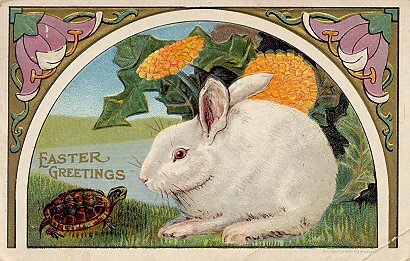
1905? "Easter Greetings" card featuring not only a hare but a tortoise! $4 from McCormick at the Sacramento Paper Fair, Dec., '96.
What, one might ask, does TH have to do with Easter? Does the fact that a one-cent stamp carried this card help to date it? The pencil-written message seems to be one asking for some reconciliation. There are some crazy things in life!
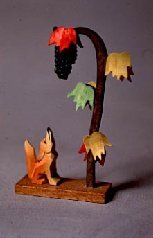
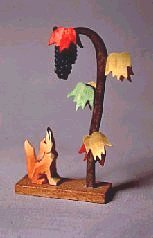
1980? East German wood carving of FG. 3" high.
This is an exquisite composite of carved elements. The delicate leaves set off the grapes and especially the fox well. The fox looks straight up attentive to the grapes.
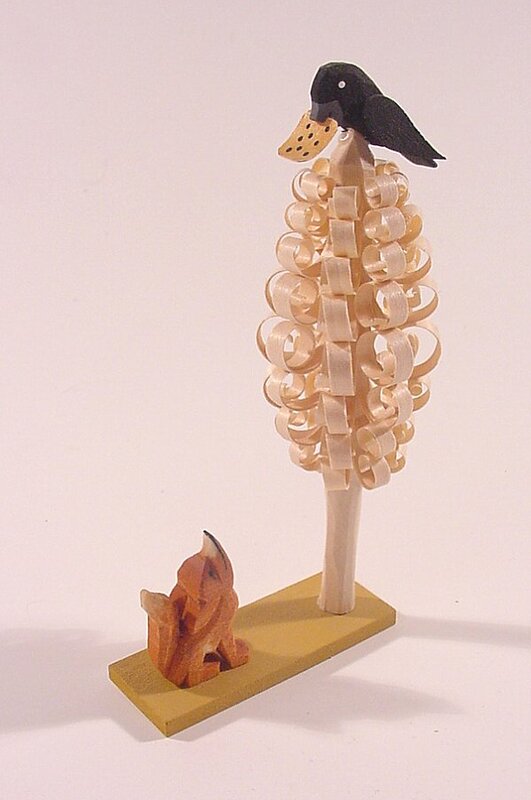
1995? East German whittling of FC. 4" high.
The same attentive fox is back from the earlier (1985?) wooden presentation of FG. Now he looks up at a crow with a slice of swiss cheese in his mouth. The crow is perched on top of a elaborately shaved tree.
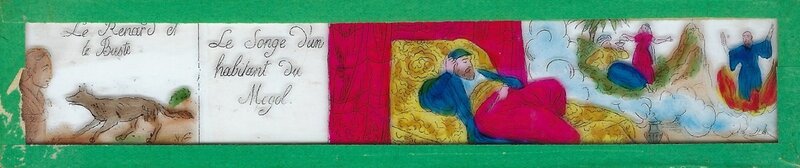
1890? Twelve long colored magic lantern slides showing La Fontaine's fables. Two fables per slide. 7½" x 1½".
The color work in these slides is strong, even after all this time. The titles in the upper left are sometimes obscured by the framing of the glass. Might the glass have been originally without a frame?
Fox and Bust/Dream of the Mongol
Man and His Image/Fortune Tellers
TB/Gout and Spider
Retired Rat/Eye of the Master
FC/Wishes
Two Parrots, Monarch, & Son/Man's Ingratitude to Luck
Martin/Women and Secrets
Wolf and Fox/Wise Man and Fool
The Lark and Her Young/CJ
FS/Old Man and Three Youths
Monkey and Dolphin/Man Running after Luck and Man at Home
FK/MSA
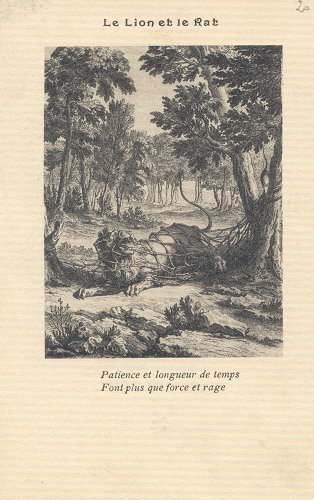
1900? Black-and-white postcard presenting LM. "Patience et longueur de temps/Font plus que force et rage." Illustration after Geeraerts? €4 from ABC de la C.P.A., Lyon, at the Paris Post Card Exhibition, Jan., '05.
The verso of this card has room for only an addressee. I would love to be able to identify exactly the source of the illustration. My first guess was Hollar, but that seems not to be the case. Perhaps someone in the French tradition?
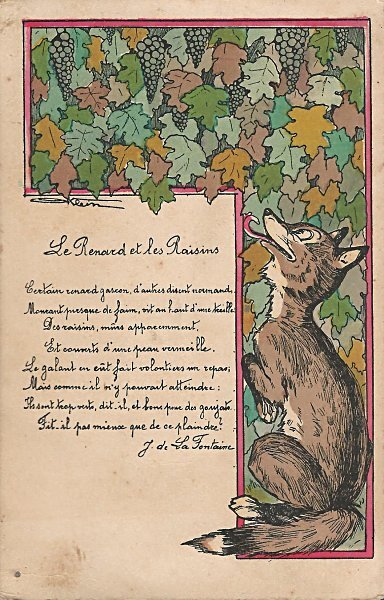
1927? "Le Lion devenu vieux." G. Klein (?). Editions E.D.F. From Linda Kelly, Lincolnshire, UK.
Highly colorful and unusually designed card. The characters extend beyond the L-shaped section for the picture. Longhand presentation of the fable, signed by J. de La Fontaine. Verso is not written upon at all.
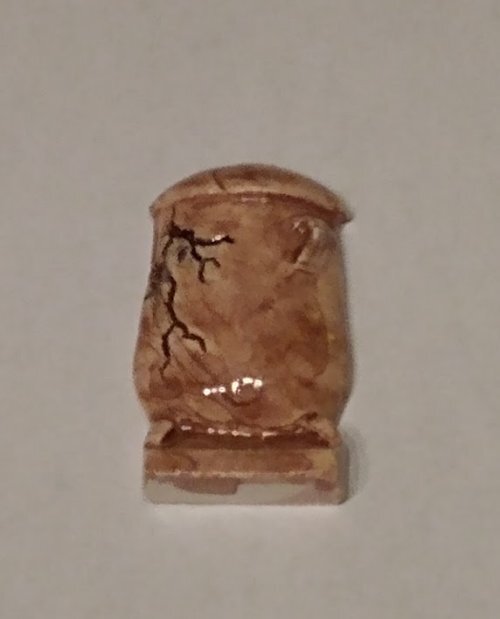
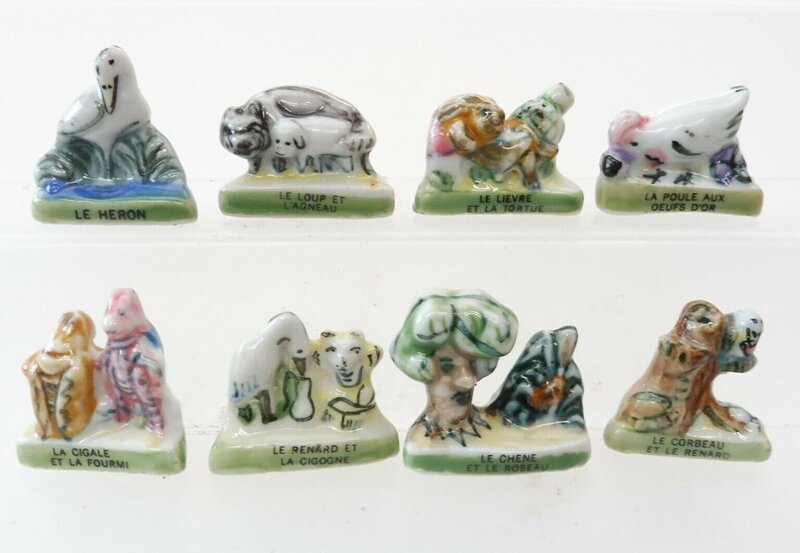
2010? Complete series DVO304 of 8 fèves of fables of La Fontaine.
This series seems to me to be done with less skill than other sets. Especially curious pieces are the oak with the "big hair" and the ant who is larger than the cicada. More successful is the wolf who has wrapped the lamb in his "embrace."
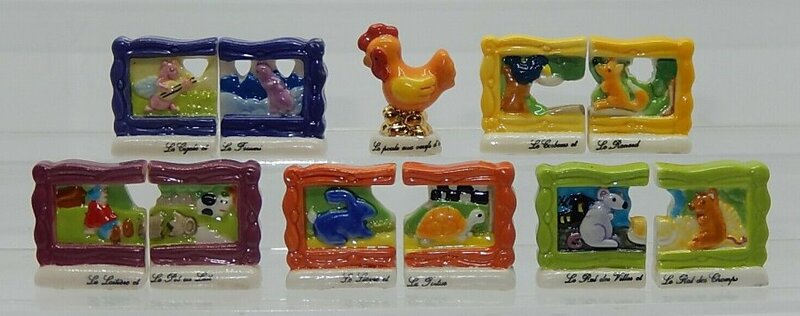
2010? DVO 237 Complete Series of 11 Fable Fèves.
Two curious features of this set of fèves include the "frame" halves of each scene including one of the two characters and the exception, the single figure of the hen that laid the golden eggs. MM presents an exception to that first pattern. If the jug is her fable "partner," it is not completely in the other half of the framed scene. I believe that the two-dimensional approach to the fable scene does not allow for as much detail as happens in three-dimensional figurines.
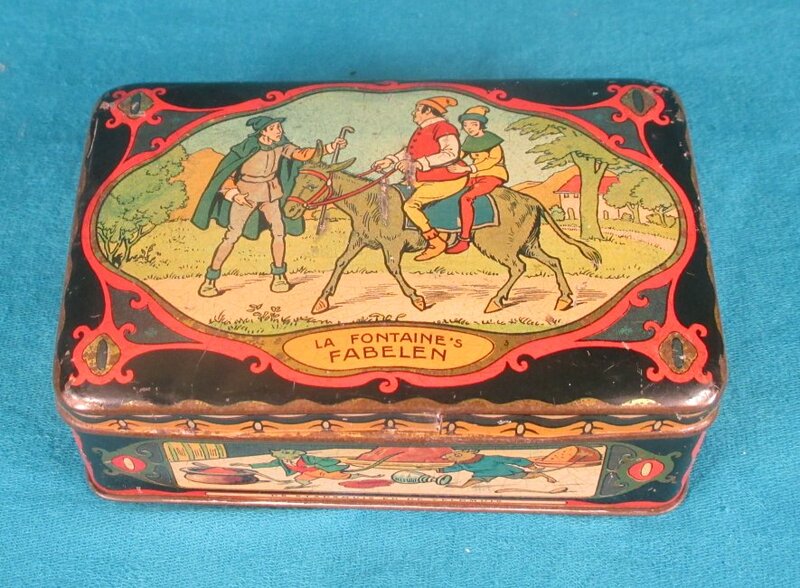
Dutch tin container with led proclaiming "La Fontaine's Fabelen" and illustrating MSA. The four sides, with scenes labeled in Dutch from TMCM, FS, "The Farmer and His Children," and FG. About 6½" x 4¼".
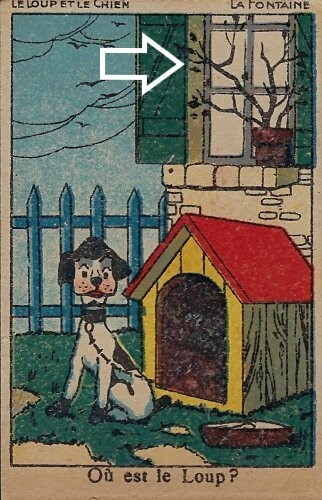
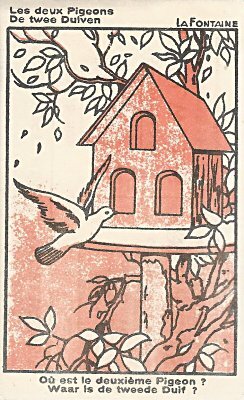
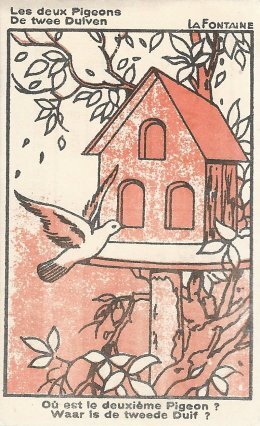
1950? 11 Dutch Guessing Game cards. 2½" x 4". 10 fables of La Fontaine, who is mentioned after each fable title at the top of the card in both French and Dutch. From Ann Filipowich, Toronto, through eBay, Feb., '15.
Five of these duochrome puzzlers repeat colored images from the parallel French set. Six are different. All versos advertise "Speculoos Edelweiss," apparently a type of shortbread cookie. Two use blue; the others use reddish orange.
1950? Six monochrome cards 2½" x 4¼" displaying La Fontaine's fables with bilingual titles and hidden-picture questions. Each advertises "Mono Poeders" in Dutch. $7 each from Bertrand Cocq, Calonne Ricouart, France, Sept., '20. And 11 cards advertising "Speculoos Edelweiss" from Ann Filipowich, Toronto, through eBay, Feb., '15.
These cards use the same designs as the polychrome hidden-picture cards here titled "Colored French 'La Fontaine' Hidden Picture Cards." As I found there, the solutions are not easy! Again here, I offer not only an enlarged "light box" version but a solution, with a normal view of what I believe is the hidden object. Several still elude me! "Speculoos Edelweiss" are apparently a type of shortbread cookie. Two among these use blue; the others, like all in the “Mono Poeders” group, use reddish orange.
1925? Dust-jacket with WL illustration and, on the verso, mathematical tables. $6 from Bertrand Cocq, Calonne-Ricouart, France, Sept., '20.
This simple dust-jacket may have the least identifying material of any in the collection! I find nothing suggesting either printer or artist. Hel
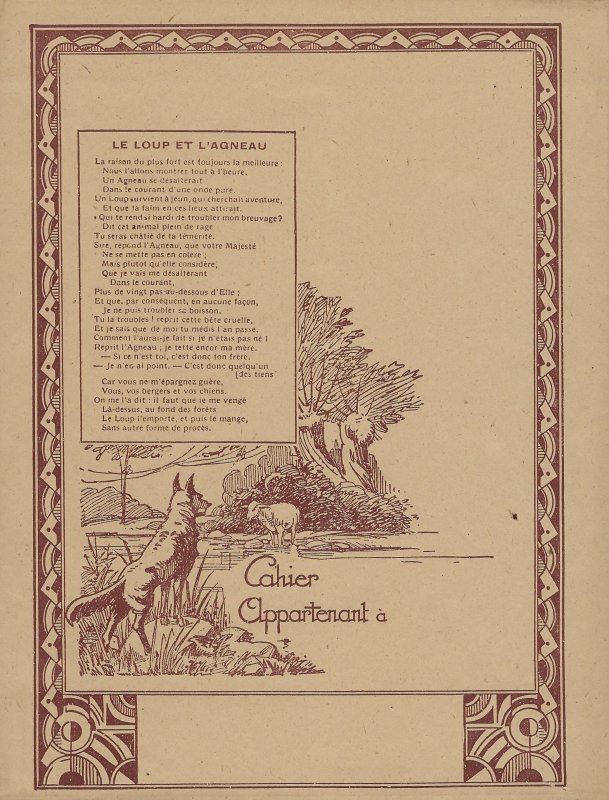
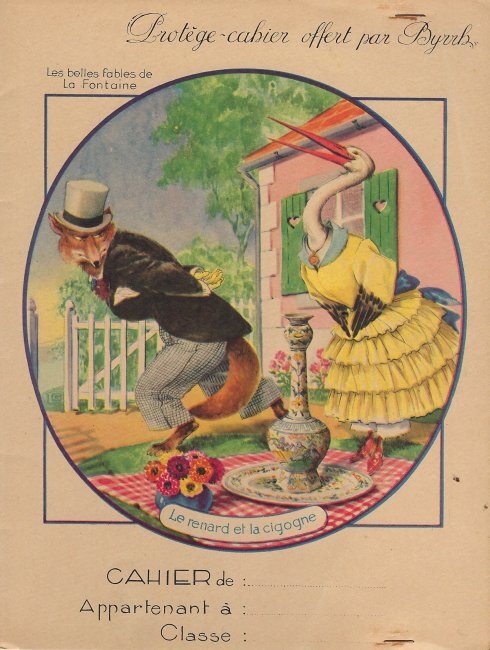
1950? Dust-jacket with an oval illustration of FS and, on the verso, the text of the fable. "Protégé-cahier offert par Byrrh." €8 from Albert van den Bosch, Antwerp, June, '23.
This picture is unusual for emphasizing the defeat and chagrin of the dapper fox. He goes away angry and outdone.
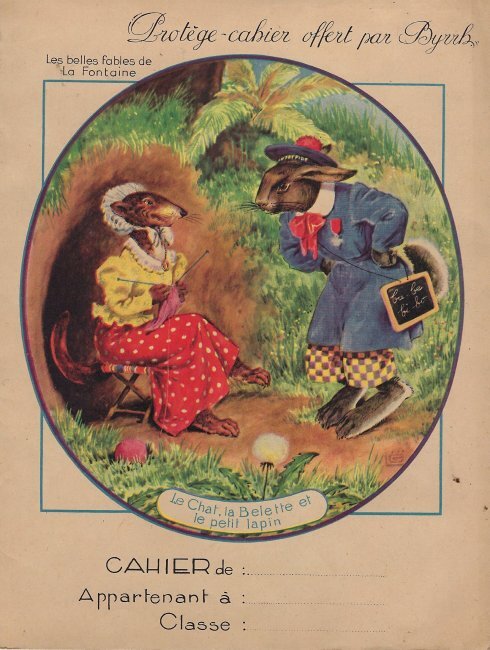
1950? Dust-jacket with an oval illustration of "Le Chat, la Belette et le petit Lapin" and, on the verso, the text of the fable. "Protégé-cahier offert par Byrrh." €6 from secoressource through Ebay, Oct., '21.
This picture is unusually well done for a simple dust-jacket! The rabbit returns home from school to find his home occupied. Neither will do well in the end. Byrrh offers "le grand vin au quinquina." Are we selling wine to schoolchildren? Is that an artist's signature of "LG" in the lower right?
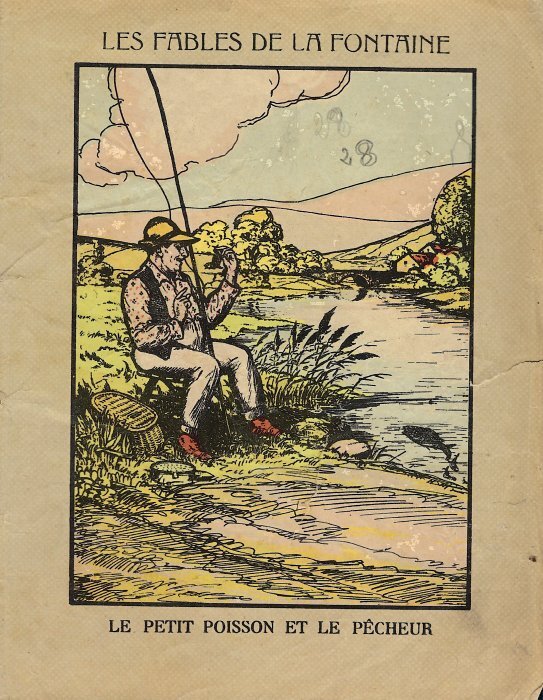
1920? Dust-jacket with "Le Petit Poisson et le Pecheur" illustrated on its cover. Text on the back cover. Imageries Réunies de Jarville-Nancy. €2 from maribrengue-0 through Ebay, Sept., '22.
This is the simplest and lightest of our dust-jackets. While it has the text of La Fontaine's fable on its verso, there are no flaps and there is nothing printed on the inside of this simple sheet. The image seems to be a classic of Imageries Réunies de Jarville-Nancy.
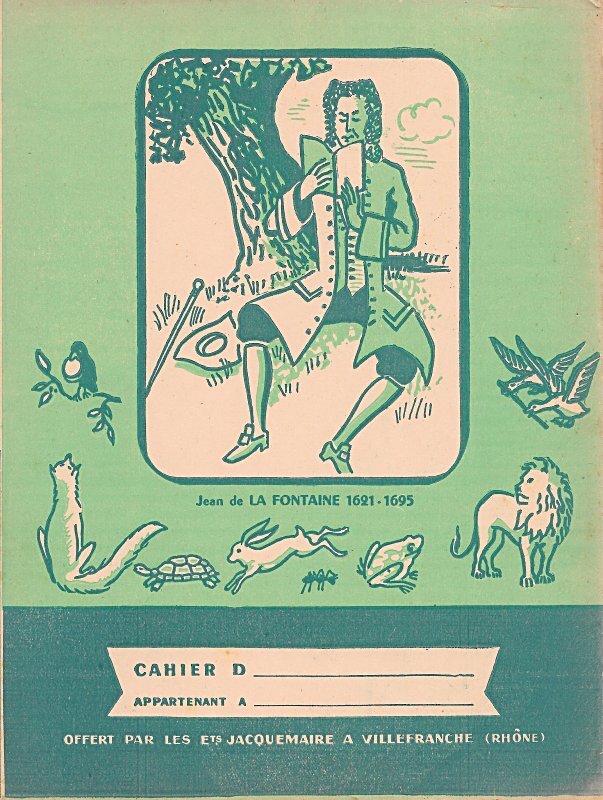
1930? Dust-jacket representing Jean de La Fontaine and advertising Blédine Blécao, apparently available at "Les Ets Jacquemaire a Villefrance (Rhône)." $5 from Mme Denise Debuigne, Rennes, France, Feb., '05.
Characters from some of La Fontaine's most famous fables are arranged under his portrait. The back of the dust-jacket quotes his promythium to TH: "Running solves nothing. You need to depart on time." The inside flap encourages babies to ask "Maman" to make sure that this is a "bébé BLÉDINE."
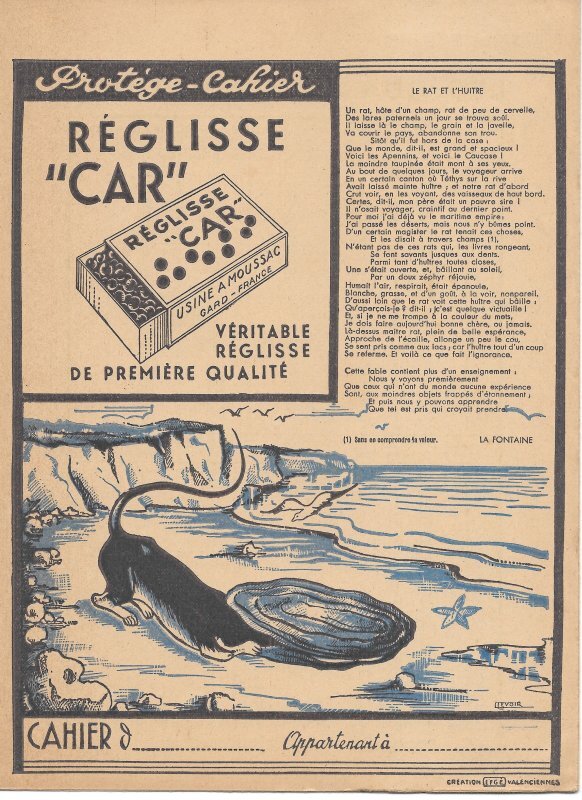
1935? Dust-jacket provided by "Car" licorice. The cover presents "The Rat and the Oyster" in a black and blue illustration designed by C. Levoir (?). $5 from Mme Denise Debuigne, Rennes, France, Feb., '05.
The back of the dust-jacket presents tables of addition, subtraction, multiplication, and division. The design on the cover is simple enough. Neither critter is going to win this encounter!
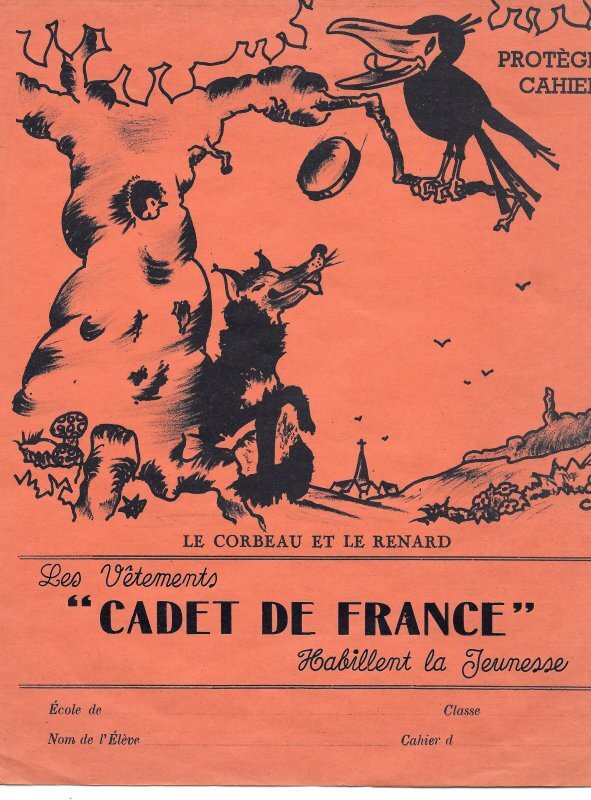
1935? Dust-jacket provided by "Cadet de France" offering clothes for young people. FC monochrome design. $5 from Mme Denise Debuigne, Rennes, France, Feb., '05.
A rather primitive design signed by "CR" shows the cheese in mid-air falling to the waiting fox. The back cover offers La Fontaine's verse text and tables of addition and subtraction. The end-flaps offer chances to list the program for morning and evening each day of the week.
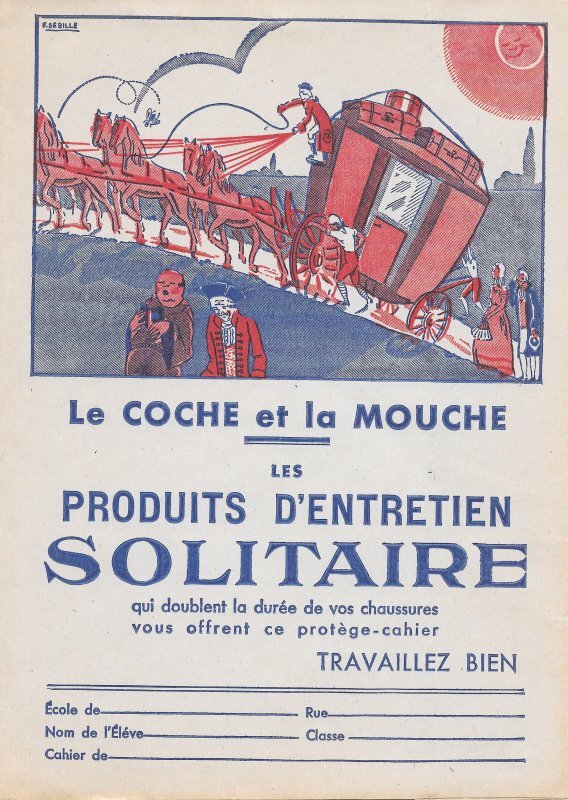
1930? Dust-jacket presenting "The Coach and the Fly" in red and blue from Solitaire Shoe Preservative. Artist F. Sébille. $5 from Mme Denise Debuigne, Rennes, France, Feb., '05.
The verso presents the text along with comparative presentations of a shoe without and with Solitaire protection. The fly on the front of the jacket is quite outsized! I can find nothing on F. Sébille.
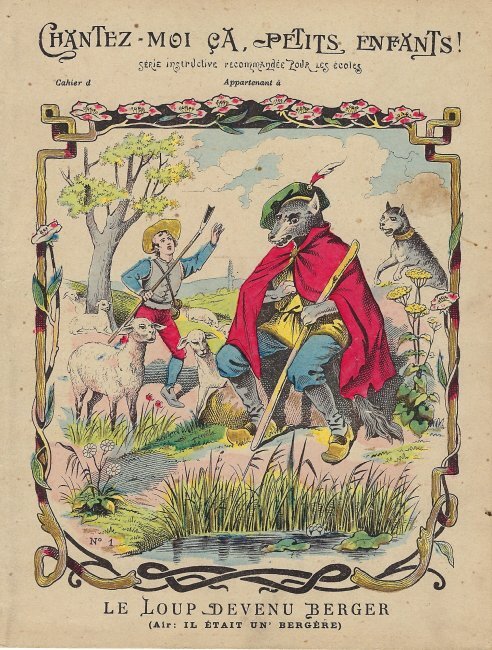
1900? Dust-jacket from "Chantez-Moi Ça, Petits Enfants!" presenting "Le Loup Devenu Berger." To be sung to the tune of "Il Était un' Bergère." Bichelberger, E. Champon et Cie, Étival (Vosges). €10 from Albert van den Bosch, Antwerp, June, '23.
The back cover of this dust jacket has the fourteen verses, the last of them incorrectly labeled "VIX." The color work on the wolf-shepherd seems to me excellent. Of course I would love to see more in this colorful series -- and gather them into this collection!
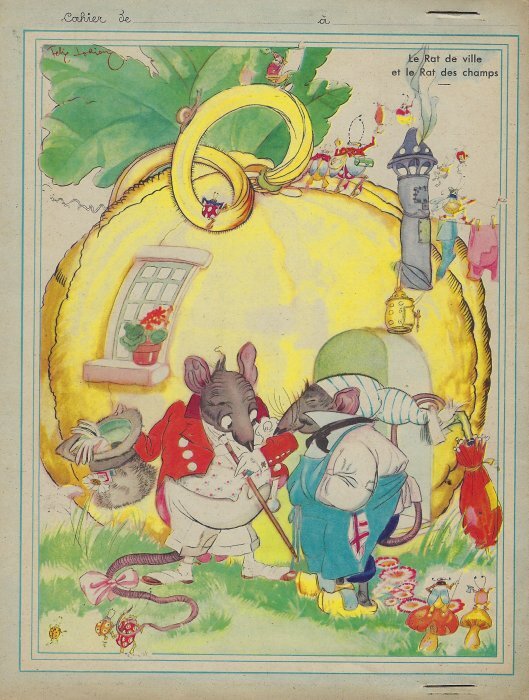
1950? Dust jacket presenting TMCM by Felix Lorioux. Advertisement on verso for Biscuits de l'Alsacienne. Texts for TMCM and TH. €8 from blandjul through Ebay, August, '22.
Good color work! Lorioux is always fun. The figure of La Fontaine on the verso is puzzling.
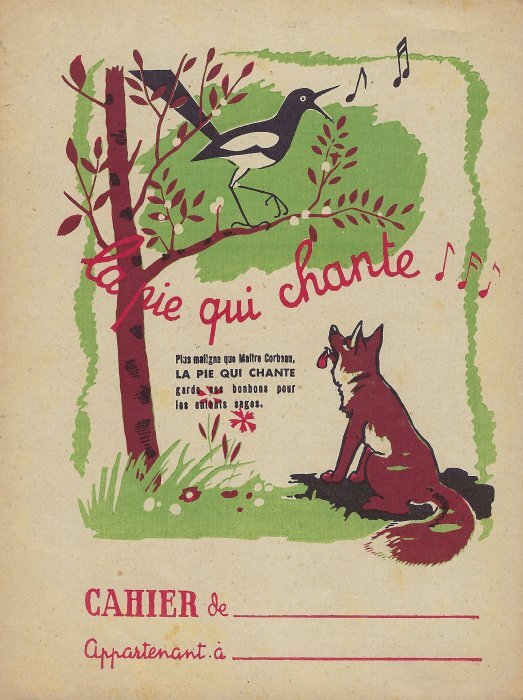
1950? Dust jacket presenting "la pie qui chante." Three colors. €8 from blandjul through Ebay, August, '22.
The recto explains "Cleverer than Master Crow, the magpie who sings keeps his bonbons for wise children." The verso shows the candy factory of "la pie qui chante" and explains the phased pleasures of eating this candy. Is that tree on the recto growing the white candies?