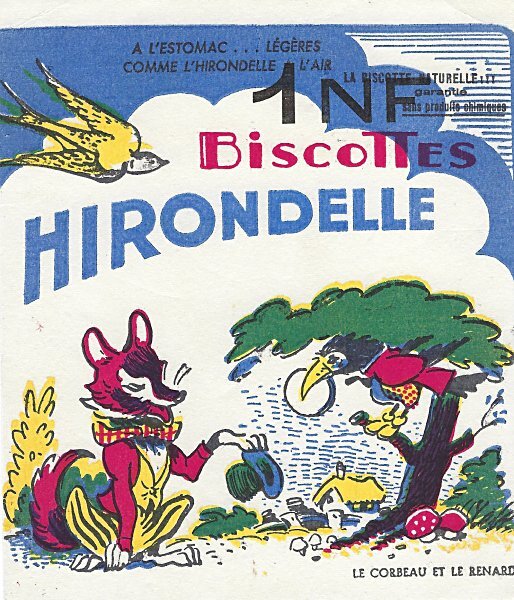
1960? Duplicate blotter from Biscottes Hirondelle featuring FC. €1 from French Vintage Shop, Paris, through eBay, Feb., '13.
This general duplicate has some specific differences. The first is the large "1 NF" stamp. Others include small print dropped from the left and bottom margins indicating "blotter" and, apparently, the weight of the cookies that came with this blotter. Printing near the top of the blotter is also rearranged.
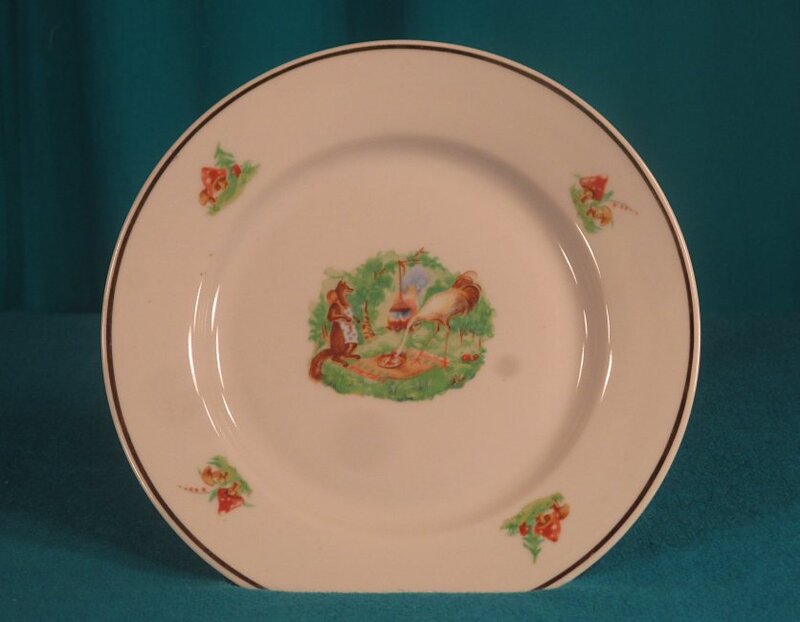
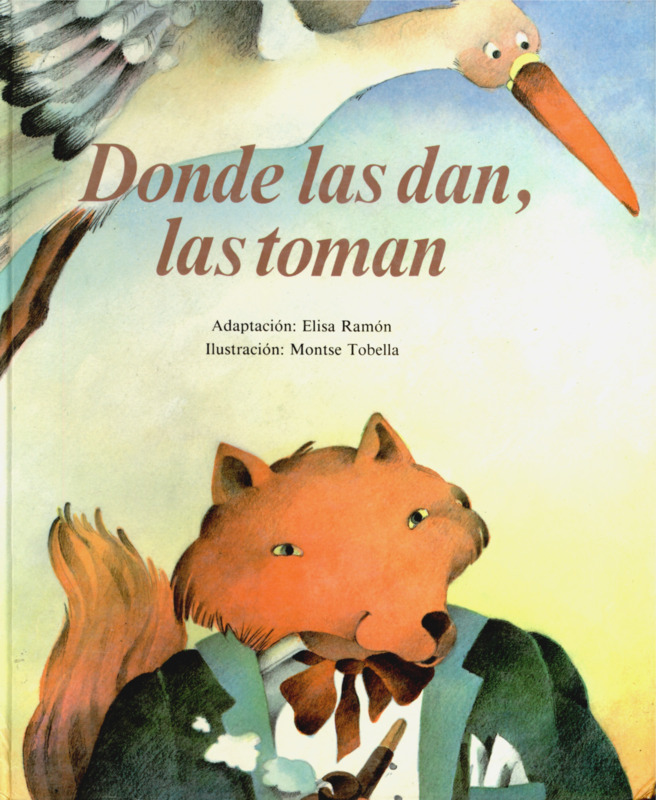
1980? Russian plate almost 8" in diameter presenting FS. "Dulero IS 5." "7 87." $60 from Evgeny Ponomar, Russia, Sept., '18.
The design on this lovely plate with gold rim and four mushroom designs stresses the stork's long neck. The fox has apron and ladle worthy of a cook. The dish is laid out in the middle of the forest on a lovely blanket. It is curious that the design stresses the first of the two acts in this play.
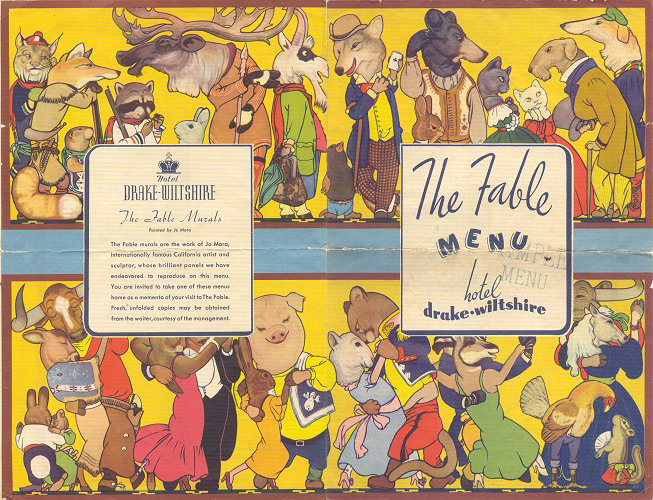
1938 Drake-Wiltshire Hotel Fable Menu. Friday, September 23, 1938. Jo Mora Fable Murals. $9.99 from Michael Kopperman, Toronto, Ontario, through eBay, July, '03.
Unfold the menu and you find a nice panorama of two of the Drake-Wiltshire's fable murals. As with the fable postcards displayed elsewhere, the murals seem not to depend on any traditional fables for the match-ups among the animals. The filet mignon dinner cost $1.25!
1950? Full-page advertisement for Doxa timepieces. “Les Fables de La Fontaine: Le Heron.” 8.75” x 12.2”. Unknown source.
This full-page advertisement may echo the treatment of “Le Heron” in Doxa’s 1950 booklet. Here the message is “Do not be like the heron. Do not hesitate to buy a Doxa!” The web shows a similarly formatted Doxa advertisement using TH.
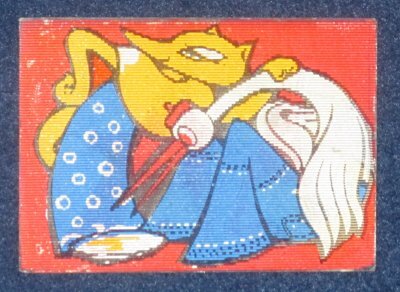
1960? Russian pocket multiplication table with "stereotype" double-vision FS on the verso. $4.89 from Liuba Mateva-Dineva, Stara Zagora, Bulgaria, March, '19.
Here is one of the more unusual items in the collection. The picture side of this stiff card shows a different picture depending on which angle one uses to view it. I am not sure that "stereotype" is appropriate but the word signals at least the double views. The approach is excellent for this fable's two phases: the clever fox prevails, and then the cleverer stork repays. This fable seems to have entered Russian culture as a popularly repeated and developed folktale. The seller mistook the multiplication table on the opposite side for a calendar. A calendar would have helped in dating this unusual item!
2000? Double Ring Featuring TH. Plastic? Two copies, one with defective tortoise. Unknown source.
This ring, or others quite similar, is readily available on the web. Our first ring is a double ring! Who would have imagined that?
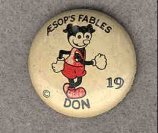
1930? A pinback 15/16" in diameter, labelled "Aesop's Fables - Don - 19."
Against a white background we find "Aesop's Fables" at the top, "Don" at the bottom, and "19" on the right side. In the center is figured a walking male. This is no doubt Don the Dog from the Aesop's Fables movie cartoons that were popular at the time. This button helps me to make sense of the "Countess" button found earlier.
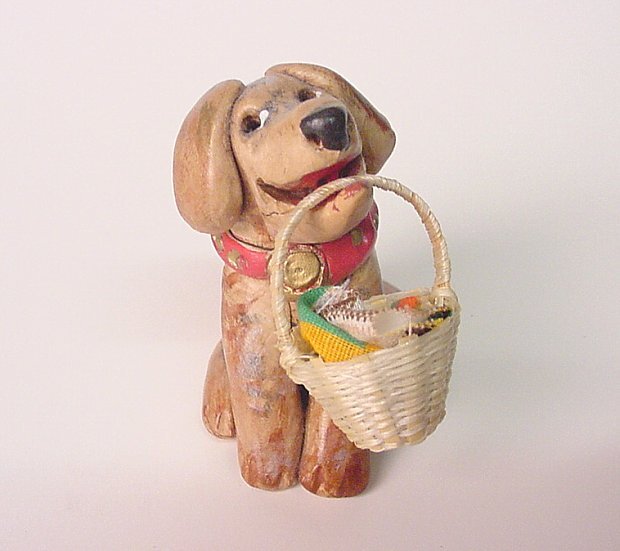
1987 Dog holding master's lunch pail. 2¼" high. Pat Lane Diaz, Wausau, WI. West Allis Craft Fair.
Diaz here gives the dog a very winning personality. It is not hard to believe that this dog had the good sense to set his master's lunch down when the alternative was to fight a pack of dogs while struggling to protect the basket from them.
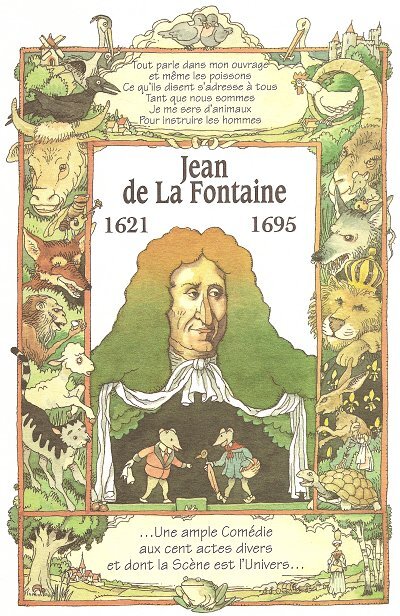
1995 One four-page documentation folder on the series of La Fontaine stamps issued in 1995. "Collection Historique du Timbre-Poste Français." €9.99 from Philatelicpassion, Paris, through eBay, Oct., '06.
This is a large (8¼" x 11¾") folder done in full color on its front and back. The front makes La Fontaine's scarf into a stage curtain over the two characters of TMCM. Surrounding his portrait are animals from the most famous fables, rendered in the distinctive style that R. and C. Sabatier bring to the stamps. Underneath one finds his own description of what he presents: "Une ample Comédie aux cent actes divers et dont la Scène est l'Univers…." Above LaFontaine's head is another fine description of his work from the dedication to the Dauphin: "Everything speaks in my work, even the fish. What they say addresses all of us, whoever we are. I use animals to instruct people." The back cover presents a lovely view of Château-Thierry from under a tree that happens to have a cheese falling from its branches! This page also features the embossed stamp "Controle Imprimérie Timbres-Poste." The interior has a pasted-in set of the stamps, a life of La Fontaine, and a few lines of the appropriate fable for each of the six stamps. I am surprised that there is not something about the artists.
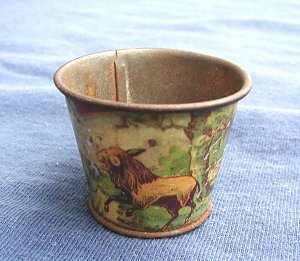
This handle-less cup, 1½" high, shows DLS. The DLS scene is surprising in that the donkey is moving left in the left half of the panel, and the sheep in the right half are moving right. $36.99 from Jo-Ann Deacon, Hamilton, Ontario, through Ebay, Feb., '00.
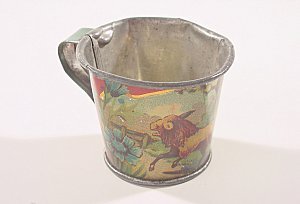
This version of the same DLS cup, 1½" high, kept its handle but received some dents along the way. This cup has "Germany" printed alongside its handle. $12 from Marlene Schmidt, Readlyn, Iowa, Nov., '00.
1900? DLS
This appears to be a book illustration cut out with no identifying marks left. The perspective is unusual. The owner approaches the shaggy-dressed donkey menacingly with one hand behind his back and a club in the other hand. I have no idea where I got this picture!
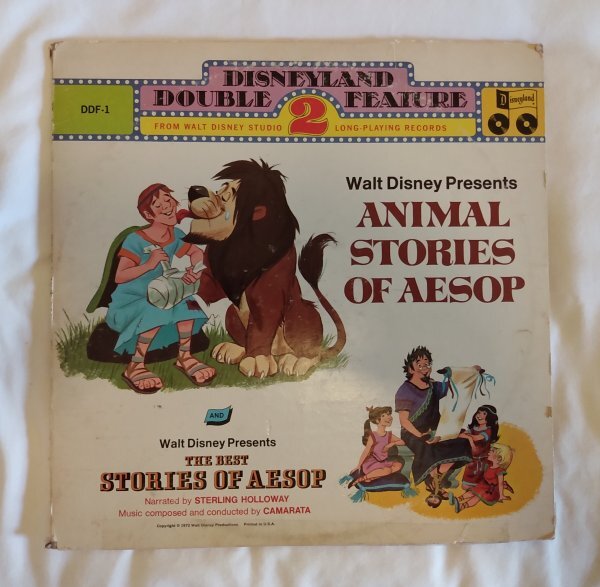
1972 Disneyland Double Feature: Walt Disney Presents The Best Stories of Aesop and Animal Stories of Aesop. Both narrated by Sterling Holloway, with music composed and conducted by Camarata. Walt Disney Productions. Disneyland DDF-1.
The second of the two records here is identical with the one produced by Disney in 1961. See my copies above. The first seems to follow the same format as the second, offering five fables: GGE, FC, and "The Hare and the Hound" on Side 1, with DM and TH on Side 2.
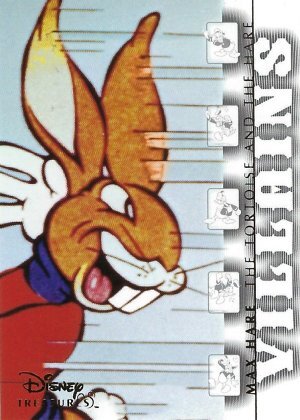
2003 Disney Villains: Max Hare. #138. Upper Deck. $.01 from Ken Reid, Brownsburg, IN, through Ebay, March, '23.
This is the original Max Hare that starred in the Disney book and cartoon. The card includes a hologram. My, Disney knows how to make money in so many ways! I note that our collection set a record for the cheapest expense with this purchase! I had not known that "Villains" cards existed! A little research showed that there is also a "grasshopper" villains card. I found it immediately on Ebay! And might there be a "Heroes" card for Toby the Tortoise?
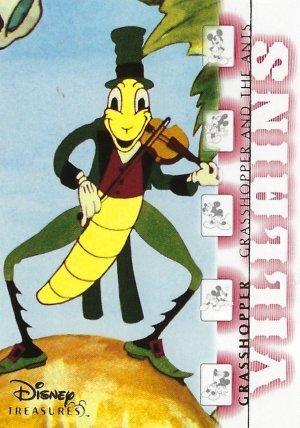
2003 Disney Villains: Grasshopper. #24. Upper Deck. $.99 from "the saint rules" through Ebay, March, '23.
This is the original "Grasshopper" figure that starred in the Disney book and cartoon. The card includes a hologram. As I mentioned about our "Max Hare" card, I had not known that "Villains" cards existed! I believe that there are no further fable cards among the "Villains."