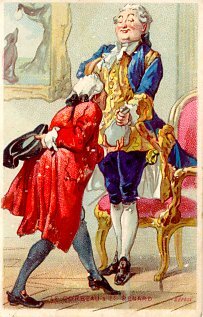
1890? 4 full-colored cards almost 4¼" x 2¾" and showing La Fontaine's fables. Each card has a block-print red title and "Deposé" on the picture side and nothing on the verso.
The haughty crow in FC is paying the bowing and scraping man in the red coat to praise him. I think these are excellent illustrations! FG is a classic, as the unhappy old man turns away from the pretty young women. Note the grapes in the left background. The faces on both figures in GA are well done: judgmental and rejected, respectively. The MM card, though cropped, presents a lovely picture of a disappointed young woman. She is in fancy attire to take milk to town, including roses on her slippers! Notice the animals galloping away from her. Well done! While "Deposé" probably indicates only that the publisher or design is registered somewhere, it is the only identifying mark I can find. I believe that these cards were ready for imprinting as trade cards, and so I have included them here.
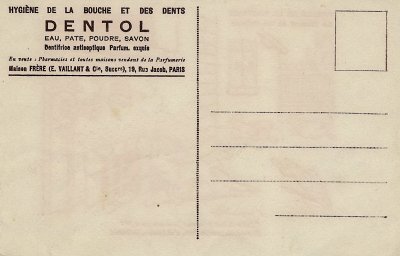
1924? Dentol Advertising Postcard Parodying La Fontaine's FG. €6 from Bartko-Reher, Berlin, Feb., '25.
As in a similar magazine advertisement by Rabier, the fox makes this statement: "Climb up there? Never! I'm not so stupid…. Still, for teeth, Dentol is famous!"
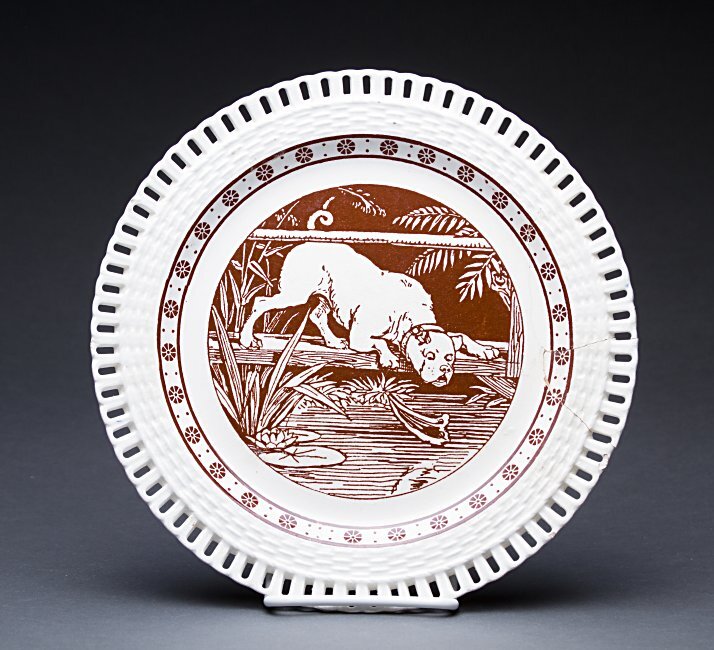
1920? Brown and white plate 9" in diameter with an open-dentelle fringe showing DS at its center.
This plate is marked by its open dentelles around the outer rim, with an arched opening in each dentelle. Inside at the center is a recognizable image of DS. It is exactly the image that appears on Minton tiles of the same period, whether they are brown or blue. The choice of a moment to depict is good because the dog has just lost his piece of meat, and it has not yet entered the water to be lost forever.
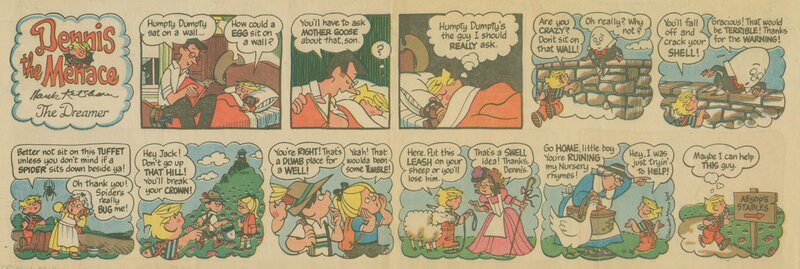
1965? Dennis the Menace. Hank Ketcham. “The Dreamer.” One extra copy. Unknown source.
Aesop’s fables are mentioned here as an alternative to nursery rhymes. Dennis has been going strong since 1951!
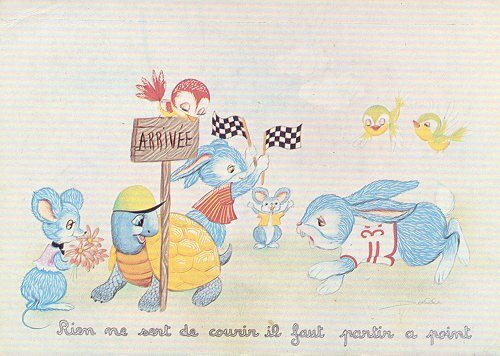
1995? TH postcard: Rien ne sert de courir il faut partir a point." Delta Productions. Z.I. de la Lauze. Saint-Jean-de-Vedas. Imprimé en France. Postmarked from Henday Plage Jan., '97. €1.50 from Gerard Crucy, Yerres, at the Paris Post Card Exhibition, Jan., '05. Extra copy for $5 from an unknown source, Feb., '22.
The art work seems to be signed "Dalle" or something similar. It is a heavily pastel scene of the finish line, drawn for young children. The exhausted blue hare wears a runner's shirt. Various birds and mice are at the finish to celebrate the tortoise.
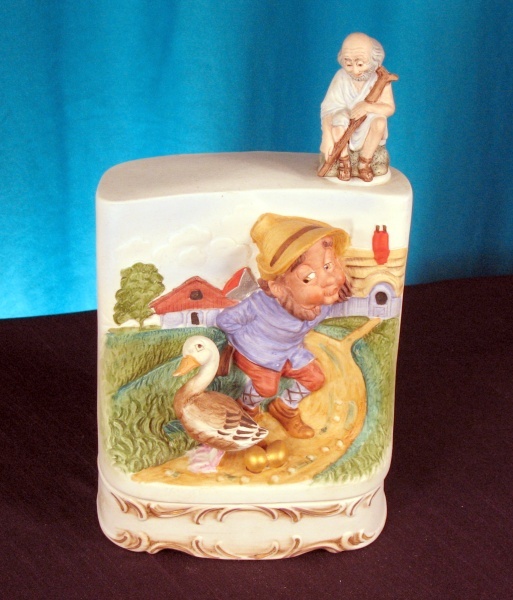
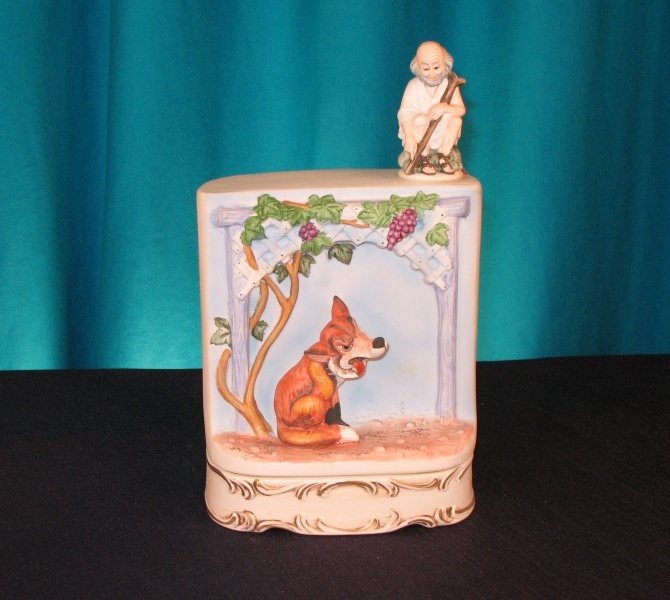
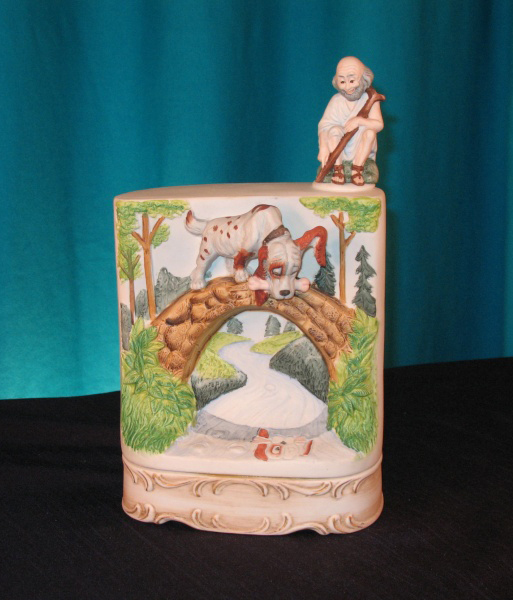
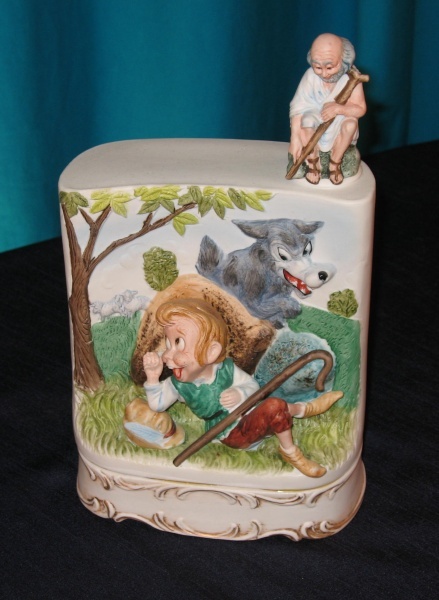
The rendering of two things is excellent in this decanter. First, the dog's left ear is arched up as he looks down intot he water with the bone in his mouth. Secondly, the flat reflection in the water below is well done.
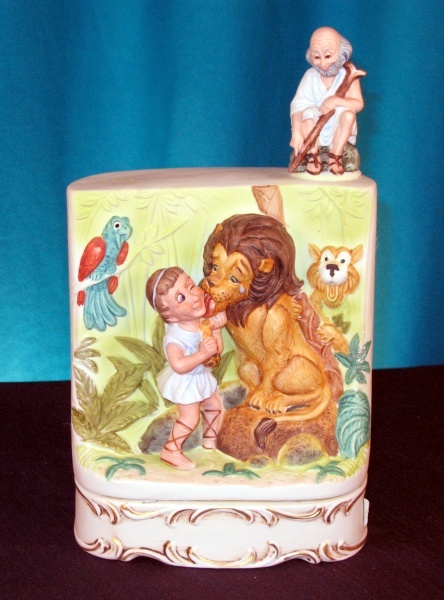
The lion is kissing or licking Androcles, whose one eye squints as he removes the thorn from the crying lion's paw. The decanter plays the tune "What the World Needs Now Is Love, Sweet Love." See a detail of the scene below.
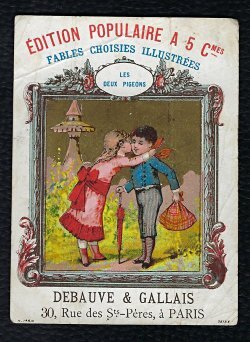
1890? "Edition Populaire a 5 Cmes." Debauve & Gallais, 30, Rue des Sts-Pères, à Paris. Nineteen cards that apparently accompanied chocolate. All illustrate "Fables Choisies Illustrees," each with a title above a framed scene of children. Imp. H. Laas, Paris. 2273.B. 3⅛" x 4½". $7 each from Bertrand Cocq, Calonne Ricouart, France, Sept., '20.
Would one have been able to purchase a candy bar for 5 Centimes back then? We have other cards from H. Laas, some showing the same scenes of children. These cards have an elaborate pattern complementing the ornate frame for each illustration. Debauve & Gallais, which still thrives near the Du Bac metro station, had several series of cards, two of them also illustrating fables. I can find no evidence online of this set – and therefore of its size.
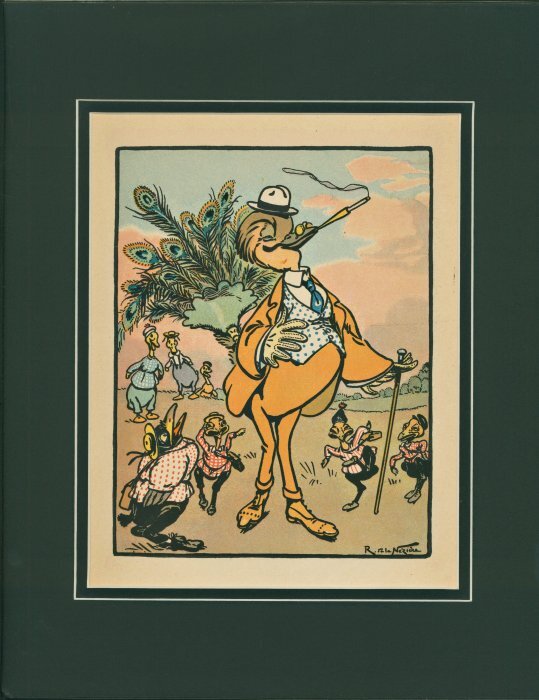
1929 “BF.” Matted color illustration b R. de la Nézière. Image 6.4” x 8.24”. Whole piece 10.8” x 13.8”. LA and Washington, DC: BungaloChic, UrbanCottage Accents.
Typically delightful Nézière work! This bird is a plump fat cat with a large belly and all the accoutrements: walkng stick, gloves, pnce-nez, cigarette holder, and hat. He cuts a figure. Unfortunately for him, that is all that he does!
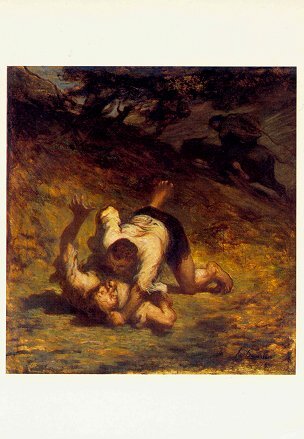
1986 Honore Daumier, "Les voleurs et l'âne" (vers 1848-50). Paris: Musée d'Orsay. Imprimé en France. Réunion des musées nationaux, Paris, 1986.
While the two thieves fight over possession of the horse, an unknown third steals it from them. Part of the artistry of this work is that the fight is highlighted in the picture as it is in the experience of the two thieves, while what goes on in the background of the picture--out of the picture's focus and out of theirs--turns out to be more important.
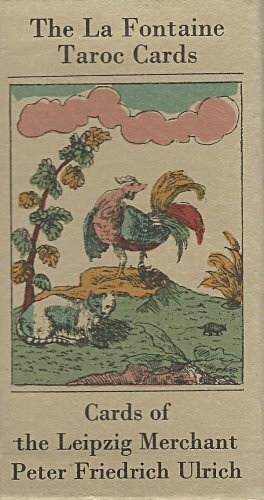
1980 Das La Fontaine-Tarock des Leipziger Kaufmanns Peter Friedrich Ulrich. Double boxed. Leipzig: Hermann Haack.
Taroc developed in Italy, apparently as early as the 1300's. It used a pack of 73 or 74 cards: the 52 we have come to call standard plus 21 or 22 tarot cards as trumps. This deck has the clown as the first of those 21 and then fables as the other 20. It has four picture cards in each suit plus 10 plain cards; the accompanying booklet explaining the history of this deck claims that this deck contains 78 cards, but I believe that the total is really 77. The date of the original pack of cards seems to be about 1780. This is a pleasant facsimile done in the German Democratic Republic. 2¼" x 4¼". Click on any one of the lower three images -- of cards -- to see it enlarged.
2011 Das Grosse Fabel- und Tiermärchen Hörbuch. 2 CDs: Fabeln von Jean de La Fontaine. 2 CDs: Tiermärchen von Manfred Kyber. Gelesen von Andreas Muthesius. Made in Germany. Merenberg, Germany: ZYX Music GmbH.
Muthesius' portrayal of these fables and Märchen is delightful, with helpful musical background by Ismail Boulaghmal and wonderfully varied voices. I wish we were told who did the verse translations of La Fontaine. Kyber is new to me. His stories are longer, more developed, and perhaps more modulated than most fables. I listened to three and found them all delightful: "Der K.d.R."; "Der grosse Augenblick" and "Die Haselmaushochzeit."