Full-page magazine advertisement for Container Corporation of America picturing TH. Black and white. Artist: Herbert Bayer. Great Ideas of Western Man Series. 11" x 8".
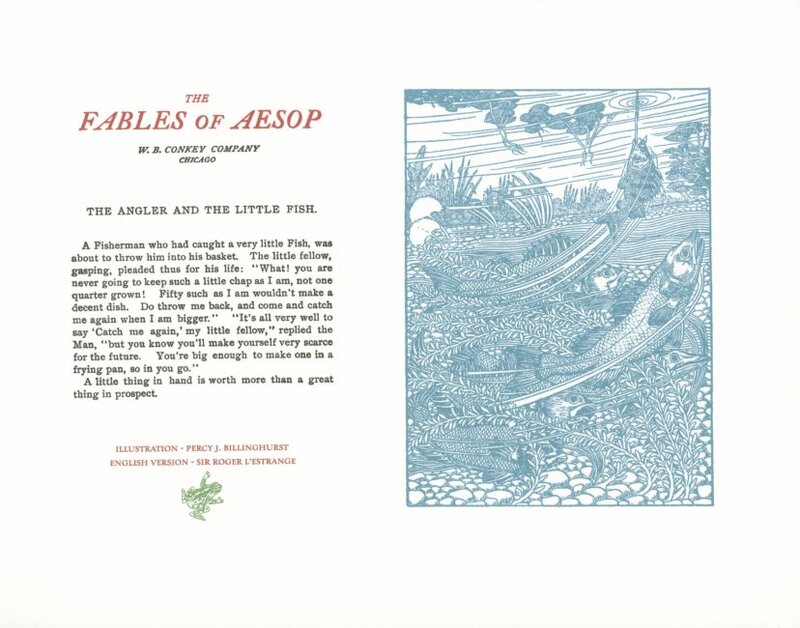
2020? Fifteen broadsides re-presenting Percy Billinghurst's illustrations with J.B. Rundell's texts on heavy stock. 14" x 10¾". $10 each from Shakespeare, Berkeley, July, '22.
These are attractive broadsides, nicely printed. Strong work with various colored inks. There are two striking anomalies. One is that the standard J.B. Rundell texts used regularly in Conkey editions of Aesop are used here but labeled as coming from "L'Estrange." The other anomaly was already present in the early Conkey editions: Billnghurst did these illustrations for La Fontaine's fables.
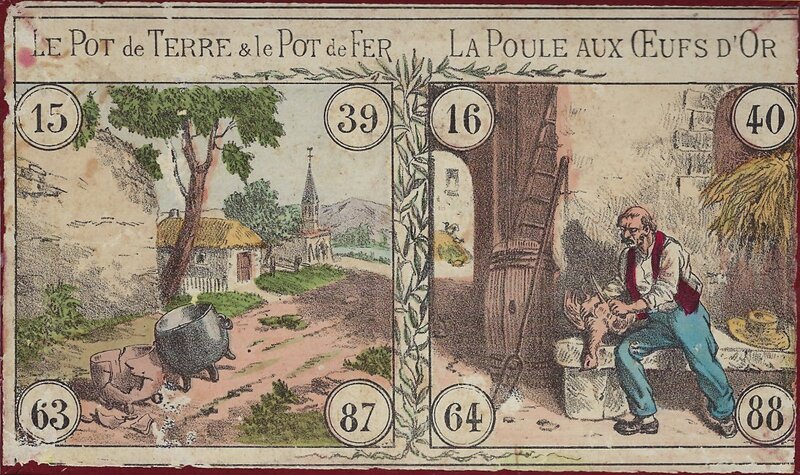
1900? Complete set of twelve lotto cards with red backing, each with two La Fontaine fable images, with titles and four lotto numbers each. €150 from Thierry Corcelle, Paris, June, '19. Six duplicate cards for $45.86 from Alexandra Lacroix of nantes-antiques, Nantes, France, through Ebay, Oct., '20.
The colored fable images here are exquisitely done. The number system is regular and consistent. The numbers in the upper left of each image are from 1 to 24. Those in the upper right of each image are from 25 to 48. Those in the lower left of each image are from 49 to 72. The numbers in the lower right of the first nine cards are from 73 through 90. The lower right numbers on the last three cards follow no system I can discern. Stiff board backing, slightly bowed.
1960? Complete set of 24 paper cigar bands from Verellen, Vieille Anvers in mint condition. 1 3/16" x 7/8". The bands are two shades of red, and frames for the colored illustrations are gold. The subjects are animal stories including fables. $18.55 from Andre Prenger at The Holland America Cigar Band and Label Store, Amsterdam, through Ebay, July, '99.
Since these fables came shortly before I left Omaha for a year away, they have eluded cataloguing and scanning. Now at last three years later I can offer them. The graphic work is done in such a small space that it is hard to do the subjects justice. And so I offer here actual size presentations on this page with an enlargement each. For me it is already fun to know that someone used fables as subjects on cigar bands! The best of the group are FG by Lessing (7), "Quartet" (8), "The Wolf with the Frozen Tail" (10), "Chantecleer" (16), "The Bees and the Bumblebees" (18), and TT (20). The verso has numbers, authors, and titles in Dutch and French.
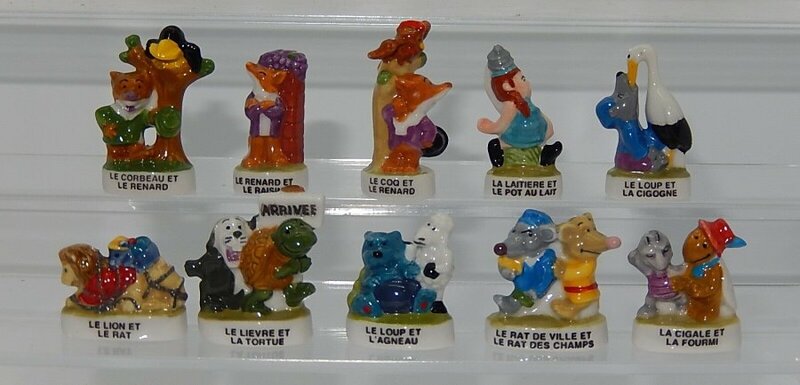
2010? Complete Series of 10 Fable Fèves.
This is a particularly successful set of fable fèves. The challenge is regularly how to bring together the two characters often involved in a fable. That challenge makes MM perhaps the most curious piece in this group. Is her "leaning back" posture meant to suggest the coming fall of the pail of milk? The fox is wonderfully smug, though the grapes appear to be quite near his reach. WC, I would say, is particularly successful. This set can also be seen in three dimensions here. Eight of these feves, differently and rather bizarrely colored, are grouped here.
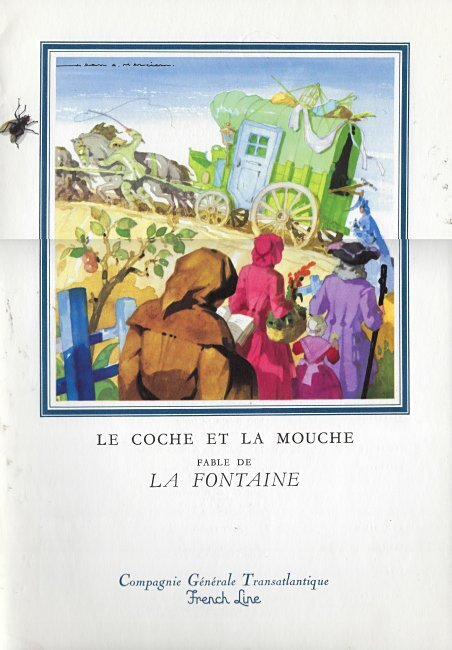
1956 41 different menus illustrating eight different fables with La Fontaine's text printed for the Compagnie Générale Transatlantique French Line. For use on transatlantic voyages between December, 1956 and July 11, 1959 on ships "Liberté," "Flandre," and "Ile de France" and at a dinner and dance at the Elks Club January 19, 1957 sponsored by the Women's Auxiliary for the benefit of Saranac Lake General Hospital (in the Adirondacks in New York State). Images by Jean A. Mercier. The menus cost between $3.66 and $30 each. While I did not keep track carefully of where I found all 41, aligning the dates of the menus showed distinct groupings and helped me match some menus with sellers. Those curious can find the list of fables, dates, ships, and sellers here.
These are not only menu jackets but menus themselves, with a fable text on the back cover and a fable image and title on the front cover. We used one of them – "The Coach and the Fly" – in the Joslyn exhibit because of its clever trompe-l'oeil use of a fly right on the menu itself. I find the images delightful. Lovely pastels work together effectively in these light-hearted pictures. To judge from the splashes on the "dinner and dance" menus, it must have been some party! The fables and numbers of copies are
The Coach and the Fly (8);
The Little Fish and the Angler (5);
FC (4);
MM (4);
The Monkey and the Dolphin (6);
The Ass and the Lapdog (3);
The Wolf Become Shepherd (6);
WL (5).
2011 €5 coin commemorating the year of the rabbit. On the verso is Jean de La Fontaine with the 12 animals of the zodiac.
This is a nice presentation of La Fontaine. Apparently commemorative coins are a way for governments to raise funds. This one comes in a lovely holder. I am not even sure I can figure out how to open the holder or close it again, and so I will not!
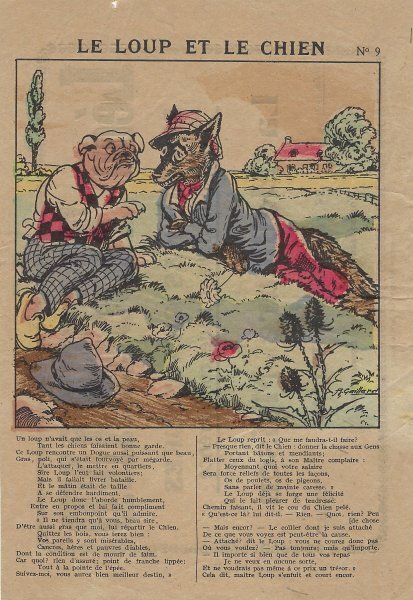
1930? Colored handbill displaying DW with La Fontaine's text. #9. Verso is an advertisement for Léon Tisserand dealer of shoes, Dijon. 5½" x 8". Printed by Imageries Réunies de Jarville-Nancy. €3.45 from croquette999 on Ebay, Sept., '23.
This is a lovely rendering of the DW scene, nicely conceived and well colored. The pudgy guard-dog tells an alluring story to the starving wolf, who listens at leisure.
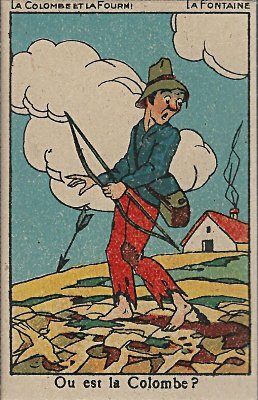
1950? Two full-color hidden picture fable cards presenting DW and "The Robbers and the Ass." "La Fontaine." $14 from Bertrand Cocq, Calonne Ricouart, France, Sept., '18. Six more cards from Bertrand for $5 each, all advertising "Chichorée Extra "A la Menagère" from Duroyon & Ramette in Cambrai. Printed by L. & A. Nisse, in Croix (Nord), Sept., '20. Ten further cards, including several extras, for €10 from Grenadines Sari, Paris, through eBay. FC and "Rabbit and Frogs" for €4.66 each from Bernard Majdecki, Dijon, Jan., '22.
Each card has a fable title and "La Fontaine" at the top, a full-length colored image, and a question at the bottom, asking "Where is the wolf?" and "Where is the ass?" I did not find these easy! There is nothing on the verso. Click on the card to see a bigger version and on "Resolved" to see a solution. This series seems to overlap in its designs with the our "Mono Poeders Monochrome Hidden Picture Cards." 2½" x 4". French apparently knows these cards as "Les Belles Devinettes."
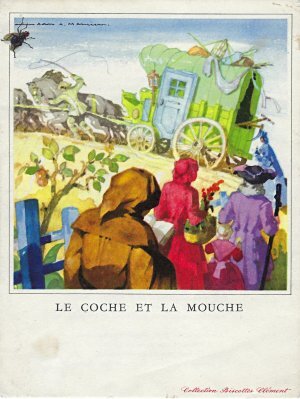
1960? Colored fable card advertising "Collection Biscottes Clément" and presenting "The Coach and the Fly" by Jean Mercier.
I recognized this image immediately. It was done by Jean Mercier and appeared on menus for Compagnie General Transatlantique. In fact, that menu appeared in the Joslyn Museum exhibit of this collection in 2018. Its most unusual feature is the oversized fly apparently sitting on the paper. The fly is so insignificant, despite his own ideas of his accomplishment, that he does not appear otherwise in the image. One is tempted to whisk him away in order to look at the picture! The printer's name ends in something like "ugges" in Paris and Nantes. In an earlier existence this card lost that bit of its printer's name. The title and text of the fable make up the verso of the card.
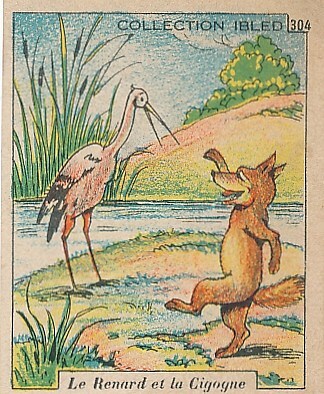
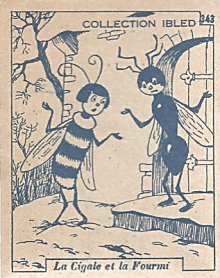
1925? Thirty small (2⅛" x 2¾") numbered colored "Collection Ibled" trade cards illustrating fables of La Fontaine.
Simple thin cards with nothing on the verso. The image side of the card has "Collection Ibled" at the top along with a number ranging from #304 to #582. The style is sometimes reminiscent of Benjamin Rabier. The design of the illustrations of these cards does not replicate the design on the "Collection Ibled" black-and-white cards, which are otherwise in the same format.
1925? Nineteen small (2⅛" x 2¾") numbered black-and-white "Collection Ibled" trade cards illustrating fables of La Fontaine. Five cards a gift of Denise Debuigne, Chantepic, France. Fourteen cards for $90 from Bertrand Cocq, Calonne Ricouart, France, Sept., '18.
Simple thin cards with nothing on the verso. The image side of the card has "Collection Ibled" at the top along with a number ranging from 375 to 531. The style is sometimes reminiscent of Benjamin Rabier.
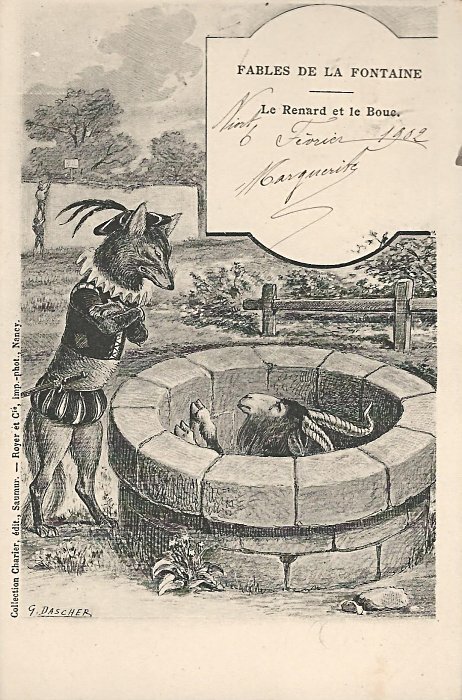
1900? 6 black-and-white portrait postcards featuring fables of La Fontaine. Signed by G. Dascher. "Collection Charier, edit., Saumur. Royer et Cie, imp -phot, Nancy." St. Ouen, August, '15. One extra copy of Le Singe et le Léopard. Extra copy of "Le Singe et le Léopard" for €7 from Bartko-Reher, April, '21.
The characteristic feature of this set is a rectangular or near-rectangular inset "Fables de La Fontaine" and the title of the individual card. The two cards not signed by Dascher seem to be signed by "HBGI." They are in a different style. These two are WC and FC. The Dascher cards are "The Fox and the Goat"; "The Thieves and the Ass"; "The Monkey and the Leopard"; and "The Wolf Become a Shepherd." A trade card from Nouvelles Galeries in Saumur is so similar that I include it here as well as there for comparison.
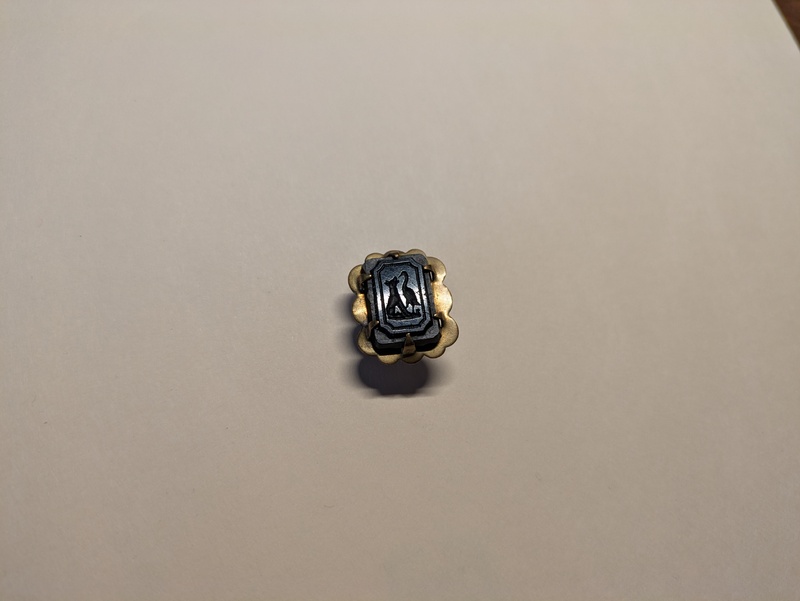
1900? Collar stud displaying WC on black material. .75” x .89” x .5”. Unknown source.
I have tried to use some glare to show the miniature scene on the face of this piece. The rounded back does not seem to be separable. Might the black stone be onyx?
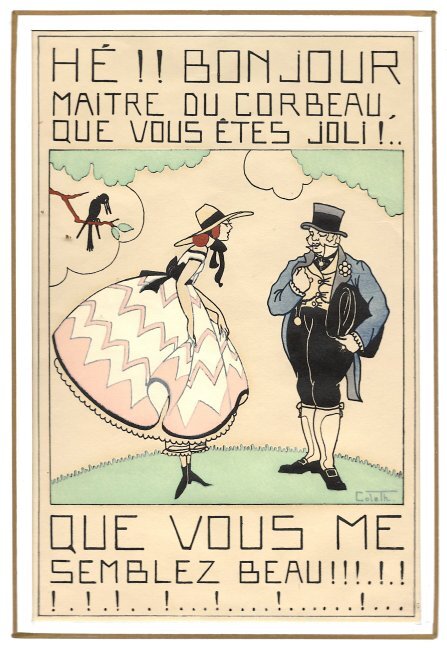
1930? Pochoir gouache of FC by Coleth. Matted. €20 from chez.Daniela through Ebay, Sept., '21.
The stencil technique, gouache coloring, and art deco style come together wonderfully here for Coleth. "Maitre du Corbeau" is the tipoff here. The stylish young woman is the fox getting something out of the not-so-beautiful old gentleman. From what I could find on Coleth, this figure seems utterly typical of the artist's work. I find the illustration visually captivating
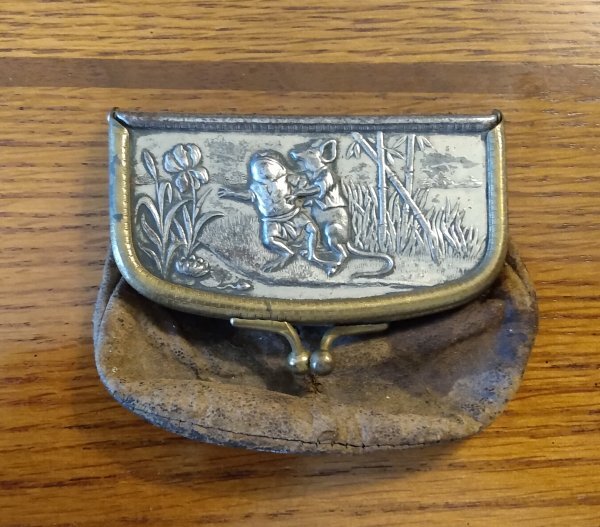
1930? Coin purse advertising Luis Knierim Café. "Restaurant and Furnished Rooms for Gentlemen Only." Wheeling, West Virginia. Image of "The Frog and the Mouse."
Now here is a first. A coin purse! There is an irony here. "The Frog and the Mouse" is a story of ugly hospitality. After the host mouse shows great hospitality to the guest frog, the host frog drowns the guest mouse -- but pays for it in the end by being supper for a hawk. Not the best advertisement for furnished rooms!
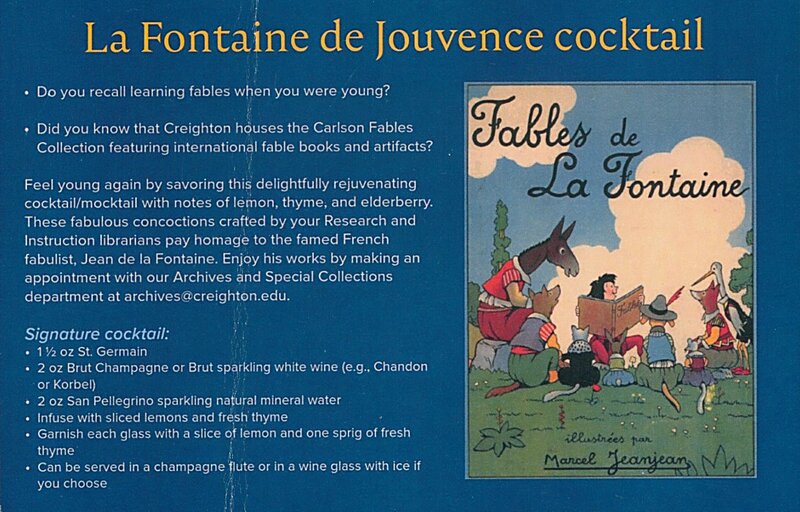
2024 Cocktail and mocktail card advertisements. Kingfisher Institute, Creighton University. April 2, 2024.
Each year the Kingfisher Institute offers a get-together for Creighton faculty and staff. In April of 2024, they did so in conjunction with Reinert Alumni Library. The event has two special features: a game of trivial pursuits and a special cocktail or mocktail of the day. This year the event celebrated the Carlson Fable Collection by basing a set of the trivial pursuit challenges on the fable collection. For added fun, they based the drink of the day on La Fontaine, playing with his name as "the fountain" of youth. What fun!
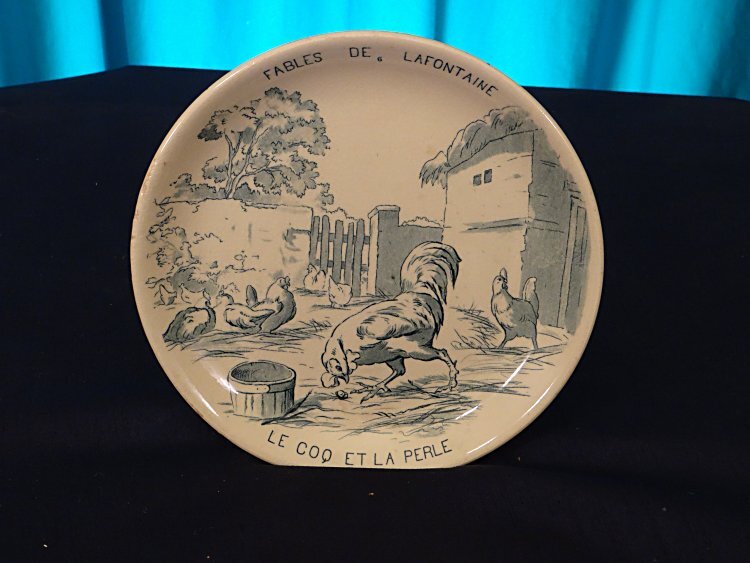
1920? 8" cream-colored plate with a blue-green colored design depicting CJ. The plate reads "Fables de LaFontaine" and "Le Coq et la Perle." The partial back stamp reads "Porcelaine …e de Gien." There is a registry mark on the plate's back. $35 from Linda Leffingwell, Doyestown, PA, June, '11.
The block lettering is typical of Gien work. The cock is dramatically positioned in the center of the scene and oriented to the pearl just beneath him. The scene covers the entirety of the front of the plate.
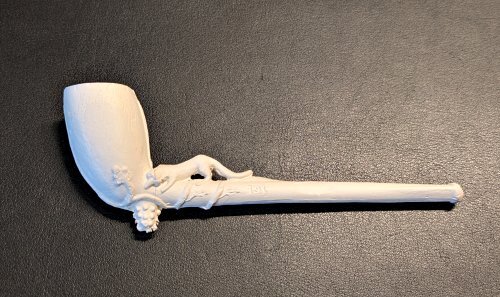
1990? Clay pipe featuring FG. 5". Unknown source.
The fox seeks the grapes right at the joint of the stem with the bowl. In an unusual turn, the fox here needs to go down to get the grapes. This pipe is fragile. It has already been broken once.
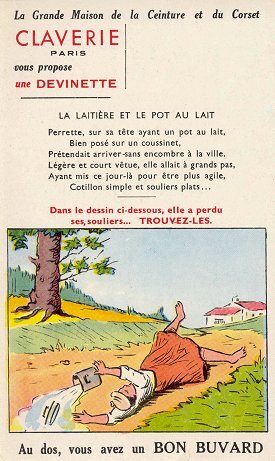
1960? Two puzzle blotters from Claverie, Paris, "La Grande Maison de la Ceinture et du Corset." 3¾" x 6¼". TH and MM, each with a "riddle" of finding a hidden character or two. The verso of each includes a fuller text advertisement for Claverie in Faubourg Saint-Martin. $5 each from Mme Denise Debuigne, Rennes, France, Feb., '02.
The lower half of each portrait-formatted blotter is a colored fable illustration. The upper half mentions Claverie as setting the viewer a riddle. A few of the fable's opening verses occur. The image for MM includes her shoes. Can you find them both? TH includes a hidden tortoise.