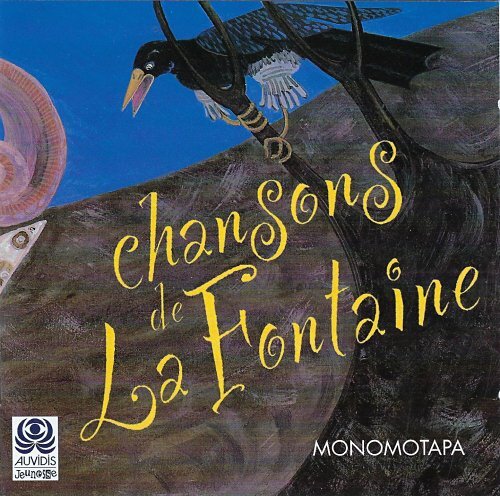
1997 Chansons de la Fontaine. Monomotapa. CD. Nineteen fables rendered as songs. Composition and arrangements of almost all: Jean Chavot. Auvidis Jeunesse. Studio du Palais. Liège, Belgium: Studio S.O.S.
This disc is a very pleasant surprise. The texts of La Fontaine are presented verbatim, if not always at the same level of intensity or audibility. But each text is encased in a true chanson, with its own rhythm and persuasion. These chansons move! I enjoyed the first four immensely, not least the conjunction of the third and fourth: "The Rat and the Elephant" and "The Frog Who Wanted to Be as Big as An Ox." They are very much about the same pretentiousness. The voices here work together wonderfully! An accompanying little booklet with clever illustrations offers a key refrain from each song.
2000 Chalk Drawing of "The Fox and the Mask." Megan Douglas for English 120 at Creighton University, Fall, '00.
Here is a wonderfully sensitive study of forms. Is that the fox's tail that sweeps around the right side of the mask? The fox seems appropriately unimpressed!
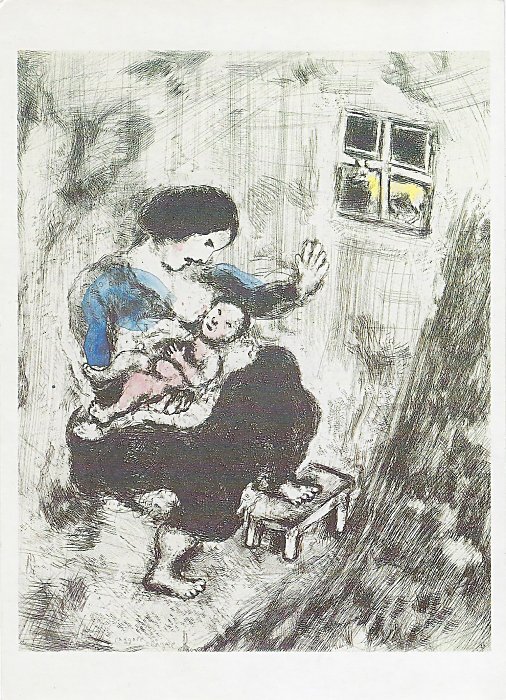
2000? Postcard Marc Chagall, colored illustration of "Mother, Child, and Wolf" from Teriade's 1952 publication. Lessing J. Rosenwald Collection, L of C, Pomegranate, Petaluma, CA. Printed in Korea. $9.95 from Pack Rabbit, Westport, Canada, Sept., '12.
This postcard gives a clue to one part of the Chagall history with fables, namely that he hand-colored a number of the 200 Teriade copies that he made in 1952. Here only the child, the mother's blouse, and the wolf seem to get a bit of color.
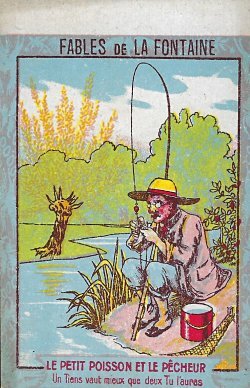
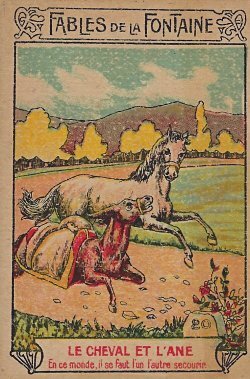
1915? 7 of 8 "Fables of La Fontaine" trade cards. Printed by Ch. Duffit, Paris. One extra of GA.
I commented on the first card twenty years ago that it was in many ways the cheapest card in this collection. It is done on poor stock and uses a traditional approach to picturing this fable. There is an unusual uncolored strip across the top of the card. Bouchard specialized in Bala syrups and pills and in bandages. The picture portions of these cards seem identical to those in what I have called "Plain Fables of La Fontaine Cards."
1900? Five colored trade cards printed by Ch. Duffit. 2½" x 4". 2 from an unknown source. 3 further cards for $18 from Bertrand Cocq, Calonne Ricouart, France, Sept., '20. Seven further cards presented as "Bon Point" cards advertising DeGuillié Tonic Elixir.
The two cards depict "Les deux Mulets" and "Le Loup devenu Berger." Each card is titled "Fables de La Fontaine." Each at the bottom has the title of its fable and the moral. One advertises Francetta chocolate. Another advertises "Chauss? Paul." This firm seems to sell "specialités pour Pieds sensibles" and is a "Maison de Confiance." The three from Bertrand in 2020 bear no advertising. All but one of the cpcr958 cards are stamped on the verso with "Nouveaux Prix" and the new and higher prices. I wonder how big this series of cards is….
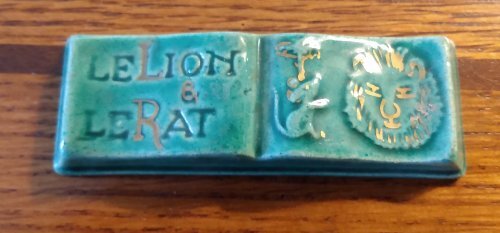
1980? Ceramic knife-holders as books. GA and LM. Green with gold highlights. 3" x 1". €18 from mathilde9662, Jan, '22. Two duplicates and four other members of the series -- LM, WL, TH, and FC -- found earlier from an unknown source.
There is an extra of LM and an unhighlighted extra of GA. The highlights accent parts of the picture and the capital letters in the title. I have searched the web for further members of this set, with no luck yet. Might these be less good than knife-rests with a level center?
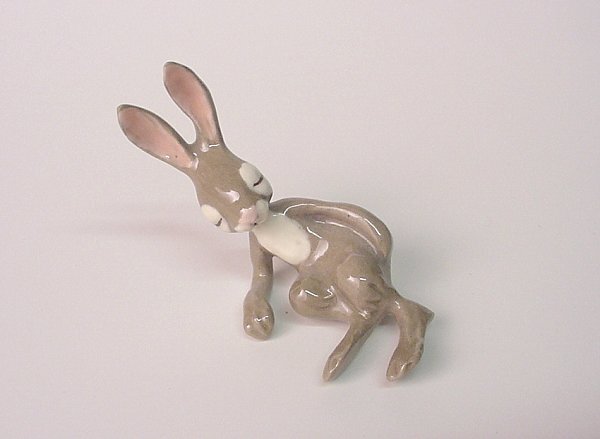
1970? Ceramic knick-knack of a sleeping hare. 2¼" x 1½" x 2" high. Unknown source.
I cannot remember where or when I found this little fellow. One can only presume, I think, that a sleeping hare comes from TH. The pose here is excellent: the hare leans on one arm with his body slanted diagonally.
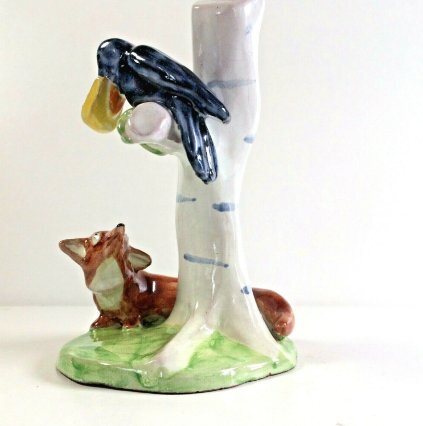
1980? Ceramic figurine of the fox & the crow. Handpainted. 6" tall x 4" wide x 3½" deep.
FC is such a popular motif in flat art that I am glad to see it make its way into a three-dimensional object. The only helpful marking on this statue itself is "FOREIGN" stamped into the bottom of the base. The seller describes this object as "unusual, quirky, and rare."
1975? Ceramic FG matted and framed, signed "Bellardo." Presumably by Paul Bellardo. Image 12.75" x 6". Overall 10.5" x 17.5". Unknown source.
This is a lovely and impressive piece. We are still not sure of its material. Splendid use of color. Of the many unidentified-source objects in our collection, this is one whose provenance I would love especially to discover.
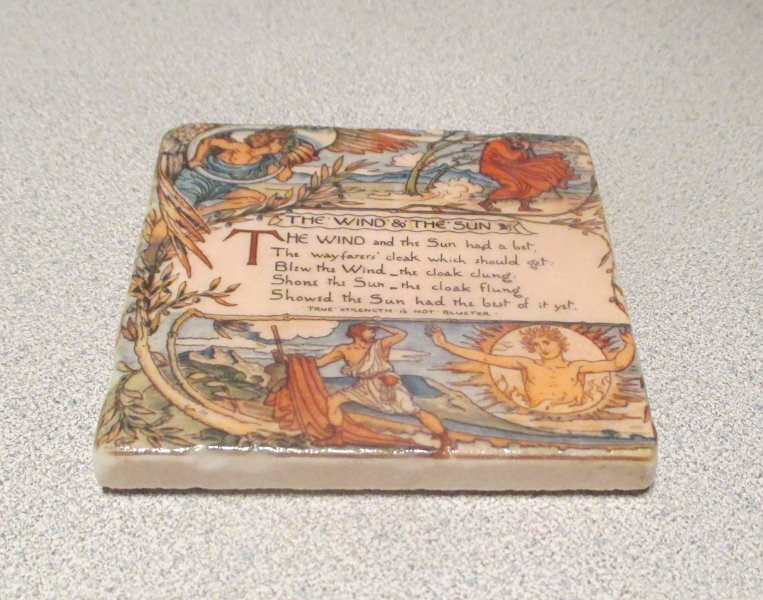
2020 Three ceramic coasters showing three scenes from Walter Crane's Aesop's Fables. Almost 4" square.
How nice to see someone picking up Crane's beautiful work! And dealing with Etsy is so personal! These are well done!
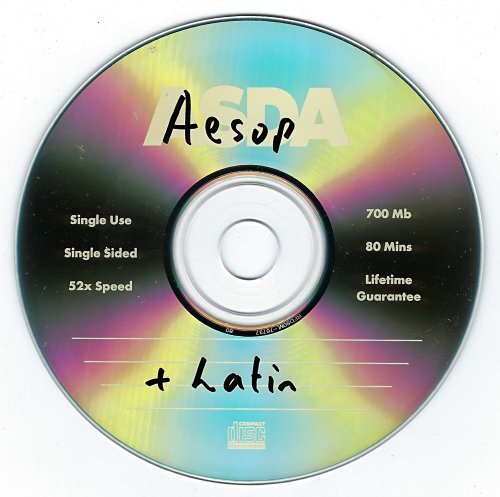
CD-ROM containing a PDF of an 1884 Aesop's texts, consuming 91 pages on the disc. Accompanied by exercises based on the Cambridge Latin Course, unrelated to Aesop's Fables.
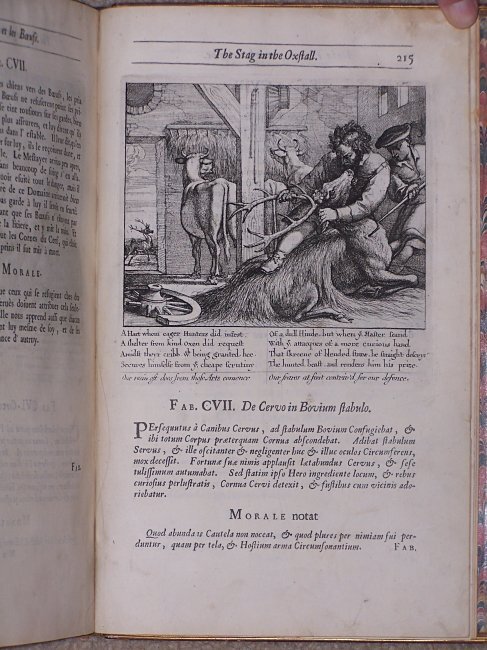
2019 CD of page-by-page jpeg photographs of Francis Barlow's 1666 Aesop's Fables with his Life: in English, French, and Latin, Newly Translated. 325 images, including each page containing one of the 110 Barlow illustrations. Done by Gregory Hollins using the Creighton copy of the book. Illustrations appear on images between 100-231 and 100-2410.
The illustrations are wonderfully distinct in these photographs. Note that the photographs are of pages, not of the illustration portions of pages. Some photographs of prose pages are better duplicates of less distinct images. That these are photographs of the Creighton copy is clear, for example, from the tears on 132.
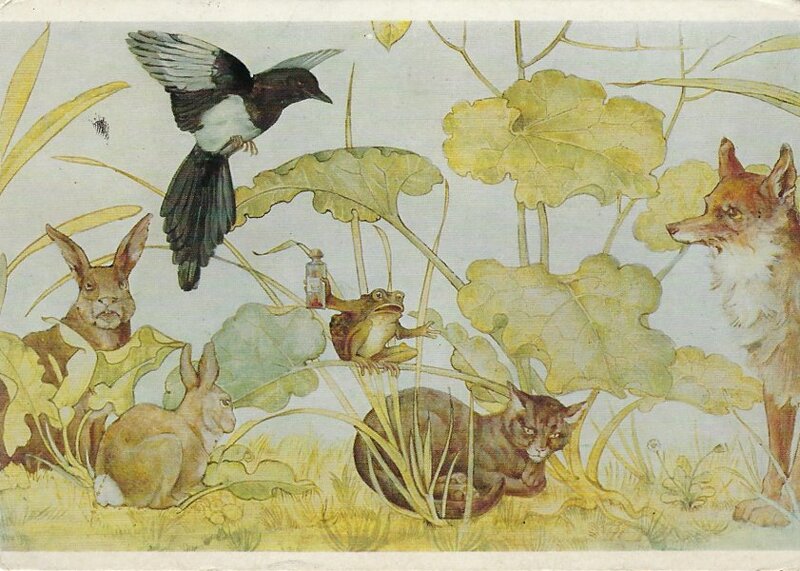
1990? Picture postcard of animals illustrating Aesop's Fables from the walls of the Drawing Room, Castell Coch, South Glamorgan, Wales. €.99 from catsmelanie on Ebay, Feb., '20.
My hero in this gathering of fable characters is the frog physician holding a bottle of his elixir in the center of the picture. My, how I would love to get to Castell Coch myself to enjoy the Drawing Room!
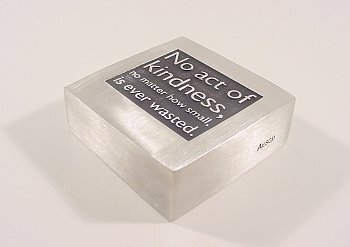
1998? Cast pewter paperweight "No act of kindness, no matter how small, is ever wasted. Aesop." 2" square. Made in USA. Vilmain + Klinger.
As the Ebay advertisement says, this solid cast pewter paperweight is elegant and handsome. It is also heavy! I presume that they found this proverbial moral attached to LM.
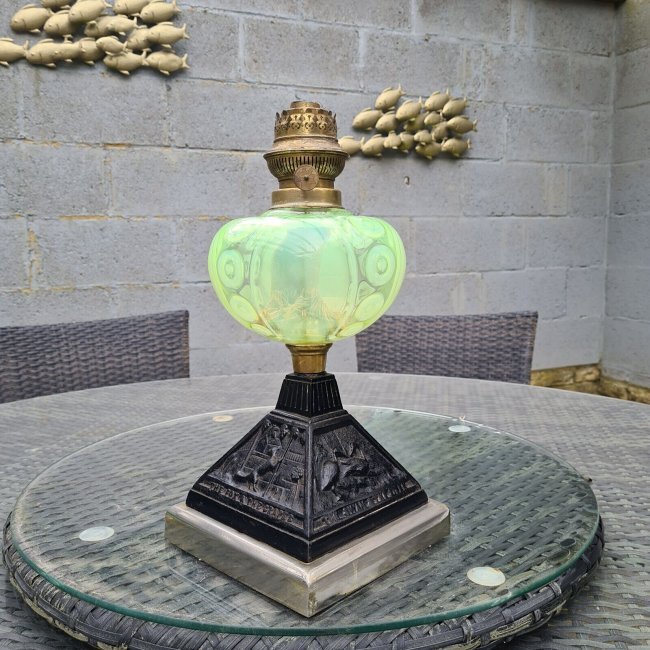
1880? Cast iron & brass oil lamp base. Each of four faces with a fable illustration. 15" diameter. £200 from lampman78 through Ebay, May, '23.
I found this heavy piece of artistry so unusual that I splurged and went after it. We are not much into lantern bases anymore! I am surprised at the inclusion of "Swan and Stork" among the fables pictured on the four faces. I presume that it is the story about the difference between looks and power: only one of these two birds can fly!
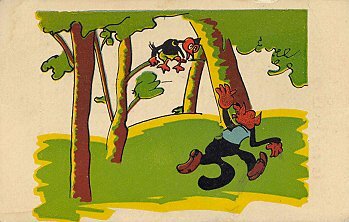
1950? 11 cards each with a simple cartoon illustration of a La Fontaine's fable on one side and the text of the fable on the other. 3" x 4¾". Apparently given as school prizes for attendance or punctuality. 10 Francs apiece from Helen Moncourt on the Quai de la Seine, May, '97.
Simple figures, strong colors, and lively scenes make this a good set for children. My favorite here is TMCM. These rats are having fun! For a copy of MM that landed elsewhere in the collection, see "Individual Fable Cards."
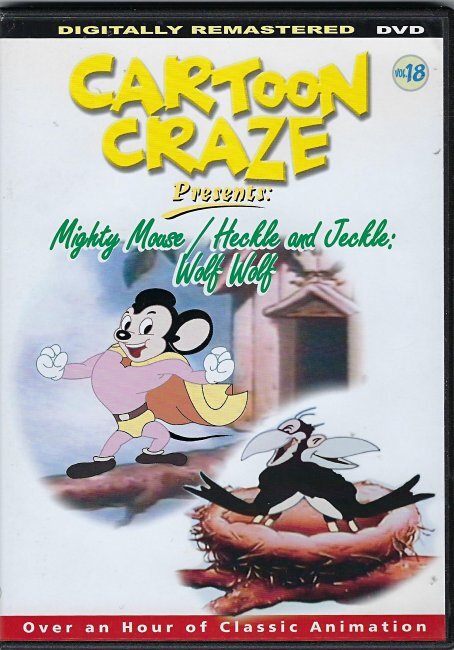
2004 Cartoon Craze, Vol. 18. DVD. Mighty Mouse/Heckle and Jeckle: Wolf Wolf. Digiview Productions. Made in China. 10 cartoons, mostly Paul Terry. Unknown source.
This dvd should not be confused with the several Van Beuren dvd's with similar titles. It offers ten colored cartoons from the 1940's. "Wolf! Wolf!" in 1944 brings together several traditional stories and rhymes, including "Little Bo Peep." I do not find fables involved here or elsewhere in this dvd. This story involves contemporary elements significantly, particularly wartime elements like periscopes and cannon. There is also an emphasize on contemporary jazz, which can lure the lost sheep into the wolves' lair. I also enjoyed "Cheese Burglar" (1946). Though it has nothing to do with fables, it has fun with Herman the Mouse. 62 minutes.
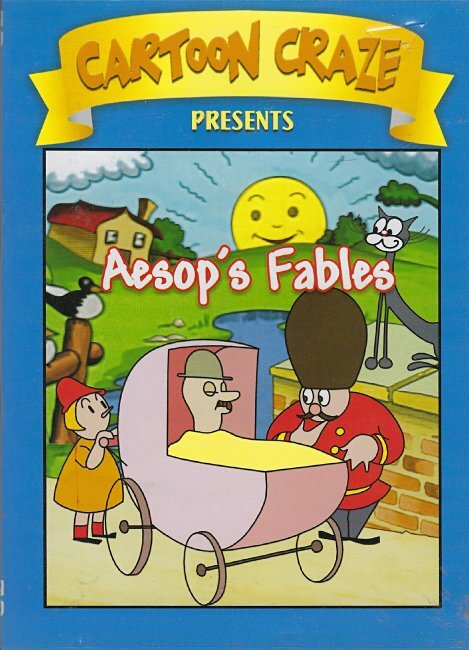
2004 Cartoon Craze. DVD. Taiwan: Digiview Productions.
Here are eight Van Beuren cartoons from about the 1930's, starting with "Close Call," "Dizzy Day," and "A Toytown Tale." As generally is the case with Van Beuren "Aesop's Fables" cartoons, they are not really from traditional Aesopic material. They are described in the cartoons themselves as "sugar coated pills of wisdom." As is true of cartoons more broadly, there may be more going on underneath the cartoon's surface – politically and philosophically – than is immediately apparent.
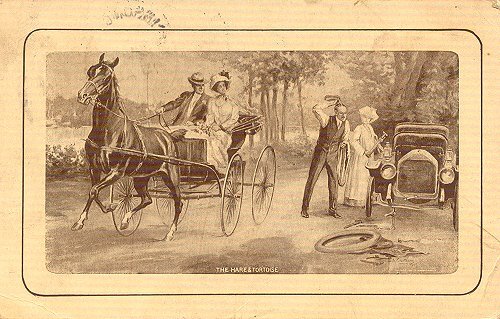
1909? "The Hare & Tortoise." Postcard print by A.F. Carter. "The Pink of Perfection: The Fairman Co. N.Y." Postmarked July 4 at 5 a.m., but apparently without indication of the year, from Gibson, IL. $2 from Lois Carroll, of Peru, IL, through eBay, Feb., '03.
This card reproduces in smaller format the print found under Printed Material - Prints. As I write there, this scene had perhaps already become an old joke by the time this print appeared. The dashing horse-and-buggy glides by the stalled automobile. The frustrated driver of the latter has already removed his coat and is holding a dilapidated innertube in his hand, while the woman holds a pump ready for action. The outer tire lies on the road with some tools. Good fun!
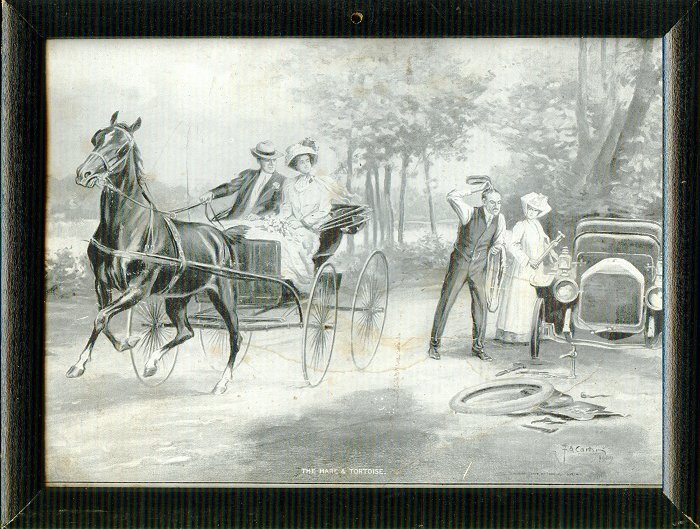
1909 Black-and-white print of F.A. Carter's "The Hare and the Tortoise." Framed. 9" x 7". $4.99 from Joe Lockhart, Easton, ME, through eBay, Dec., '03.
This scene had perhaps already become an old joke by the time this print appeared. The dashing horse-and-buggy glides by the stalled automobile. The frustrated driver of the latter has already removed his coat and is holding a dilapidated innertube in his hand, while the woman holds a pump ready for action. The outer tire lies on the road with some tools. Good fun!