1970? Buvard offert par Semelflex, a maker of shoes. With a trace-the-dots painting of La Fontaine's shoemaker from "The Shoemaker and the Financier." Premiere Serie C: Bottillon d'Enfant. Mesmer Pub. Imp. Sézanne. 5¼" x 8¼". $5 from Mme Denise Debuigne, Rennes, France, May, '02.
Green, red, and black highlight the face of a man and a child's shoe. When—as here—someone connects the dots, the delightful shoemaker appears, with his pipe in one hand and his hammer in the other. The blotter's invitation is well phrased: "Trace a line in the sequence of 1, 2, 3, 4, 5, etc… and you will designate the shoemaker whom La Fontaine let sing from morning until evening."
2019 Business Card of Erlesenes Bookshop in Vienna.
Visiting this bookshop was one of the most refreshing of my fable-seeking adventures. I noticed online an unusual volume that they were offering: "A Bölcs Esopusnak" in Hungarian from 1943. I found their bookshop -- it was not easy -- and was immediately struck by the FG symbol at the doorway. This bookshop is a search for the exquisite grapes of literature! Their advertising is consistent with their brand, and so I have three bookmarks as well as this three business card. There is also an incident connected with my visit there. The manager could not find the book and at last remembered that it might be in the "Lager," since she had worked on the volume. She found it! Victory! The exquisite possessed!
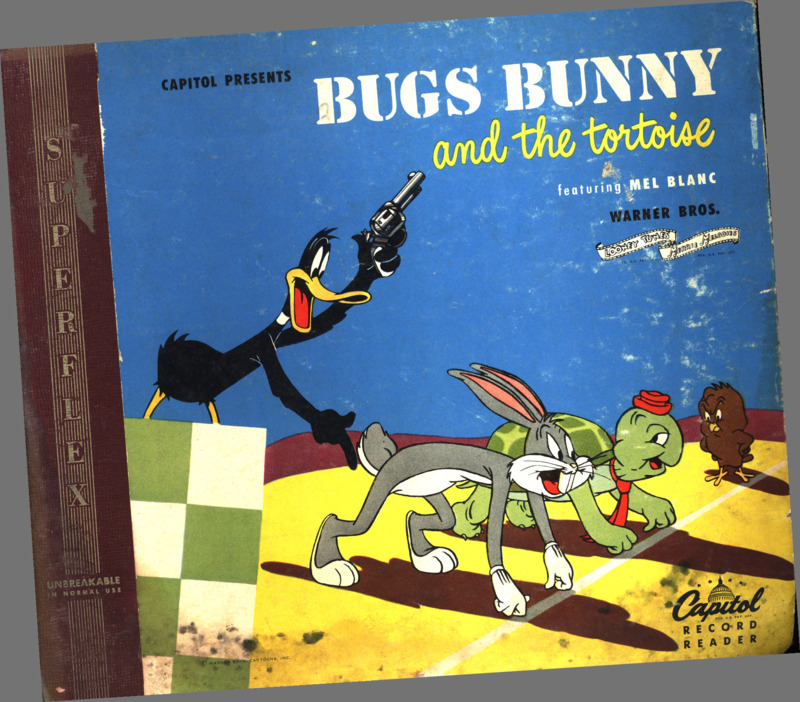
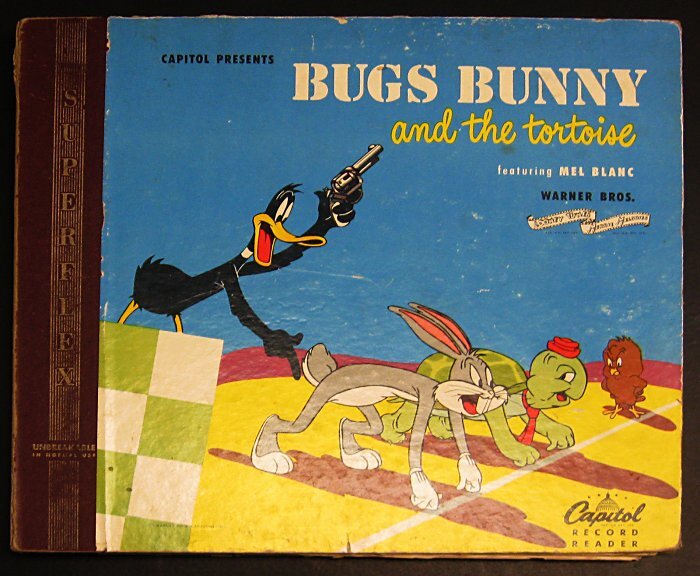
1947? Bugs Bunny and the Tortoise. Mel Blanc. Canvas-bound. Warner Brothers.
I found this album during a chance visit to an antiques store as I walked back to the hotel from a lovely train ride in Duluth. I have remarked in several cases, including Disney and Random House presentations of TH, that the rabbit resembles Bugs Bunny. Well, here is Bugs Bunny himself in Capitol Records and Warner Brothers' "Looney Tunes and Merry Melodies" presenting the famous race. Elmer Fudd is, both visually and on the 78 rpm records, our host and narrator. The book, pasted into the cardboard jacket, has 20 double-sided pages, numbered to allow viewers to see a pair of facing pages with every portion of the two records. Bugs trips over a book of TH. Bugs goes directly to the end of the book to see by how much the hare beat the tortoise. He is angered by the result, even more when a tortoise offers to bet him on a race together. Daffy Duck serves as announcer for the race out and back again. After establishing an early lead, Bugs opines that the hare in the book probably knocked himself out. Bugs tries to avoid that by taking a rest. In the meantime, he puts a young duck into the water even though that duck does not want to get wet. Fun goes further when Bugs passes the tortoise, and the tortoise asks a taxi to follow Bugs. Only the taxi does not take the tortoise with him! Bugs walks into a trap, set for chickens by Henery the Hawk. A carrot farm proves to be Bugs' undoing. His stomach bulges as he sleeps against a tree. When the tortoise comes by, Bugs surprises him with the alarm clock he has set. The tortoise air mails himself by having a couple of air mail stamps slapped onto himself. Bugs wins by an ear. After a close finish, Elmer declares that "Bugs Bunny won by a hare!" Apparently first done in 1947 and republished in 1975. I cannot find any date information on either the printed material or the record. Researching this lovely find led me to finding better preserved copies online, and I have ordered one for the collection.
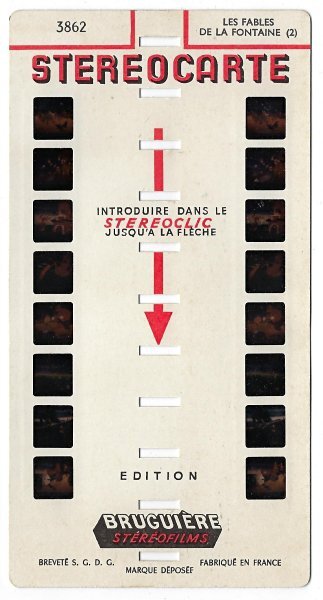
1960? Bruguière Stereocartes. Les Fables de La Fontaine (1) and (2). #3861 and #3862.Paris: Bruguière Stéréofilms. Made in France.
Here are two cards from the fourth format of three dimensional viewers, represented already by stereopticon slides, Lestrade Stéréoscopes, and View Master. I tried in all sorts of ways to view the illustrations themselves, but mostly failed. I was able to establish that they are cartoon-like. I wonder how many La Fontaine Fable stereocartes there were. I learned that Bruguière went through a number of viewing devices. Either their "stereoclic" or these cards were popular in the late 1950's to the late 1960's.
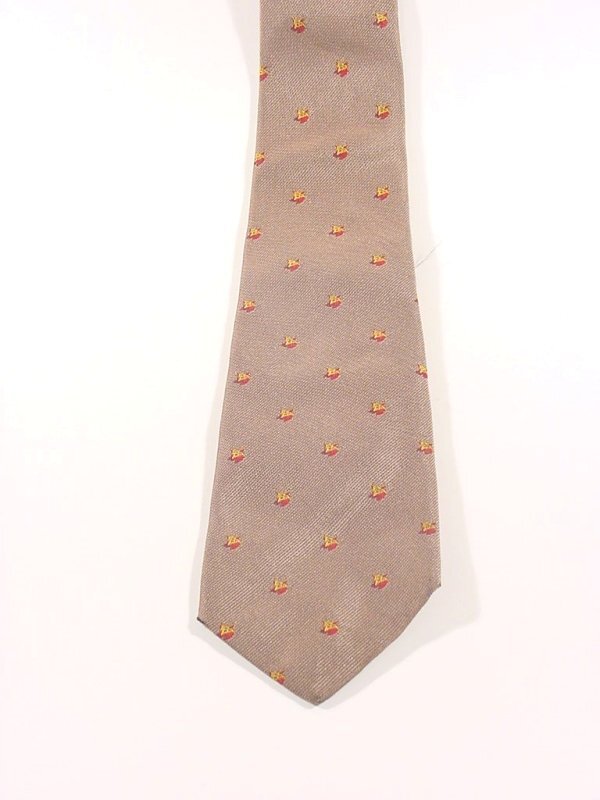
1995? Brooks Brothers tie with a fox holding grapes in his mouth. 65% silk, 35% polyester. Woven in England.
Many tiny gold foxes carry red grapes in their mouths against a taupe background on this foulard tie. Click on either image to see an enlarged version.
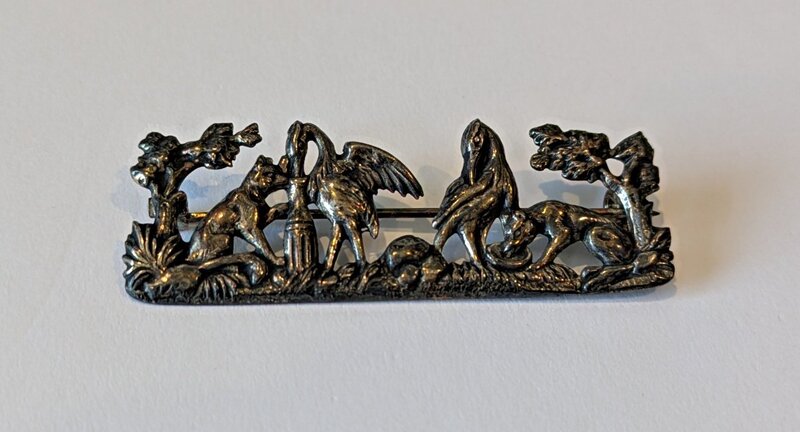
1900? Brooch: FS in Two Scenes. Oxidised silver. 2" long. Unknown source.
This brooch is highly unusual because it presents both scenes of FS. For some reason, the starting scene is on the right. There is a record of another that was available on Etsy.
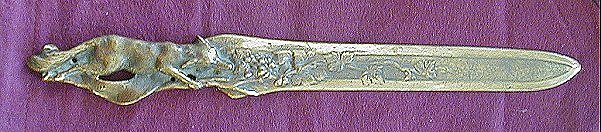
1910? Bronze (?) letter opener 12" long with a maximum width of almost 1½". The handle is a fox; on the blade are the grapes which the fox seeks.
Exquisite metal work! The fox fits the hand perfectly. Dyan comments correctly that this heavy piece is more like a dagger than a letter opener. The fox seems to be clutching the vine as he tries to climb up toward the grapes. I had never seen something like this! A great find! It will be hard to stop using it on my desk.
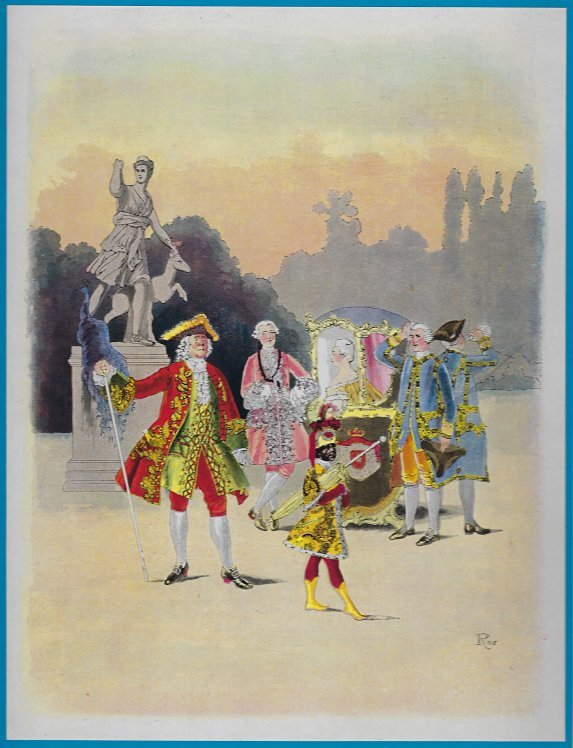
1960? Eighteen reproductions of posters done about 1890 by Maison Quantin. The artists include H. Vogel, Gaston Gélibert, Mangonot, Godefroy, Etienne-Maurice-Firmin Bouisset, (Anatole Paul?) Ray, Job (=Jacques Marie Gaston Onfroy de Breville), and Gustave Fraipont. €10 each from Librairie AMK, Marche Dauphine, Saint-Ouen, June, '19.
These reproductions are well done. The seller estimated the date as 1960. Several things have been removed from the original, including the text of the fable, found generally in a box with the original animal characters, and the artist's signature. The range of these illustrations is fuller than in the larger broadsides, and the illustration "behind" the text box is filled in nicely.
2023 Wolf in Sheep's Clothing. Black and White Print by Brian Serway. $23.81 from Brian Serway Art on Etsy, Dec., '23
Wow! The first startling thing about this strong piece consists in the four empty eyeballs. The second, I would say, is the weird congruence of the bodies. Not pretty!
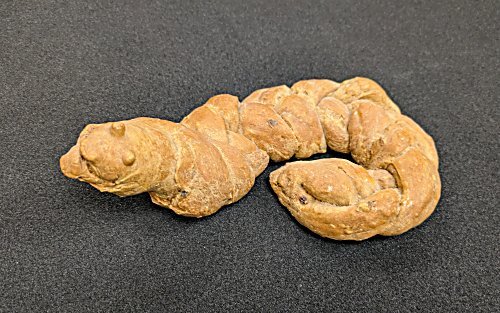
2014? Braided Bread Snake Offering a Rose to Zeus.
Clever creation of a student who went on to oversee a popular Omaha bakery. Mikaela? If only her professor had a better memory for names! Preserved for so many years, I believe, because an outer layer of some sort was applied.
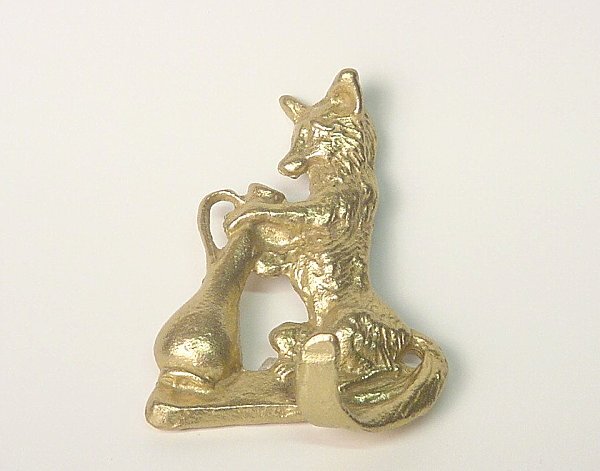
1980? Three pair of brass wall hooks showing the fox looking down into the stork's vase. His raised tail forms the hook protruding more than an inch from the metal fixture. 3¼" x 4¼" high. Through Ebay. Further particulars seem lost!
Here is another great example of Aesop showing up in unexpected places. How many people know what a fox is doing looking down into a vase? Click on the image to see it enlarged.
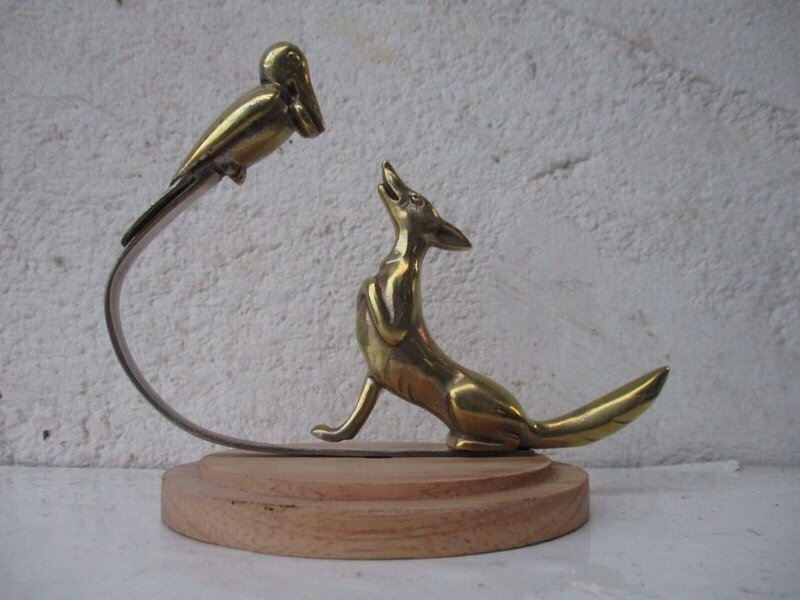
1990? Brass statuette of FC. Wooden base. 4" diameter, 5" height.
Here is another unusual creation! The creator either made or found the two brass figures and matched them with each other by means of a single metal strip. They attend to each other perfectly. Is that a begging stance we see in the fox, with one leg folded over his chest? The swoop of his tail completes the round of this lovely piece!
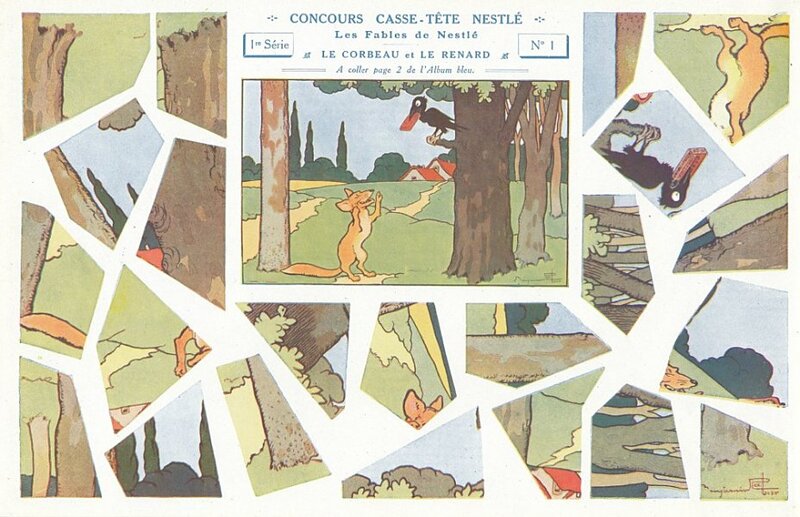
1950? Twelve large (9½" x 6") sets of puzzle pieces to cut out and assemble to make the central picture. "Les Fables de Nestlé." Numbered 1 through 12, with two sheets together in each case. Seven signed by Benjamin Rabier and five (#2 and #4-7) signed by Maurice Toussaint. The signatures may include dates. At least one of Toussaint's seems to be "1919." The title for each page of pieces is "Concours Casse-Tête Nestlé." 1re Série. $144 from Bertrand Cocq, Calonne Ricouart, France, Sept., '18.
This is a curious find! Apparently a child was to study the image from Rabier or Toussaint, cut out the pieces, and put them together. Was there then a competition to see which child had assembled them best? These sheets came apparently in a wrapper entitled "Les Fables de Nestlé," as the title continues, with twelve compositions in colors presented as puzzles. Several of the "fables" here take liberties with their stories. Is that a monkey substituting for Little Red Ridinghood in #10? Of course, Nestlé's products show up delightfully in the illustrations!
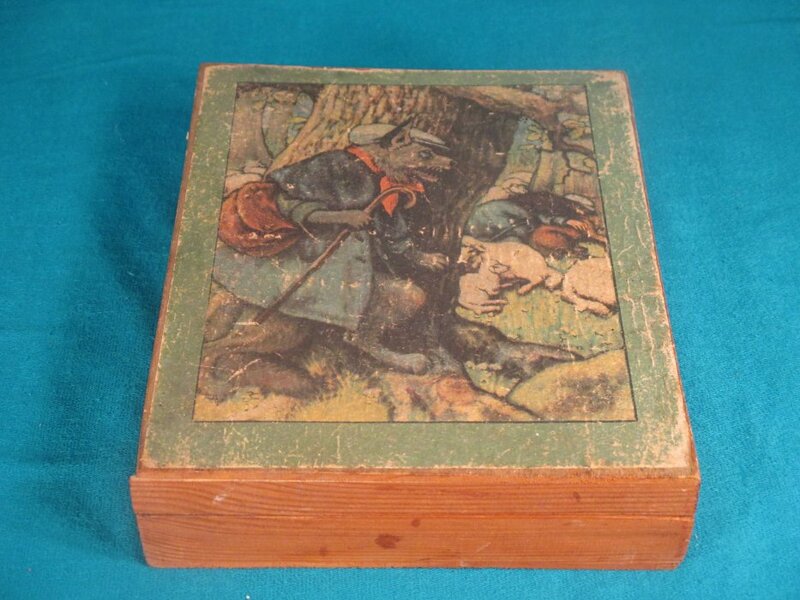
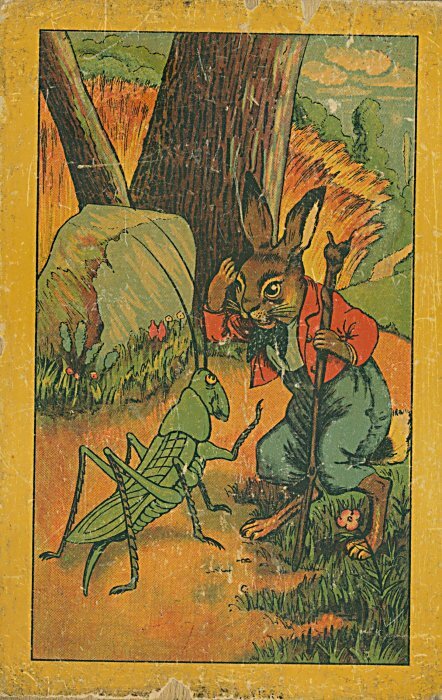
1920? Set of 20 six-sided picture cubes illustrating fables. Slightly larger than 1½" on each cube's side. In the original box? "Wolf in Shepherd's Clothing"; "Horse and Mule"; "The Fox and the Goat"; GA, FS; and an image involving a grasshopper and a rabbit. $34.36 from vali51000 through Ebay, July, '20.
This set of story blocks involves several stories. It makes use of a common set of chromolithographs from the early 20th century. One of the blocks has been extensively redone on one side. One of its images does not immediately bring to my mind a fable: Which fable presents a grasshopper and rabbit? I made a serious mistake concerning this set. Shipments from France cost a great deal these days. I was asking Bertrand Cocq if he would purchase several Ebay.fr offerings for me and send them all together with the many cards he was assembling for me, and he graciously agreed. When his shipment arrived, I missed finding the story blocks I had been looking forward to for many weeks. They were not there. I got in touch with the seller to ask what had happened, and the seller immediately wrote back and asked what had happened to payment and the address to which they were to send! I had mismanaged the deal and was lucky that I could still get this lovely old treasure!
1920? Set of 15 six-sided picture cubes illustrating fables. Slightly larger than 1½" on each cube's side. In the original box? "Wolf in Shepherd's Clothing"; "Horse and Mule"; "The Fox and the Goat"; GA, FS; and an image involving a grasshopper and a rabbit. €35 from choupette-fr through Ebay, March, '24.
This set is particularly fascinating because it is so similar to a set, probably contemporary with it, that features four columns of five blocks, not three columns. The pictures are identical. These sets make use of a common set of chromolithographs from the early 20th century. One of its images, as I mentioned there, raises a question: Which fable presents a grasshopper and rabbit? Shipments from France cost a great deal these days. This was a case in which the shipment cost more than the item.
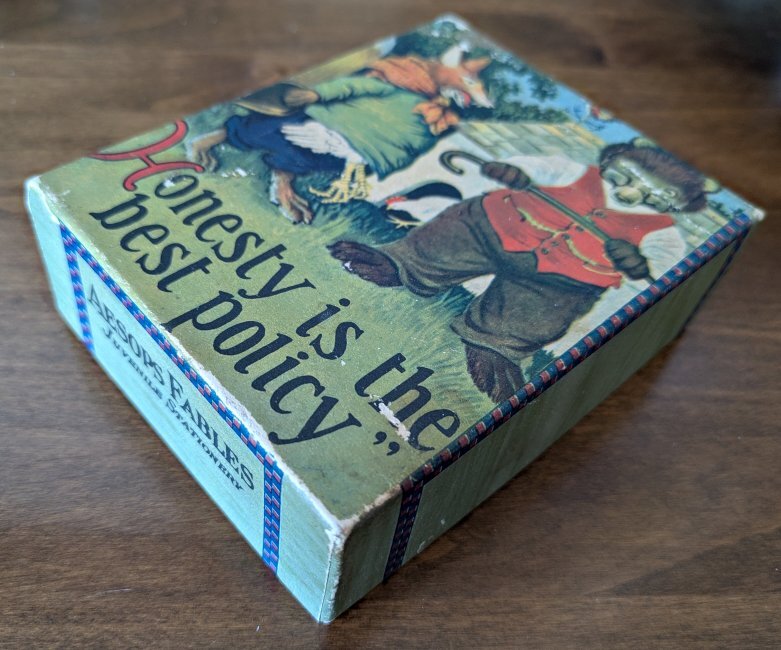
1926 Box of Juvenile Stationery. Copyright B & B (Brown and Bigelow). 4" x 4.75". Two copies, one with stationery still inside. Unknown sources.
The stationery is a single lined folded sheet with an image of Brer Rabbit stealing cabbages, pursued by a farmer. There are also eight miniature envelopes and a cardboard frame filling out the box. The box's cover-image is one that B & B used similarly on an advertising calendar in this collection. There as here, one wonders which fable is intended between the fox and the bear.
2011 Box of Chinese characters with pen and booklet. "Fables Selected Enlightenments for Reading." Ben She. Hubei Children's Publishing House. 5¾" x 6". $6.50 from World Books through Ebay, May, '22.
This set has puzzled me for some time. I can understand some things about it. It offers children a set of some 30 sturdy cards for learning Chinese characters. There is also a sponge-tipped writing instrument. Also inside the box is a 30-page booklet with TH on its cover; this is the same image on the box's cover. As far as I can tell, there are seven stories. None of them seems to be TH or any other fable I know. Strange! I will keep this with printed materials. I would be happy to catalogue the book with other books, but I cannot decipher enough of it!
2011 Box of Chinese characters with pen and booklet. "Fables Selected Enlightenments for Reading." Ben She. Hubei Children's Publishing House. 5¾" x 6". $6.50 from World Books through Ebay, May, '22.
This set has puzzled me for some time. I can understand some things about it. It offers children a set of some 30 sturdy cards for learning Chinese characters. There is also a sponge-tipped writing instrument. Also inside the box is a 30-page booklet with TH on its cover; this is the same image on the box's cover. As far as I can tell, there are seven stories. None of them seems to be TH or any other fable I know. Strange! I will keep this with printed materials. I would be happy to catalogue the book with other books, but I cannot decipher enough of it!
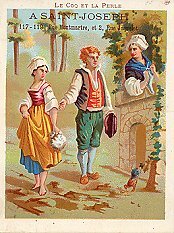
1880? 20 cards (plus 10 extras) with a picture side showing a small animal scene and a larger parallel human scene. 4.5" x 3.5". 7 of the cards are marked "Au Printemps" and were done by Bouillon, Rivoyre et Cie. Dangivillé et Cie, rue de l'Industrie, 17, Paris.
The human scenes are provocative, as when a prince, living out WL, condemns a handcuffed human being to the executioner in the presence of some natives. "Le Lion Amoureux" uses Samson and Delilah for its human scene, just as OR uses David and Goliath. In FG, the amputee on crutches can only look at the beautiful well-dressed woman as he passes by. The text of La Fontaine's fable is on the back side of the "Au Printemps " (AP) and other Bouillon & Rivoyre (BR) cards. Several with " L. Villain " (V) on the picture side feature advertisements for Bon Marché on the back. The other cards tend to feature either advertisements for the sponsors mentioned on the picture side, or they are without a name on the front and blank in back (B). Sponsors include Modes Mercerie a Saint Augustin in Paris (MM), "Aux Armes de Belgique" (AA), "Mon Bonneau" (MB), "A Saint Joseph " (SJ), "Au Chapeau Rouge" (CR), and "De la boutique de Peabody " in Salem (P).. The titles are printed in blue above the illustrations for AP, CR, and BR cards; in red for MM; in black for V and AA; and in brown for blank-backed and the other remaining cards. On the "Au Printemps" cards, the printer has a clever sense about where to insert "Au Printemps" into each picture. Look for it! The artist has likewise been clever in integrating the human and animal scenes into the design. The three cards from Mon Anthoine -G. Broteau" have calendars for 1880 on the verso.