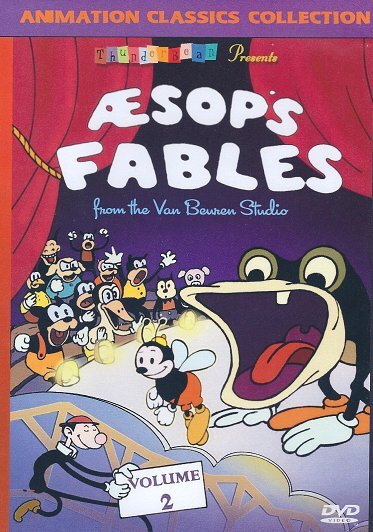
2009 Aesop's Fables from the Van Beuren Studio, Volume 2. Thunderbean Animation. DVD reprint of cartoons from 1928 through 1933.
There are sixteen "Aesop's Fables" cartoons on this DVD. I tried three of them and enjoyed them. They are a curious mix of fantasy, song, dance, and mayhem. My favorite here is "A Toy Town Tale" from 1931. Toys come alive, march around, get into fights, and fall in love. An apparently frequent feature of the cartoons involves imaging animals in their geometric parts and letting them come apart and get back together. At least one cartoon, "Presto Chango" from 1929, does have an Aesopic element: a final saying allegedly from Aesop and supposedly summing up the cartoon. This DVD has some nice additional features, including views of an Aesop's hanky book -- unfortunately without the hanky! -- and an array of buttons, many of which I have collected. Theirs may even be a full display.
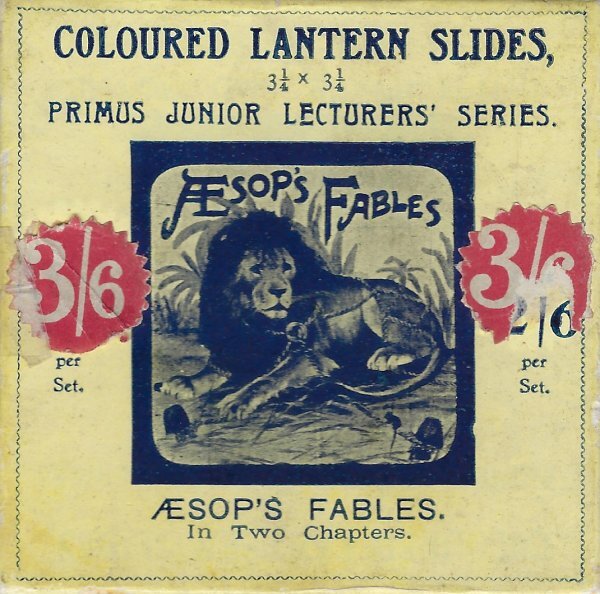
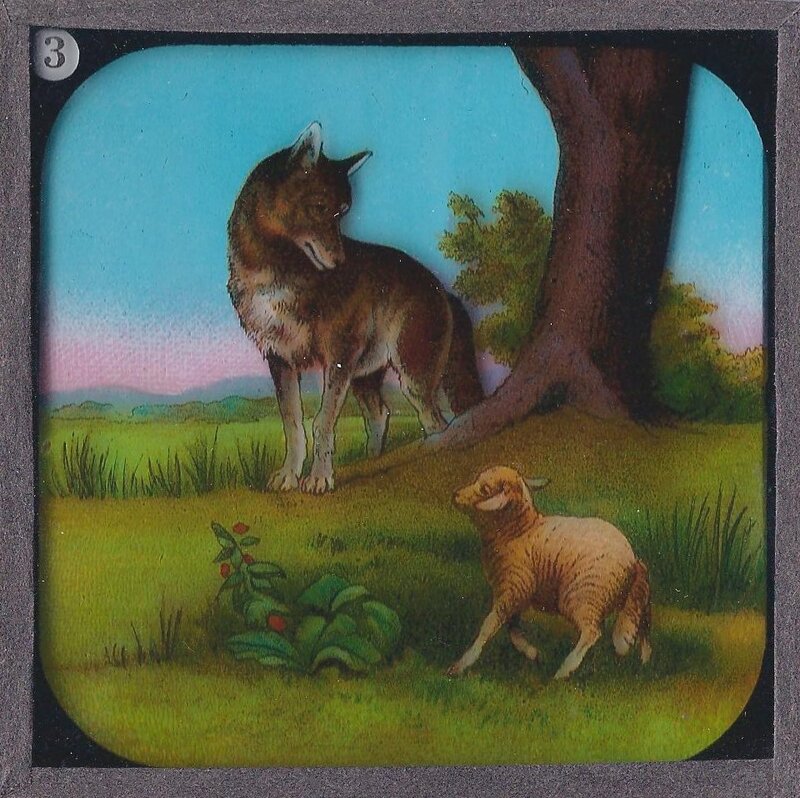
1908? Aesop's Fables from Father Tuck's Story Books. Coloured Lantern Slides. Junior Lecturers' Series. Chapter 2 of 2 Chapters. In the original box. Watford: Tuck. $35.20 from mike3949 on Ebay, July, '21.
Another very lovely set of eight substantial and richly colored slides. The numbered scenes included are given on the T of C on the box's side. I am so happy to get this set to complete the pair of Tuck's Lantern "Coloured Lantern Slides."
1908? Aesop's Fables from Father Tuck's Story Books. Coloured Lantern Slides. Junior Lecturers' Series. Chapter 1 of 2 Chapters. In the original box. Watford: Tuck.
A very lovely set of eight substantial and richly colored slides. The numbered scenes included are: 1. LM (title slide: "Aesop's Fables from Father Tuck's Story Books"), 2. "The Dove and the Crow," 3. WL, 4. DM, 5. "The Fighting Cocks and the Eagle," 6. TH, 7. "The Hares and the Frogs," and 8. "The Quack Frog." I first saw a set of these in a German museum a year ago and wrote asking if any might be for sale. In the meantime, these were offered in London and were even set aside for me without my knowing it! I am already thinking about how best to display these beautiful pictures....
2008 Aesop's Fables for Children. Dover "Listen and Read" CD. Included in the book of the same name, illustrated by Milo Winter. Mineola, NY: Dover Pictorial Archive Series: Dover Publications. $10.39 from Amazon.com, Feb., '10.
This CD accompanies the fine reprint of the classic The Aesop for Children published in 1919 by Rand McNally. I am delighted to see that Dover is reprinting this book and doing it so well! I have long recommended that people try Border's or Barnes and Noble for one of their reprint editions. This may be an even better bet because of the quality of the illustration-printing and because of the CD. I will keep the CD with the book.
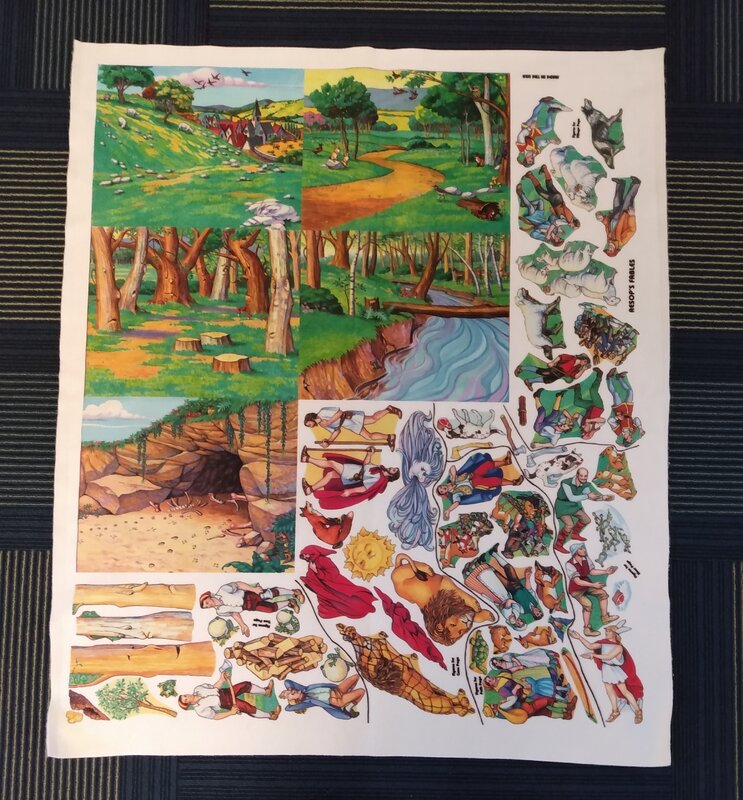
1995? Aesop's Fables Felt Activity Book cloth. Uncut. 37½" x 30½". Made in the USA. Salem, Utah: The Story Teller.
Somewhere along the way I acquired the whole felt single unit from which scenes and characters are taken.
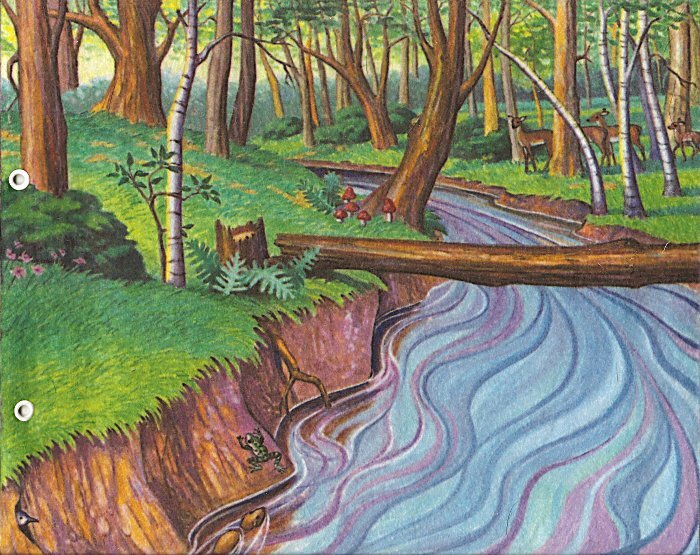
1995? Aesop's Fables Felt Activity Book. Made in the USA. Salem, Utah: The Story Teller. $10.95 from Jody Sumner, Towaco, NJ, April, '08. Here is an already constructed version of what I had earlier found as an assemblage of materials. Let me adapt and repeat some of my comments from that listing. This is a felt book with five pages. Each page is the scene for three different fables. Fifty-seven characters are supplied, ready to be stuck onto the scene in the appropriate places and otherwise to be stored in a pocket on the back of the page. The pocket lists a handy moral for each fable. The village scene includes BW, "A Man and His Sons," and "The Wolf in Sheep's Clothing." The river scene has "Mercury and the Woodsman," "The Hares and the Frogs," and DS. The path is the scene for TH; "The Birds, the Beasts and the Bat"; and "The Boasting Traveller." Into the cave one can put LM, "The Sick Lion," and SW. Finally among the trees we find OF, "The Miser," and "The Trees and the Ax."
1995? Aesop's Fables Felt Activity Book. Made in the USA. Salem, Utah: The Story Teller.
I found and ordered this curiosity at a craft fair in Sonoma County. The materials are here to construct a felt book with five pages. Each page is the scene for three different fables. Fifty-seven characters are supplied, ready to be stuck onto the scene in the appropriate places and otherwise to be stored in a pocket on the back of the page. The pocket lists a handy moral for each fable. The village scene includes BW, "A Man and His Sons," and "The Wolf in Sheep's Clothing." The river scene has "Mercury and the Woodsman," "The Hares and the Frogs," and DS. The path is the scene for TH; "The Birds, the Beasts and the Bat"; and "The Boasting Traveller." Into the cave one can put LM, "The Sick Lion," and SW. Finally among the trees we find OF, "The Miser," and "The Trees and the Ax."
1998 Aesop's Fables 1999 Calendar. Arthur Rackham, Milo Winter, Charles Folkard, and Charles Henry Bennet (sic: Bennett). Printed in Hong Kong. NY: Dorset Press. Gift of Margaret Carlson Lytton, Nov., '98. Extra copies a gift of Julie Stringer, Feb., '99 and for $5.98 from Barnes and Noble, Milwaukee, Dec., '98.
Each month presents a full-page picture. The page hanging below it includes within the grid of the month's days a title, moral, attribution of the picture, and text of the fable. The selections are, in order: "Venus and the Cat" (Rackham), "Jupiter, the Lion, and the Elephant" (Rackham), "The Cat, the Rooster, and the Young Mouse" (Winter), "The Fox and the Monkey" (Folkard), "TH" (Folkard), OF--but without any mention of an ox!--(Folkard), GA (Bennet[sic: Bennett]), LM (Winter), "The Owl and the Grasshopper" (Folkard), "The Satyr and the Man" (Folkard), "The Trees and the Axe" (Rackham), and TMCM (Folkard). All twelve illustrations are arranged on the back cover.
2005 Aesop's Fables 1-2. Xi'an, China: Open Your Ears: Xi'an Jiaotong University Press.
This is one of two audio-cassettes accompanying a book of the same name. Apparently each of the four sides contains about ten fables. of the forty-one fables in the book. The book enhances each English text with vocabulary, translations, and "listening points." The cassettes present, after some opening Chinese, a reading of each of the fables with its listening points. These idiomatic phrases may be the strongest point of these tapes and of this combined publication. The tapes feature good native American speakers. I see some references to 2008 on the verso of the title-page, but I will trust the eBay seller's statement that the book was published in 2005 and that this is a copy of its first edition. All of the information on the cassettes except their numbers 1a, 1b, 2a, and 2b is in Chinese. There is a "3" on each side of each cassette; perhaps Aesop's Fables is the third book in the series "Open Your Ears."
2005 Aesop's Fables 3-4. Xi'an, China: Open Your Ears: Xi'an Jiaotong University Press. $3 from peiyantu, Hangzhou, China, through eBay, Sept., '11.
This is one of two audio-cassettes accompanying a book of the same name. Apparently each of the four sides contains about ten fables. of the forty-one fables in the book. The book enhances each English text with vocabulary, translations, and "listening points." The cassettes present, after some opening Chinese, a reading of each of the fables with its listening points. These idiomatic phrases may be the strongest point of these tapes and of this combined publication. The tapes feature good native American speakers. I see some references to 2008 on the verso of the title-page, but I will trust the eBay seller's statement that the book was published in 2005 and that this is a copy of its first edition. All of the information on the cassettes except their numbers 1a, 1b, 2a, and 2b is in Chinese. There is a "3" on each side of each cassette; perhaps Aesop's Fables is the third book in the series "Open Your Ears."
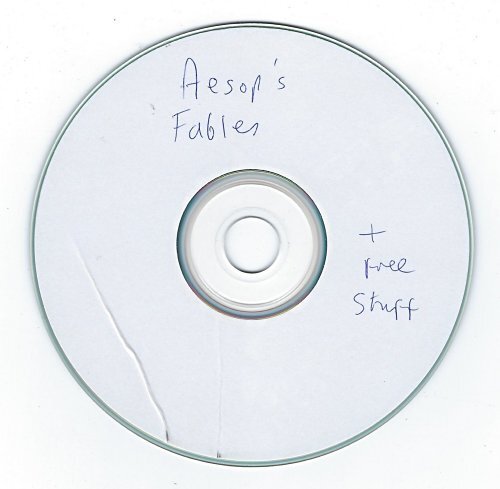
2003? Aesop's Fables + free stuff. DVD? Teaching aids including tests concerning 15 fables and the correct answers. Also a word document offering 91 pages of digitized fables from a standard source. Unknown source.
Here is a surprising assortment of teaching helps from letter forms antonyms to all sorts of word games and tests. I believe I have seen, somewhere in our collection, the same digitized 91 Word document pages of standard fables, including a short introduction quoting four lines of Latin. The pdf files on fables are doublets of each other: one a fill-in-the-blank quiz on one of the fifteen fables, and the other the appropriate answers. We can say to Aesop with Dr. Seuss "My, the places you will go!"
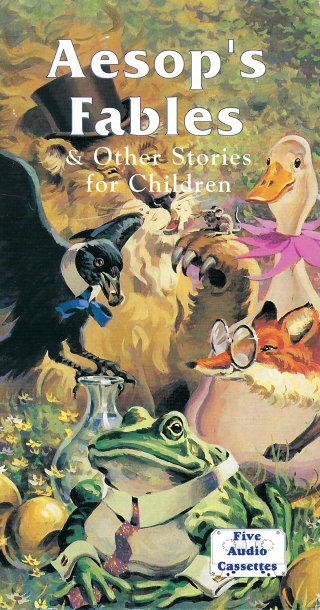
1993 Aesop's Fables & Other Stories for Children. Five Audio Cassettes. Newport Classics Library. Laguna Niguel, CA: Newport Publishers.
"Aesop's Fables" is the first of five cassettes. The others are "Snow White/Sleeping Beauty," "Nursery Rhymes," "Sense and Nonsense," and "Fiction and Fantasy." The fable cassette seems to run about fifteen minutes on each side. There is a short introduction to Aesop and fable. Each fable has an announced title and moral. The strength of the fable presentations here lies in two facets. First, there is fine musical accompaniment throughout, including a short orchestral climax after each moral. The second feature is surprising: the speakers use a variety of accents, including mock German, Hispanic, Italian, Eastern European, and Southern United States. The versions chosen are sometimes weak. The mouse, e.g., "happens by" the lion captured in a net. The audio quality is unfortunately less than excellent.