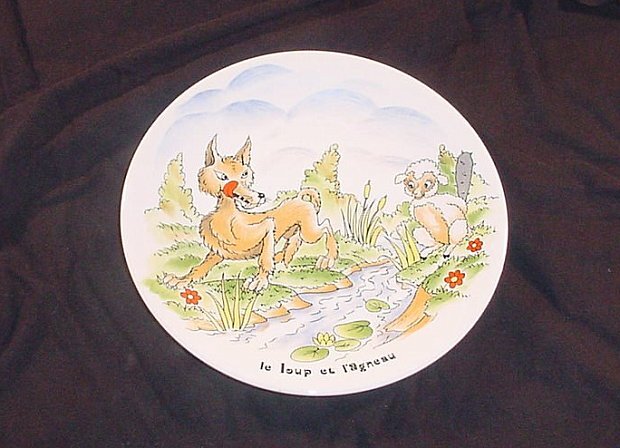
Le Loup et l'agneau Like the other plates, this presentation presumes that a viewer knows the standard story. Then the plate can present a surprise. The surprise here is that the lamb is waiting for the wolf with a big club behind his wolly little back.
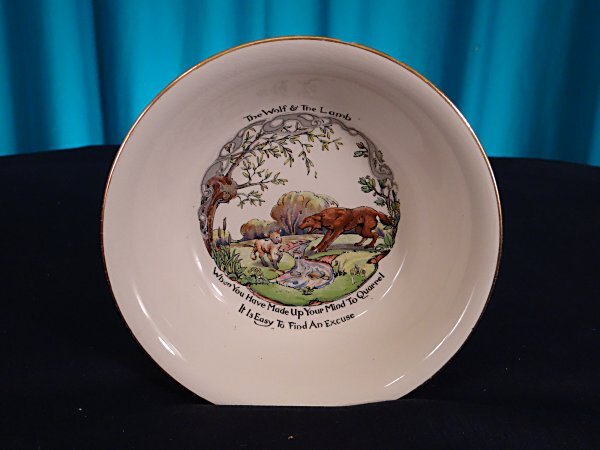
1920? Hand-painted bowl 6¾" in diameter and 1¾" deep. Title "The Wolf and the Lamb" above the hand-painted colored illustration, and "When You Have Made Up Your Mind To Quarrel/It Is Easy To Find An Excuse" below. Gold trim around the outside edge of the top ring. Aesop's Fables Series. Royal Winton, Grimwades. Made in England. $25 from an unknown source, about 2005.
The depiction of WL is consistent with the depiction on other members of this Royal Winton series.
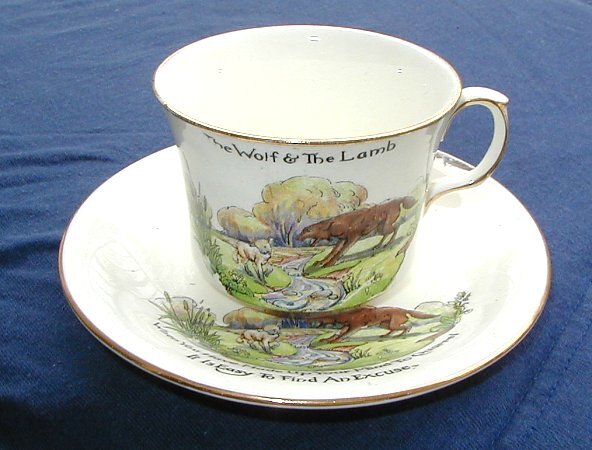
1920? Cup and saucer. Title "The Wolf & The Lamb." "When You Have Made Up Your Mind To Quarrel/It Is Easy To Find An Excuse" around the rim of the saucer. Similar hand-painted illustrations of lamb, river, and wolf on each. Gold trim around the handle and the edges of both cup and saucer. Evergreens (?), cones (?), and silver swirl patterns on the non-picture sides of both pieces. Aesop's Fables Series. Royal Winton, Grimwades. Made in England. $22 from Tamy Treso, Redvers, Saskatchewan, through Ebay, Feb., '00.
As with the two bowls, the strength here of Royal Winton lies in its lovely colors. The pastels in the river make it almost psychedelic! Both pieces have a golden "A" as an additional mark on the bottom. Click on the image for a larger version.
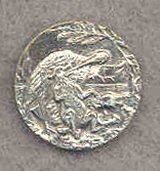
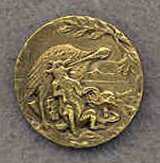
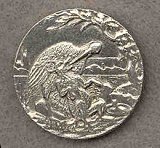
1890? 1 silver WC button, .6" in diameter. Paris: Solidaire Bte SGDG, A P & Cie, Paris.
Identical with the bronze button described just above. Might this button be slightly larger than that? The silver buttons in this series are harder to read than the bronze.
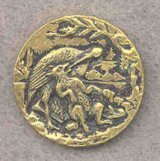
1890? 1 bronze WC button, .6" in diameter. Paris: Solidaire Bte SGDG, A P & Cie, Paris.
Clearly the same scene as the larger Gotbuttons and Goldbarg versions of WC. Thus it is also developed from J.J. Grandville's illustration. The doctor's pan is not so easy to identify here. The stance of the figures is that of Grandville's illustration. The stamped metallic front again seems to have been folded over the back with a self-shank surrounded by the manufacturer information quoted above.
1890? 1 bronze WC button, 7/8" in diameter. Paris: Solidaire Bte SGDG, A P & Cie, Paris.
The same in motif motif as the Gotbuttons larger button with these differences: this is brass, smaller, and marked with "Solidaire Bte SGDG" rather than "Breveté" on the back. The metal of this button shows less relief than that of others I have, and the button is thus considerably brighter. This button has the same construction as that, including the self-shank. This specimen seems to be that presented as #11 on Plate 152 of BBB.
1890? 1 two-piece silver WC button, 1 1/16" in diameter. A P & Cie Breveté, Paris.
Developed from J.J. Grandville's illustration, I believe, because the doctor's pan is visible near the wolf's back paw. The stance of the figures is that of Grandville's illustration. This and the following three buttons from the same manufacturer are remarkably similar despite their different colors and sizes. The stamped metallic front seems to have been folded over the back, which is lifted at its center to form a tunnel-hole, where others have an implanted hook or circle. BBB calls this a "self-shank" (371). Around this raised mound one can read the manufacturer information quoted above.
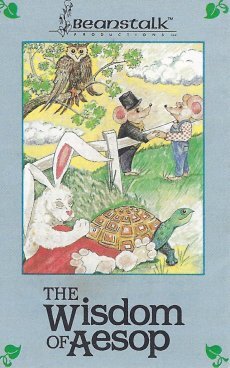
Produced and adapted by John Hohmann. Designed by Janet Albrecht. Illustrations by Dominick Giustino. Storytelling by Carl Grapentine. NY: Beanstalk Productions.
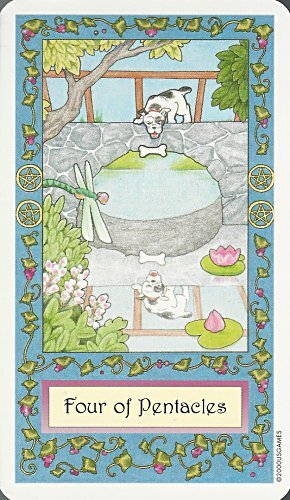
2000 The Whimsical Tarot. Boxed. Illustrated by Mary Hanson Roberts. Created by Dorothy Morrison. Deck printed in Belgium. Booklet printed in the USA. Stamford, CT: U.S. Games Systems, Inc. August, '10.
Four cards in this 78-card deck mixing fairy tales and tarot figures present fables: "Four of Pentacles" presents DS. "Two of Rods" presents LM. "Four of Cups" presents "The Emperor's Clothes." And "Five of Rods" presents "The Tarbaby."
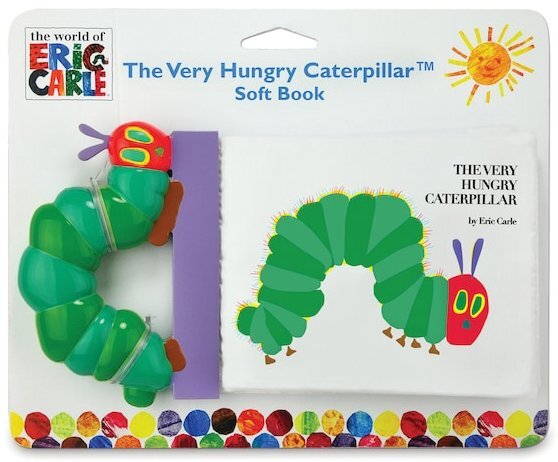
2011 The Very Hungry Caterpillar. Eric Carle. Softbook with caterpillar handle. $4.95 from Black Swan Books, Oakland, Dec., '19.
Here is a book of eight pages that counts its way through the caterpillar's meals until, on the last page, one finds "beautiful butterfly." I am not sure that this is the text of Carle's original fable, which, I gather, has become justly famous. It has stimulated a variety of copies and versions. Here is one of the more surprising versions! The first page even rustles and crinkles!