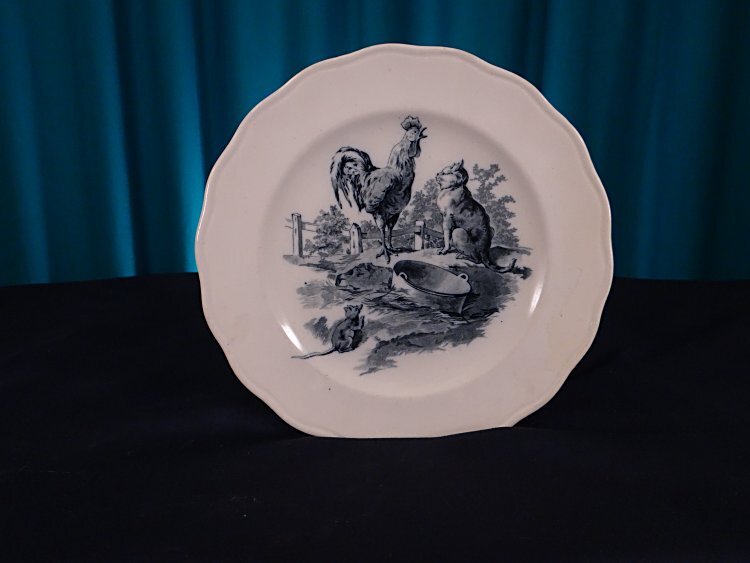
1890? A cream-colored plate over 9" in diameter with a 6" black-and-white circular design at its center presenting "The Mouse, the Rooster, and the Cat." The back of the plate shows a number of registry marks, the clearest an ink stamp working down from a crown through a circle surrounding a coat of arms with "BWM & Co" across it and "Fables" underneath it. Other marks include an indented sign surrounding a large "R" and an indented name, apparently Brown-Westhead. Well repaired edge from about 2:00 to 4:00. Hanley, Staffordshire: Brown-Westhead, Moore and Company (in existence from 1861 to 1904). $35 from Mary Ellen Kennedy, Larchmont, NY through Ebay, Dec., '99.
Perhaps the loveliest plate I have. High quality artistry throughout. Especially attractive is the attentive pose of the mouse in the foreground. The two characters he looks at present just what the fable wants from them: aggressive crowing from the rooster and welcoming, quiet fuzziness from the cat. Watch out, young mouse!
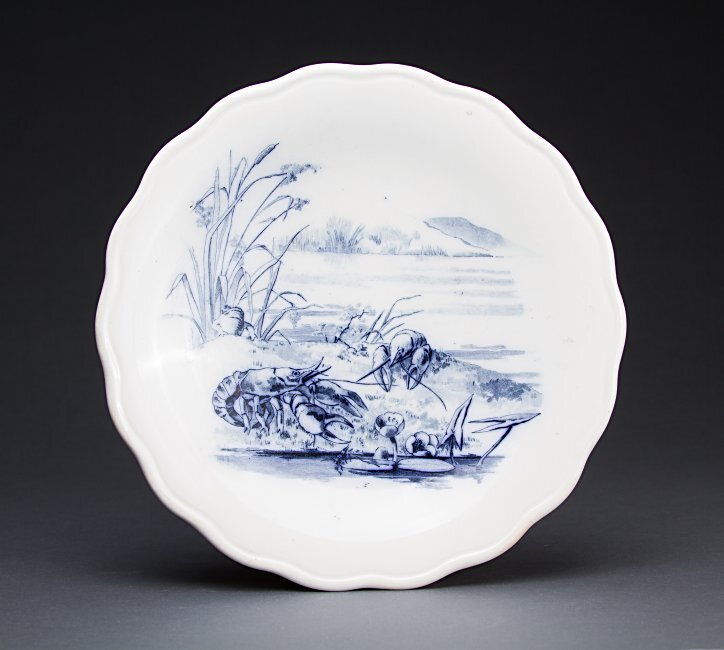
1890? A cream-colored cake serving plate 9¼" in diameter with a 6½" blue-and-white circular design at its center presenting "The Lobster and her Mother." 5½" high. The bottom of the dish has the "Brown, Westhead, Moore and Company Fables" logo and two other marks: either "6" or "9" and a red and blue mark.
A frog looks on as the mother supposedly shows her child how to walk straight. I am not sure what this fable might have to do with the serving of cake! Over half of the design on the top surface of this serving plate is open space, pond, and reeds. Around the base are two designs, apparently independent of each other: two birds on a branch and a rabbit.
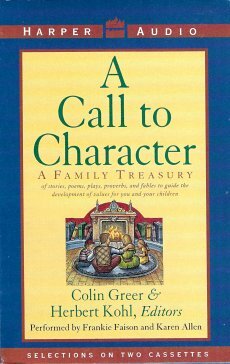
1995 A Call to Character Tape One: A Family Treasury of stories, poems, plays, proverbs, and fables to guide the development of values for you and your children. Colin Greer & Herbert Kohl, editors. Performed by Frankie Faison and Karen Allen. Made in USA. NY: Harper Audio: HarperCollins Publishers.
See my comments on the book of the same title and year, from which these selections are taken. I was disappointed that only a few fable materials are taken: on this first tape only the morals from student fables collected by Kohl (34; e.g. "Better to be old than bold!") and two other short materials on the second tape. The tape itself made delightful listening as I drove across Nebraska to attend Sarah FitzSimmons' wedding! The selections represent a noble effort to engage parents and their children in the discussion of values well depicted in classic literature. The tape may include a little too much preaching outside the literature itself. Still, it was a pleasure to hear!
1995 A Call to Character Tape Two: A Family Treasury of stories, poems, plays, proverbs, and fables to guide the development of values for you and your children. Colin Greer & Herbert Kohl, editors. Performed by Frankie Faison and Karen Allen. Made in USA. NY: Harper Audio: HarperCollins Publishers. $3.99 from Book Express Online through Bibliofind, August, '97.
See my comments both on the book of the same title and year, from which these selections are taken, and on Tape One. I was disappointed that only a few fable materials are taken: one selection on the first tape and two short materials here: Aesop's "The Lion and the Boar" (269) retold by Ann McGovern and, in the section on responsibility, "Fable" reported as anonymous (333). This latter is really Perry #36 with an oracle instead of the old man here asked whether what two young people hold in their hands is dead or alive.
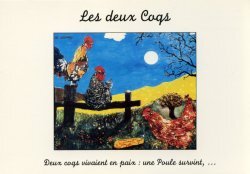
2002? Au pays de la Fontaine. Seventeen card series of oil paintings on cloth by A.C. Bertrand disseminated on postcards. Chateau Thierry: Imprimerie Harvich. €3 apiece at St. Ouen, August, '113. Extras of #4, 10, and 11 for €3 apiece from Témoignage d'Images, Paris, at the Paris Post Card Exhibition, Jan., '05.
The color schemes are strong here. Each of the paintings seems to suppose knowledge of the fable; it would be hard to deduce the fable from the rather static picture. Each card (except for CJ) gives a title above its painted picture and a key line below it.
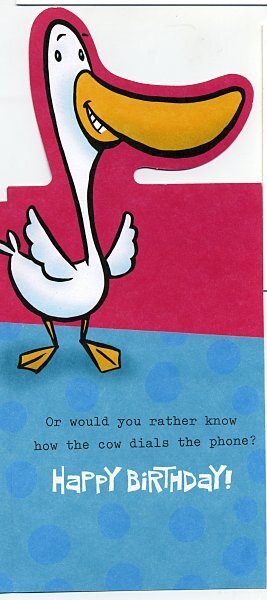
2005? Birthday card: "A Birthday Fable." Hallmark. Envelope included. Unknown source.
The front side of this card tells a story about a rowdy birthday party among ducks. Cows in a neighboring barn called the police. The front of the card asks "Would youlike to know the moral of this story?" The inside of the card then asks "Or would you rather know how the cow dials the phone?"
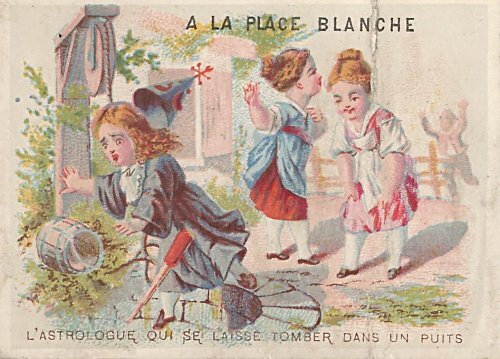
1890? 8 cards with full-color images of children acting out La Fontaine's fables. Just over 2½" x 3½".
These cards present some of the same scenes found in the "Dépot Central" set. Advertisers include A la Place Blanche, Maison Pigeon-Fernet, Grande Maison de Lingerie G. Bignou, A la Mère de Famille, Fil au Dragon, Au Marche Menilmontant. Printers acknowledged include Bouillon, Rivoyre et Cie and Leroy Sécail et Cie.
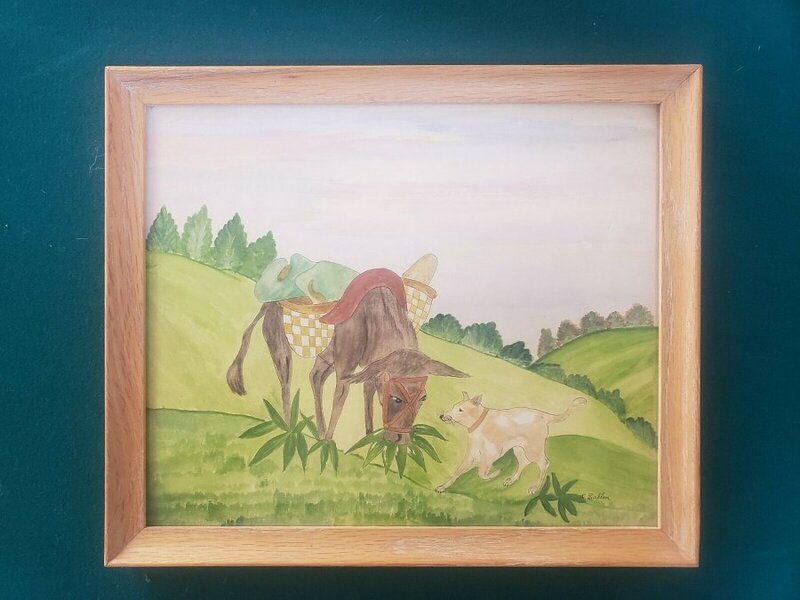
1965? 7 original watercolor paintings of Aesop’s fables by LouLette Sablon (1897-1970), framed and signed. Each 11" x 13". $45 for the lot from Merchant of Denim through Ebay, July, ’21.
It was hard for me to believe that the whole lot of originals was selling for this low price. I find these watercolors lovely! LouLette Sablon was born on July 16, 1897 in France. She was an actress, known for To Catch a Thief (1955), Around the World in Eighty Days (1956) and Gentlemen Prefer Blondes (1953). She died on October 21, 1970 in Los Angeles County, California, USA.I bet that she would have said that she was painting not Aesop but La Fontaine.
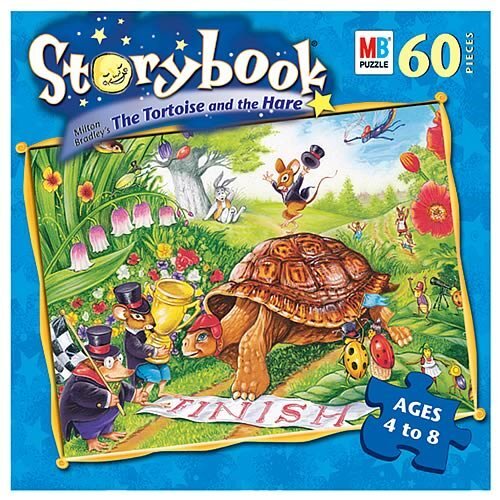
2002 60-Piece TH Puzzle. Storybook. Hasbro: Milton Bradley. Ages 4-8. 10" x 13". Box sealed by manufacturer to prevent lost pieces. When and where?
In this artist's conception, the hare is just awakening under a tree as the tortoise -- with his old football helmet? -- is reaching the finish line. There a mouse has a golden trophy cup to give him.
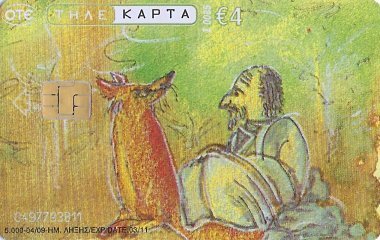
2010 6 Greek telephone cards, each worth €4, each with a fable illustration and a fable text on the verso, out of an apparent set of 12.
Of course the collector in me wants to find the other six cards. I include the individual numbers here. The set apparently runs from S0085 through S0096.
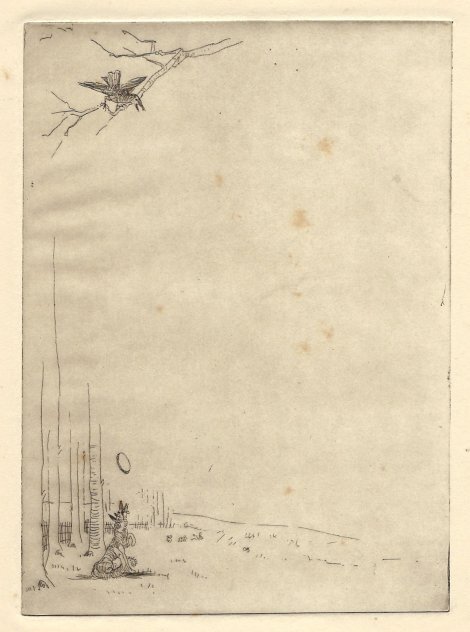
1975? 6 Eaux fortes etchings by Daniel Rouvière: "Les fables de La Fontaine." Each matted with a resulting space of 4½" x 6½". €80 from matbooks through Ebay, Sept., '23.
Daniel Rouvière (1913-1985) seems to have done etchings like these and oil paintings. FG is signed, apparently with a signature meant to cover the whole group. There are two versions of FC among the six. I would say that something like "dimensionality" marks this set of etchings: each works with the space between two characters or two scenes. The work within the limited space given to either of the two in any case is exceedingly fine. FG and TH include a snippet of text from La Fontaine. My favorite in the group is probably FS, since it contrasts two scenes. The distancing is particularly effective in FG.
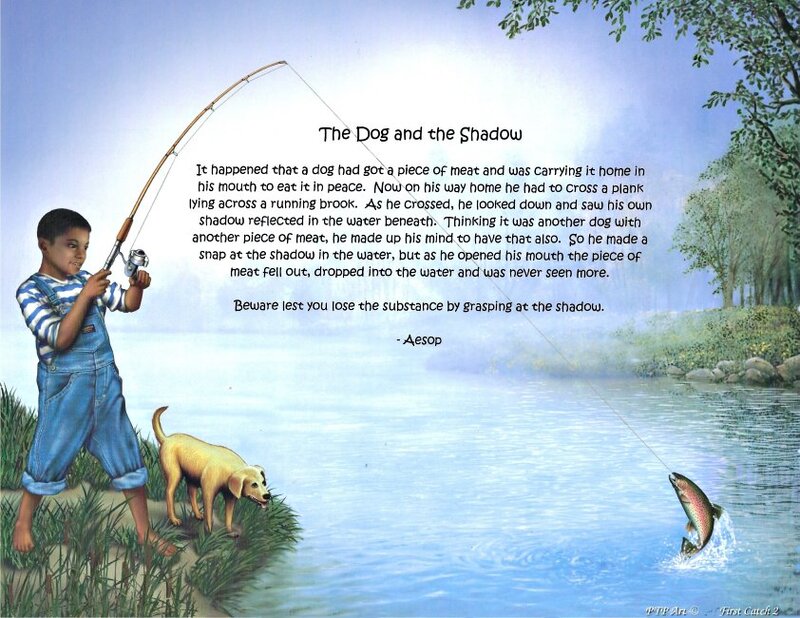
2015? 5 heavy-paper “PTP Art” art prints of fables. Unknown source. One extra copy of DS.
These are a mystery to me in summer of 2025. They are nicely printed on heavy stock. LM and DS are particularly colorful. Nowhere on the web can I find these pictures used with Aesop’s fables, and all five that we have are characterized as from Aesop. Two image backgrounds, DS and “Ant and Chrysalis,” are featured now by Personal Touch Products, but with different texts. Several are offered in different forms on Etsy. Might someone have used PTP backgrounds, some of which have been discontinued, and added fables to them?
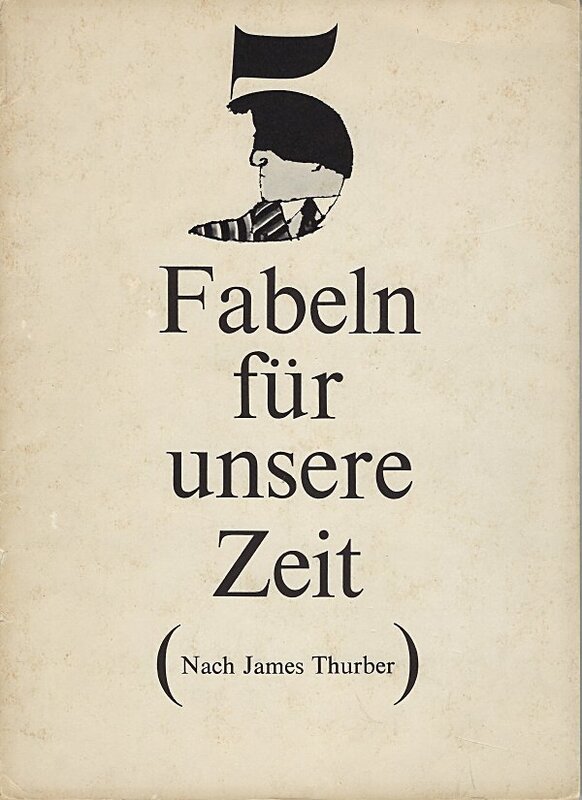
1960? 5 Fabeln für unsere Zeit (Nach James Thurber). Aus dem Englischen übertragen von Marlies Müller. Illustriert von Felix Müller. Loose in a portfolio. Bremen: Otto Behrens. €16 from Versandantiquariat Kerstin Daras, Düsseldorf, July, '18.
"Druck für den Freundeskreis der Bremer Kunstschiule." This is a folio of five 8¼" x 11¾" singlefolds. Each has a title on the front page, a text on the left-hand page, and a full-page print on the right-hand page. The illustrations are striking. Sometimes the German has to bend a little to try to meet Thurber. Thurber's owl story is particularly challenging. Two moles tried to slip quietly by, unnoticed. "You!" said the owl. "Who?" they responded. "You two" came the answer. The German resorts to the clever "You and you." The crazy questions that are soon asked of this divine figure change to equally crazy questions in German. I will also list this work among prints, with visuals for each piece. Do not miss the clever "5" on the cover. The two copies available on the web have no more idea than I do when this lovely piece was produced.-
2004 4 China Telecom Telephone Cards featuring the Tortoise and the Hare. 2004-47-(4-1)SX, 2004-47-(4-2)SX, 2004-47-(4-3)SX, and 2004-47-(4-4)SX.
Credit card size, these four plastic cards picture a moment before the start of the TH race, the start, the sleeping rabbit, and the tortoise's victory celebration. The first two cards seem to be worth 30 yen and the last two 50 yuan. The ID numbers have been scratched open; the cards have presumably been used! I thought I had exhausted the categories of uses of fables! No way!
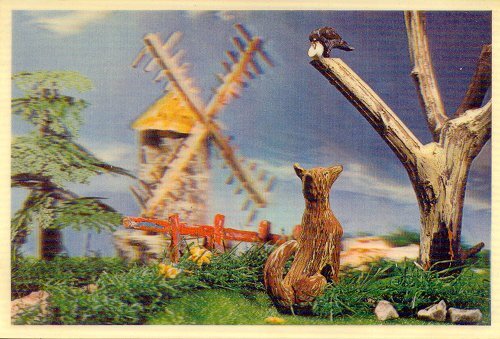
1960? Three-dimensional photograph postcard of FC. Carte Relief, MD, Paris. Xograph-Grafa. Ptd. USA. €5 from Témoignage d'Images, Paris, at the Paris Post Card Exhibition, Jan., '05.
A three-dimensional image like that of FC on this postcard is not, in my experience, computer-friendly. This image has a very well posed clay figurine waiting beneath the crow. In the background are a windmill, a red fence, and some trees. I do believe that this card is the first three-dimensional card in the collection.