1985? 6 hand-painted animation cells from Filmation for “The Tortoise and the Hare.”
I have searched but not yet found the Filmation cartoon in which these cells were included. There is a researcher’s project for the future! It is sometimes hard to picture how this single “cell” picture would be included in a motion-picture cartoon. If you look closely, you can see the movable overlay on the colored background. There is very nice work with color here!
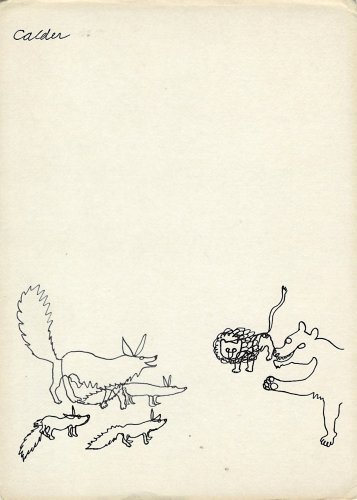
1981 Postcard of "A Lyoness and a Fox" by Alexander Calder from his 1931 "Fables of Aesop." Whitney Museum of American Art. $5.01 from HipPostcard, March, '23.
I am not even sure that this is a postcard, but it is the usual Calder fun of x-ray vision and surprising situations! This tale is provoked by mothers comparing how many children they produce at a time. After hearing their numbers, the lioness answers "I only bear one, but he's a lion!"
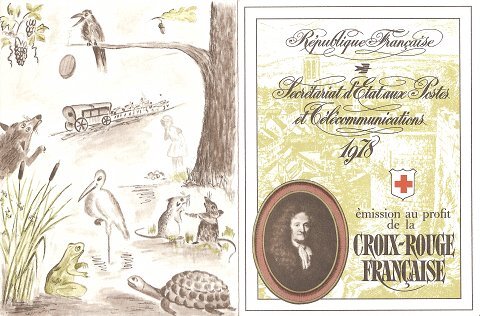
1978 Booklet enclosing four each of the 1978 Red Cross stamps of TH and TMCM. About 3" x 4". £.99 from Brian Chilton, Nairn, Highland, Scotland, through eBay, Oct., '06.
The front cover of this little booklet mixes red, green, brown, and black. The green background may be Paris in La Fontaine's time. There is a cameo bust of La Fontaine in the lower left. The script reads "République Française: Secretariat d'Etat aux Postes et Télécommunications 1978: émission au profit de la Croix-Rouge Française." The center presents a quadrant of four of either stamp postmarked Strassbourg, December 11, 1978. The back page is a monochrome mélange of several fables, perhaps FC, TMCM, MM, FK, TH and "The Heron." Click on any stamp to see a larger version of both stamps. Creating the larger version helped me to discover that both stamps are signed "Andreotto."
1978 "Série 'Croix-Rouge,' Fables de la Fontaine." French First Day Cover commemorative panel celebrating the Fables of La Fontaine and displaying the newly issued stamps of TH and TMCM. 6½" x 9". 2 Decembre 1978. No. 334. $5 from Lois Marchat, Villeurbanne, France, through eBay, August, '05.
This unusual card pictures La Fontaine and five of his most famous fables. There is then a presentation of his life and work along with judgments on the work. The artist's signature, difficult to read, is something like "F.L."
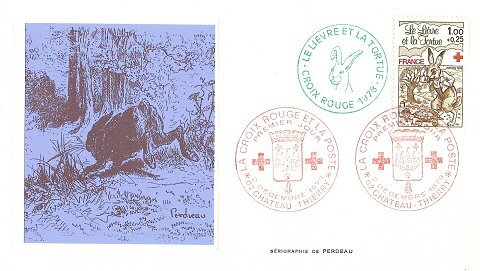
1978 Four French First Day Cover folded papers with screen prints, plus duplicates of two. Two serigraphs are of TH and two of TMCM. The rabbit image is by Perdeau, the tortoise image by Lavidiasse, the salmon colored of TMCM by Berthou, and the golden by Naxos. Cancelled December 2, 1978 in Chateau-Thierry. "Numérotation et Cotation sur Catalogue Thiaude." $12 from Topical Paradise through ebay, April, '12. Extra pair for $4 each from Loic Marchat, Villeurbanne, France, through eBay, Oct., '05.
I am still trying to figure out just what this folded paper is. Whatever it is, it is exquisitely done! A heavy sheet about 8" x 13" is folded into a nine-rectangle packet measuring about 3¾" x 6½". The left half of the resulting front shows the serigraph surrounded by a raised ridge; on the right one sees the stamp, two or three cancellation marks, and an identification of the author (e.g. "Sérigraphie de Lavidiasse"). The Perdeau front adds a green stamp showing a hare to the two cancellations from the standard red stamp; the Lavidiasse front has only these two. Similarly, there is an added TMCM cancellation on the Berthou paper. The verso of either includes an embossed seal, a comment on the visual artist, and a longer comment on La Fontaine's achievement. I seem to be able to make out a "TH" inside the embossed seal on the verso; might that be for Thiaude?Perdeau's comment has the unfortunate typo "plaisr."
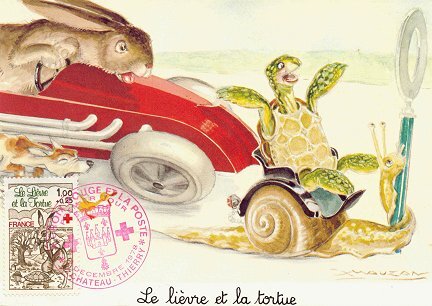
1978 5 French First Day Cover postcards dated "2 Decembre 1978" celebrating and carrying stamps of TH (3) and TMCM with art by Lucien Achille Mauzan. Two with cursive titles and giving "X. Mauzan" as the artist for $9.50 from A. Przopiorski, Sully Philatelie, Maisons Alfort, France, through Ebay, Oct., '99. TH with sweating rabbit and capped turtle for $4 from Topical Paradise Limited through eBay, August, '08. TH with golden frame, zigzag path, and "Croix-Rouge 1978" title for $5.01 from Loic Marchat, Villeurbane, France, through eBay, August, '05. Two cards with rather garish coloring of TH and TMCM for $.99 each from Filkom NV, Bornem, Belgium, through eBay, Feb., '09.
The postmarks on all the cards celebrate "La Croix Rouge et la Poste," as do the backs of the Mauzan cards. The place of each postmark is La Fontaine's own Chateau-Thierry. The Mauzan illustrations show particular whimsy. I had never before seen a snail decked out as a hot rod! The genteel rats of TMCM belong among my mother's soft sculptures! The backs of the cards give Mauzan's dates as 1883-1952. The "sweating rabbit" representation of TH appears on the 8½" x 12" sheet that is an accessory to the 1978 series, while the rabbit on the zigzag path appears on one of the envelopes done at the same time. The illustration shows a zig-zaggy yellow path through green landscape. There is a straight-line golden border around the illustration. The coloring of the garish TH card seems, except for the two main characters, to be done in horizontal strips.
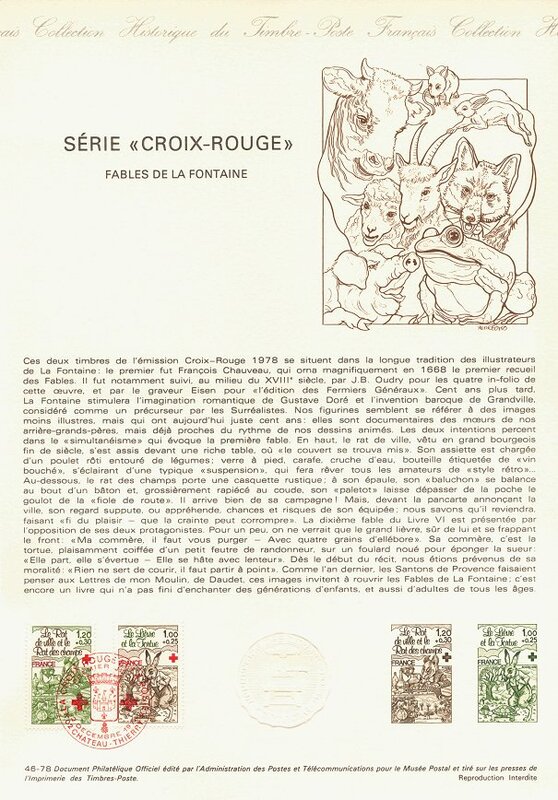
1978 "Série 'Croix-Rouge,' Fables de la Fontaine." French First Day Cover commemorative panel celebrating and displaying stamps of TH and TMCM. 8¼" x 11". 2 Decembre 1978. #46-78 Document Philatélique Officiel edité par L'Administration des Postes et Télécommunications pour le Musée Postal. Tiré sur les presses de l'Imprimerie des Timbres-Poste. $29.50 from Alexandre Prozopiorski, Lyon, France, April, '99.
This sturdy page comes from the French post office's "historical collection of the stamp." It offers a short overview of published illustrations of Aesop and an artistic analysis of the elements of each stamp. There is even a lovely imprinted seal of the Imprimerie at the bottom. At the top is a brown-and-white drawing of animals found in La Fontaine's fables. The artist's signature, difficult to read, is something like "Aldreono" or "Aldreorro."
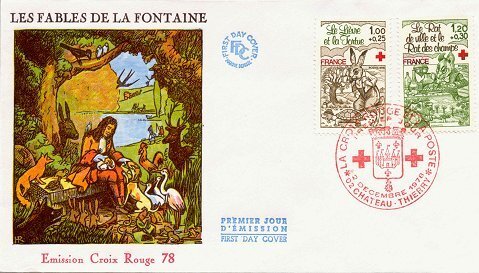
1978 Six French First Day Cover envelopes (and five extras) dated "2 Decembre 1978" celebrating and carrying stamps of TH and TMCM. The colored pictures on these envelopes show respectively La Fontaine in a pastoral setting with animals; TH at the start; TH along the way; town and city rats in the country; and two versions of the town and city rats at the city meal. La Fontaine: Between $2 and $5 from Karen Ross, Iron Mountain, MI, through Ebay, April, '99; Alexandre Prozopiorski, April, '99; Charles Legault, Gloucester, Ontario, through Ebay, Jan, '00; and Annick Tilly, Clignancourt, July, '01. TH envelope at the finish for $3 from Topical Paradise, Feb., 20. Envelope with La Fontaine portrait and Château-Thierry coat of arms for $1 from Topical Paradise, Jan., '20.
The postmark on each celebrates "La Croix Rouge et la Poste." The place of the postmark is La Fontaine's own Chateau-Thierry. The La Fontaine illustration is signed HR(?), and I seem to recognize the work, but cannot pin it down. The La Fontaine envelope proclaims "First Day Cover" twice. The woodland scene on it is lovely. "TH Start," "TMCM Country," and one of the "TMCM City" envelopes have a straight-line golden border around the illustration. "TH Along the Way" and one "TMCM City" envelope share a different format from these other two, including a number (No. 1103 and No. 1104 respectively). They alone present the text of their fable on the verso of the envelope. TH at the finish seems to present yet another format.
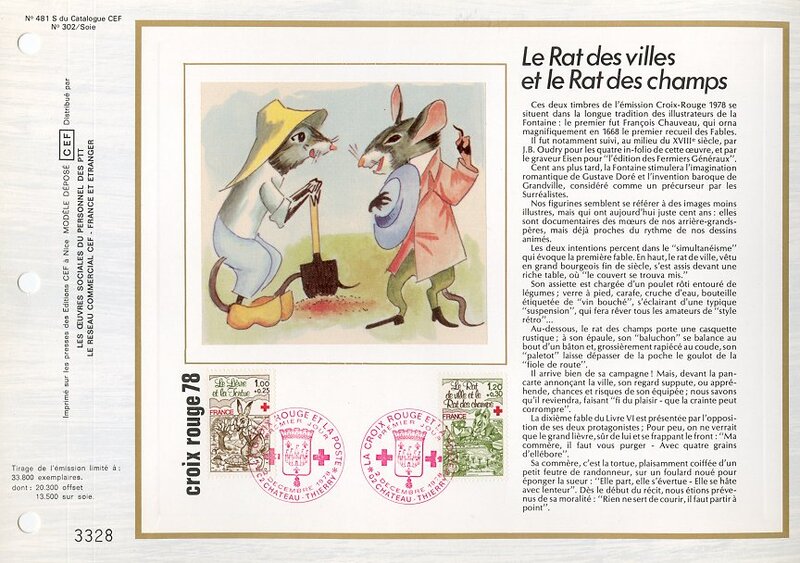
1978 Two three-holed TH and two TMCM landscape album pages, almost 8½" x slightly over 12", containing both the TH and TMCM 1978 Red Cross stamps, a large illustration, and some explanatory text in French. No. 481 (TH) and No. 481S (TMCM) du catalogue CEF. #887 and #7216 (TH) and #3328 and #6385 (TMCM) of 20,300 offset exemplars. Imprimé par Editions CEF à Nice. Distribué par Les Oeuvres Sociales du Personnel des PTT. $20.50 from Alexandre Przopiorski, Lyon, France, March, '99. #6385, an extra, for $5.55 from Gilles Descary through eBay, July, '05. #7216, also an extra, for $5 from Loic Marchat, Villeurbane Cedex, France, through eBay, June, '05.And in April of 2013 a copy of No. 363 -- in fact, Copy # 04105 of 4900 -- for $5 from Topical Paradise.
The TMCM illustration is the simple cartoon-like country scene on the envelopes from the same "croix rouge 78" promotion. There are comments on the history of illustration of La Fontaine's fables and on the illustrations found in the stamps themselves, which are meant to celebrate an illustrative style almost exactly a hundred years old at the time. TMCM 2 does the same for its single stamp, with a lavish illustration added at the city banquet. The TH illustration shows a sweating runner on the left, but the tortoise—complete with sun-hat—finishing on the right. The shorter comments on the TH page are taken verbatim from the longer comments on the TMCM page.
1971? Background and three cells for an animation of TH.
The seller identified this scene with Bill Cosby's Aesop, but I am unsure of that identification. As someone unacquainted with animation techniques, I find the working together of the various cell layers fascinating! The background here is so similar to that in my other group of cells that I wonder if they may not have come from the same film.
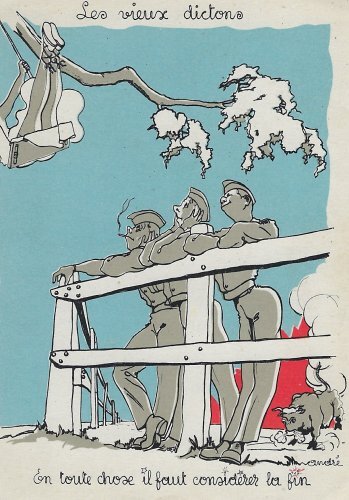
1955? Portrait three-colored humorous postcard showing three soldiers at a fence well below a young woman on a swing. "En toute chose il faut considerer la fin. Artist: André. CAP: Les vieux dictons. Cie des Arts Photomécanique. $6 from Bertrand Cocq, Calonne Ricouart, France, Sept., '20.
This strong moral from the fable of the fox and the goat sums up the fable well. It is impressive that the French not only know their fables well. A single line can bring to their minds the whole fable itself. The play on words here involves the "fin" of the young lady that the three young soldiers can observe in this situation.
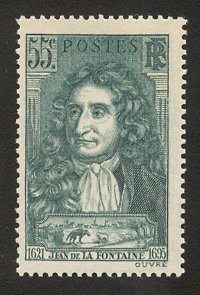
1938 One 55c French stamp from 1938 featuring a portrait of Jean de la Fontaine and a panel showing WL. Scott France #351. $2.25 from Babette Omland, Daytona Beach, FL, through Ebay, August, '01.
I have been able to verify the Scott number on the web. I am afraid this stamp does not tell me more than that, even in 1938, the French liked to think about La Fontaine!
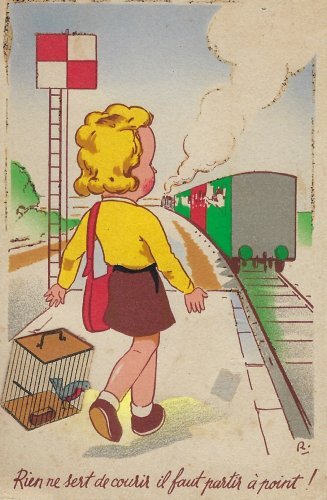
1935? Colored postcard illustrating a girl with a birdcage missing a train that has just left. "Rien ne sert de courir – il faut partir à point!" 608. JDA. Image signed by "R." $6 from Bertrand Cocq, Calonne Ricouart, France, Sept., '60.
The illustration here is quite simple. The card is enhanced with glitter around the train's smoke and around some edges of the image. The aphorism is from La Fontaine's TH, in which the hare waited at the beginning of the race to make it interesting.
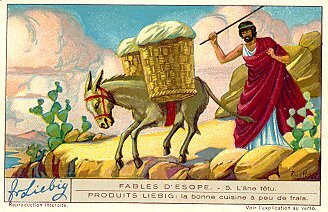
1932 Fables d'Esope. Compagnie Liebig. Six numbered French cards. Sanguinetti #1262. $7 from Alan Overton, Kraainem, Belgium, through Ebay, June, '00. Extra copies earlier for $28.50 at Murray Cards International, Cecil Court, London, July, '92, and from Alan Overton for $7 through Ebay, March, '00.
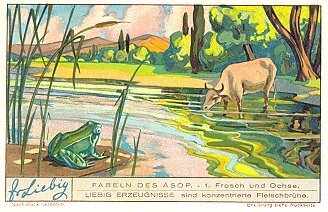
Beautifully colored scenes of OF, FS, "The Crow and the Peacocks," "The Deer in Water," "The Donkey at the Precipice," and "The Wolf and the Shepherd." The setting is deliberately classical throughout. For me, "The Deer in Water" takes a prize as a lovely traditional fable presentation with exquisite coloring. Several cards seem to have been so heavily inked that they easily stick to one another and then can become damaged. Thus all three French sets have lost color in the shepherd's cloak on the last card. For the illustration here I have substituted the corresponding last card from the German set. Besides the German, I have a set in Dutch. How is it that I have found three French sets but no English? The back of each card has a different pitch for Liebig's products. The same card has the same pitch in all three of these sets. #1 has an introduction to Aesop's fables as a genre. Cards #3, #5, and #6 in the set are signed apparently by "Zueff."
1932 De Fabels van Esopus. Compagnie Liebig. Six numbered Dutch cards. Sanguinetti #1262. £4 from Susan Potter at Mayfly Ephemera, Westcliff-on-Sea, Essex, through Ebay, July, '00.
This Dutch set replicates the French set I found first and have encountered more frequently. Beautifully colored scenes of OF, FS, "The Crow and the Peacocks," "The Deer in Water," "The Donkey at the Precipice," and "The Wolf and the Shepherd." The setting is deliberately classical throughout. I have this set in French and German besides this Dutch version. The approach on the backs of the cards is generally different here from the approach on the French and German cards. There a particular approach was taken to win housekeepers to Liebig. Here on four of the six cards a different individual Liebig product is the subject. One of the two exceptions (OF, the first card) introduces the Liebig Company. The other exception ("The Shepherd and the Wolf," the last card) lists a number of different products from Liebig. I show here the first card and its verso. To view the other illustrations, see the French set. Cards #3, #5, and #6 in the set are signed apparently by "Zueff."
1932 Fabeln des Äsop. Liebig Gesellschaft. Six numbered German cards. Sanguinetti #1262. $14 from Dieter Franke, Rossdorf, Germany, through Ebay, Oct., '01.
This German set replicates the French set I found first and have encountered more frequently. Beautifully colored scenes of OF, FS, "The Crow and the Peacocks," "The Deer in Water," "The Donkey at the Precipice," and "The Wolf and the Shepherd." The setting is deliberately classical throughout. I have this set in French and Dutch besides this German version. The back of each card has a different pitch for Liebig's products. Some of these are almost word for word the same as the French, but others take a different slant. It would be fascinating to study the psychology at work in these appeals to homemakers. I show here the first card and its verso. To view the other illustrations, see the French set. Cards #3, #5, and #6 in the set are signed apparently by "Zueff."
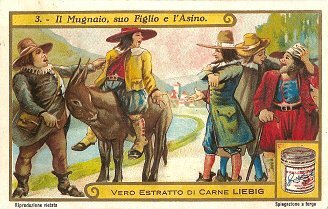
1924 Il Mugnaio, suo Figlio e l'Asino. Vero Estratto de Carne Liebig. Six numbered cards, each with a section of translation of La Fontaine's text on its verso. Sanguinetti #1158. £10 from Murray Cards International, Cecil Court, London, Sept., '06.
This set matches the French set that I had found earlier. By contrast with both copies of that set, the versos of all six of these cards are uniform in format. Like the French set, this version and its illustrations follow La Fontaine's story. As I mention there, the two best scenes here show the donkey enjoying being carried (Card 2) and all three stomping triumphantly out of the town (Card 6). Each scene puts a can or jar of Liebig's meat product in one of the lower corners.
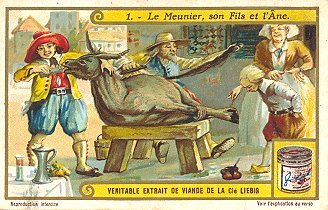
1924 Le Meunier, son Fils et l'Âne II. Compagnie Liebig. Six numbered cards, each with a section of La Fontaine's French text on its verso. Sanguinetti #1158. $15.50 from Dany Wolfs, Roeselare, Belgium, Feb., '00. Extra copy for £10 at Murray Cards International, Cecil Court, London, May, '97.
See also the original MSA set (I) from 1892. By contrast with it, this version and its illustrations follow La Fontaine's story. The two best scenes here show the donkey enjoying being carried (Card 2) and all three stomping triumphantly out of the town (Card 6). Each scene puts a can or jar of Liebig's meat product in one of the lower corners.
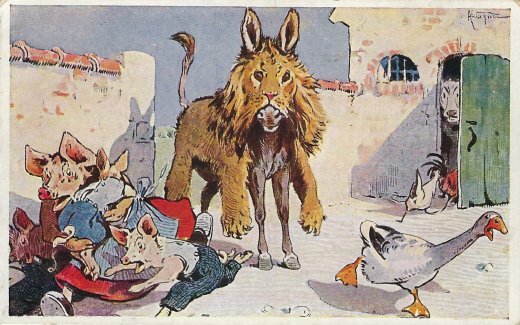
1920? Verlag des Luftfahrerdank Charlottenburg postcard presenting DLS. Karl Wagner. Tierfablekarte Nr. 141. $13.99 from HipPostcard, Feb., '23.
Delightful active scene of the donkey scaring all sorts of animals except the fox. "Luftfahrerdank" seems to have been an effort arising from WWI. Wagner died in 1923.
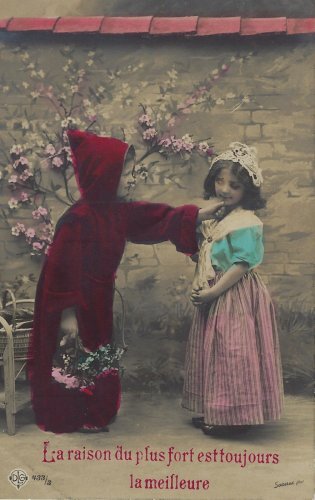
1909? One portrait colored photographic postcard of WL with the aphorism "La raison du plus fort est toujours la meilleure." Sazerac phot. DLG. #433/3. $6 from Bertrand Cocq, Calonne Ricouart, France, Sept., '20.
Our collection seems not to have any other photographic postcards formatted like this, especially with the strong moral printed in red. Does this lamb have a black eye? Is a black-and-white photograph touched up with color and then printed? Sazerac often elsewhere deals with Croissant rather than DLG. Postmarked apparently in 1909.
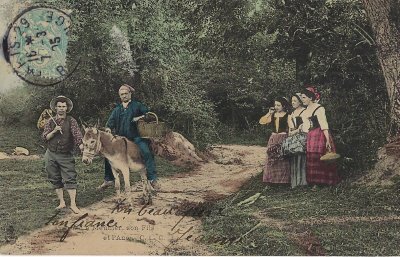
1905? Landscape colored photographic postcard of MLS. CLC. Apparently date-stamped in 1905. $8 from Bertrand Cocq, Calonne Ricouart, France, Sept., '20.
The scene has the miller riding and the son walking, while three women on the side of the path mock them. The two most interesting features of this card, for me at least, are the coloration and the adaptation of the human figures to the landscape. My guess about the first is that the coloration was added by hand to a black-and-white photograph, and then the result was reproduced as a postcard. My guess about the latter is that the two human groupings were photographed separately in a studio and then cut out and pasted onto the rural path scene. The effect of it all is curious! The colors of the women's skirts balance each other so nicely!
1903 La Fille des Rats. Conte japonais. Compagnie Liebig. Six numbered French cards. Sanguinetti #732. £15 at Murray Cards International, Cecil Court, London, July, '98.
I could not resist this lovely set when the salesman at Murray showed it to me. The Liebig product shows up here separate from the scene in one of the lower corners. The backs of the cards show the same two patterns noted above in the MSA series of 1892 and add a third on #5: "La Peptone de viande de la Compagnie Liebig." See examples of each below. Each card describes its scene in a brief paragraph at the bottom of the card's back. The rats are dressed in sumptuous Japanese robes. The parents go to the sun, the cloud (with a great shock of white hair made of a cloud!), the wind, the wall (whose kimono is patterned in bricks!). In the last scene, we see a wedding that echoes the first card's family meeting.
1900 Favole di La Fontaine. Vero Estratto di Carne Liebig. Six cards, each with an animal scene from a fable of La Fontaine attached with a stick-pin to a human scene of children. Sanguinetti #625. Publishers: Liebig Company, Antwerp. £25 from Murray Cards International, Cecil Court, London, August, '97. Extra set for $24 from Pietro Muscara, San Gregorio di Catania, Italy, through Ebay, July, '99.
I could afford this set (marked La Fontaine III) but not the other two La Fontaine sets Murray advertises, since I costs £200 (1883) and II £600 (1896). The face of each card includes a number of elements: "Vero Estratto di Carne Liebig" across its top; two pictures, one set into the other; a cameo of a key character in the lower right; heads of other fable characters along the left side over a can or jar of Liebig meat estract; "Favole di La Fontaine" across the bottom; and the title of the particular fable underneath that. The back of each card, amid lots of information about Liebig, features an illustration of a courtly character and either a recipe or an explanation "how to serve Liebig." See the two examples below. Notice that Liebig here uses Antwerp as its base, while later sets will mention England. Here is a curiosity: the extra set substitutes a French card of OF for the original Italian "I Ladri e l'Asino." I display both here. Click on any card to see it full-size.