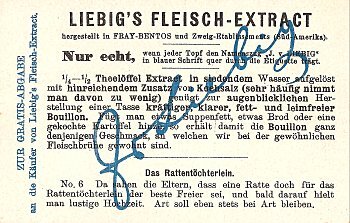
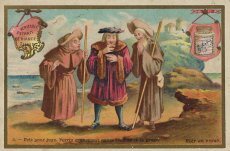
1903 Das Rattentöchterlein. Japanisches Kindermärchen. Liebig's Fleisch-Extract. Six numbered cards. £6.99 from Miroslav Goldner, Hillingdon, Middlexsex, UK, through eBay, March, '08.
Here is the same set in German as the set in French that I got from Murray ten years earlier. The Liebig product shows up here separate from the scene in one of the lower corners. The German is typically careful. Five of the six cards, in the same format, have the message "Only to be a free gift for those who buy Liebig's Meat-Extract." The card with a different pattern (#1 of the six) speaks of the "peptone" produced in South America according to Prof. Dr. Kemmerich's system. Of the five similar versos, four indicate "hergestellt in Fray-Bentos und Zweig-Etablissements (Süd-Amerika)." Each card describes its scene in a brief paragraph at the bottom of the card's back. The rats are dressed in sumptuous Japanese robes. The parents go to the sun, the cloud (with a great shock of white hair made of a cloud!), the wind, the wall (whose kimono is patterned in bricks!). In the last scene, we see a wedding that echoes the first card's family meeting.
1895 Liebig S455: Five cards of a six-card set dramatizing the story of "The Oyster and Litigants." €40 from Simon Rodrigues through Ebay, July, '22. Set-completing Card #5 for €10 from Albert van den Bosch, Jan., '23.
I had not known of this set, perhaps because there is no reference to La Fontaine or fables on this picturesque set. There is reference to Perrin Dandin on the fourth card. The only text of the story is the one-line description at the bottom of each card front. The verso offers tributes to Liebig, recipes, and "Conseils a la Maitresse de Maison." There are also seemingly unrelated human figures in black and white, sometimes carrying a Liebig product. Hurray for finding that sixth card, #5! Good work, Albert!
1892 Le Meunier, son Fils et l'Âne I. Compagnie Liebig. Six numbered cards. Sanguinetti #338. £40 at Murray Cards International, Cecil Court, London, July, '98.
1892 Die Bauern und der Esel. Liebig Company's Fleisch-Extract. Six numbered cards. $49.95 from Kyle DeRoy, Denver, through eBay, Oct., '06.
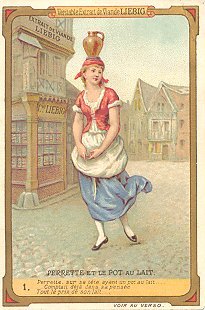
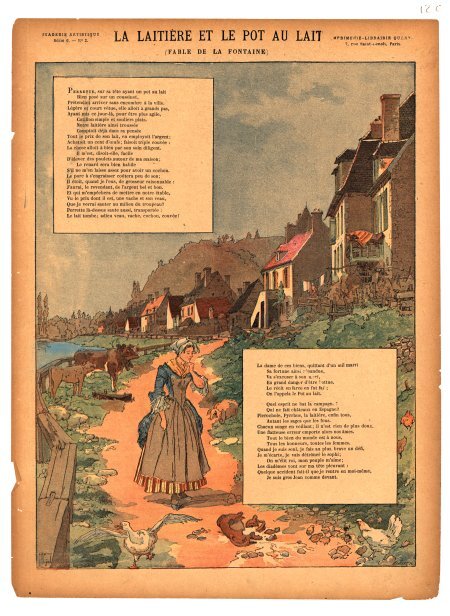
1889 Perrette et le Pot au Lait. Compagnie Liebig. Six numbered Frenchcards, each with a section of La Fontaine's text under the illustration. Sanguinetti #242. Publishers: Liebig's Company, London. £25 at Murray Cards International, Cecil Court, London, May, '97. Extra set from Albert van den Bosch.
I found this set in a bargain box, reduced from the usual price of £55. Here the name "Liebig" is worked into the scene cleverly in each of the pictures. The title is also stamped somewhere near the bottom of each illustration. I have a cropped, smudged duplicate of #3, which, by the way, shows Perrette at her dreamiest while she feeds her chickens. The backs of the cards are in two different formats, containing either recipes or a set of reasons for using or tips on how to use Liebig's meat extract. See an example of each below on the two versions of Card #3.
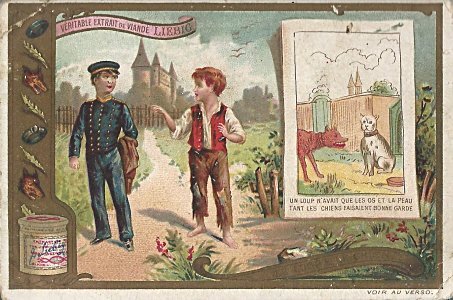
1886 Fables de La Fontaine. Veritable Extrait de Viande Liebig. Six cards, each with an animal scene from a fable of La Fontaine attached with a stick-pin to a human scene of children. Publishers: Liebig Company, Paris. From Stefan Engelhardt, Friedland, Germany.
Do not confuse this highly valuable set -- Murray sells it for £500 -- with the less rare follow-up in a similar format in 1900. An earmark for this set is the scroll across the lower right giving the title of the fable. The face of each card also includes " Veritable Extrait de Viande Liebig " at the upper left, the two pictures, one set into the other, simple symbols along the left side over a can or jar of Liebig meat extract. The back of each card, amid lots of information about Liebig, features an illustration of a human character and either a recipe or an explanation of how useful Liebig meat extract is. The six scenes presented here are FC, GA, OR, DW, OF, and "The Oyster and the Litigants."
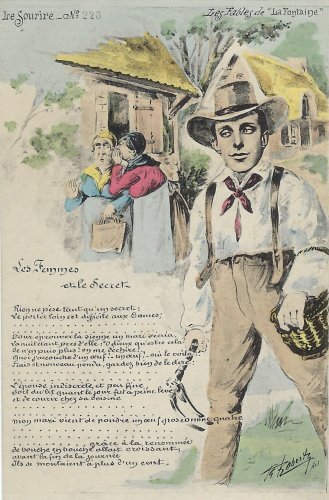
1880? Portrait postcard "Les Femmes et le Secret." Le Sourire Nr. 226. Les Fables de "La Fontaine." Illustration by A(lphonse) Robert. €15.99 from mundusvetus through Ebay, July, '22.
Here is a curious card. I can find no others in the series. Alphonse Robert died in 1880. That is why I choose the last year of his life to date this card. The stance and expression of the man here beg, I believe, for interpretation. I have seen only seldom this approach to quoting a text: leaving out whole sections, perhaps to accommodate a long fable to a limited space. This is exceptional color work! Might it make the card much later? This seems to be a thoroughly modern card, in its exact coloring, in its creative arrangement of the figures, and in the man's perhaps cynical (?) attitude!
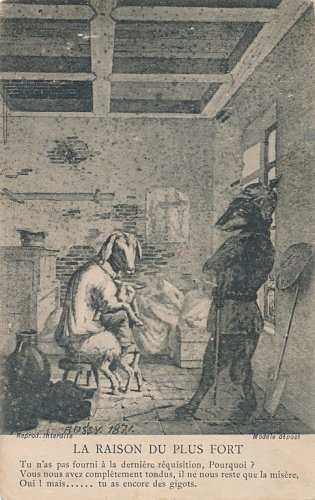
1871 "La Raison du Plus Fort." Postcard featuring WL, a black-and-white painting by "Bussy 1871" with a snatch of conversation between the two animals. Modele déposé. Reproduction interdite. $12 from Bertrand Cocq, Calonne Ricouart, France, Sept., '18.
This is a fascinating card. The wolf is clearly dressed in a Prussian uniform. I believe the wolf is complaining that the sheep did not turn in any supplies at the last "requisition." She answers "you have completely shorn us. We have nothing left but misery." "Yes, but you still have children." This is a dark political statement! I believe Bertrand that this card is rare!
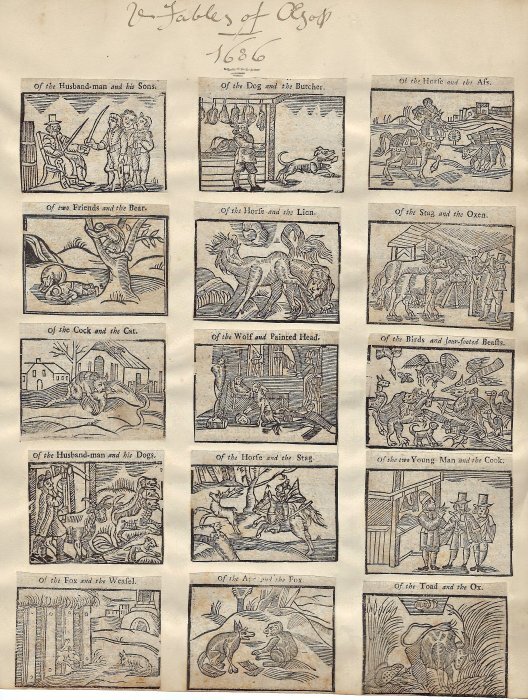
We have an unusual set of woodcuts cut out, apparently from a book, and attached to 8.5" x 11" sheets in rows. There are eleven pages of fables and two pages of the life of Aesop. I can find no English language edition of Aesop published in 1686. There is a French edition of that year. We present them here in groups of three according to the rows in which they are presented on all but one of the sheets. If we ever get to identify these with the text they came from, it will help that "Of the Boar and the Countryman" is Fable 110.
1952? 16 Fable Posters by Paul Colin. €10 each at Marché Malassis, Saint-Ouen, July, '12. Sixteen posters out of a set of, apparently, 23. 11⅜" x 15¾". Imageries Réunies de Jarville-Nancy. All are between Planche Nr. 2001 and Planche Nr. 2023. Similar in concept to the broadsides of Maison Quantin and Pellerin, these lovely posters include a rectangle of print with a plain background somewhere in their portrait presentation of a single scene from the fable. Colin is admired as one of the greats of French poster-art. This find was the beginning of a lovely -- and expensive! -- Sunday at "Les Puces"! I found these on my own in the first shop I entered; Malassis is an antiques market on the way to my favorite book market, Marché Dauphine. I had to ask the dealer to hold these for me, and I would pick them up at the end of the day. They were a serious issue when I packed my overstuffed bags to leave Paris three and a half weeks later! Now of course I need to find the other four posters! Lacking are #2004, 2007, 2009, 2020, 2011, 2014, and 2015. I have an extra copy of "Conseil tenu par les Rats"; "Le Vieillard et les trois jeunes Hommes"; "Les Grenouilles qui demandent un Roi"; "Le Chêne et le Roseau"; "Le Geai paré des Plumes du Paon"; and "Le Pot de Terre et le Pot de Fer." Scroll down if you do not yet see pictures!
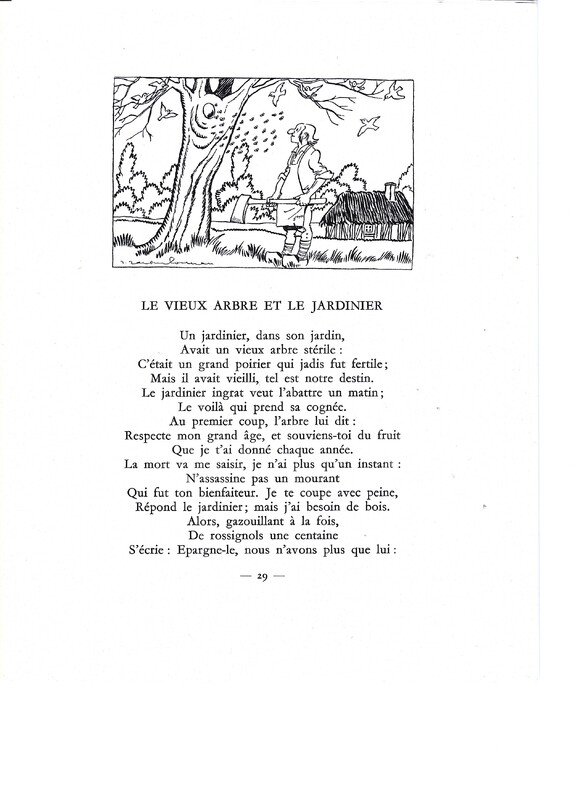
1940? 12 pages of Florian’s fables with black-and-white illustrations. 29-40. Artist’s signature unclear. Source unknown.
This is a curious find. The seller’s attached note says that she does not know the author. “Another amateur has passed before me.” Efforts to match these pages with an edition we have have failed thus far. The page illustrated here (29) gives a good sense of the style of illustration, which tends, I would say, in the direction of cartoon.
1890? 11 broadsides labelled “Imagerie Artistique.” Numbered. From Bailly, Paris, June, '17, for €147. TMCM and "Ass Carrying Relics" for €20 each from Bouquinistes, July, '23.
These broadsides are identical with those listed here as from Maison Quantin, except that they add two sets of information at the top of each broadside: on the left, “Imagerie Artistique” along with a series number and number within that series. At the right-hand top one finds “Imprimerie-Librairie Quantin, 7, Rue Saint-Benoit, Paris.”
Fables and Their Morals. 100 Designs in Set. Issued by Gallaher Ltd., Belfast & London. Gallaher issued apparently three sets of 100 cards, 1½" x 2½". The illustrations, nicely detailed for their size, are identical in each set. The picture side always features "Gallaher's Cigarettes" and a block-print title on the colored picture, with "Copyright" in the lower right corner. The design of each set's verso differs slightly. One finds the title of the series, a title, a fable text, a moral, and a bold strip at the bottom proclaiming "Issued by Gallaher Ltd., Belfast & London." Below is a copy of a verso from each set and hover hover-buttons to view the common pictures in groups of ten. My prizes among the illustrations go to these cards: #41. The Horse and the Ass, #43. The Field of Treasure, and #71. The Vain Jackdaw. At least "The Ass and His Driver" (#38) and maybe more illustrations are taken from Tenniel.
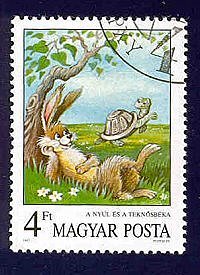
1983 1 Stamp marked "Magyar Posta," "A Nyúl és a Teknósbéka," Fúzesi ZS, and "4 Ft." TH. $.09 from Julie Collins of Valparaiso, IN, through Ebay, Nov., '99.
The hare rests his head on one paw as he watches the turtle go by. I recognized this and the other two scenes in a group of fifty fairy-tale stamps pictured and offered on Ebay. I saw that I could get at least these three, and of course I hoped for more in the pack that I would get….
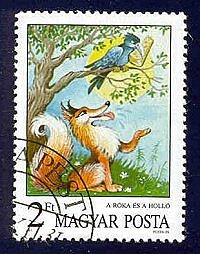
1983 1 Stamp marked "Magyar Posta," "A Róka és a Holló," "Fúzesi ZS," and "2 Ft." FC. $.09 from Julie Collins of Valparaiso, IN, through Ebay, Nov., '99.
The fox holds one paw out expectantly. The crow is nicely haloed with the sun. The cancellation mark looks like the last half of "Budapest."
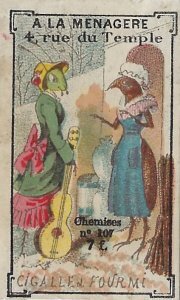
1890? 1 small card (or stamp?) picturing GA. "A la Ménagère" on the rue du Temple. 1⅜" x 2⅜".
This illustration shows dressed insects, one fully outfitted for traveling and holding a guitar, the other in a homey apron. A la Ménagère is offering shirts for either 7 Francs (front) or 5 Francs (verso). The size of this little slip is remarkable, as is its detailed artistry.