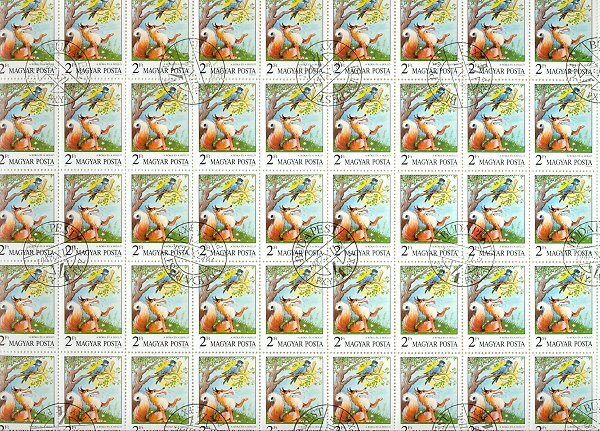
1983 1 Sheet of stamps marked "Magyar Posta," "A Róka és a Holló," Füzesi ZS, and "2 Ft." FC. 10 stamps across by 5 down. 10" x 14". Scott #3103. Postmarked Budapest. $3.50 from John Ferrari, San Carlos, CA, through Ebay, May, '01.
My, the things one can find on Ebay! I had already learned to like this stamp. Now here was a chance to like it fifty times over! Abundanza! Click on the stamps to see them enlarged.
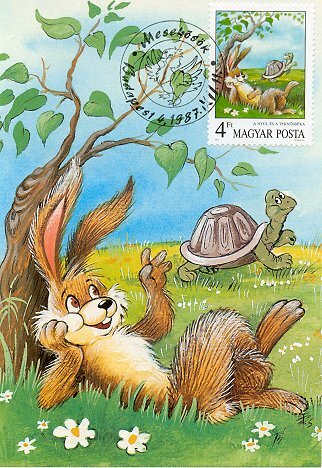
1983 1 numbered maxicard presenting a slightly altered image of the 1983 4 Ft TH stamp. Canceled in Budapest in 1987. #0456 of 1500. "Famous Fairy Tale Characters." 1987/5-c. Scott #3104. Philatelia Hungarica. Design Füzesi Zsuzsa. Hungexpo, Budapest. $9.95 from Peter Abel, Estheville, Iowa, through Ebay, August, '00.
On the stamp, the fox merely looked at the tortoise. In this scene he raises his hand in greeeting. There the tortoise turned his head back to look at the resting hare. Here he glances at the hare but plods on. The tree here has rather a different shape, and the daisies have moved around a little.
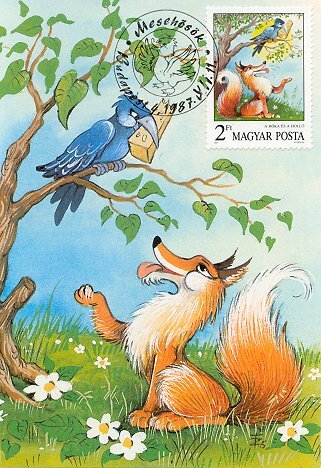
1983 1 numbered maxicard presenting an enlarged and partially reversed image of the 1983 2 Ft FC stamp. Canceled in Budapest in 1987. #0040 of 1500. "Famous Fairy Tale Characters." 1987/5-a. Philatelia Hungarica. Design Fúzesi Zsuzsa. Hungexpo, Budapest. $20 from Peter Abel, Estheville, Iowa, through Ebay, August, '00.
On the stamp, the fox looked right. In this scene he stands under the branches of the tree and looks left. He still holds one paw out expectantly. There is no longer a sun haloing the crow.
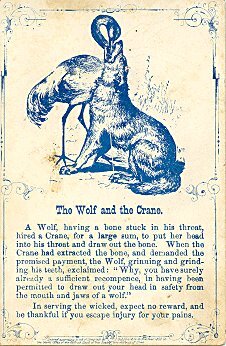
1880 1 card picturing WC. No advertising printed on either side. Gibson Company, Southern Ohio. 3" x 4½".
The illustration is Harrison Weir's (unacknowledged). I suspect that the card's date is date of a general printing permit rather than this card; if it is for this card, it would be some of Weir's earliest work, I believe. The text is not taken from the thirty I have catalogued to date.
1988 [Korean]. (Aesop's Fables). For use with two volumes of Aesop's Fables published 1990 and 1989, respectively, by Mun Gong Sa in Seoul. Bibliographical information on cassette in Hangu. $2.10 on street near Eastgate in Seoul, June, '90.
Good orchestral music backs up spirited and varied reading in Korean, complete with good animal voices.
1929 (Aesop's) Fablegram Series. Twelve monthly calendars for 1930 featuring maxims and Milo Winter illustrations. 4¾" x 10". St. Paul, MN, and Sault Ste. Marie, Ontario: Brown & Bigelow. $100 from bisboutique on Ebay, May, '24.
These are colorful presentations of animal scenes with aphorisms drawn from or like those of Aesop. The illustrations are true Milo Winter, often quite cute and often presenting a fable in different characters and circumstances from the usual. Brown and Bigelow styles themselves as "Specialists in Direct Mail Advertising." Aesop is acknowledged in this set only on the introduction card. One wonders if the card belonged to a different series. Might there have been a first series of Aesop's Fablegrams that was followed by a series of "clever animal scenes with pithy sayings."
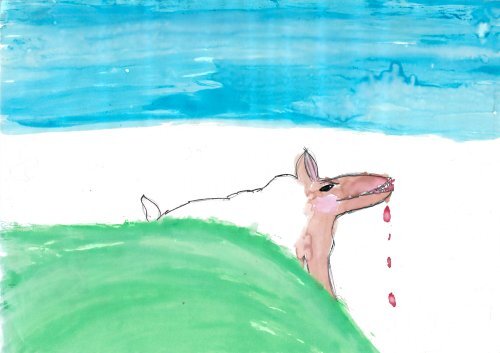
1992? “Wolf in Sheep’s Clothing.” Watercolor, 8.5” x 11”. Anonymous student work.
This simple work says a lot in its two enhancements of the wolf: the sheepskin and the bloody mouth.
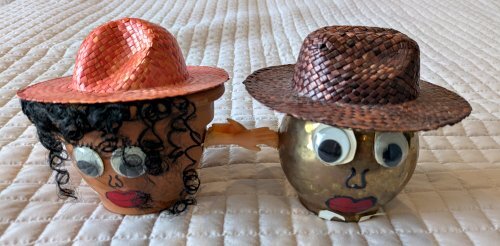
1994 “Two-Pot” Assemblage. Silvia Curra. Student creative work for a classics course.
This assemblage of two pots with arms linked between them has wonderful touches. The clay pot says “If you don’t mind, I’d rather not.” And “I’m not sure whether I would be wise to forsake my corner of the [ingle] – After all, I would only take the slightest shock, one single accident and shatter my body irrevocably.” The metal pot says “Let’s see the world together” and “But I’ll be your bodyguard.” The composition expresses the fable wonderfully!
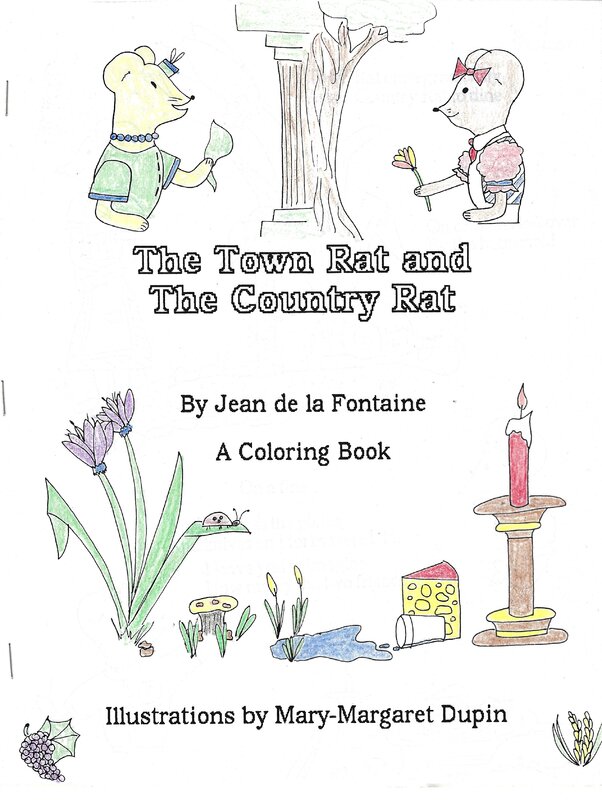
1992 “The Town Rat and the Country Rat: By Jean de la Fontaine: A Coloring Book.” Illustrations by Mary-Margaret Dupin. Presumably for requirements in a fable course at Georgetown University.
Several outstanding exemplars remain from many student “creative projects” from courses on ancient literature and especially on fables. Here is one of the best. The text is by Walter Thornbury about 1870. The illustrations are delightful! It is such a pleasure to come back to them now (January, ’26)! I give a sample below the cover-page. Do not miss the cat entering right!
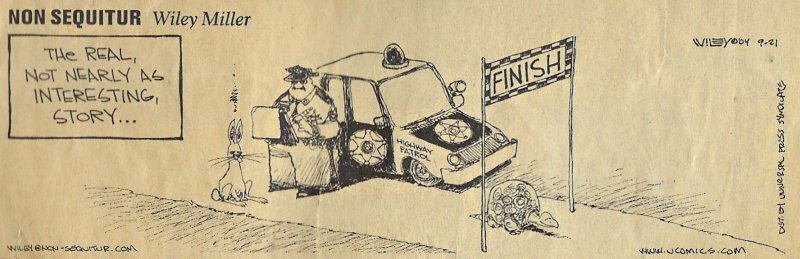
1994 “The Real Story.” Wiley Miller. “Non Sequitur.” September 21, 1994. Universal Press Syndicate. Unknown venue and unknown source.
Because TH is the best known fable in the USA, it occasions frequent “reinterpretations.” In this one, the hare probably did not go to sleep. He got arrested for speeding.
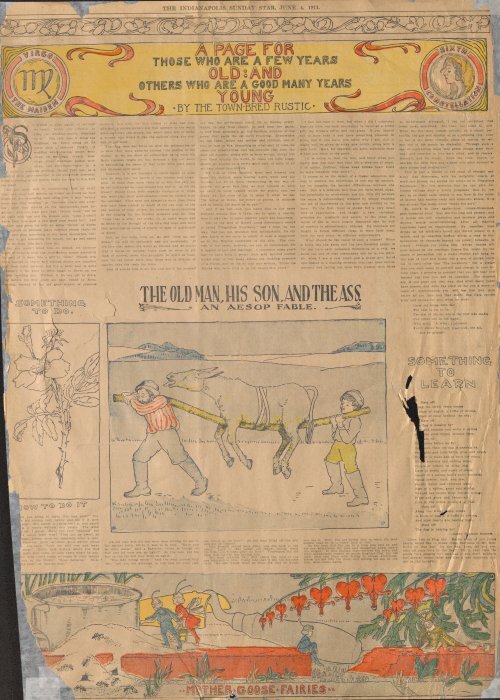
1911 Newspaper illustration and text: “The Old Man, His Son, and the Ass: an Aesop Fable.” Indianapolis Sunday Star. June 4, 1911.
In this version, “the old man, mad and tired with trying to please everybody, threw the ass into the river.” Were these colors originally sharper?
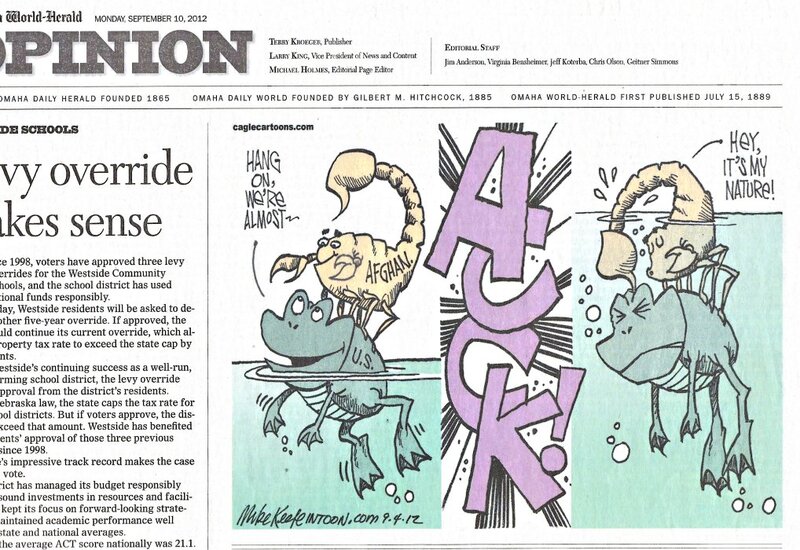
2012 “The Frog and the Scorpion.” Syndicated colored cartoon by Mike Keefe appearing in the Omaha World-Herald’s opinion page on September 10, 2012. Personal find.
The three panels of the cartoon tell the traditional fable well. A good trip among supposed friends gets interrupted when the scorpion suddenly kills the frog. Why? “That’s my nature.” So Afghanistan is killing the country (USA) that was bringing it to supposed safety.
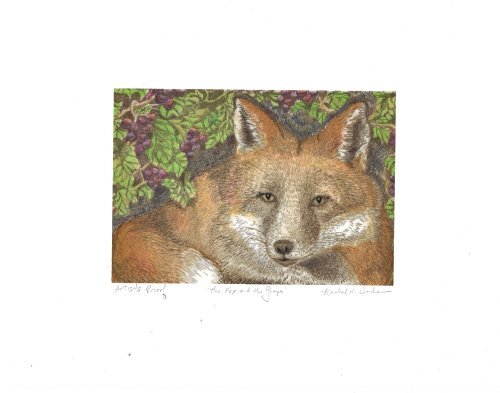
2007? “The Fox and the Grapes.” Giclée art print. Artist’s proof, signed by Rachel Badeau. 9.75” x 7.75” (image 5.5” x 3.8”).
I do not know how giclée art works, but this is amazingly detailed. As I catalogue this 17 years after receiving it, I am happy to see that t he artist and studio are still producing lovely art on Etsy.
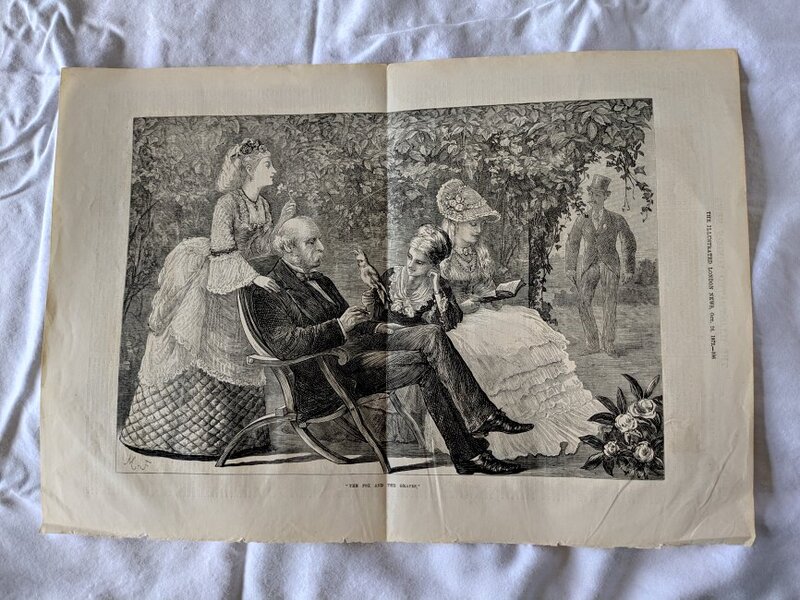
1872 “The Fox and the Grapes.” Illustration in “The Illustrated London News” for Oct. 26, 1872. (Page 396). F. Wentworth. With accompanying text on 395. Image 12.2" x 8.5". Page 14" x 11". Unknown source.
The accompanying text helps interpret the scene. It begins “The young coxcomb who lurks in the background of this scene, with his glass stuck in his right eye for a seemingly indifferent look at the girls, seated with their papa under the leafy vine, may affected to hide his disappointment at not finding one or other alone. But we shall not be deceived by this flippant behaviour on his part….”
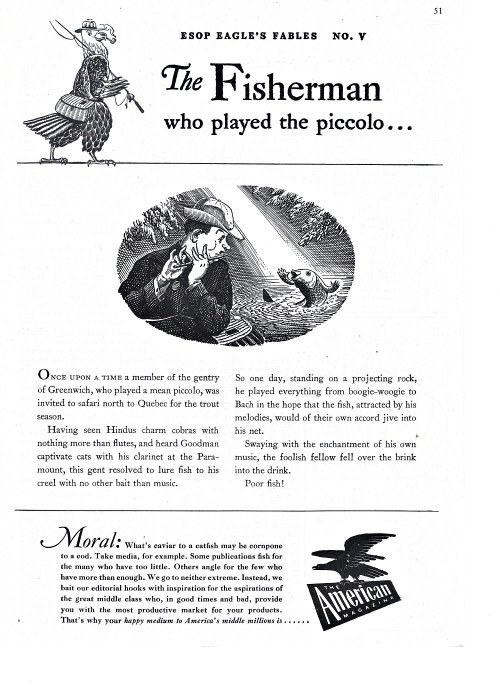
1944 Advertisement for “The American Magazine”: “The Fisherman who played the piccolo…” Esop Eagle’s Fables No. V. New Yorker, May 13, 1944. $9.99 from The Ad Store, April, ‘09.
Were the advertisement writers aware how close they are to the traditional fable of Tircis who thinks he can lure fish by his music? In La Fontaine’s X 11, the shepherd is trying to please Annette the shepherdess by catching fish for her – but has to learn to use the net instead of the flute. What attracts people does not attract fish. This advertisement turns the moral to attracting the middle. That is what “The American Magazine” does. Apparently, it did it it well enough to last for another twelve years.
1950? New Yorker Advertisement: “The Fable of the Hen Who Laid Easter Eggs Every Day.” New York: W & J Sloane. No date. Source Unknown.
Ophelia laid a colored egg on Easter, and her master was pleased. So she began laying an egg of a different color every day. Then one day a muddy brown egg came. So she turned to two-toned eggs, spotted eggs, striped eggs. The master got more and more disappointed as time went on. Finally he asked “Could you lay a perfectly plain egg?” She had completely forgotten how. When you visit the Sloane store, you will be impressed by the original ideas. But you will be impressed even more “by the restraint with which this originality is used.” I find no echoes of this advertisement on the web.
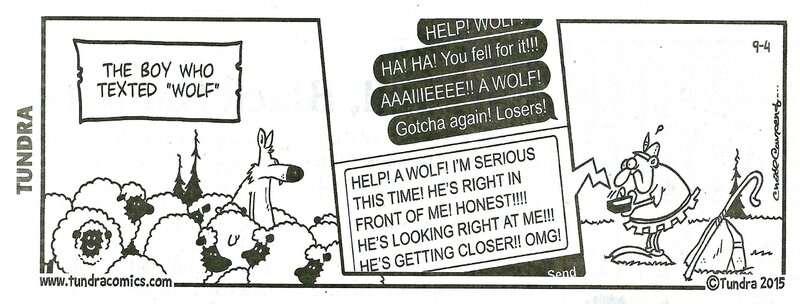
2015 Tundra comic. “The Boy Who Texted ‘Wolf.’” Photocopy. Tundra Comics. Unknown source.
The close-up of the phone screen shows a new message following the “Gotcha” messages. The first panel shows a wolf among the sheep.
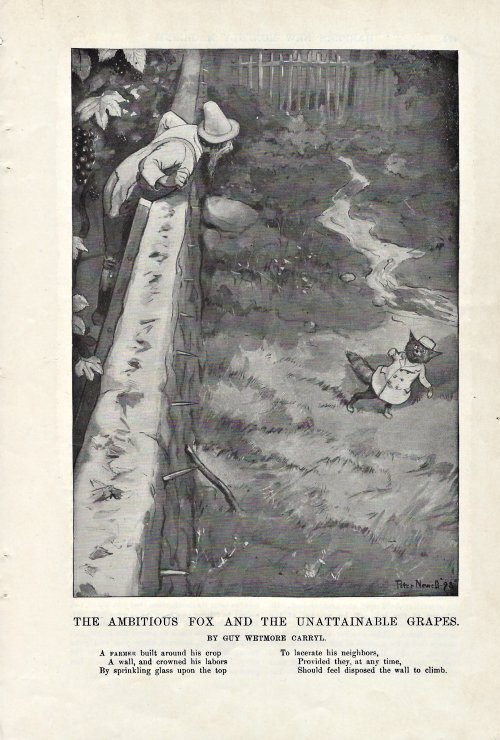
1897? “The Ambitious Fox and the Unattainable Grapes.” Guy Wetmore Carryl. Illustration by Peter Newell. Harper’s New Monthly Magazine. 493-94. Taken from “Fables for the Frivolous.”
Harper’s here borrows from Carryl’s playful presentation of fables. In the process, the magazine drops the book’s title for the illustration, “The Fox Retreated Out of Range.” Apparently from the Dec., ‘1897 issue.
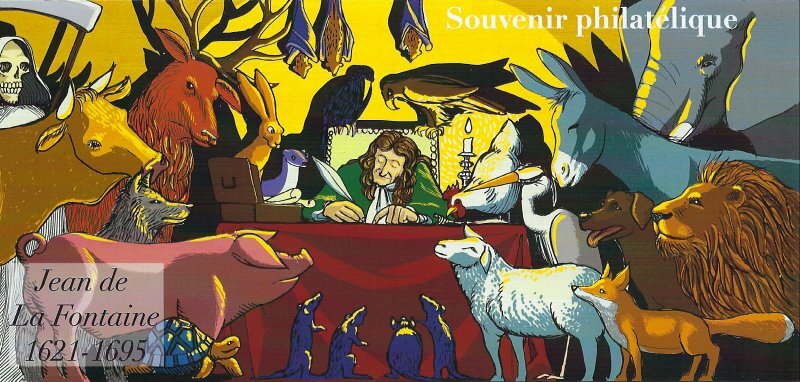
2021 “Souvenir Philatelique” celebrating the 400th anniversary of the birth of Jean de La Fontaine. Two parts: a folded leaflet jacket imaging La Fontaine writing among many animals and a page inside featuring the two new memorial stamps. $19.77 from empirefondation1965 through Ebay, July, ’21.
The stamps are situated as wall coverings, each above a fireplace, in a palatial building. The stamp itself is defined by surrounding perforations. The combination of black-and-white art with the colored stamp – all on one gummed page – is striking! The cover of the leaflet is marked by deeply rich colors.
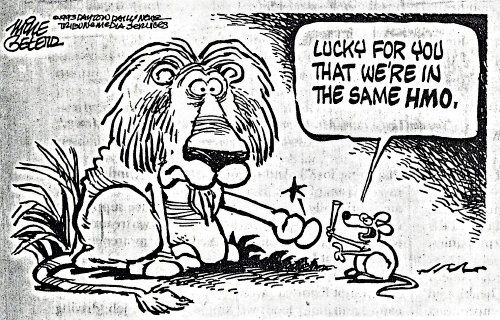
1993 “Same HMO.” Mike Lester. Dayton Daily News. Tribune Media Services. Xerox copy. Source unknown.
The conversion to HMO organization for health care of the USA leads to this humorous application to the story – a fable story I think I do not yet understand – about a mouse taking a thorn out of a lion’s paw.