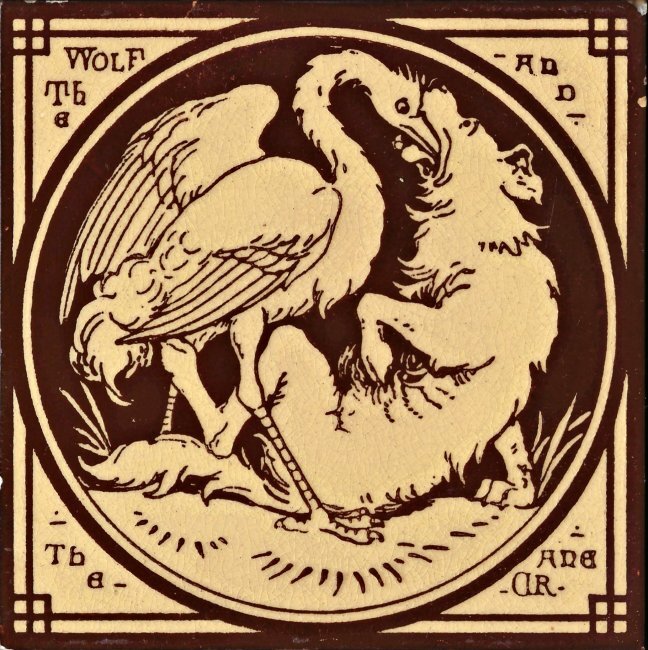
1875? Six-inch square tile titled "The Wolf and the Crane." Manufactured by Mintons China Works, Stoke on Trent. Designed by John Moyr Smith. Unknown source.
In this lively scene, the two characters' forms fill out over 50% of the circle's circumference. Can we see in their faces the diligence of the crane and the (temporary) submissiveness of the wolf? Lovely brown and cream colors. The title is read in curious fashion, starting from nine o'clock and reading toward three o'clock, and then restarting from eight and reading toward four. In the upper left and lower right, one needs to read going up; the key is to start as far left as possible and always move right.
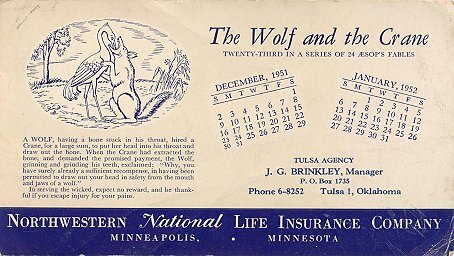
1951 "The Wolf and the Crane." Twenty-Third in a Series of 24 Aesop's Fables. With calendars for December, 1951 and January, 1952. Compliments of the Tulsa Agency, J.G. Brinkley Manager. Minneapolis: Northwestern National Life Insurance Company. $2.50 from Rocky Trading, Neodesha, KS, through Ebay, Jan., '02.
This blotter, about 3½" x 6¼", presents an oval line drawing of WC in the upper left, with a full text and moral below it. The right half of the card presents its title, the series, a calendar, and the local Tulsa sponsor. The bottom of the blotter shows the national sponsor. This blotter may be among the most prosaic fable items I have.
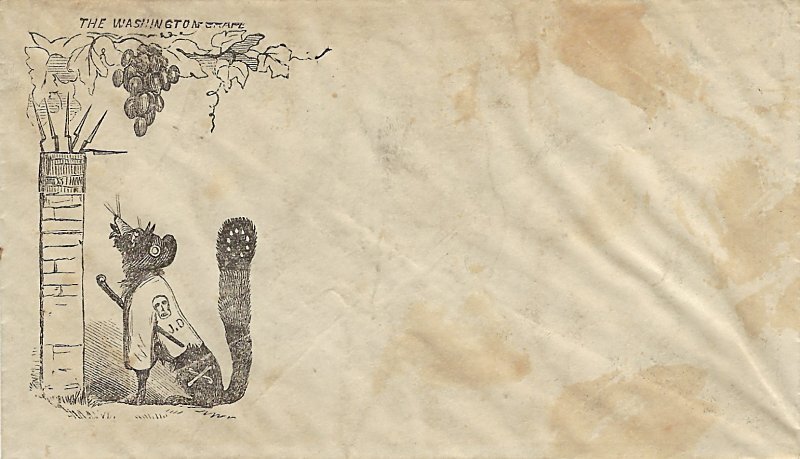
1865? "The Washington Grape." An envelope with an illustration of FG. The Ebay seller describes it as "black printed Civil War Patriotic," and identifies the fox with the South and the grapes with the North. 5½" x 3¼". $9.99 from Douglas Uzakewicz, East Northport, NY, through Ebay, Feb., '02.
Notice the "Johnny Reb" crossed guns on the hind quarters of the fox. The fox is apparently Jefferson Davis ("J.D."), and he is hankering after the city Washington, whether as a military objective or as a political "plum." Is the fox's tail bandaged? What might the circle of holes or markings on the end of his tail suggest? Perhaps that he has been shot up?
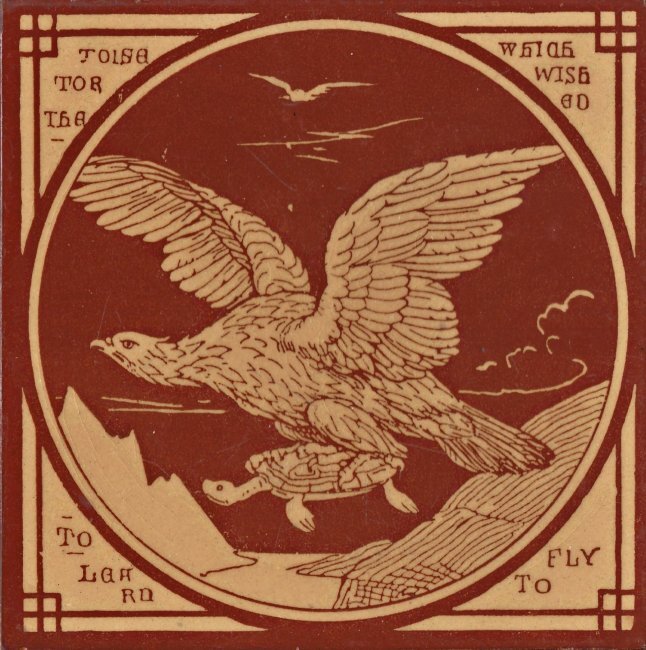
1875? Six-inch square tile titled "The Tortoise Which Wished To Learn To Fly." Manufactured by Minton's China Works, Stoke on Trent. Designed by John Moyr Smith. $86 from Artifacts Gallery and Custom Framing, Trenton, NJ, through Ebay, March, '99.
This is my first of Minton's series of twelve. Lovely brown and cream colors. The title is read in curious fashion, starting from nine o'clock and reading toward three o'clock, and then restarting from eight and reading toward four. The eagle looks serious and gruff, while the tortoise has his neck extended. Other birds fly elsewhere in the sky. The seller identifies the style as early Arts and Crafts.
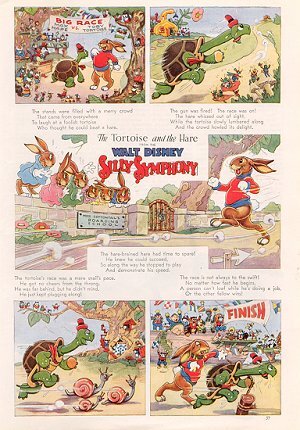
1934 "The Tortoise and the Hare from the Walt Disney Silly Symphony." Good Housekeeping, Oct., 1934. Page 37, with five cartoon panels detailing the race. 8 1/8" x 11½". $12.50 from Byron Grush, Cerrillos, NM, through Ebay, Sept., '00.
The conception here is just as it is in the early Disney book presentations of TH in 1935. Rhyming verse quatrains here follow the story, with Disney's usual inclusion of Miss Cottontail's Boarding School, interested snails, and a last minute thrust of his head by the tortoise to win. Excellent condition.
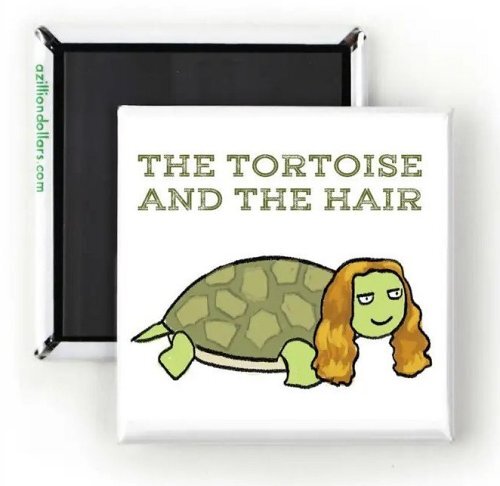
2001? "The Tortoise and the Hair" magnet. Metal. 2" square.
This pun has been used before, for example in "Sin City Fables" from 1981. The cartoon character here is charming! I am unsure of the use of this magnet -- perhaps on refrigerators? The creator recommends it as a gift to hairdressers. Fables provoke fun!
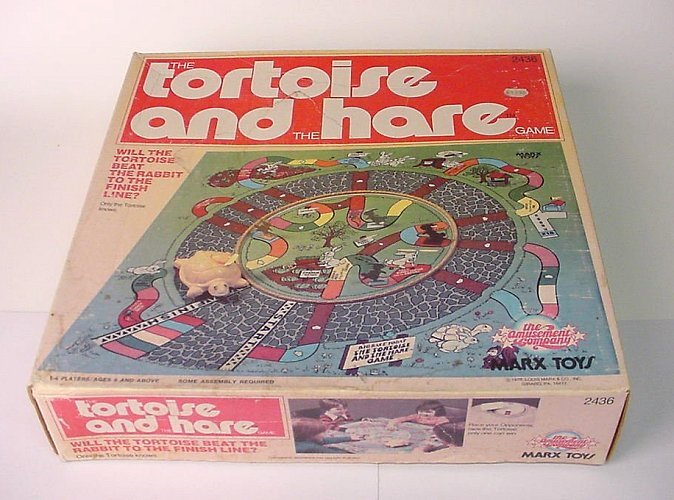
1978 "The Tortoise and the Hare" game. Made in USA. Girard, PA: Louis Marx Co. $2 from Connie Tibbitts, Providence, UT, through Ebay, March, '01.
This seems to be a simple game. The large stiff playing board includes a circular track, with a plastic ledge to insert as its inside rail. The wind-up tortoise moves around in a clockwise circular fashion to land on various squares. The game itself is in mint condition, though the box shows significant wear. There are instructions, four small rabbits, and even a decal!
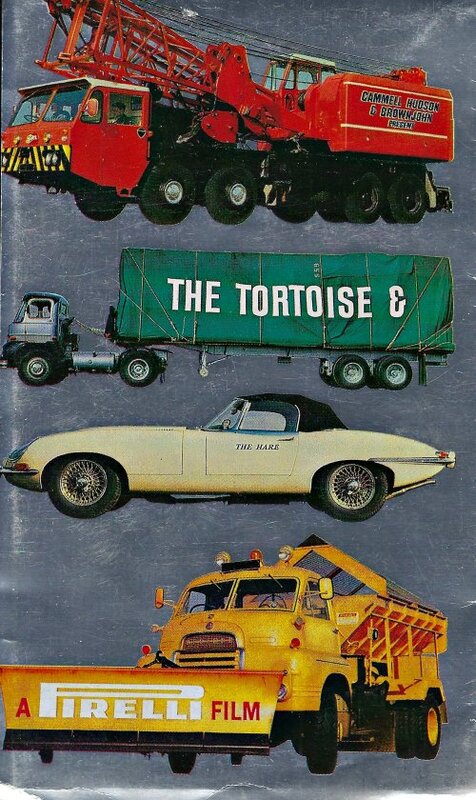
1967 "The Tortoise & the Hare: A Pirelli Film." Combined map, advertising for the film, and for Pirelli's Cinturato tires. Film presented by Cammell Hudson & Brownjohn Associates. Produced and directed by Hugh Hudson. Starring Liz Allsopp, Gino Zottarelli, and Lucy Hornak. Script by David Cammell and Hugh Hudson, inspired by La Fontaine. Map produced by Mears Caldwell Hacker Ltd. £2.79 from Timothy Gardener, Bedhampton, UK, through eBay, June, '04.
This is a tour-de-force! The map sets the scene for a movie that seems built around a tour of its own. I gather that a sports car overtakes a truck, only to find the same truck ahead again, and again, and again. On the back of this oversized map are a number of stills from the film and photographs of the actors and settings. Prose talks about the generation of the film's idea and Pirelli's backing of it. Two of the many little panels--I think I count eighty-three of them--reproduce TH from standard text pages of Aesop and La Fontaine. Would this map have been sold in the theater on the occasion of the film? Or perhaps handed out as advertising for Pirelli's Cinturato tires (or as the brochure reads, "tyres")? Like almost every other map in the world, this one is big, unwieldy, clumsy. But besides that, it is one of the craziest of Aesopic remnants I have found. Aesop lives!
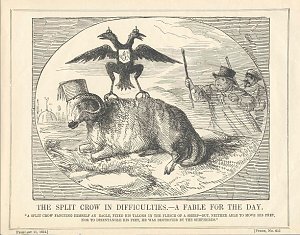
1854 "The Split Crow in Difficulties.--A Fable for the Day." Punch, No. 657. February 11, 1854. 10¾" x 8¼". $9.99 from Ed and Laura Harrison, oldartgallery, N. Olmsted, OH, through Ebay, August, '99.
"A split crow fancying himself an eagle, fixed his talons in the fleece of a sheep--but, neither able to move his prey, nor to disentangle his feet, he was destroyed by the shepherds." Part of the joke here lies in the fact that the crow is split and wears a Kaiser's crown--in fact, two of them! There is an inch tear through the border of the cartoon. Click on the image to see a much larger version
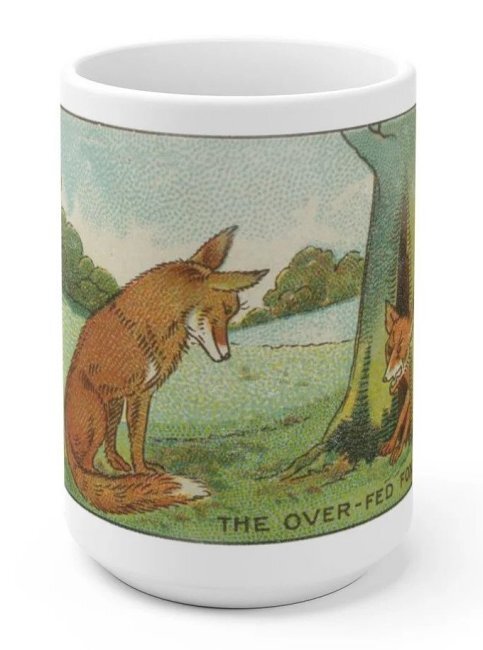
2010? "The Over-Fed Fox" coffee mug. Featuring Gallaher Cigarette Card #24. $18.97 from EclecticRetroBazaar on Etsy, Jan., '23.
I am encouraged. I recognized the image immediately and thought it might be from the Gallaher horizontal set. Here it is! My curious mind wonders what brings an artist to select a particular image or fable from the great array that is out there.
2022 "The North Wind and the Sun." Paired A5 art prints. $30.72 from Wodlingtown, Plymouth, UK, through Etsy, July, '22.
Wodlingtown advertises "Weirdo black and white illustrations for weirdo people." In this case, I think anyone who likes fables is a weirdo! This pair is well executed. The contrast of the two prints is stark and significant. I hope they do more fables!
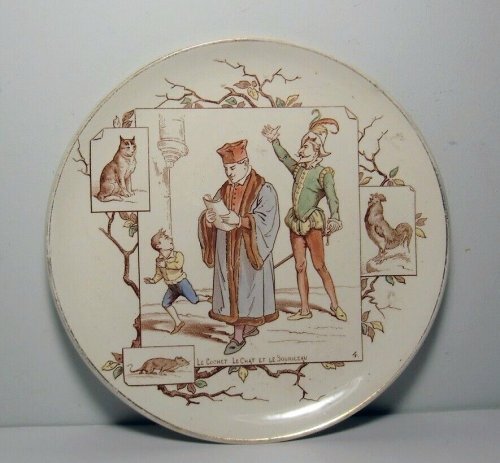
1900? Faience plate 8" in diameter showing two scenes depicting "The Mouse, Cat, and Rooster." Numbered "4." A mark on the back seems to combine the letters "M" and "C" and says "déposé Fables Terre de Fer." $17.50 from thegreenloft through Ebay, June, '22.
This plate features a central framed and colored illustration of human characters, with three monochrome frames around it presenting the three animal figures of the fable. Apparently, the naïve child runs from the loud soldier, who might protect him, and trusts the judge. The judge, it turns out, is a devouring cat.
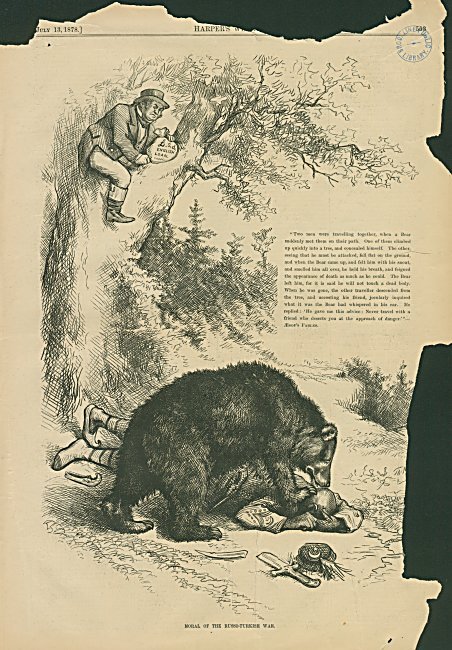
1878 “Moral of the Russo-Turkish War.” Full-page cartoon in Harper’s Weekly, July 13, 1878. Page 553. Unknown source.
Do I have my history right that the Ottoman gentlemen with a loan from Great Britain is avoiding danger and has left his Turkish ally to suffer at the hands of the Russian bear? For me, the upshot of this strong cartoon is: readers of Harper’s in 1878 knew this fable of “The Bear and the Two Travelers.” Life has changed since then!
1991 "The Mice's Thanksgiving." The Broadway Local Theater. American Radio Company. Garrison Keillor narrator. November, 1991. Recorded by Rev. Edward W. Bodnar, S.J. 10:15.
A great rendition of TMCM. The voices and vocal effects are excellent. Some great wit. An uptown express sewer carries the mice during TV commercials! The "Voice of Reason" and the "country mouse" are especially good characters. Keillor is a great narrator. "It's not the city but me, isn't it?" "You're the mousiest guy I ever knew." A trap gets Randy, and with a punishing pun Keillor has him buried in a mausoleum.
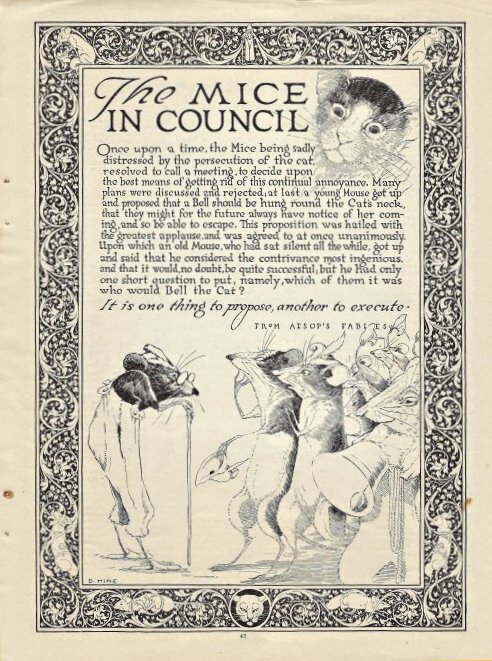
1920? BC. 8.5"x11" page (47) from an unknown magazine or encyclopedia presenting "The Mice in Council," illustrated by D. Hine.
An elaborate broad margin-design of cat and mice surrounds a title balanced by an image of the cat looking down, a half-page of text, and an image of one mouse wearing spectacles speaking to a group of mice, one of whom holds a bell. The text, including moral, seems lifted verbatim from James. The article on the back of the page gives women advice on how to test textiles.
1920? "The Grasshopper and the Ant" print. By A.B. Frost. 7” x 9.5”. $3.74 from Steven Moraweic, Oct., '03.
This print of GA shows the scene familiar from numerous French prints but offers, rather than a young woman artist and a mother, two Blacks, one warmly dressed and carrying food and drink, the other a musician asking for help.
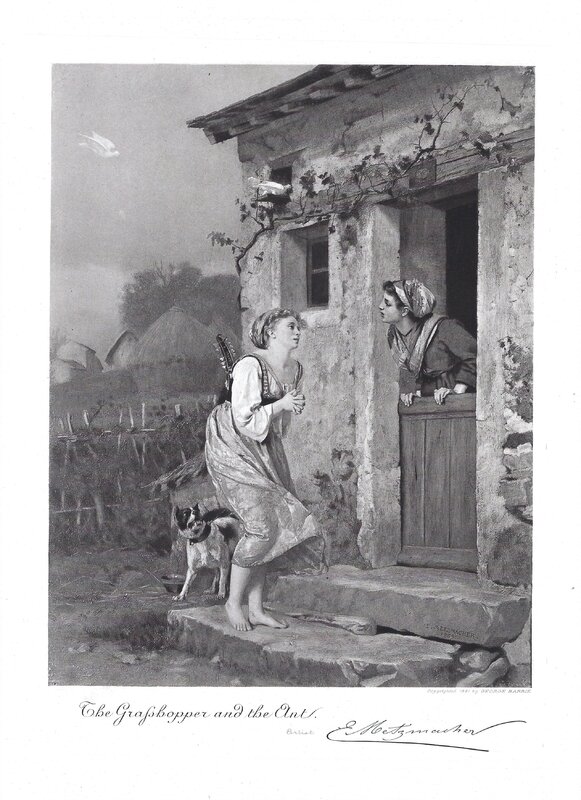
1881 "The Grasshopper and the Ant." Print of an original painting titled “The Grasshopper and the Ant” by E(mile Pierre) Metzmacher. Copyright 1881 by George Barrie. 9” x 12”. From martin2001@martin2001. Unknown cost and date.
This smaller version has differences from the larger copy below. The printer includes his name and date. The typeface and formatting for the title under the image are different. Though I found this at a different time and am cataloguing it at a different time, I still agree with the comments on the larger copy catalogued first.
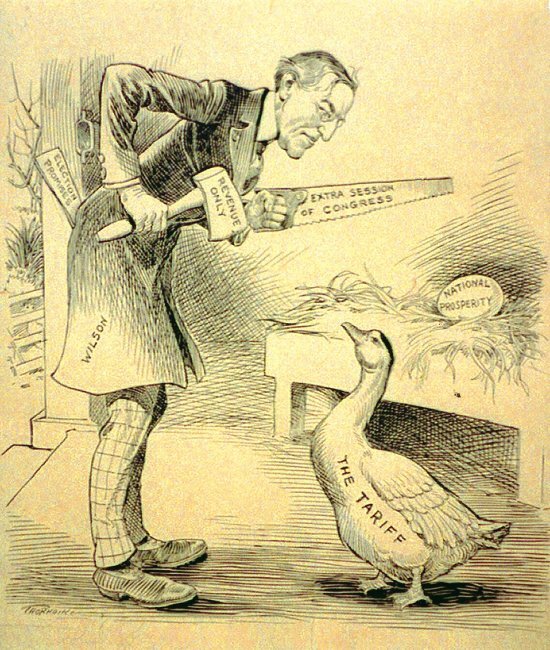
1917? "The goose that lays the golden egg." Political cartoon by R. Thorndike. Los Angeles Times. $10 from Old Photos Online through Ebay, May, '23.
Woodrow Wilson, armed with a saw, is jeopardizing continued national prosperity by attacking the tariff. Will he use his hammer to knock the goose cold or to smash the latest egg? In the meantime, his election promises are stuffed into his back pocket. Might this cartoon have appeared in the times at the time of either the 1913 or 1917 election?
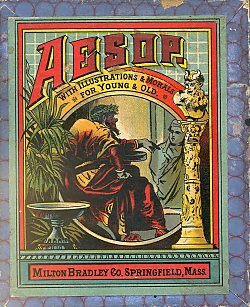
1940? "The Game of Aesop." Boxed as "Aesop" from Milton Bradley Company. Seventeen pairs of cards (text and illustration, respectively), lettered alike A through Q, and one odd card with a picture of Aesop. Springfield, MA: Milton Bradley Co.
These cards are identical in print and image with those from the Artcraft (?) "The Game of Aesop" with several modifications. Here the backing of each card is orange-brown, and the ink used for both text and image is brown. And this set comes in a beautiful, if very well used, box giving the game the simpler name "Aesop."
1980 "The Fox and the Grapes." Use with the book. Society for Visual Education, Inc. $1.39 from Barb Daniels, Lebanon OR , through eBay, March, '04.
This tape presents with several voices exactly the words of the book of the same title and year. The tape runs just under five minutes. There are a few sound effects. The tape has been well used. The vocal quality is sometimes poor. At one point in his leaping he touches the grapes. He tries to leap at them ten times. The fox admits at the end that the grapes look and smell good but claims that they do not taste good. "Good-bye, sour grapes," he says at the end. The narrator says that the fox hated something because he could not get it. I also have the book.
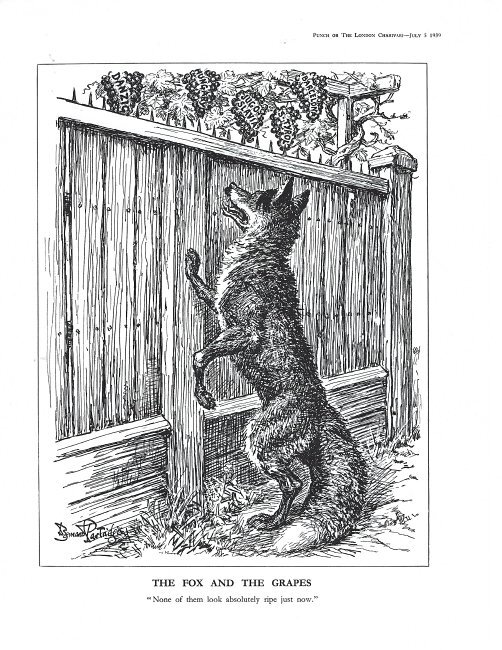
1939 "The Fox and the Grapes." Reproduction of a cartoon appearing in Punch July 5, 1939. Bernard Partridge. Unknown source, perhaps North Country Books through Ebay, unknown date.
I am a bit surprised that the fox here is not somehow identified, though everyone reading "Punch" in 1939 would know that the fox is either Germany or Hitler. I wonder if the clot of hair across the fox's brow is not an attempt to make the fox into Hitler. Partridge did a lot of Punch caricatures or cartoons for decades.
1980 "The Fox and the Crow." Use with the book. Society for Visual Education, Inc. $1.39 from Barb Daniels, Lebanon , OR , through eBay, March, '04.
This tape presents with several voices exactly the words of the book of the same title and year. The tape runs five minutes. There are a few sound effects. Vocal quality is good on this tape. The "caw" is particularly good here. This fox does the flattery of the female crow well. He starts with compliments on general beauty and feathers, and then moves on to the crow's eyes and her virtues. Only then does he move on to her voice. The crow moves down closer to hear his flattering whispers. I also have the book.
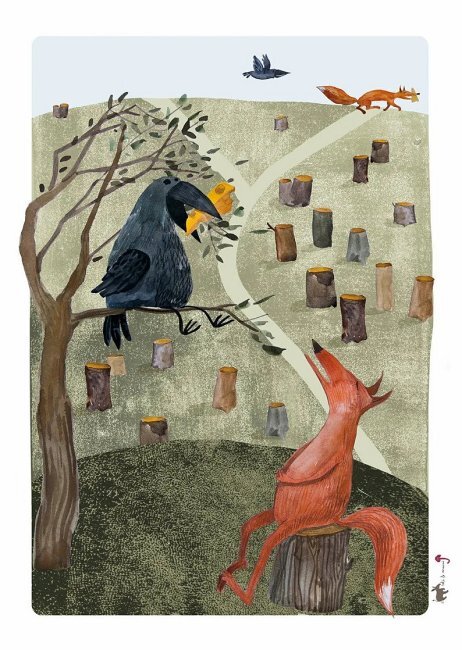
2023 "The Fox and the Crow Fable" poster by TaliMooni. Vilnius Lithuania. 16½" x 23½". $18.94 through Etsy, Jan., '23.
This is a splendid, dramatic piece of work! A special touch is the element perhaps not noticed at first: the two creatures exit right in the background, one with cheese and one without. Snout and beak get special handling here!