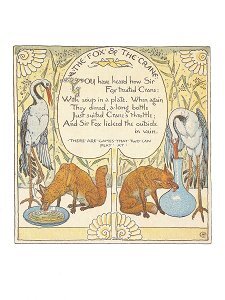
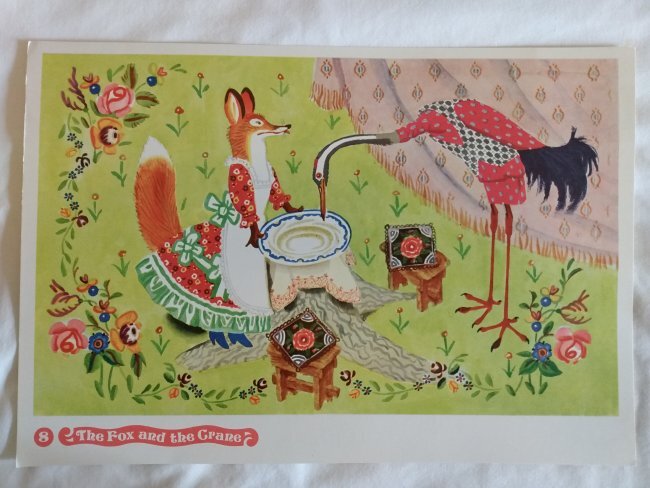
1982? "The Fox & the Crane" by Walter Crane from Baby's Own Aesop (1887). Notecard with envelope from the Rare Book and Special Collections Division, Library of Congress. Three extras.
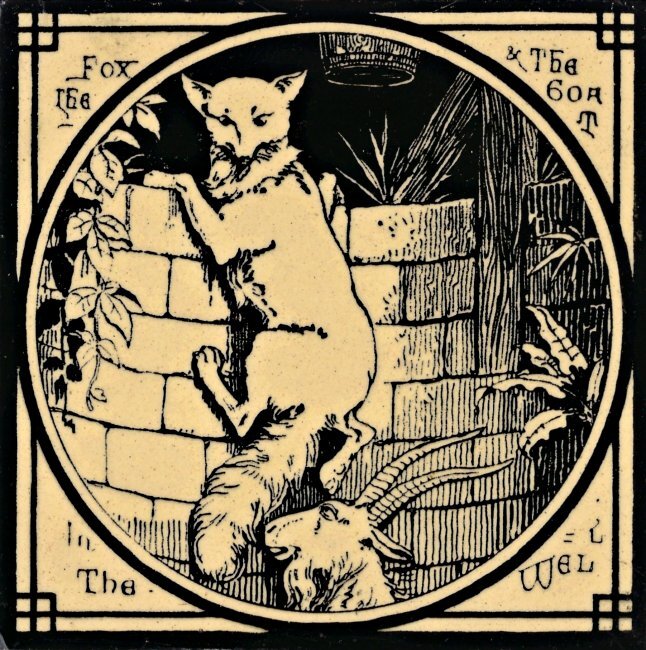
1875? Six-inch square tile titled "The Fox & the Goat in the Well." Manufactured by Mintons China Works, Stoke on Trent. Designed by John Moyr Smith. Unknown source.
In this lively scene, can we see in their faces the arrogance of the fox and the ignorance ofthe goat? Lovely brown and cream colors. The title is read in curious fashion, starting from nine o'clock and reading toward three o'clock, and then restarting from eight and reading toward four. In the upper left and lower right, one needs to read going up; the key is to start as far left as possible and always move right.
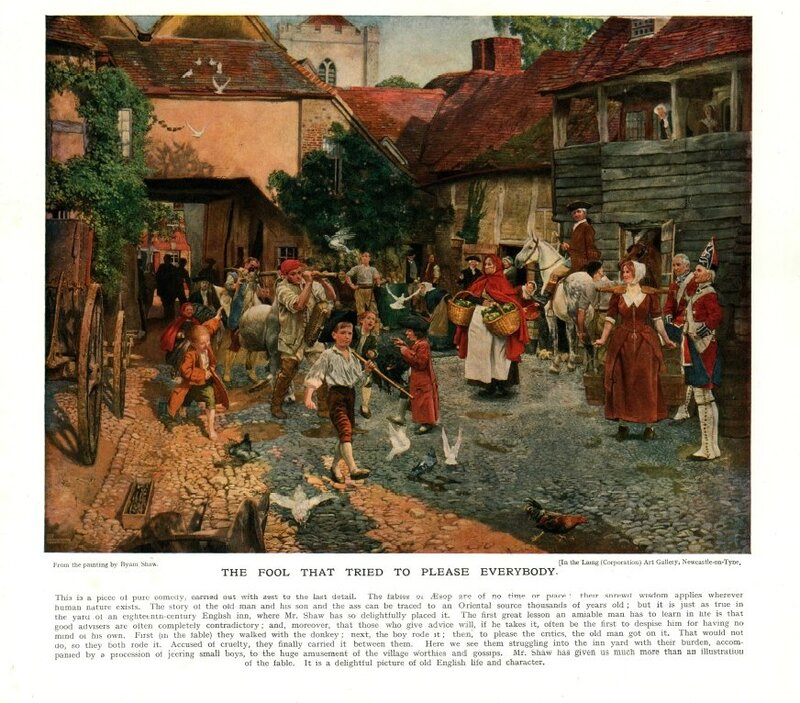
1912 "The Fool that Tried to Please Everybody." Illustration by Byam Shaw and text on p. 21 in "Libby's Annual" for 1912. $13.50 on Ebay, Dec. 20, '06.
The original painting, according to the article, is in the Lang Art Gallery. Shaw died in 1919. The painting is a more detailed presentation of MSA than I believe I have ever seen elsewhere. Libby's comment is excellent.
This is a piece of pure comedy, carried out with zest to the last detail. The fables of Aesop are of no time or place: their shrewd wisdom applies wherever human nature exists. The story of the old man and his son and the ass can be traced to an Oriental source thousands of years old; but it is just as true in the yard of an eighteenth-century English inn, where Mr. Shaw has so delightfully placed it. The first great lesson an amiable man has to learn in life is that good advisers are often completely contradictory; and, moreover, that those who give advice will, if he takes it, often be the first to despise him for having no mind of his own. First (in the fable) they walked with the donkey; next, the boy rode it; then: to please the critics, the old man got on it. That would not do, so they both rode it. Accused of cruelty, they finally carried it between them. Here we see them struggling into the inn yard with their burden, accompanied by a procession of jeering small boys, to the huge amusement of the village worthies and gossips. Mr. Shaw has given us much more than an illustration of the fable. It is a delightful picture of old English life and character.
1957 New Yorker advertisement for Edward Petry & Co: “The Fisherman who got a Bight.” Full page. August 31, 1957. Unknown source.
This advertisement, marked “A Fable,” goes a long way around to tell a story of someone who did not advertise well. Its best phrases are “not very bright about Bights” and “the Bight was a beaut.” Edward Petry will help you to use radio to advertise well!
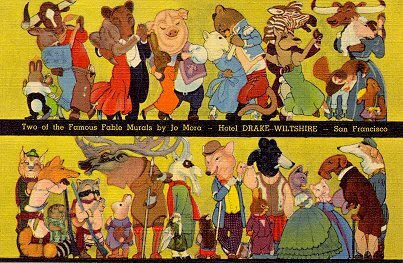
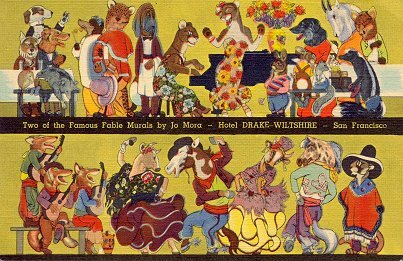
1925? "The Fable Restaurant" postcard with murals by Jo Mora, advertising The Fable Restaurant in San Francisco's Hotel Drake-Wiltshire. 5 3/8" x 3½". C.T. Art-Colortone. Genuine Curteich, Chicago. $16.69 from Gary Moretta, San Diego, CA, through Ebay, June, '00.
This card presents "Two of the Famous Fable Murals by Jo Mora." The figures above are dancing pairs. Those below seem to be conversing on their way to a hunt; at least some have rifles along. Now I begin to wonder how many cards there were in a set.
1925? "The Fable Restaurant" postcard with murals by Jo Mora, advertising The Fable Restaurant in San Francisco's Hotel Drake-Wiltshire. 5 3/8" x 3½". C.T. Art-Colortone. Genuine Curteich, Chicago.
This card presents "Two of the Famous Fable Murals by Jo Mora." The figures above seem to be individuals gathered around the piano, where a leopardess plays. Thus there are waiters, diners, drinkers. Below are several guitar-playing musicians who seem to have a very lively Flamenco sort of dance going among the five who are dancing. The flaunced skirts of two of these dancers are spectacular!
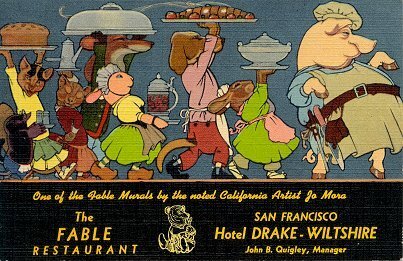
1925? "The Fable Restaurant" postcard with mural by Jo Mora, advertising The Fable Restaurant in San Francisco's Hotel Drake-Wiltshire. 5 3/8" x 3½". C.T. Art-Colortone. Genuine Curteich, Chicago.
The upper 2/3 of the card is "one of the Fable Murals by the noted California Artist Jo Mora." It pictures a parade of animal waiters led by a pig wearing a chef's hat. The card is not written on on the back. The picture side of the card is linen-like. I was lucky: another exemplar of this card sold a month earlier on Ebay for $10 more.
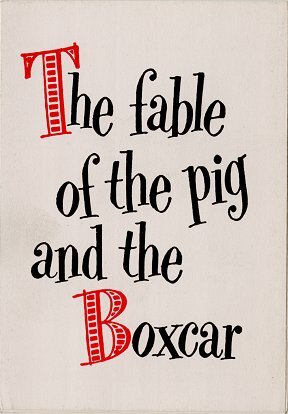
"The fable of the pig and the Boxcar." 3¼" x 4½" fold-out brochure by Southern Pacific Railway asking users of their railroad cars to clean them afterwards.
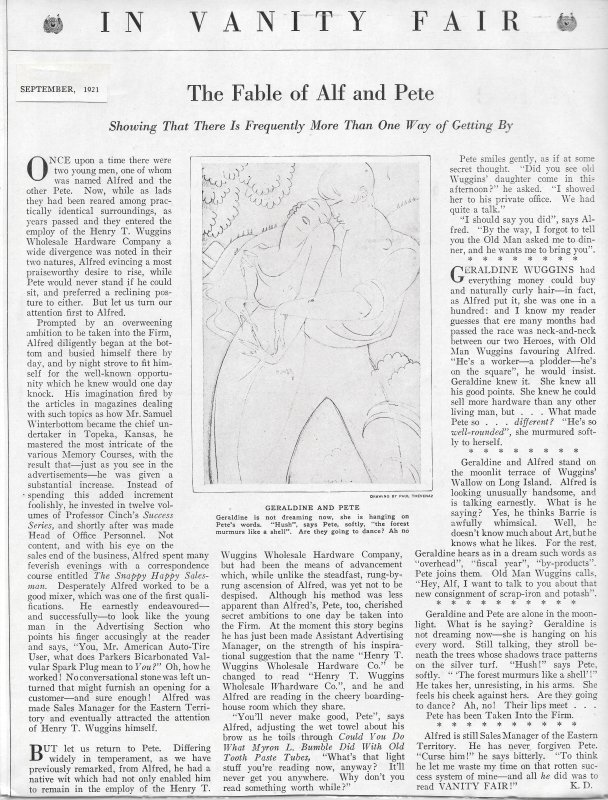
1921 "The Fable of Alf and Pete." K.D. Vanity Fair, September, 1921. 8.5" x 11".
An original fable in the magazine “Vanity Fair”. The author's initials are K.D. The title states “The Fable of Alph and Pete; Showing That There Is Frequently More Than One Way of Getting By.” A print of a picture titled “Geraldine and Pete” accompanies the story. The visual artist’s name is Paul Thevenaz.
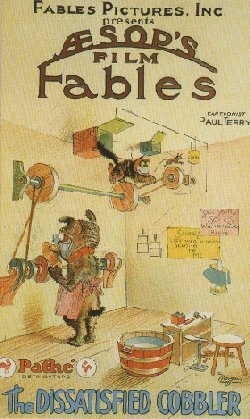
1922/80? "The Dissatisfied Cobbler" movie poster. "Fables Pictures, Inc., presents Aesop's Film Fables. Cartoonist: Paul Terry. Pathé Distributors." The original of this poster was released on 2/8/22. Matted and framed. $7.95 from Bob McDaniel, Lima, NY, through Ebay, May, '99.
Cat on treadwheel chases mouse on treadwheel, and that power's a dog-cobbler's rotary machine for working on shoes. Signs on the shop wall say "Shoes left over 10 days belong to me" and "Save your soles -- Walk on your hands." What might this scene have to do with Aesop? There is a signature of "Morgan" in the lower right of the lithograph, though I cannot discern the rest of the logo; I presume Morgan was the printer of the poster.
1980 "The Crow and the Pitcher." Use with the book. Society for Visual Education, Inc. $1.39 from Barb Daniels, Lebanon , OR , through eBay, March, '04.
This tape presents with several voices exactly the words of the book of the same title and year. The tape runs just over five minutes. There are a few sound effects. The tape has been well used. The pitcher answers back when the crow says that she wants the water. In fact, the artist works hard to give the pitcher strong facial expressions. The not-so-swift pitcher opines that tossing pebbles to get water makes no sense. The pitcher is smart enough to notice at the end of the story that he is stuck with all the pebbles! I also have the book.
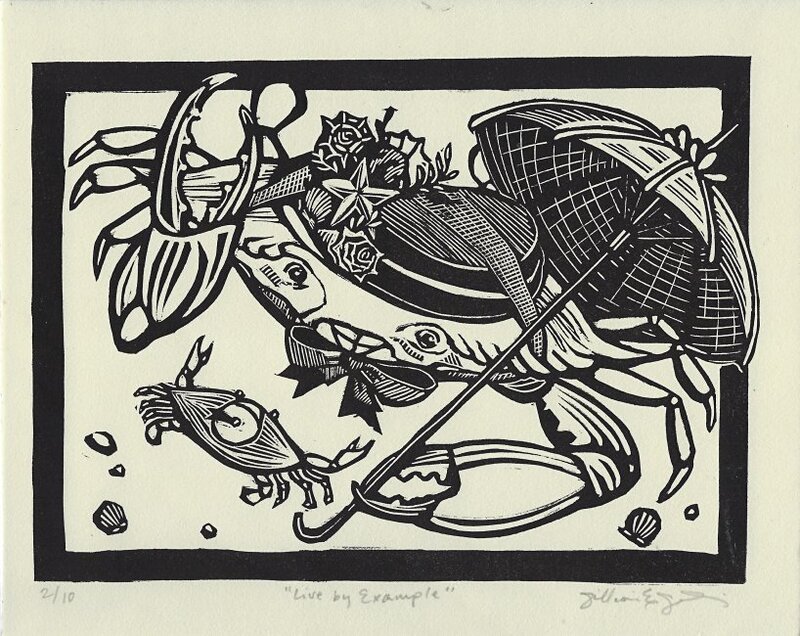
2015? Signed, numbered linocut block print of Aesop's Fable "The Crab and His Mother" in black and white by Jillian E. Jenkins of jumpjackstudio, Baltimore, MD, on Etsy. "Live by Example." #2 of 10. 8" x 10". $48.16, July, '20.
This is a bold, strong, delightful presentation. It gives the mother a hat secured under her chin by a bow, along with an umbrella in her claw. She dwarfs her little child as the two look straight at each other. The going straight is the issue here! "Live by example" indeed! The artist writes "I love making art that helps other people to see the world a little differently." That happens well here!
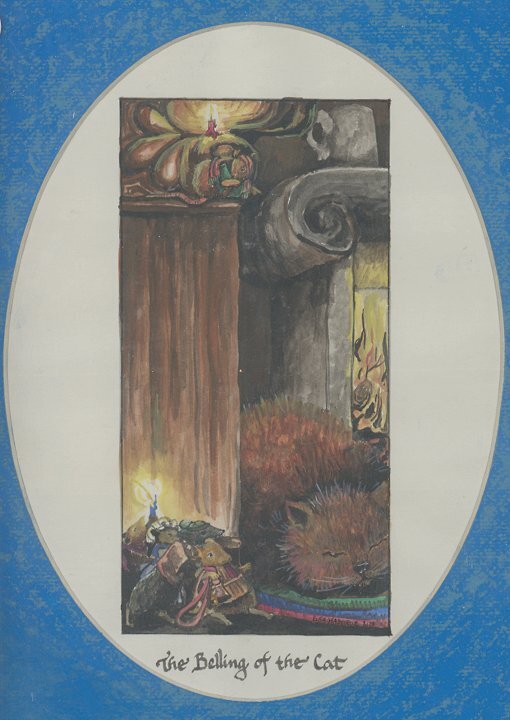
1970 "The Belling of the Cat." Water-color and ink panel by Lisa Haderlie. 4" x 7½" on paper set inside oval matting and framed in glass. $25 from William Hayes at the Alameda flea market, Jan., '02.
This is a typical instance of my collecting luck. At this flea market, I asked only a few dealers if they might have anything dealing with fables. Luckily, this was one of the dealers whom I asked! His answer was something like "Well, does Belling the Cat count?" Of course it does! Here is a one-of-a-kind work. The mouse is all ready, with bell in paw, as another mouse looks on from above. Is the cat aware of what is happening and about to make a move? How lucky of me to find this piece! Click on the smaller version just below to see a larger version.
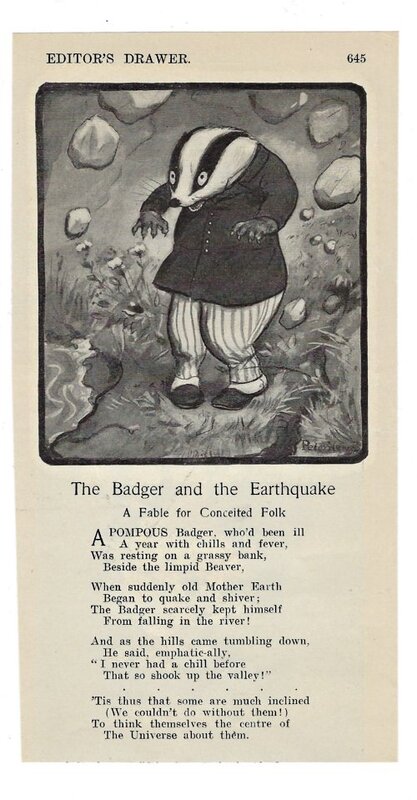
1905 "The Badger and the Earthquake: A Fable for Conceited Folk," , p. 645, Harper's New Monthly Magazine, March 1906. “Editor’s Drawer.” Image by Peter Newell. $3.50 from woods elf through Ebay, May, ’06.
A conceited badger thinks that his chills cause an earthquake. “I never had a chill before That so shook up the valley!” He exemplifies well “It’s all about me.”
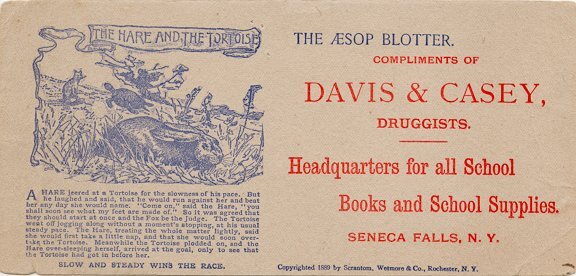
1889 "The Aesop Blotter" compliments of Davis & Casey, Druggists. Headquarters for all School Books and School Supplies. Seneca Falls, N.Y. Copyrighted 1889 by Scrantom, Wetmore & Co., Rochester, N.Y. $10 from Dave Cheadle, Englewood, CO, Sept., '99.
This blotter, about 3¾" x 8", shows the evidence of some use on its back. On its front, it has a good classic rendition of TH (I wish I could establish that this pudgy bunny was done by Weir) with James' text and moral verbatim. Nice job of blue and red printing on what might be a difficult medium.
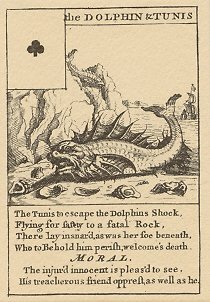
1797?/1980 "Superfine Harry VIII Playing Cards Made by I. Kirk, London. X Pounds." 2½" x 3¾". Reproductions produced especially for the Colonial Williamsburg Foundation. Two extras.
The legend on the packet, which shows a crude image of Henry the VIII, reads "For Exportation. Fifty pounds penalty if relanded, and twenty pounds if sold or used in Great Britain." Thomas Kirk did the illustrations for the Croxall edition of 1797; might he be connected with this "I." Kirk? Each card has a title, a fable and moral in verse, a picture, and a playing card face. That is a great deal of information to put into a small space! The verses presume that the player knows the fable. My favorite illustrations in this fifty-two card set are WC on the Jack of Hearts and "The Goat in the Well" on the Eight of Hearts. Many (all?) are signed by Kirk.
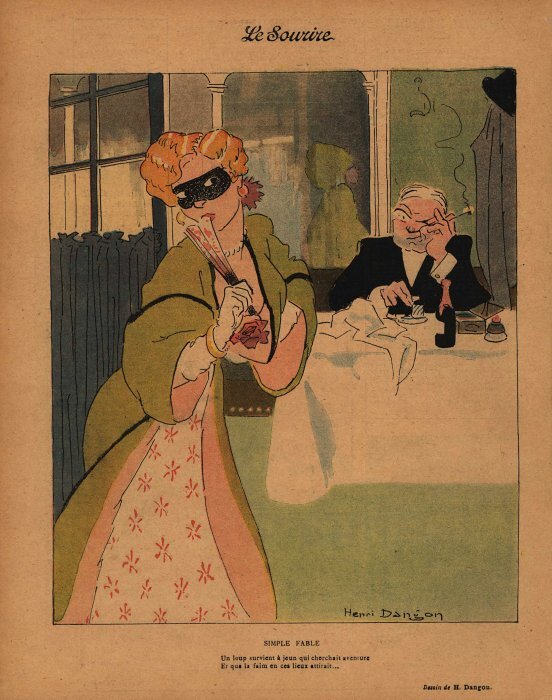
1899 "Simple Fable." Dessin de Henri Dangon. Back cover. Le Sourire No. 440, April 4, 1908. 9½" x 12". €10 at Clignancourt, July, '19.
A hungry wolf is here, and someone is seeking adventure. I myself am not too sure who is the wolf and who is the lamb in this attractive sketch. I also have a crazy sense that we have this illustration already somewhere in the collection, but I cannot find it.
1983 "Russian Folk Tales"(?) Set of ten oversized illustrations by E. Rachyov, with a Russian text. Various authors. Moscow: Malvish (?) Publishers. $19 at Fairy Tales & Dreams, DC, Dec., '91.
This excellent illustrator (named Rachyeva there) is responsible for excellent books of Krilov's fables done in 1965 and 1983. Here we have tales by O. Kapeetsa, M. Boolatov, and A(leksei) Tolstoy. The tales seem to be: "The Fox and the Wolf"; "The Goat and the Wolf"; "The Cat, Ram, Goat, and Bear"; "The Bear and the Little Girl"; "The Fox, the Cat, and the Rooster" (see Harvest [1967/70], 123); "The Bear and the Man"; and on the covers "The Rooster, the Hare, and the Fox." Rachyov's style is distinctive and engaging.
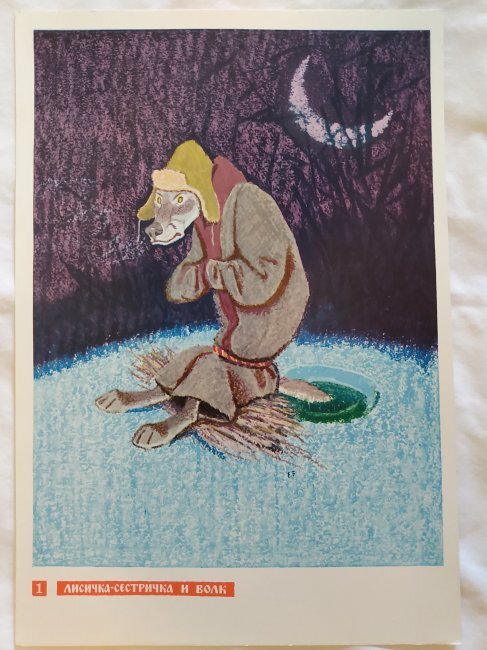
1978 "Russian Folk Tales." Set of ten oversized illustrations by Veniamin Losin, with text. Various translators. 11½" x 16¼".Moscow: Malysh Publishers. $6.48 at The Book Center, SF, Jan., '91.
#8 and #1 illustrate FC. Note that #8 pictures the first phase of the fable, while #1 pictures the second. Large, colorful folk art.
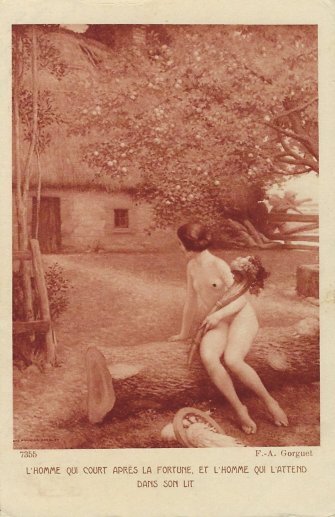
1900? Postcard "The Man Who Chases Fortune." F. A. Gorguet. Braun & Cie 7355. $7 from HipPostcard, Oct., '24.
Here is a surprising French postcard found in Cluj, Romania. La Fontaine's long fable ends up saying that Fortune has been sitting in front of your home while you have been chasing her around the world. Notice the figure chasing off -- after Fortune? -- in the upper right.
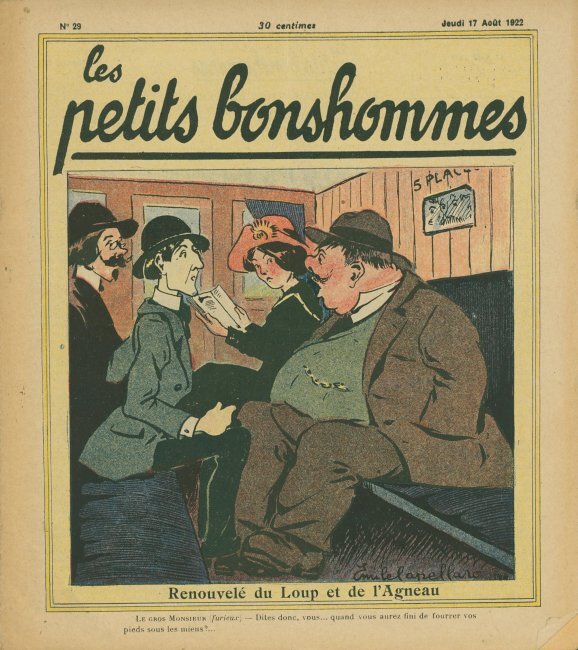
1922 "Renouvelé du Loup et de l'Agneau." ("Repeat of WL"). Emile Lapellaro. Les petits bonshommes, No. 29. August 17, 1922. €10 at Clignancourt, July, '23.
"The fat Monsieur, furious: 'Say, when have you finished sticking your feet under mine?" This is the wolf accusing the lamb of muddying his water. It fits perfectly! He has been stepping on her feet the whole time.
1992? "Reineke Fuchs." 32 plastic-coated cards featuring a backing, numbering system, Kaulbach image, and two or three lines from Goethe's text.
There are eight "quartets," each presenting a phase of Reynard's story. The numbering system assigns a numeral in a circle within the black-and-white image on each page for the quartet—from "1" to "8." Above this, outside the image, is a set of from one to four symbols like asterisks. So each card is unique: the second card, e.g., of the fifth quartet. The backing of each card presents the same set of six fox images in a checkerboard pattern balancing light and shadow. I believe that Herr von Fuchs arranged for the production of these lovely laminated cards himself. I am sorry that my favorite image of the cat attacking the local priest is not here. Perhaps the most graphic of the cards here is the third card of the sixth quartet, in which the severed head of the rabbit is brought forth from the wallet.
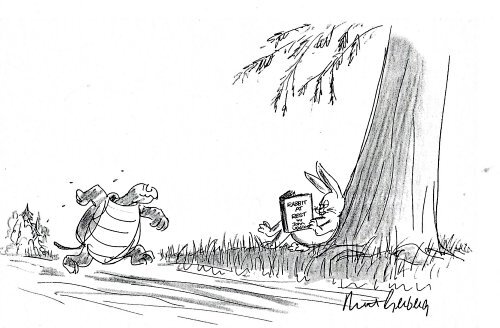
1990? “Rabbit at Rest.” Mort Gerberg. New Yorker. Xerox copy. Unknown date and source.
In 1990, John Updike published his fourth novel about "Rabbit" Angstrom, titled Rabbit at Rest. I presume that Gerberg is having fun carrying that book back into the fable. Well done! In fact, this particular cartoon was discussed in a famous retrospective conversation with Gerberg.
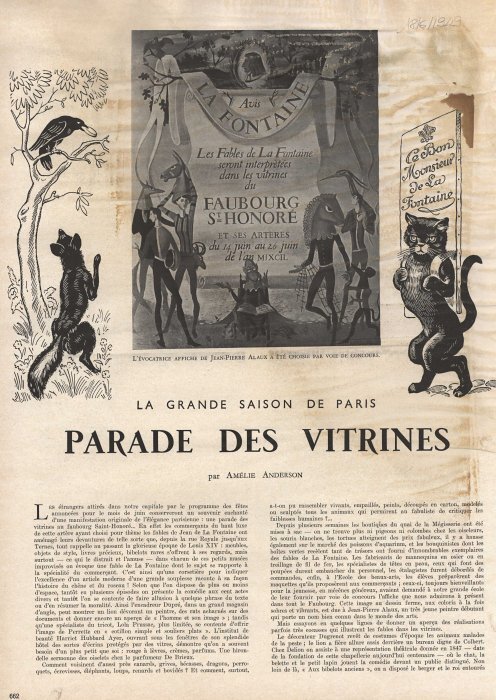
1949 Two-page article (from Illustration Magazine?) "Parade des Vitrines" by Amélie Anderson. Pages 662-663. 1949.
Apparently the stores and shops in the Faubourg St. Honore and its adjacent streets at this point in history put on grand shows of coordinated windrow dressing. In June, 1949 that effort focused on the fables of La Fontaine. The pre-title of this article is "La Grande Saison de Paris." This is one of the few objects in the collection that has been harmed since it came to us. There is water damage that hurts the images, but -- happily -- not the text. I have sought for a replacement, but so far in vain. Apparently the shops focused on culture at the time of La Fontaine, including furniture, books. Each window focused on one fable of La Fontaine that had something to do with the objects offered by that vendor. A corset-maker focused on OR! "Bend, do not break!" A specialist in tricots took Perrette from MM. A frame-maker chose "The Lion and Artist" and "A Man and His Image." Photos from the actual windows contribute well to this article. Where is another copy?