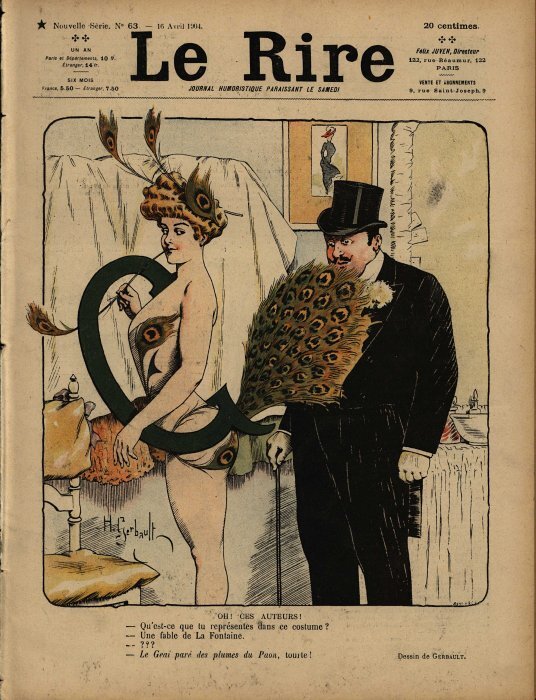
1904 "Oh! Ces Auteurs!" Dessin de H. Gerbault. Front cover. Le Rire Nouvelle Serie No. 63, April 16, 1904. 9" x 12". €10 at Clignancourt, July, '19.
I have no idea how "tourte" (meat pie) figures here. I gather he is asking what her costume represents and she is answering first "a La Fontaine fable." Then to his silence she further responds "The Jay with Peacock Feathers." Is she calling him a "dummy"?
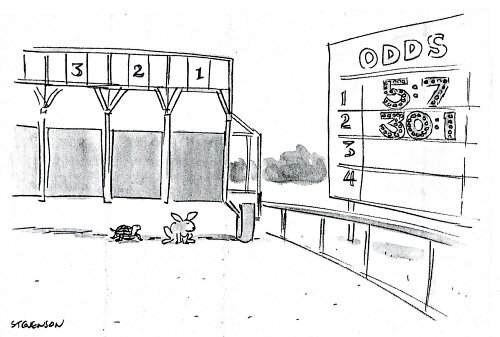
1990 “Odds on the TH Race.” James Stevenson. New Yorker. Jan. 29, ‘90. Xerox copy.
It does not look good for the tortoise with these odds announced before the race!
1912 "Number by Caption." The number in the series here appears in the upper left below the banner at the top of the verso. There are larger and more elaborate floral patterns in both upper corners. Within the banner we read not only "100 Designs in Set" but also "Series I." Complete set for £140 by mail from Murray Cards International, Cecil Court, London, Oct., '06. Complete set of 100 missing only card #36 for £32.10 from John Whitehurst, Staffordshire, England, through eBay, August, '03. Card #36 from Murray Cards International, London, for £3, August, '03. Extra copies of #20, #33, #41, #45, #46, and #77.
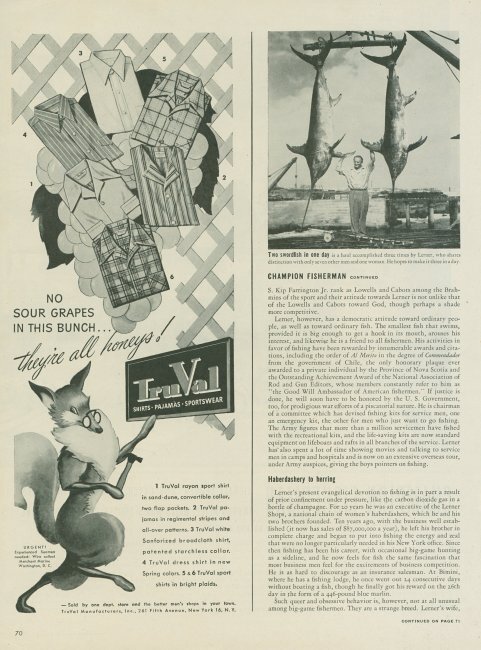
1942? "No Sour Grapes in This Bunch…they're all honeys!" Advertisement for TruVal shirts, pajamas, and sportswear. Unknown magazine. $10 from an unknown source, Feb., '24.
The black-and-white fox here appears elsewhere and even in color in further TruVal advertisements. Notice the urgent plea for experienced seamen for the Merchant Marine. Does the magazine insert this kind of extra invitation into someone else's advertisement?
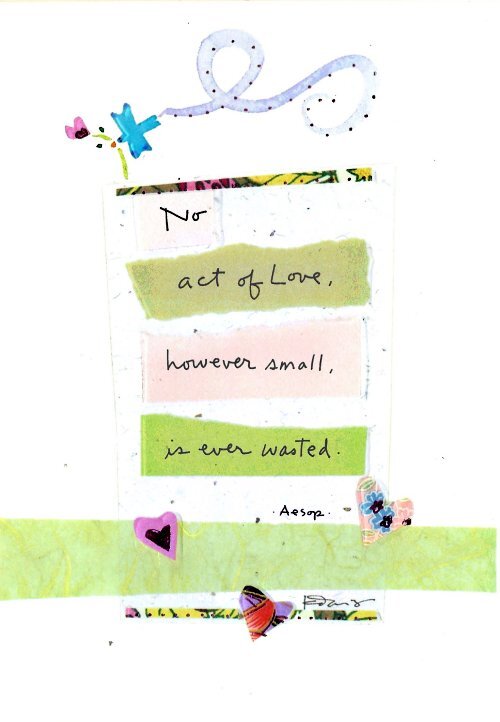
1971? "No act of Love, however small, is ever wasted. Aesop." K(athy) Davis: Sweet Nothings. Recycled Paper Greetings. Gift of Mary Pat Ryan, July, '86.
Here are two pages of a card sent to Mary Pat by a friend. Mary Pat framed it for me. I am unsure of how the two pages fit with each other: most probably the "Aesop" and "Thank you" sides were #1 and #3 of the four-sided card. The saying raises a question for me: from where in "Aesop" did this saying come? I presume LM. Even more I am asking "In which version of Aesop in English" did this saying appear? It would make a fascinating but wide-ranging project to track all the sings which people attribute to "Aesop"! I have found Kathy Davis on the web and her signature, but I have not found this dear ephemeral card!
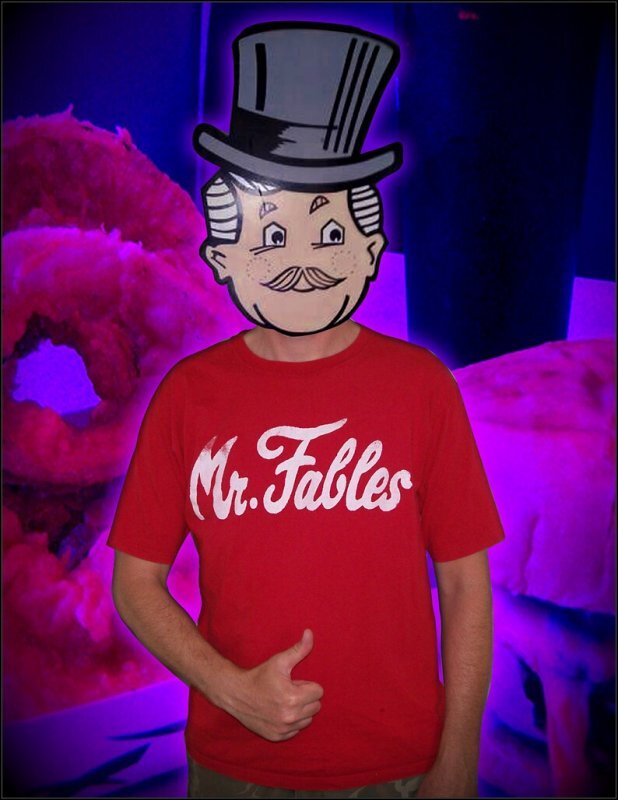
2023 "Mr. Fables" T-shirt.
The seller quotes "People like Mr. Fables- People like yoooou!" Mr. Fables was a chain of cafeteria-style family restaurants located throughout Western Michigan. If you grew up around the area you probably have rosy memories of their huge onion rings and awesome Mr. Fabulous burgers with their "secret recipes." Alas, they fell victim to the national chains and the last of them vanished in the late 90s." I thought the composite photo on Etsy also too good to miss!
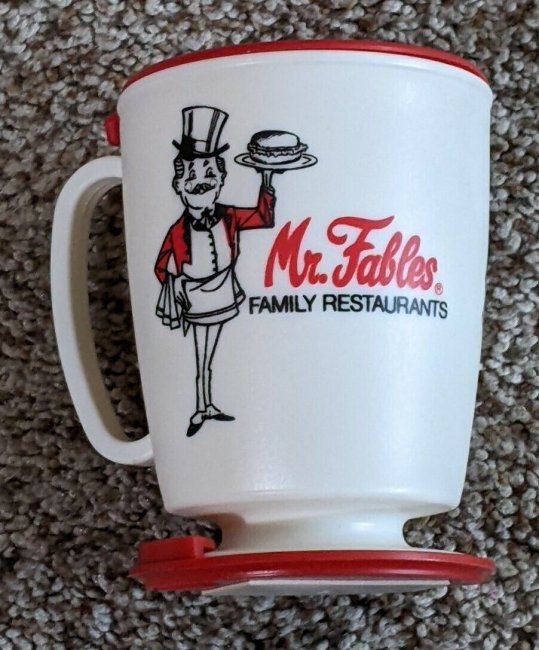
1982? "Mr. Fables Family Restaurants" travel mug. Grand Rapids, MI. Whirley Industries. Suitable for dashboard use. $16 from anythingeverythingandmo through Ebay, Oct., '22.
There is a sticky adhesive patch on the separate red bottom-piece to hold it onto the dashboard of a car or truck, and then one can slide the mug into this holder. The seller emphasizes that "This is an extremely collectible Mr Fables travel mug, and probably quite rare in its unused condition." See also the sets of gift certificates from Mr. Fables restaurants.
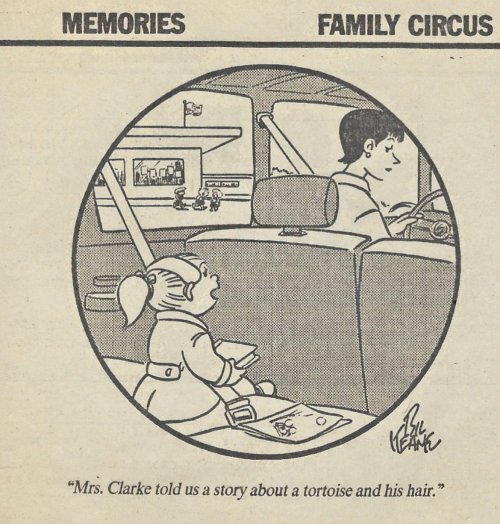
1998? “Memories.” Bill Keane in the series “Family Circus.” Unknown newspaper. Unknown source.
A colored version of this appeared in 1998. The wordplay on “hare” is ever recurrent!
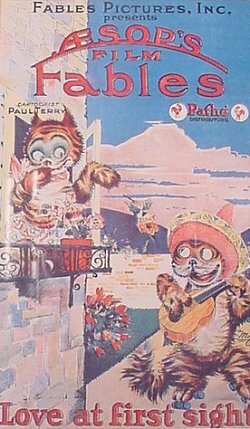
1922/80? "Love at First Sight" movie poster. "Fables Pictures, Inc., presents Aesop's Film Fables. Cartoonist: Paul Terry. Pathé Distributors." The original of this poster was released on 4/11/22. Matted and framed. $11.90 from Bob McDaniel, Lima, NY, through Ebay, May, '99.
A cat with roller skates and a sombrero serenades a lovely female cat on a balcony. What might this scene have to do with Aesop? I think I can discern a signature of "Morgan" from Cleveland in the lower right of the lithograph; I presume Morgan was the printer of the poster.
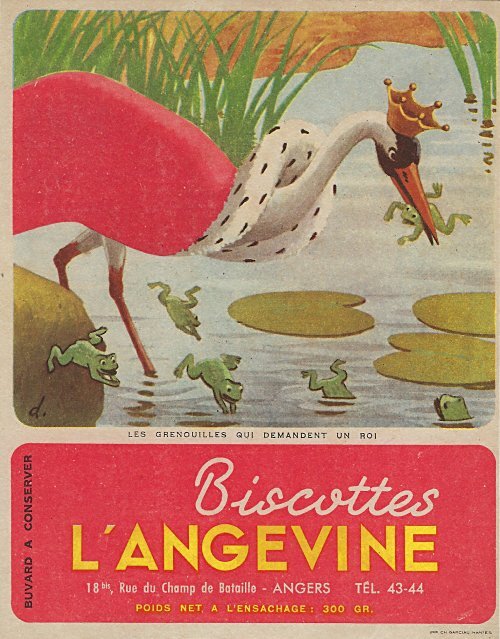
1950? "Les Grenouilles qui Demandent un Roi." Biscottes L'Angevine. Angers. 5¼" x 6¾". Printed in Nantes. €1 from French Vintage Shop, Paris, through eBay, Feb., '13.
The crown and regal garb distinguish this king. The frogs are generally in mid-leap into the water – all but the helpless one caught in the king's beak. Lively colors mark this blotter.
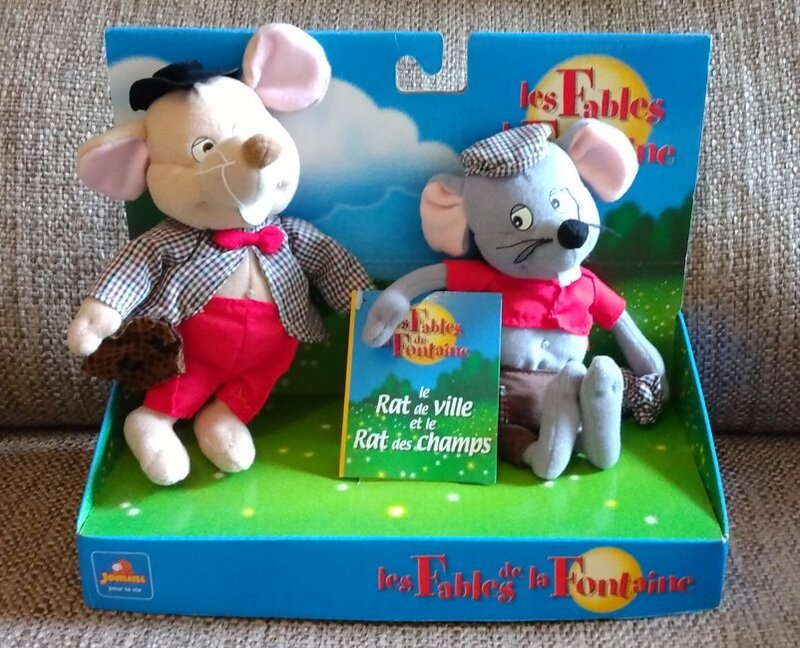
2000? "Les Fables de la Fontaine: le Rat de ville et le Rat des champs." Soft sculptures. Écommoy, France: Jemini. Made in China. Unknown source and date of acquisition.
Two cute little fellows, nicely contrasted with each other. The back of the packaging displays at least three other pairs in the series, and I have seen yet another that was once available on the web. "Collectione les tous!"
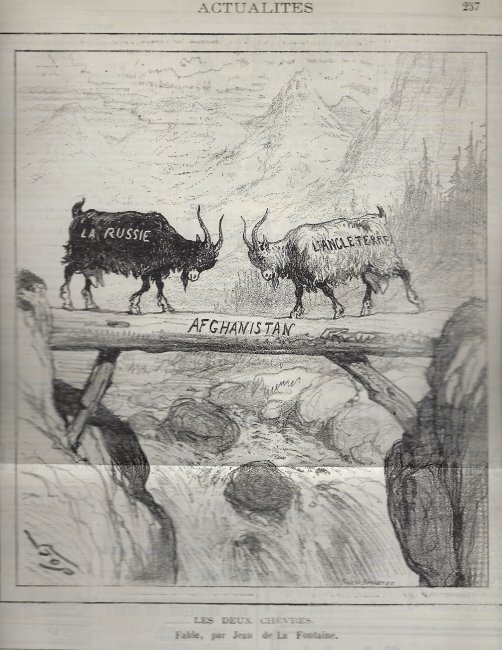
1878 "Les Deux Chevres." Charivari, Paris, November, 1878. Russia and England will hurt each other fighting over Afghanistan. €4.50 from lycoum2 through Ebay, March, '22. Second copy from an unknown source, July, '22.
Alas, how many international conflicts follow the pattern of this sad fable of two enemies meeting on an bridge large enough for only one. Does the impact of a cartoon like this depend utterly on the audience's knowing the fable beforehand?
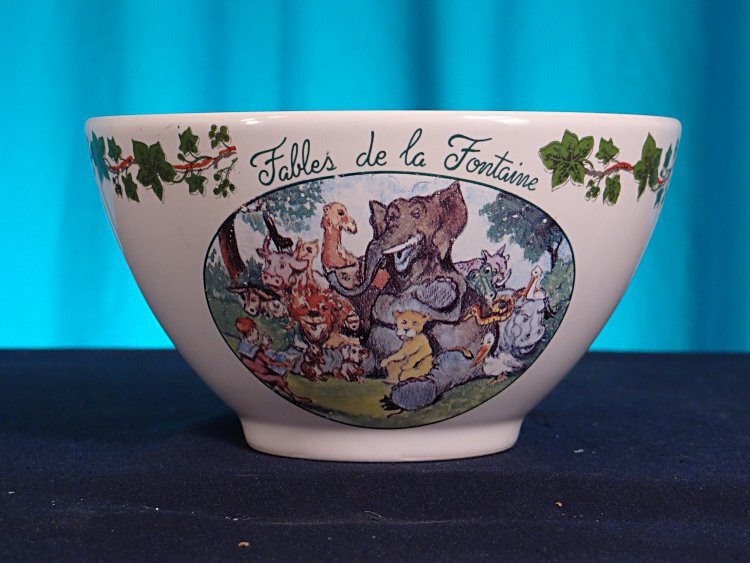
A handleless bowl 6" across featuring "Les Animaux de La Fontaine." The lines on the back are "Ecoutez humains/Vous verrez que chez vous/J'ai puisé ces leçons." The illustration shows a child sitting before a large gathering of animals with the camel and elephant at their center.
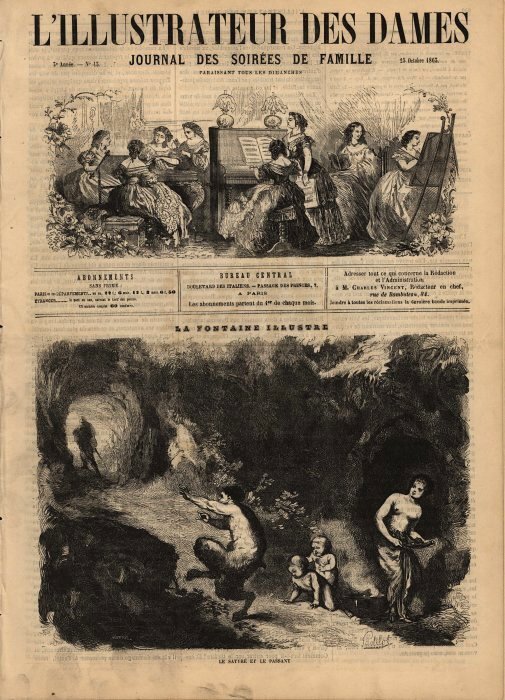
1863 "Le Satyre et le Passant." (Jean) Pastelot. L'Illustrateur des Dames: Journal des Soirees de Famille." 3rd year, No. 43. October 25, 1863. Front cover. 10¼" x 14".
This rendition of the fable is more active than some others. The satyr is actively dispelling the visitor or, perhaps more accurately, warding him off from his children and wife. The attractive woman balances the male satyr nicely. I cannot tell whether we are in a cave or a woods: perhaps that is the point!
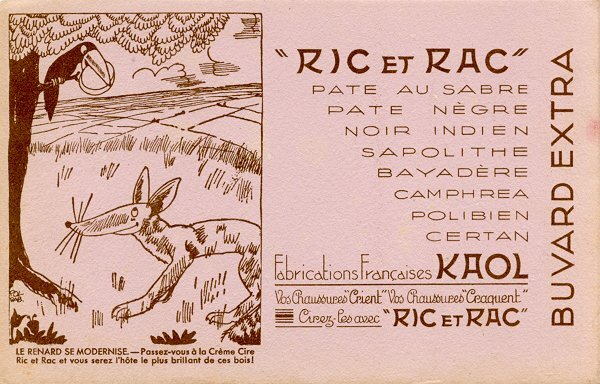
1955? "Le Renard Se Modernise." "Ric et Rac," Fabrications Françaises KAOL, a manufacturer of shoe polishes. The illustration is signed "Pol Pab" or "Pol Rab." 8½" x 5 3/8". $5 from Mme Denise Debuigne, Rennes, France, May, '02.
Here is a simple blotter with brown ink on a light pink background. The left section of the blotter consists in a traditional sketch of FC. The fox is, however, asking the crow to pass the Ric et Rac, and then he will be the most brilliant inhabitant of the forest. I gather that the crow is holding not a cheese but a can of shoe polish! The bottom lines have a nice jingle: "Your shoes creek, your shoes crack./Polish them with 'Ric et Rac.'"
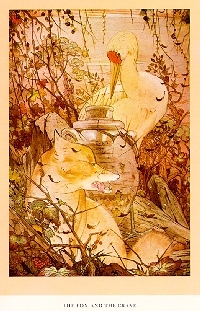
1909 "Le Renard et le Héron" from Detmold's Fables d'Esope (1909). Purchased as a gift by Deborah Ruck on January 14, 1990 from a stall on the bank of the Seine near Notre Dame, Paris. The print is an offprint, rather than a page taken from a book. Mounted and labelled.
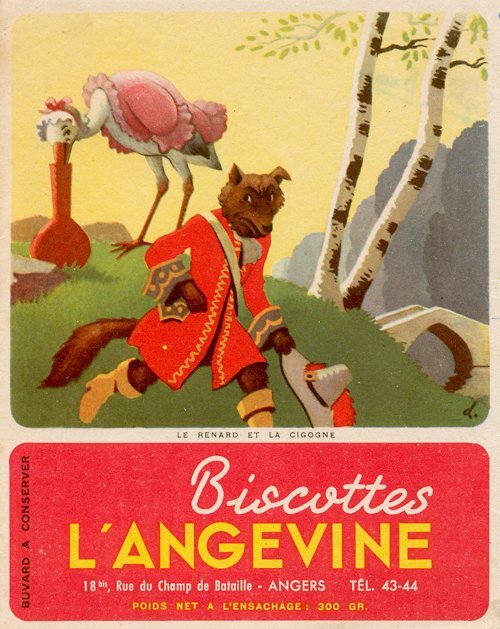
1950? "Le Renard et la Cigogne." Biscottes L'Angevine. Angers. 5¼" x 6¾". $5 from Mme Denise Debuigne, Rennes, France, May, '02.
The upper three quarters of this colorful blotter are a simple illustration. The fox dressed in courtly garb strides away disgruntled from the feminine stork with her beak in a vase. This blotter seems to have doubled as the label for the package, since the blotter gives a net weight at the time of their packaging.
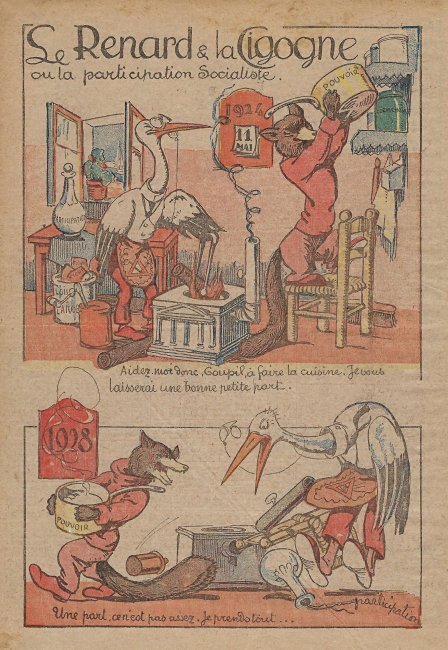
1927 "Le Renard & la Cigogne ou la participation Socialiste." Franc Maconnerie? Which journal unknown. $8.24 from LeGrand Ythier, Ouzouer sur Loire, France, through Ebay, July, '20.
From what I can see, this delightful duochrome cartoon presents 1924 – in fact, May 11, 1924 – as a promise of great cooking together between the fox and the stork. "Help me to make the meal, Goupil. I'll leave you a nice little part." I gather that is the voice of the fox Renard. The pot is labeled "power." Then in 1928, the fox makes off with the whole pot. "One part, that is not enough. I take it all." In the meantime, what comes dribbling out of the stork's famous vase is "participation." So "Socialist promises end up being totalitarian"?
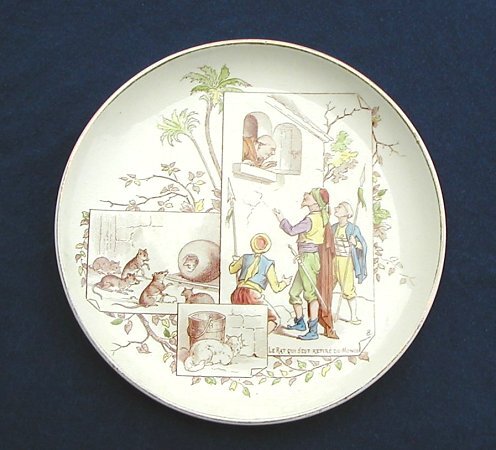
1900? Faience plate 8" in diameter showing three scenes depicting "Le Rat qui s'est Retiré du Monde." Numbered "8." A mark on the back seems to combine the letters "M" and "C" and says "déposé Fables Terre de Fer." $45 from Daria Edwards, NY, Feb., '00.
This sad story is of the religious hermit-rat who moves into a cheese to live and turns down his fellows when they, under attack, come asking for help (La Fontaine VII 3). He offers them a blessing and says that he, separated from such worldly concerns, will give nothing more. Here a colored panel shows three human soldiers appealing to a monk who leans out of his home's window as they appeal to him. The smaller monochrome panels show the animal scene, complete with its large ball of cheese, and also the enemy: the cat waiting at a hole for any rat who emerges.
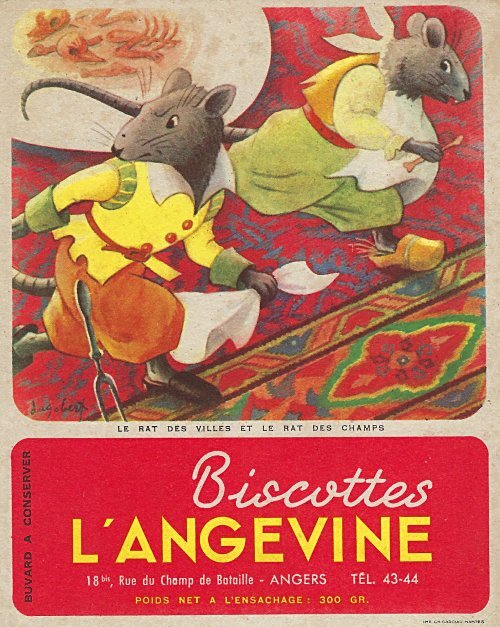
1950? "Le Rat des Villes et le Rat des Champs." Biscottes L'Angevine. Angers. 5¼" x 6¾". Artist: Dagobert. Printed in Nantes. €1 from French Vintage Shop, Paris, through eBay, Feb., '13.
This blotter is one of the best executed of the set. Both mice take off in a hurry. The country mouse in the upper right has simple garb and wooden shoes. The luxurious carpet is beautifully done. The title of this fable is usually given "Le Rat de Ville et le Rat des Champs."
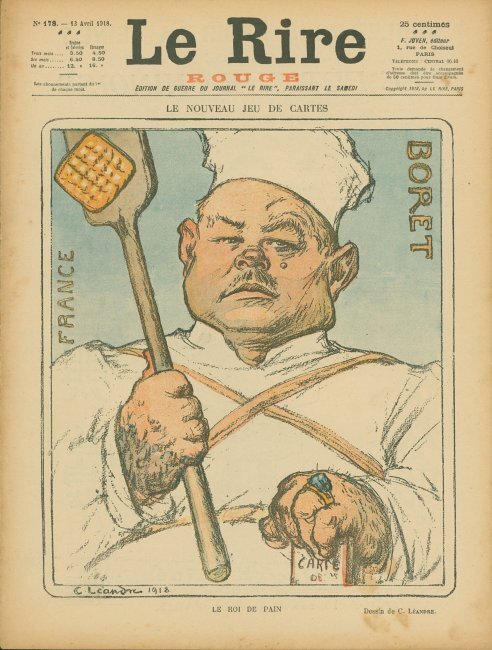
1918 "Le Nouveau Jeu de Cartes." Boret: Le Roi de Pain. Cover of Le Rire Rouge, Édition de Guerre. €10 at Clignancourt, July, '23.
I purchased this copy wondering if it was a parody on Florian's "Le Chateaux des Cartes." I doubt that now. But one never knows..... Boret was the Minister of Food Control in the late days of World War I. He is thus the "King of Bread."
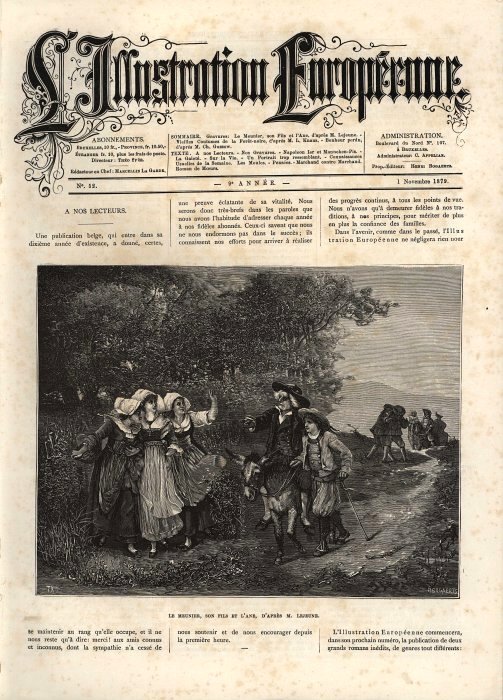
1879 "Le Meunier, son Fils et l'Ane, d'apres M. Lejeune." L'Illustration Europeenne, November 1, 1879. 9th year, Number 52. Front cover. 10¼" x 14".
This rendition of MSA seems very familiar. A group of women criticize the adult miller for making his son walk beside his mount. The son is here propped up with a stick. The following page quotes a 16th century version of the fable, concluding with "Ne nous en chaille, mais faisons toujours ce qui'il est bon de faire." The article then asks "Ne trouvez-vous pas cette conclusion superior a celle de La Fontaine?" La Fontaine's miller decides to please himself.
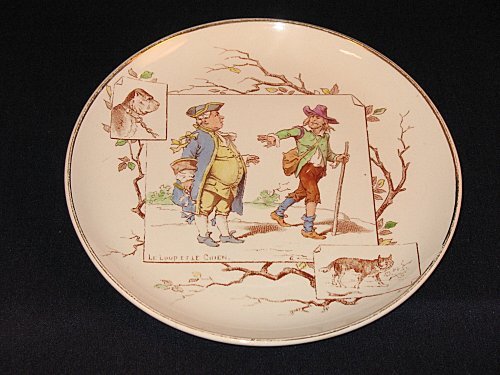
1900? Faience plate 8" in diameter showing three scenes depicting "Le Loup et le Chien." Numbered "6." A mark on the back seems to combine the letters "M" and "C" and says "déposé Fables Terre de Fer." $9.99 from Antiques Gallery, St. Cloud, MN, through eBay, Feb., '03.
The smaller pictures on the upper left and lower right picture the chained dog and the departing wolf, respectively. The central picture portrays a thin, poorly clad man with his stick and satchel taking his leave from a rotund man in a uniform of service. The latter carries a set of keys. La Fontaine's fable says that this wolf ran away and is running still!
1960? "Le loup et l'agneau." Dauré Apéritif Naturel. 5" x 7¾". $5 from Mme Denise Debuigne, Rennes, France, Feb., '02. Extra copy in only good condition from Dany Wolfs, Roeselare, Belgium, May, '01.
Red ink on a cream background. This fable builds on La Fontaine's WL. Here the wolf proclaims to the lamb as the latter scampers away: "You are lucky that I have not yet taken my Dauré this morning!" Is the point that water comes only after a Dauré aperitif opens the way for it?