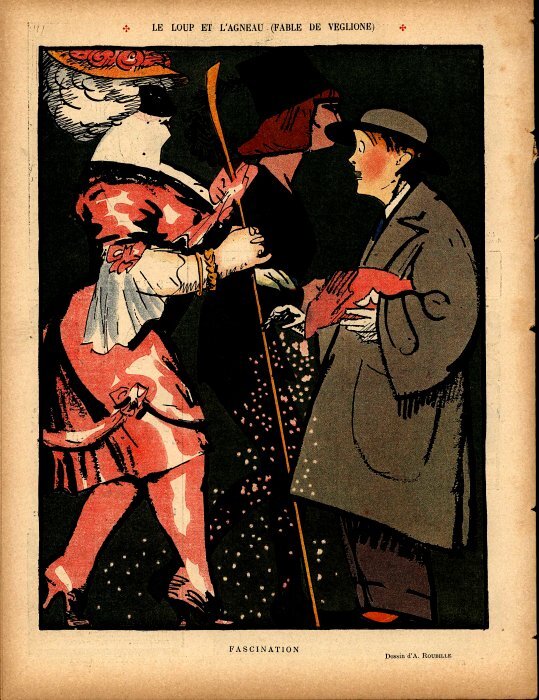
1911 "Le Loup et l'Agneau (Fable de Veglione): Fascination." A. Roubille. Le Rire No. 428, April 15, 1911. 9" x 12". €10 at Clignancourt, July, '19.
Is the wolf in pink about to devour the fascinated male lamb in gray?
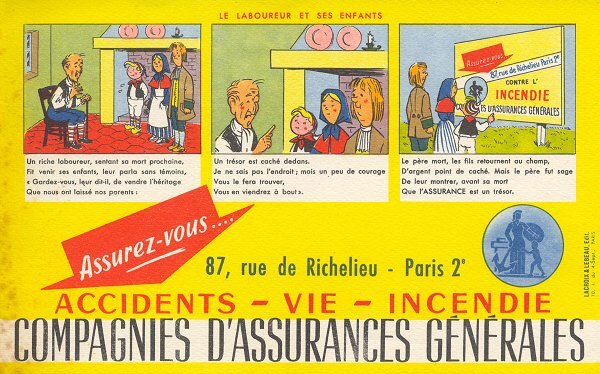
1955? "Le Laboureur et ses Enfants." Compagnies d'Assurances Générales, Paris. 8¼" x 5". Paris: LaCroix & LeBeau, Edit. $5 from Mme Denise Debuigne, Rennes, France, August, '02.
The story of "Le Laboureur et ses Enfants" is presented in full color in three quadrants across the top of this lively yellow blotter. The first two scenes quote La Fontaine and are true to his version. The third scene shows the children facing a billboard sign advertising insurance from Compagnies d'Assurances Générales. The father had been wise enough, the advertisement's text says, to show them that insurance is a treasure. The turning of the fable into an advertisement is clever enough.
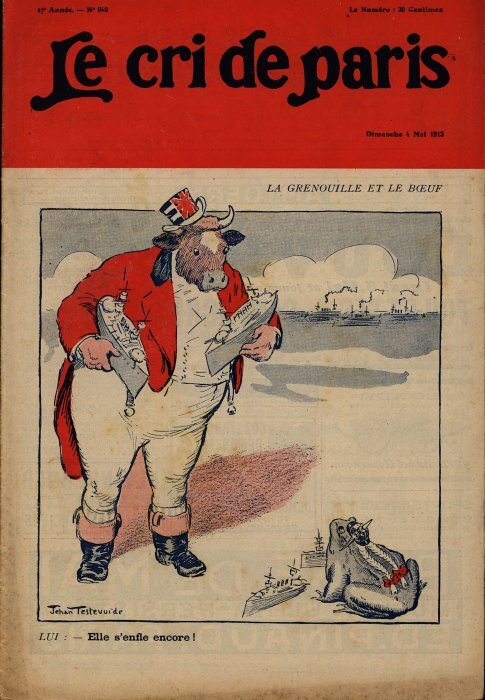
1913 "Le Grenouille et le Boeuf." Jehan Testevuide. Front cover. Le Cri de Paris No. 849, May 4, 1913. 8¼" x 11¾". €10 at Clignancourt, July, '19.
England holding its ships looks at the little frog and finds him blowing himself up with ships. Is England even giving ships to the frog? Is that the famed British fleet in the background? A little online research suggests that Testevuide did several covers for "Le Cri de Paris."
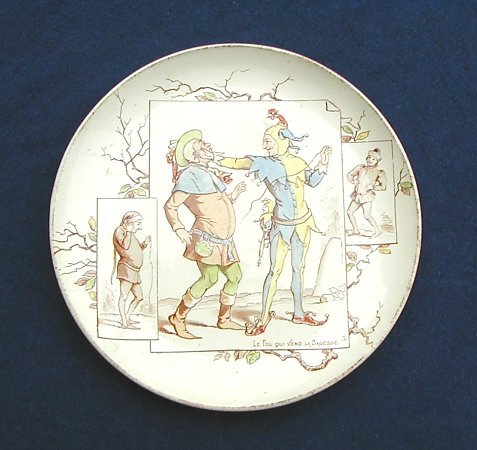
1900? Faience plate 8" in diameter showing three scenes depicting "Le Fou qui Vend la Sagesse." Numbered "3." A mark on the back seems to combine the letters "M" and "C" and says "déposé Fables Terre de Fer." $45 from Daria Edwards, NY, Feb., '00. Click on the image to see it enlarged.
The madman offers wisdom for a price, and gives those who pay a slap and a piece of thread two ells long. In this strange and wonderful story (La Fontaine IX 8), the first result is that we should not try to make sense of this act – or of anything else that fools say or do! The second result occurs in the story when one fellow, embarrassed by the blow and thread, goes to find a wise man, who tells him immediately that these things are symbols: "Stay this length of thread away from all madmen, or you'll get similar 'caresses.' You were not fooled; that madman does sell wisdom." The plate effectively presents both objects of trade, the slap and the thread. Monochrome characters in the panels at left and right are pondering the string and laughing, respectively.
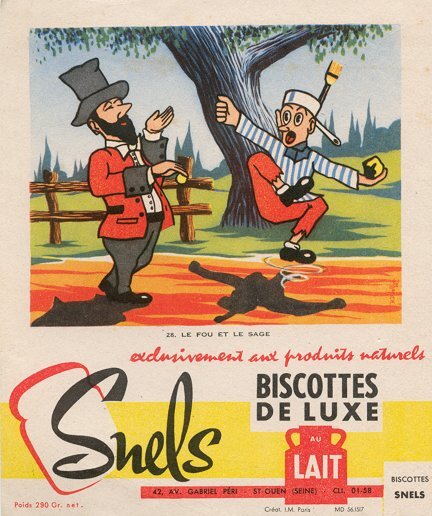
1958? "Le Fou et le Sage." #28 from Snels Biscottes de Luxe au Lait. 5¾" x 6¾". St. Ouen (Seine). Créat. I.M., Paris. $5 from Mme Denise Debuigne, Rennes, France, May, '02.
A large colored cartoon dominates this blotter. La Fontaine XII 2 is, in Spector's edition, "Un Fou et un Sage," whereas this blotter has "Le Fou et le Sage." This is clearly the fable, a replay of Aesop's rewarding the fool who threw a stone at him and then encouraging him to throw one at a richer man for a bigger reward. Here the well-dressed man has, I gather, a coin in his hand, while the fool has a large rock that he is ready to hurl. The latter is marked as a fool, I think, by the cooking pan he wears for a hat.
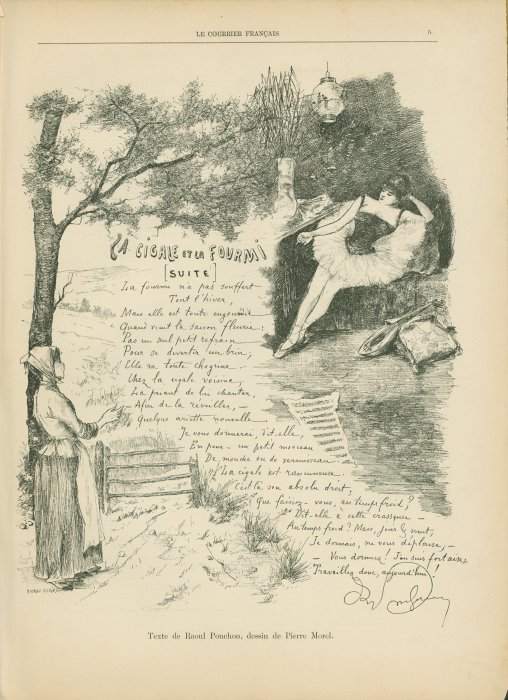
1886 "Le Courrier Français," July 25, 1886: La Cigale et la Fourmi (Suite). $10 from journauxanciens through Ebay, Feb., '24.
In a text by Raoul Ponchon with an illustration by Pierre Morel, the situation is now at the end of winter and the beginning of spring. The ant comes to the Cicada to offer to pay for a song. The cicada, rightfully resentful, asks what the ant did all winter. "I slept!" The cicada answers "Then work now!" Page 5 of the 8-page magazine, 11½" x 15¼". The cover cartoon has a more obscure reference to FK.
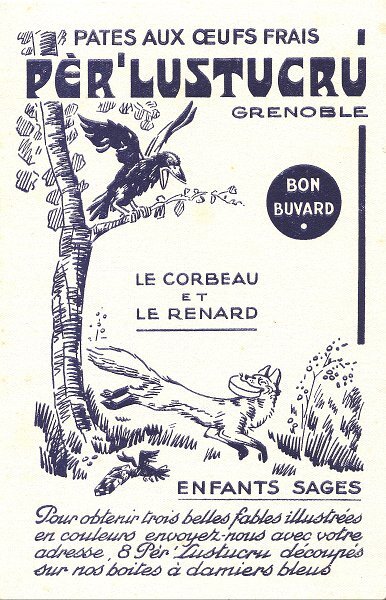
1965? "Le Corbeau et le Renard" blue and white blotter. "Bon Buvard." 5¼" x 8¼". Pates aux Oeufs Frais Pèr' Lustucru. Grenoble. Paris: E.G.F.P. $5 from Mme Denise Debuigne, Rennes, France, May, '03.
The blotter shows the fox running away with a large cheese in his mouth. The text on this blotter is a further advertisement: "Enfants Sages. Pour obtenir trios belles fables illustreés en couleurs envoyez-nous avec votre adresse, 8 Pèr' Lustucru découpés sur nos boites à damiers bleus."
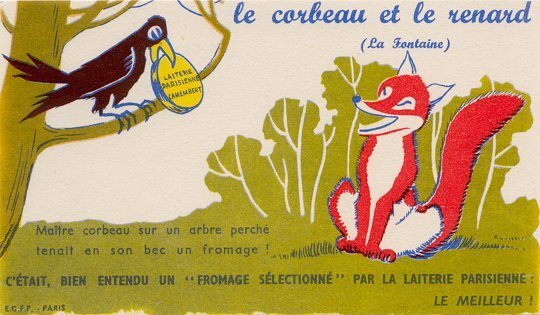
1965? "le corbeau et le renard" (La Fontaine)" colored blotter. 7¼" x 4¼". La Laiterie Parisienne. Paris: E.G.F.P. $5 from Mme Denise Debuigne, Rennes, France, May, '02.
The blotter quotes the first two lines of La Fontaine's fable: "Master Crow perched on a tree held in his beak a cheese" and then adds "It was, of course, a 'Fromage Sélectionné' from The Parisienne Dairy. The best!" The illustration in green, brown, yellow, and orange is striking.
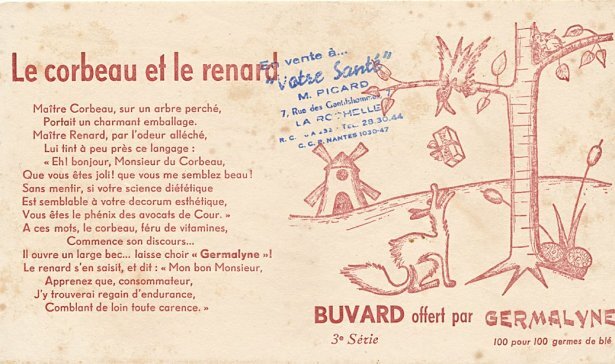
1960? "Le corbeau et le renard." Buvard offert par Germalyne. 5" x 8½". 3e Série. $6 from Bertrand Cocq, Calonne Ricouart, France, Sept., '18.
Red ink on a cream background. This blotter, like the does not just present a La Fontaine fable. It builds on the fable of FC to offer a new point. The crow is carrying not a "fromage" but an "emballage." The fox speaks not of the crow's possible singing voice but about his "science diététique." The crow lets his package of Germalyne fall, and the fox knows that it will help make up whatever he might be lacking in endurance. This advertisement also announces "100 pour 100 germes de blé."
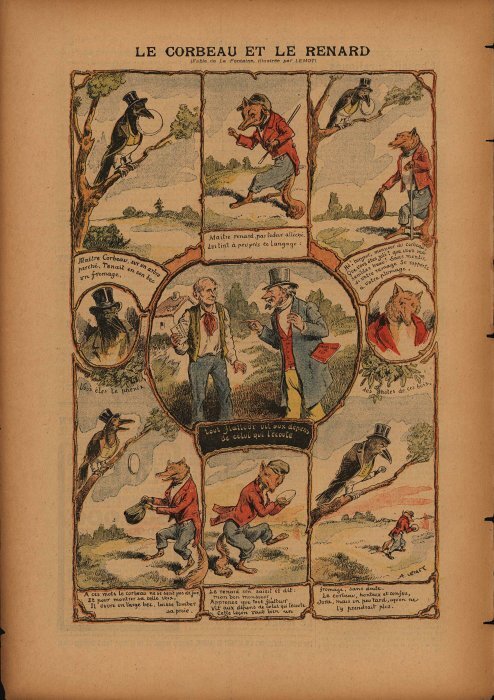
1906 "Le Corbeau et le Renard." (Achille) Lemot. La Croix Illustree. 7th year, No. 312. December 16, 1906. Back cover. 10" x 14".
This large illustration tells the fable, with La Fontaine's verse, through three top and three bottom cartoon panels. At the center, flanked by the fable's two animals, are two men. The fox on the right is perhaps cajoling the rustic to vote as the fox wants. This human fox has in his pocket the book "Profession of Faith: Citizens." The rustic holds a flier "Bulletin de Vote."
1906 "Le Corbeau et le Renard." A(chille) Lemot. La Croix Illustrée 7th year, No 312, December 16, 1906. 10" x 14". €10 at Clignancourt, July, '19.
Three panels at top and three at bottom present La Fontaine's fable, complete with his verses. In the center, flanked by the two animals, is a panel of two humans. Is that a fox on the right wheedling a vote out of an unsuspecting rustic on the left?
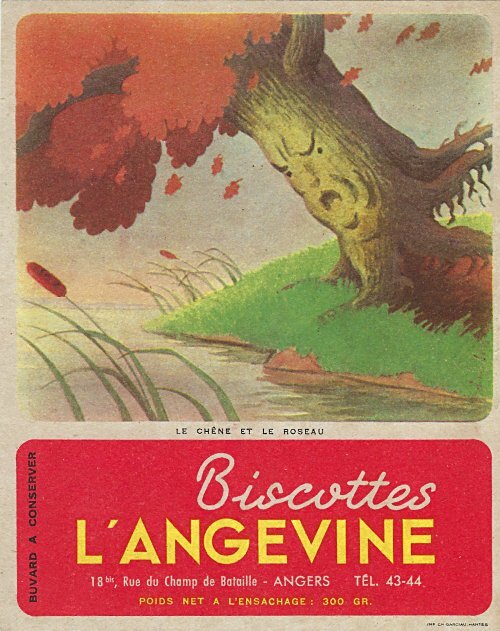
1950? "Le Chêne et le Roseau." Biscottes L'Angevine. Angers. 5¼" x 6¾". Printed in Nantes. €1 from French Vintage Shop, Paris, through eBay, Feb., '13.
Just the oak is personified in this blotter, which is less sharply done than others in the set. The oak looks down angry and surprised at his uprooting. Two different sets of reeds bend with the wind.
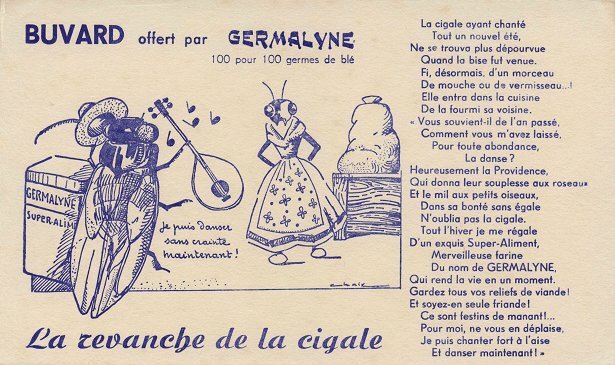
1950? "La revanche de la cigale." Buvard offert par Germalyne. 5" x 8½". $5 from Mme Denise Debuigne, Rennes, France, Feb., '02.Three extra copies, one rendered in green, from Denise Debuigne, Rennes, France, August, '07.
Blue ink on a cream background. This blotter does not just present a La Fontaine fable. It builds on the fable of GA to offer a new point. This cicada comes back one year later and gets her revenge. She claims now, in verse, to be ready for the tough winter--because she has Germalyne food supplement! "Now I can dance without fear!" she proclaims. The advertisement announces "100 pour 100 germes de blé." Might that mean that each of a one hundred pills contains the equivalent of one hundred grains of wheat?
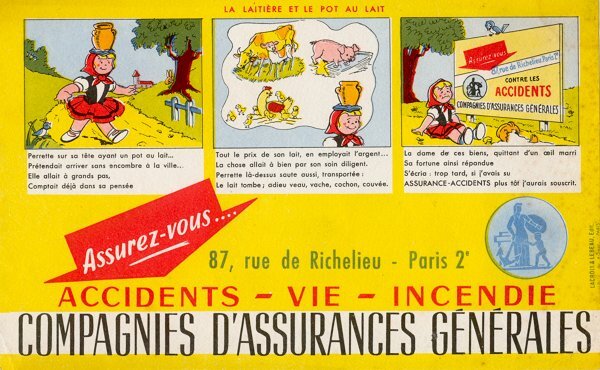
1955? "La Latière et le Pot au Lait." Compagnies d'Assurances Générales, Paris. 8¼" x 5". Paris: LaCroix & LeBeau, Edit. $5 from Mme Denise Debuigne, Rennes, France, May, '02.
The story of MM is presented in full color in three quadrants across the top of this lively yellow blotter. The first two scenes quote La Fontaine and are true to his version. The third scene shows the young milkmaid with her dropped pail in front of a billboard sign advertising insurance from Compagnies d'Assurances Générales. Here the milkmaid says "If I had known Assurance-Accidents earlier, I would have subscribed."
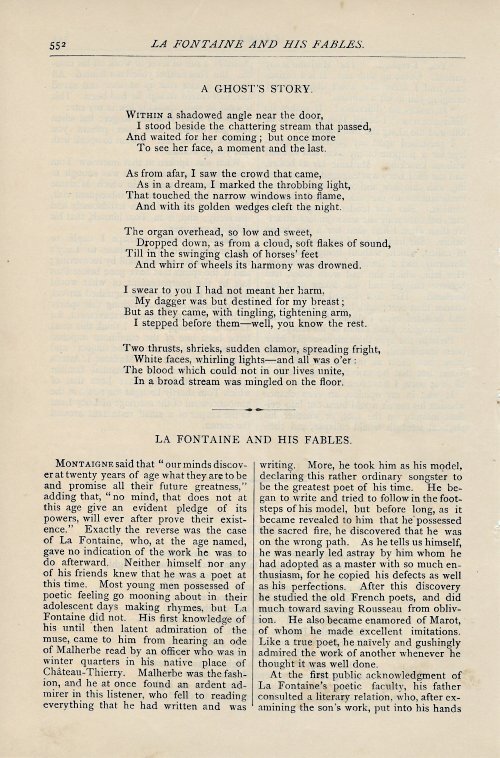
1875 "La Fontaine and His Fables." Albert Rhodes. J.J. Grandville. Article from Scribner's Monthly, Volume IX, No. 5., March, 1875: $5.64 from Legacy Books II, Louisville, KY, through AbeBooks, Nov., '22.
Here is part of the seller's description: "16pp extract, printed in double columns, illustrated with 13 characteristic Scribner's engravings after various of the fables, salvaged from a damaged issue of Scribner's Monthly, Volume IX, No. 5, March, 1875." The illustrations may be typical of Scribner's, as the seller writes, but all except the last are "borrowed" from J.J. Grandville. The last, "The Cat and the Mouse," is a vivid piece done by a "Hyputhonski" or some similar name The article itself is perhaps a bit heavy on La Fontaine's life and character, which evokes its own engagement, but never as much as do the fables.
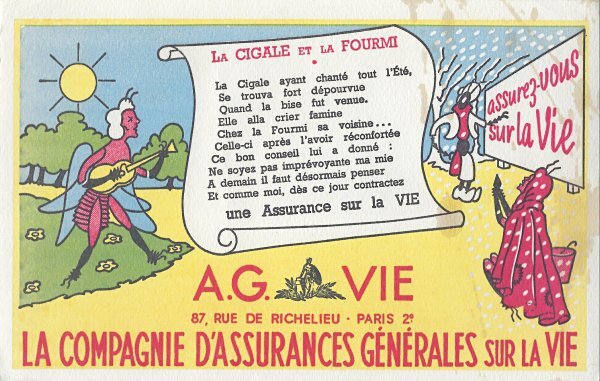
1965? "La Cigale et la Fourmi." Compagnies d'Assurances Générales, Paris. 8¼" x 5". Two slightly different versions with one extra of the second version for $21 from Bertrand Cocq, Calonne Ricouart, France, Sept., '18. Duplicate of the upper version for $5 from Mme Denise Debuigne, Rennes, France, Feb., '05.
Here only one field of image joins the singing cicada in summer on the left and the pleading cicada in winter on the right. The story remains the same as in the earlier (?) version. Though not separated into three panels, the ant's rejoinder to the cicada is exactly the same as in the blotter above. Again a billboard sign advertising insurance from Compagnies d'Assurances Générales helps the ant to make her point. In this version, the printer is not acknowledged. CAG still has the same address in Paris. The lower version here has lighter inking on the "summer" cicada and smaller typeface for the company name at the bottom of the blotter. Strange things!
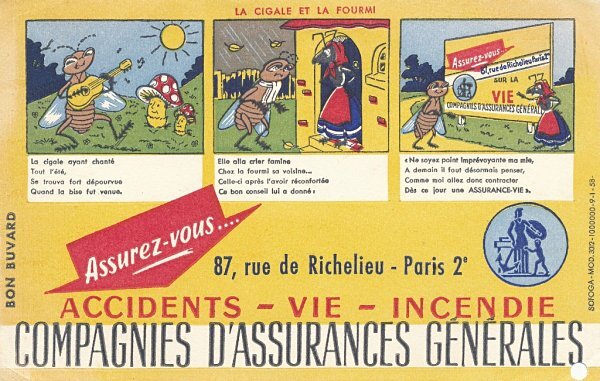
1958 "La Cigale et la Fourmi." Compagnies d'Assurances Générales, Paris. 8¼" x 5". Sofoga. $7 from Bertrand Cocq, Calonne Ricouart, France, Sept., '18.
The story of Ga is presented in full color in three quadrants across the top of this lively yellow blotter. The first scene quotes La Fontaine but then the ant consoles the cicada and encourages her to start tomorrow in getting insurance from CAG. A billboard sign advertising insurance from Compagnies d'Assurances Générales helps the ant in the third panel to make her point to a now smiling cicada, and the winter wind seems no longer to be blowing. Though by a new printer, this blotter is consistent with the first two in format.
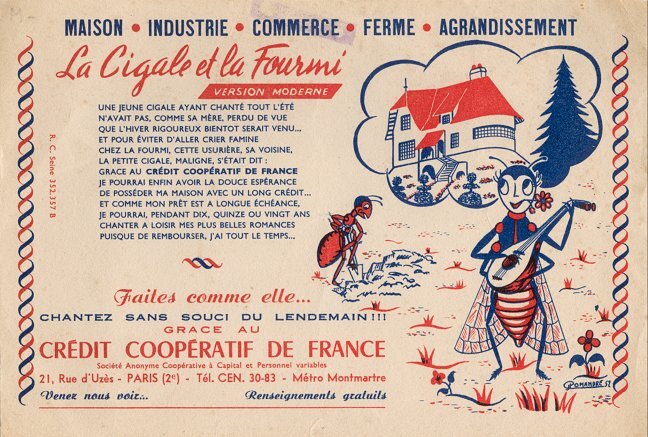
1952? "La Cigale et la Fourmi: Version Moderne" compliments of Crédit Coopératif de France, Paris. Signed "Pomandre 52." R.C. Seine 352.357 B. 50 Francs from Annick Tilly, Clignancourt, August, '99.
In this modern version, the young cicada, unlike her mother, did not forget winter while she sang all summer. To avoid having to cry famine, she trusted in the Credit Cooperative to have a house on long-term credit. She knew that she could sing in peace for ten, fifteen, or twenty years. The house of the cicada's dreams is pictured in a nice bubble above her as she sings. Lively read and blue art on a 6" x 9" blotter.
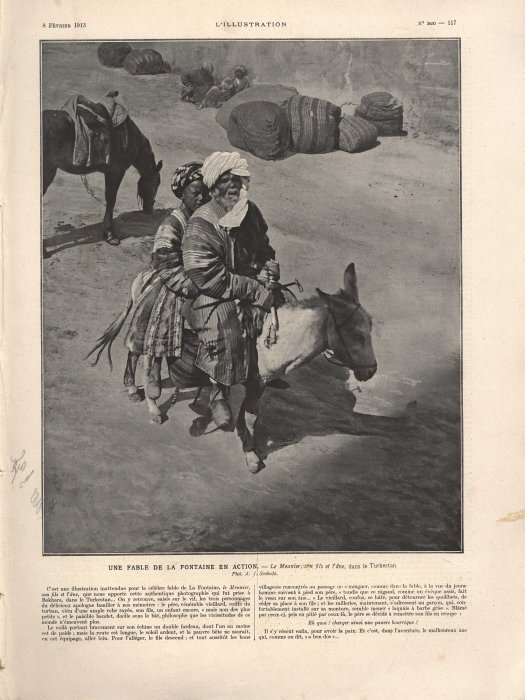
1913 "L'Illustration" magazine for February 8, 1913, includes a full-page insert (page 117) as it reports on elements of, I believe, the "Balkan Wars." The full-page insert offers a photograph of a mule and two riders in Turkestan who illustrate MSA. The caption retells the fable. €12 from journauxanciens through Ebay, Feb., '
I agree with the editors that it is rare that one finds an uncontrived human situation perfectly illustrating a fable. I am grateful that the French have loved La Fontaine's fables so dearly and followed them so assiduously!
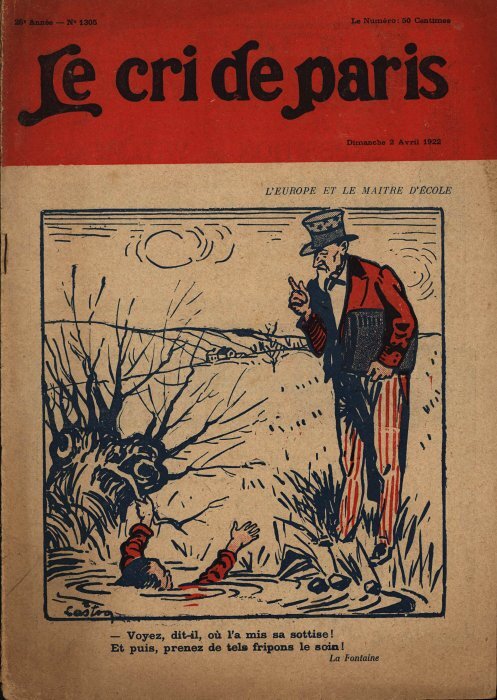
1922 "L'Europe et le Maitre d'École." Uncle Sam as the Pedant lectures the drowning child that is Europe, quoting La Fontaine. Front cover. Le Cri de Paris No. 1305, April 2, 1922. 8¼" x 11¾". €10 at Clignancourt, July, '19.
I take it that Uncle Sam is scolding Europe: "See where this stupidity has led. Take care to avoid such companions." I am unsure only about the reference here to companions. Are the nations of Europe to withdraw from Europe? And is this Uncle Sam Woodrow Wilson?
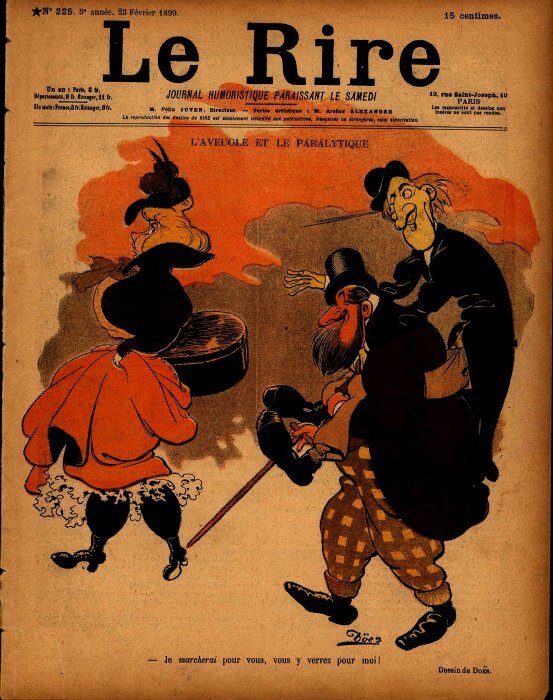
1899 "L'Aveugle et le Paralytique." Dessin de Doës. Front cover. Le Rire No. 225, February 25, 1899. 9" x 12". €10 at Clignancourt, July, '19. Extra copy for €15 from a bouquinist, Paris, July, '23.
Behind an attractive woman, the invitation takes on more meaning: "I will walk for you and you will see for me."
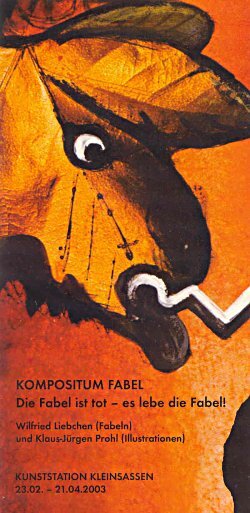
A 4" x 8" stiff card advertising "Kompositum Fabel: Die Fabel ist tot - es lebe die Fabel!" presented by Wilfried Liebchen (Fabeln) and Klaus-Jürgen Prohl (Illustrationen) at Kunststation Kleinsassen from February 23 to April 21, 2003.
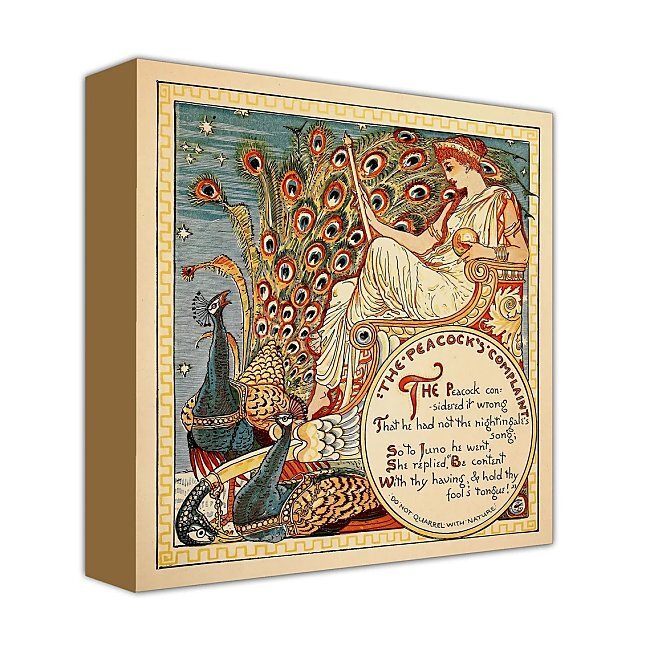
"Juno and the Peacock." Framed digital canvas reproduction of an illustration taken from Walter Crane's Baby's Own Aesop. 10" square. $17.61 from ArtTecPrints on Etsy, Jan., '25.
People on Etsy are doing all sorts of things with Aesopic illustrations, and I was happy to catch an exemplar of this kind of transformation. I prize this fable especially because of its invitation to examine psychology. At one level the fable says "Be content with what you have." At a second level it suggests "Be content with what you have or you will lose even it." At yet another level, the fable suggests that going to the giver and complaining risks angering the giver into taking away what one already has. At a final level, it suggests something like "Do not go to the dark side; it will do you no good."