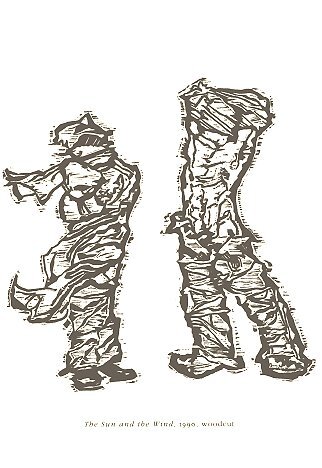
The Sun and the Wind. Woodcut by David Schorr to advertise his show: "Illustrations for Norman Shapiro's The Fabulists French: Verse Fables of Nine Centuries" at the Davison Art Center, Wesleyan University, Middletown, CT, August 28-October 18, 1991.
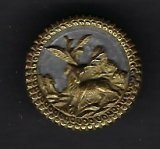
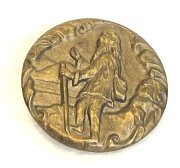
1900? Small (⅝“ diameter) button, perhaps presenting “The Stag with Antlers Caught in a Tree."
I am cataloguing this unusual button almost eleven years after we received it. One could say that I fell behind in cataloguing! The fable of the stag looking into the water and admiring his antlers but despising his legs, is frequently retold, but I think I have never before seen it on a button. Surprises keep coming!
2004 The Rabbit Who Overcame Fear/The Hunter and the Quail. Oakland: Jataka Tales for Children: Dharma Publishing. $3 from the publisher, Dec., '04.
This CD-Rom, produced together with a coloring book containing the texts, presents the stories in two booklets with these same titles published earlier. There are several voices--poorly recorded--with music and good sound effects. The first is the standard tale of the timid rabbit who hears the thud of a ripe mango dropping and thinks it is the end of the world. On the CD-Rom, the rabbit is female, while the book's rabbit is male. The accent here is on the altruism of the lion who stops the animals from running off a cliff into the sea. "The Sage" is a wise quail who lives happily with his family in a deep forest. A clever bird-hunter lures the quails with clever calls and throws nets over them. The Sage suggests to his family that, when trapped by the hunter's net, they should poke their heads through an opening and then beat their "wings in a flurry and take to the air." They do what is suggested and it succeeds. They come down over a thorn bush and can wriggle out underneath the net and bush. After some recurrences, the hunter's wife chides him upon his empty-handed return home. The hunter answers that soon enough the spirit of cooperation will dwindle among the quail, and he will be bringing home prey again. He turns out to be right. The Sage takes his family away to safety, but those remaining bicker and are taken. "So it was in ancient times that quarreling birds were captured by the hunters, but those who learned to work together could escape the cleverest foe."
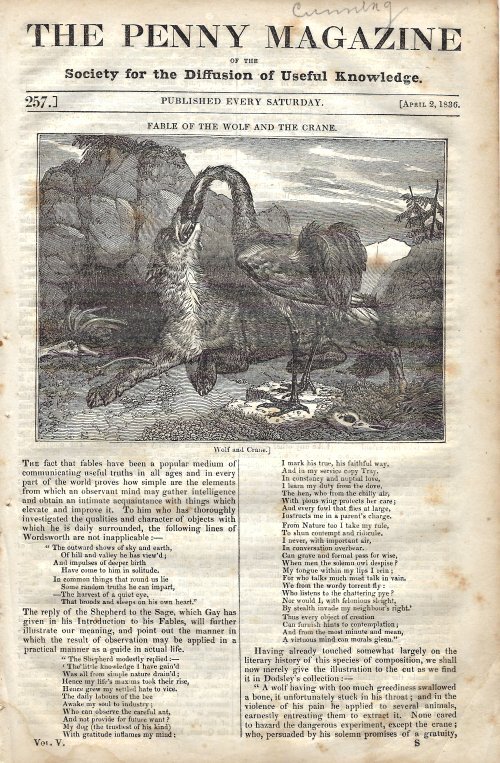
1836 The Penny Magazine, Vol. V, #257. London: The Society for the Diffusion of Useful Knowledge. Extra copy from an unknown source.
I have already listed this publication under books. I add our second copy here to make sure that people can find the illustration. The opening of this weekly magazine for Saturday, April 2, 1836, offers a large black-and-white illustration of WC and then argues that "the result of observation may be applied in a practical manner as a guide in actual life." It quotes the introduction to Gay's fables, in which a shepherd speaks to a sage about the simple knowledge he has gained from nature. It then quotes Dodsley's WC and refers to the illustration as taken from there. Sources on the web attribute the illustration to either George Cruikshank or Ernst Griset -- or might one have borrowed from the other?
1900? Large (1½") button depicting "The Peasant of the Danube." Unknown source.
This exemplar seems darker than our original button but seems otherwise identical.
1900? Large (1½") button depicting "The Peasant of the Danube." $25 from an unknown source, August, 2022.
La Fontaine's fable tells the story of a German peasant who visits Rome as an ambassador for his people during the reign of Marcus Aurelius. The peasant tells the Senate about the cruelty of life under Roman rule, and his eloquence earns the senators' respect. La Fontaine describes him as ragged and hairy. I am curious about where this button would be most appropriate.