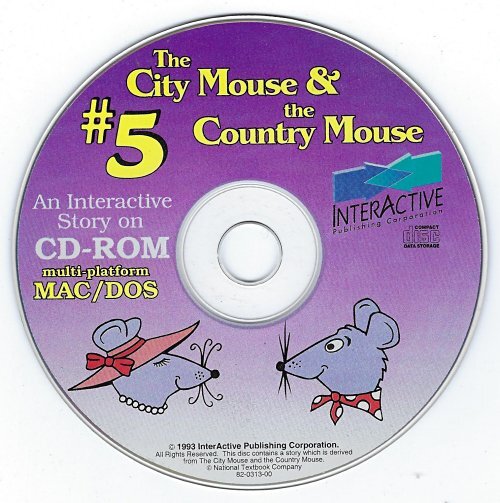
1993 The City Mouse & the Country Mouse Interactive CD-ROM. Production Manager George Fleischman. Produced in USA. Interactive Publishing Corporation.
This is a simple presentation of TMCM on cartoon slides with the text on the screen highlighted phrase by phrase while it is read. A listener can also click on any word to have it said or on any object to see and hear the word. The reading is enhanced with simple musical background and some sound effects. The speed of the presentation is so slow that it is burdensome to any but those who are learning to read. The text is copyrighted by National Textbook Company, the producers of Chiquita y Pepita (1978/89). Compare the bus-seat illustration here with the one there. An audio cassette is included with the same sound track (listed separately under 1993) and so are crayons to color the printable black-and-white slides. To get the CD-ROM running, I followed the sequence Start/Run/D:/OK and double-clicked on the "go.bat" icon. Molly (CM) and Margaret (TM) are cousins. Molly invites Margaret to a party along with a number of friends. A large dog attacks in the city even before the mice get to food. Molly drinks some wine with Margaret helping by holding the glass. At dinner a cat attacks. Further, loud noises like the clock's bonging bother Molly.
1993 The City Mouse & the Country Mouse. Production Manager George Fleischman. Produced in USA. Interactive Publishing Corporation. $10 at the Omaha Computer Swap Meet, May, '98.
This audio cassette reproduces the narrative of the CD-ROM of the same name, year, and manufacturer. See my notes there. The text is copyrighted by National Textbook Company, the producers of Chiquita y Pepita (1978/89). Molly (CM) and Margaret (TM) are cousins. Molly invites Margaret to a party along with a number of friends. A large dog attacks in the city even before the mice get to food. Molly drinks some wine with Margaret helping by holding the glass. At dinner a cat attacks. Further, loud noises like the clock's bonging bother Molly.
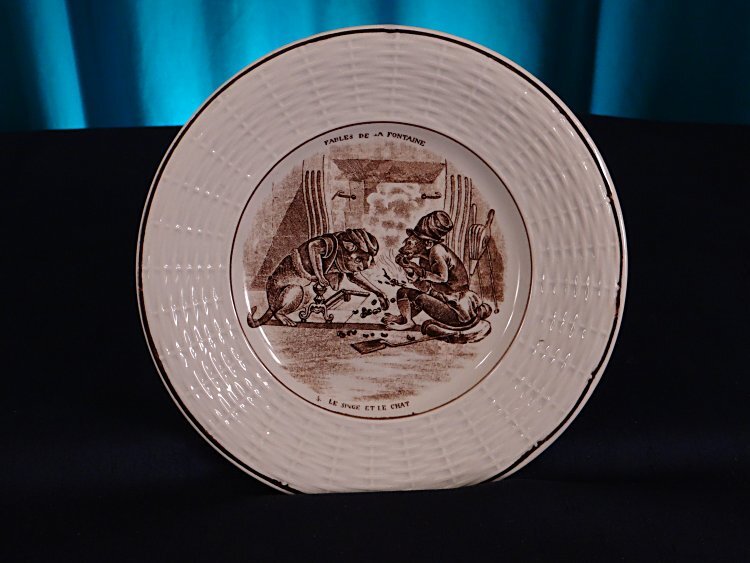
1930? 7" white plate from Sarreguemines, France. Inside a 1.5" rim there is a representation of Grandville's "The Cat and the Monkey" (IX 17). The front carries two inscriptions: "Fables de la Fontaine" and "5. Le Singe et le Chat." The back has a smudged "Digoin" stamp. One extra exemplar.
With GA, this is the closest following of Grandville. It is also perhaps the best executed design of all the plates I have seen thus far. My only question concerns Grandville's interpretation of what was going on in the scene. I think the monkey needs to be behind the cat's back--in any case not eating the nuts in front of him! There is a slight hiatus between a fallen "DE" and a high "LA" on the top front of the plate. Also, the "5" is not clear. I had thought it might be a "4."
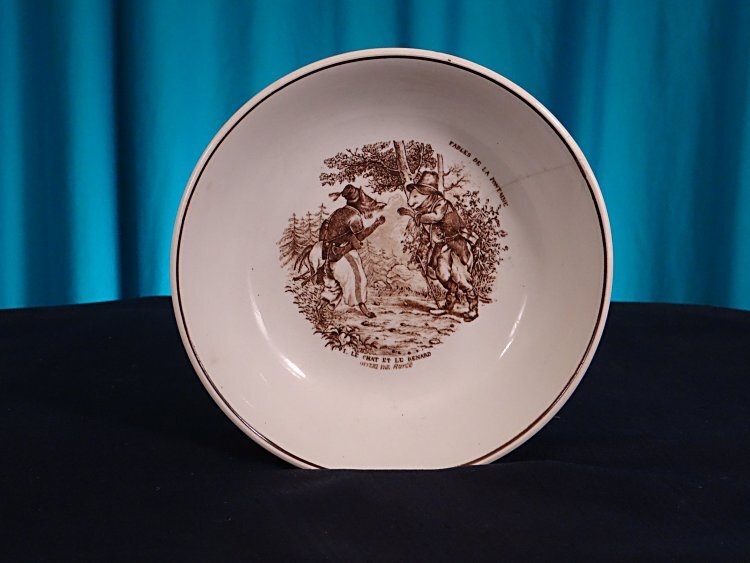
1930? 7¼" white bowl from Sarreguemines, France. 1.5" deep. Inside the bowl there is a brown adaptation of Grandville's "The Cat and the Fox." The front carries two inscriptions: "Fables de la Fontaine" and "1. Le Chat et le Renard." The back has the usual Digoin stamp. From an unknown source before 2006.
The two characters are in the outdoor setting that will test their evasive "tricks." Each raises a paw in their contention with each other about the effectiveness of their manoeuvres. Hats, vests, and trousers humanize both. The fox is carrying prey he has captured. The cat has a walking stick. Was Royce an adapter of Grandville's work?
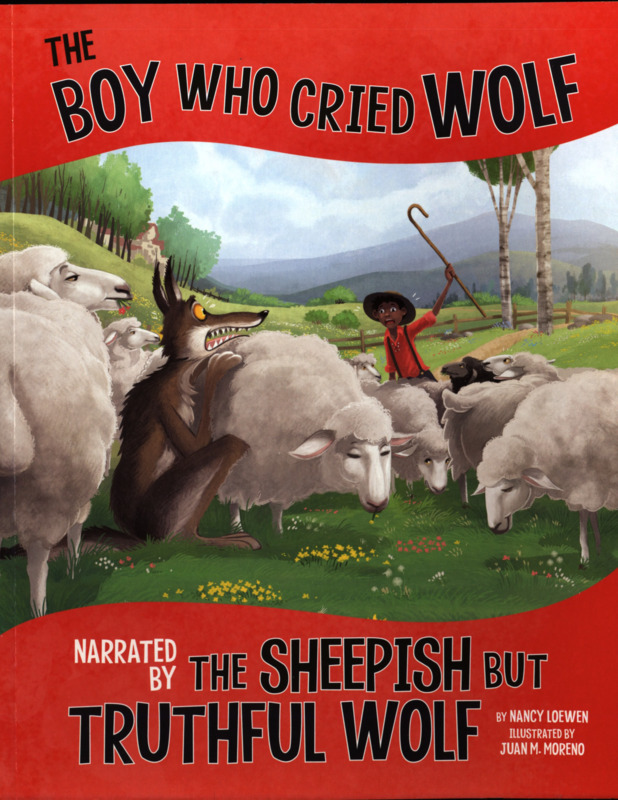
2010 The Boy Who Cried Wolf and more children's fables: 5 stories. Scholastic Storybook Treasures. A Read-Along DVD. 74 minutes. Illustrations by Boris Kulikov, Marcia Brown and others.
Two of the five stories here seem to me to be fables. There are extras, including an interview with Boris Kulikov on his development of the classic fable, including architecture and costumes from various periods and introducing a fly who appears several times during the fable. The shepherd boy is bored with the sheep's "munch, munch, munch." They do not want to play. For the first day's trick, he reports one wolf, which people seek but do not find. The second day he reports two wolves. On the third day there are three wolves, and they are thinking "lunch, lunch, lunch." There is no report of losses after the third incident. In fact, one can see most of the sheep up in the tree! There is also Marcia Brown's classic "Stone Soup," mistakenly reported on the clamshell as narrated by her. As in her book, there are three soldiers and they convert selfish townfolk who at first hide their food from them. This fable has distinctly French settings and names. The disk advertises having been done with Russian resources and help.
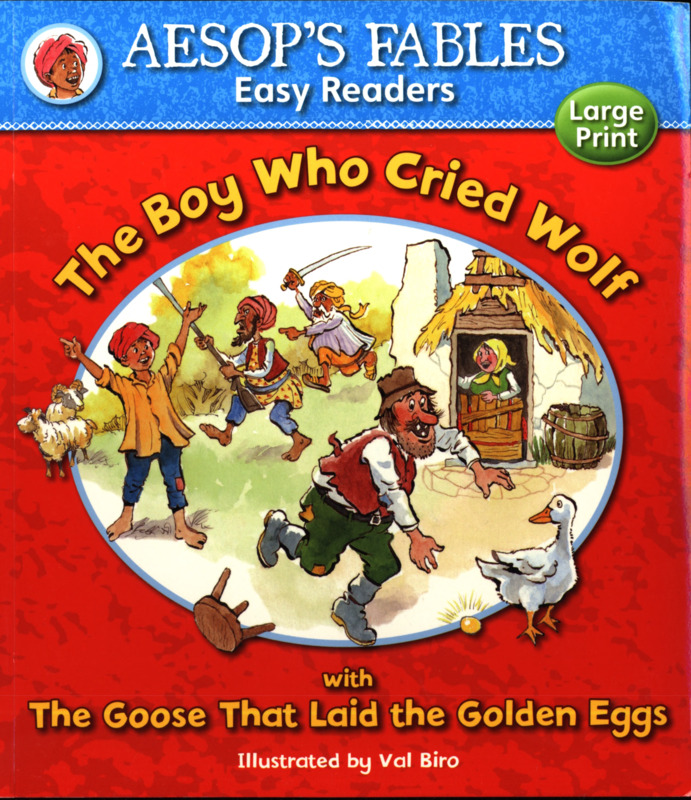
1962 "The Boy Who Cried Wolf." #16. Kenner-Color Slides for use with Kenner's Give-A-Show Projector. Made and printed in U.S.A. Kenner Products Co.
7 four-colored panels. There is less text here. Panels 2, 4, and 6 have none, each showing the blowing of the boy's horn. In the first panel he had been told to blow it if he saw a wolf. The final image shows the wolf licking his chops and saying "Even bad boys taste good!"