2004 Tales of Magic. EastwestDVD video. Five classic tales identified by country.
Primitive colored cartoons from Russia, Germany, Czechoslovakia, and Italy, besides GA from Greece. The dvd dives right into the first story without introductory material like a T of C. This extended version of GA offers some different elements not usually found in the classic fable. the fun-loving grasshopper in spring makes a violin and plays with a whole orchestra of insects, while animals love his frequent dance parties. During one of their parties, ants make noise by working. The grasshopper and other animals mock them this time and often in the future. The grasshopper's sister feels sorry for the ants and invites one into the party. The grasshopper makes fun of the ant and trips him. As the weather turns, other animals leave the grasshopper's party to prepare for winter. The grasshopper never does any chores. When he runs out of food and shelter in winter, the grasshopper carries his sister and his violin. When they come upon the ants' home, he trusts that the ants will take them in. His sister says "They won't help us now." Soon the grasshopper realizes "I deserve to be left out." The two walk away from the ant home without even knocking on the door, and the ant is never even aware of their plight. The two grasshoppers spend the winter cold and hungry.
2023 T-shirt with image and lines from "The Scorpion and the Frog."
This shirt image represents a surprising choice. Most people do not know this fable of a frog who offers a ride to a scorpion. The scorpion stings and kills him along the way. "Why?" the dying frog asks. "Because I am a scorpion!" It is typical fable wisdom: learn or get destroyed; or never trust a killer. This design-artist adds "Laugh out loud!" and "In my arrogant opinion."
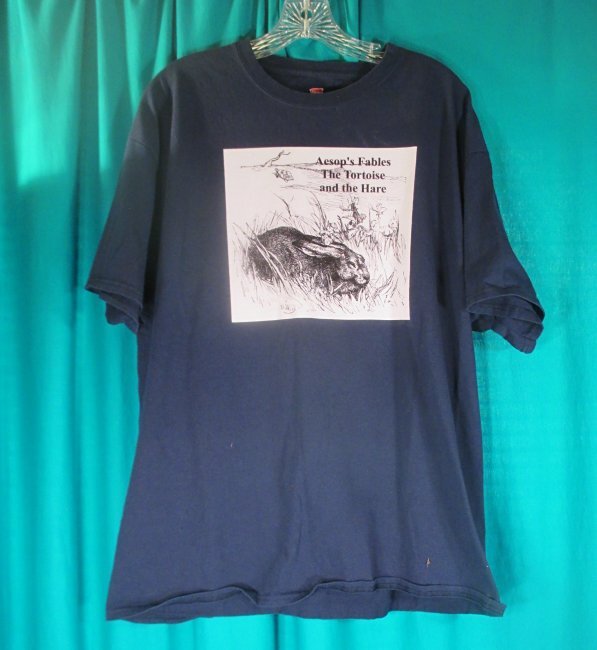
2019 T-shirt with Harrison Weir's illustration of TH and "Aesop's Fables The Tortoise and the Hare." Gift. Christmas, 2018.
What a treat to see an old classic illustration like this still alive land well! The bunny sleeps as the turtle trudges
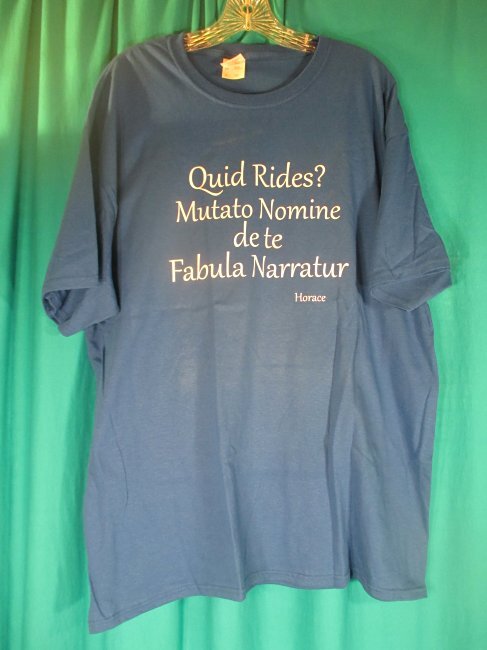
2020 T-shirt featuring "Quid rides? De te fabula narratur" from Horace. Short sleeves.
This has been a favorite line of mine from Horace's Satire I 1, verse 69. He has just been retelling the story of Tantalus as part of his satirical attack on people's wayward desires. "Why do you laugh? Just change the name and the story is about you!"
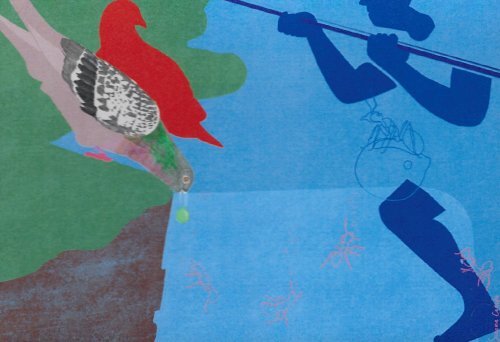
2020? 6 Colored fable cards: original art by Susana Cereja. FC; GA; OF; LS; AD; and DW. $20.87 through Etsy, March, ‘21. One extra set.
What a delightful set of illustrations! Though they are listed as postcards, they do not have the usual verso of a postcard. For now, I treat them as fable cards. My favorites are FC, where the fox is playing a violin for the willing crow, and DW, which features the dog tightening his formal necktie. Well done, Susana! In GA, what is on the monochromatic egg’s side besides a broom: ant eggs or unlimited food for the future?
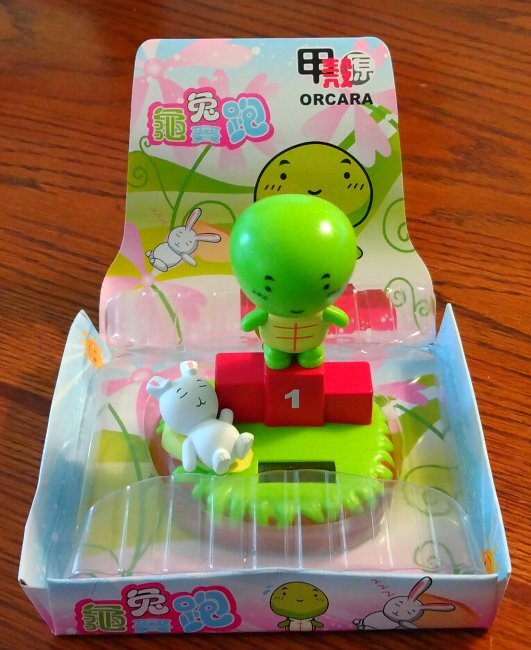
2015 Sun Catcher Featuring TH. Chinese. Orcara. Unknown source.
It takes very little sunshine to get this tortoise to move his oversized head! According to web resources, Orcara is a Chinese toy manufacturer that produces a diverse range of high quality miniatures. This TH sun catcher seems no longer to be available. This bunny sleeps while the tortoise wobbles proudly on the victor's stand.
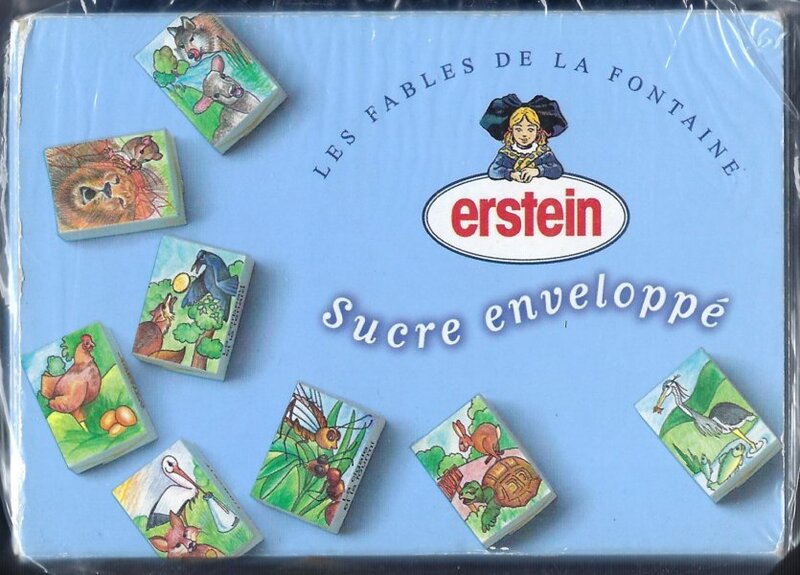
2007? Package of "Erstein Sucre enveloppé." Les Fables de La Fontaine. 192 packets of two sugar cubes, each packet wrapped in a paper illustrating a fable. I kilogram package, 5¾" x 4" x 3". Unknown source.
I remember marveling over this find. Our images may not be the best: we have wrapped the heavy cube in cellophane packaging to try to preserve it, even though that it means I have never seen the little packages. A little research shows that Erstein had this label copyrighted from 2004 to 2014. Why did I not find another brick when I could?! I find no reference to it on the web other than from the French copyright office. That copyright is #3298163.
1930? Twelve numbered cards from the 269 series of 12 portrait-formatted trade cards advertising Suchard products. La Fontaine fables. €33 each from collectomania, Oct., '22.
These cards follow the pattern found in the later cards of having each card advertise one of Suchard's particular products. In this case, the product itself is pictured as part of the front of the card. The verso of each is highly ornamental. At the top, five Suchard products are listed. Under "Suchard," a text-box features at least a portion of the fable. Around this text-box is a repeated design of various fable characters. "Série 269" is at the bottom right of each verso.
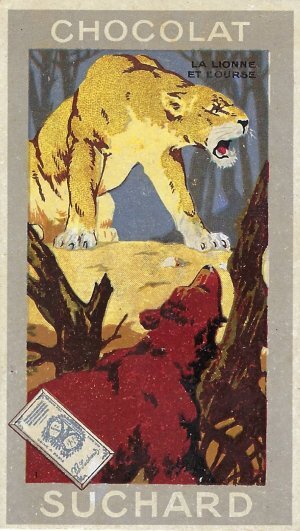
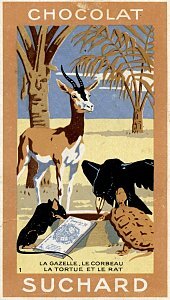
1980? Twelve numbered cards in strong portrait format (2⅜" x 4⅛") distributed among five "families" of Suchard: Chocolat, Velma, Milka, Cacao, and Noisettine. €25 from Albert Van den Bosch, Antwerp, Belgium, Feb., '12. BF from olivier9682 through Ebay for €6.50, July, '22.
Some of these cards still have the feel that the powder with which they came is still on them. Strong colors and simple forms mark these cards, which are quite different from the more traditional Suchard landscape cards. The identifying numbers between "1" and "12" can be hard to find but they are there in the corner of the image segment.
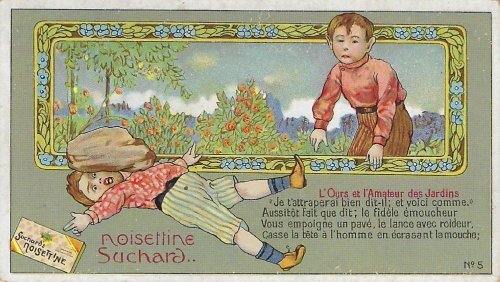
1910? Four numbered cards from a series of 12 landscape formatted trade cards advertising Suchard products. La Fontaine fables. €30 each from collectomania, Oct., '22.
The verso of each card shows a woman in kerchief with four children and a cat and the notation "Série 235." The front of each card follows a formula including a green or green-and-red rectangular border; a scene of children that overflows the borders of that rectangle; some Suchard product with its name; the title of the La Fontaine fable; and a few verses from the original fable. Some of the illustrations start to become a bit grotesque, particularly WC and "The Bear and the Gardener." We have now #4, 5, 11, and 12. Let's find the other eight!
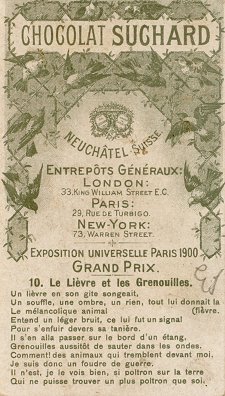
1905? 12 numbered French cards of La Fontaine fables from Chocolat Suchard. 2 3/8" x slightly more than 4". $63 from Marie Foreman, Hamilton, Ontario, Canada, through Ebay, Feb., '02. The last two cards for $10 from Albert Van den Bosch, Antwerp, Belgium, April, '13.
These small landscape-formatted cards offer beautiful colored pictures of human scenes exemplifying animal fables. The picture-side includes "Chocolat Suchard," a number up to 12, and a title. The verso, sometimes showing a glue-tear, comes in four different patterns. In each of the patterns, a title and excerpts from the fable occur beneath an elaborate monocolor floral or animal background, "Neuchatel, Suisse," and mention of London, Paris, and New York offices. The addresses are the same in each format. Each format also mentions "Exposition Universelle Paris 1900 Grand Prix." The colored illustration cleverly includes both the animal scene and some Suchard product into the human scene. Even a bridge and a road bear the Suchard name! Do not miss in "Les Deux Coqs" the dramatic confrontation of two men in the farmyard, while a young woman looks on. The joker in FC is about to lure the Suchard chocolate from the vain dandy who carries it. The scene in "Le Rat et l'Huitre" is complex. A boy stealing packages of Suchard chocolate is about to experience the jaws of an attacking dog, just as the rat probing an oyster is about to have the oyster snap shut on his or her head!
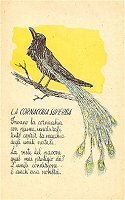
1955? Five different Italian postcards with verse text and colored picture on one side and room for a message and address on the other. 3 3/8" x 5 3/8". Though the card stock is cheap, the color work is very nice. It seems to involve about four colors per card. The visual works are signed by "stefanini" (?). Studio Stefan. A cura dell'Associazione Cardinal Ferrari. 10,000 Lire each at the Porta Portese flea market, August, '98. One extra of "La Cornacchia Superba." Click on any image to see it full-size.
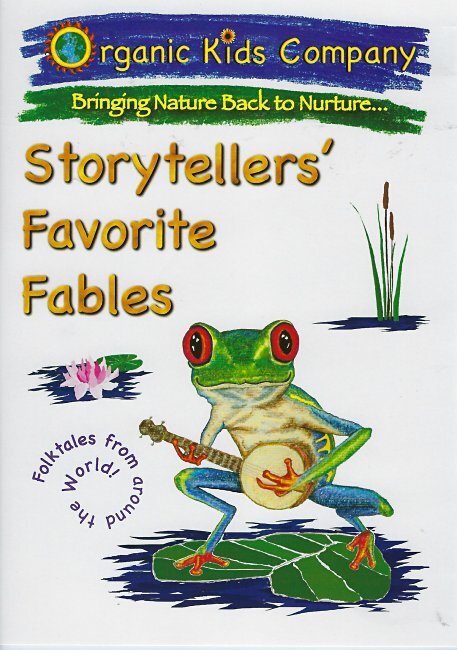
2015? Storytellers' Favorite Fables: Folktales from around the World! Organic Kids Company. DVD. 62 minutes. Eight tales.
Storytellers do lively presentations here with the help of a guitarist and a small audience of children. The fifth of the eight tales is "Bone Day," a lively retelling of DS with plenty of musical participation.
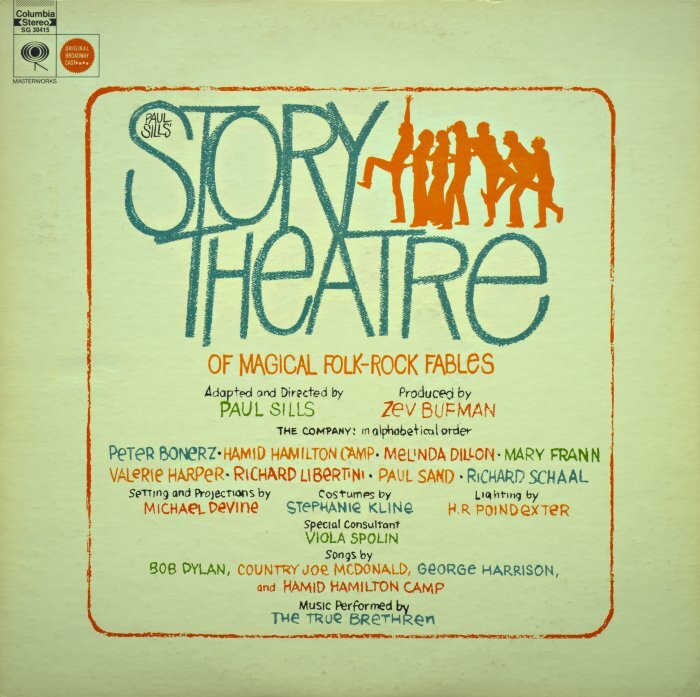
1971 Story Theatre. Adapted for the Stage by Paul Sills. “Of Magical Folk-Rock Fables.” Original Cast Recording. Two-record album.
As I wrote of the book of the same year, we have here among other "Venus and the Cat," "Two Crows," and GGE. The last of these three grows to great proportions in the play. The first has a nice touch: the man throws up and at the end kicks the cat, which has been transformed back into her old shape. "Two Crows" is fun and basic Aesop: the suggester-crow gets the oyster dropped by the other who wants to crack it open.
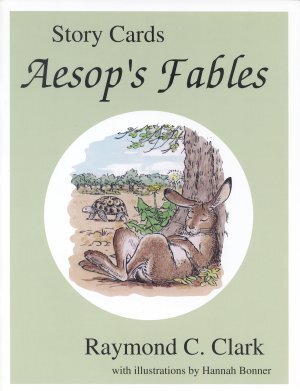
1995 Story Cards: Aesop's Fables. Compiled by Raymond C. Clark. With Illustrations by Hannah Bonner. Large-format pamphlet. First printing. Printed in USA. Brattleboro, Vermont: Pro Lingua Associates. $14.50 from Pro Lingua Associates, June, '97. Extra copy at the same price from the publisher at the same time.
Here are forty-eight fable cards, four to a page, to tear from the 8½" x 11" book. On the back of each card is the appropriate title and story. The color cartoon work is well done. The whole dead donkey is loaded onto the uncooperative horse (#3). "The Lion and the Fox" (#7) is done in terms of written invitation and written response. I am not sure I remember ever seeing "The Men and the Chameleon" (#38) before. "The Donkey's Brains" (#47) shows the hole in the donkey's head quite graphically! Human dress is ancient. I will also list this under "Fable Cards." I will also include with each copy a copy of the Pro Lingua catalogue for 1997, featuring WC on its cover.
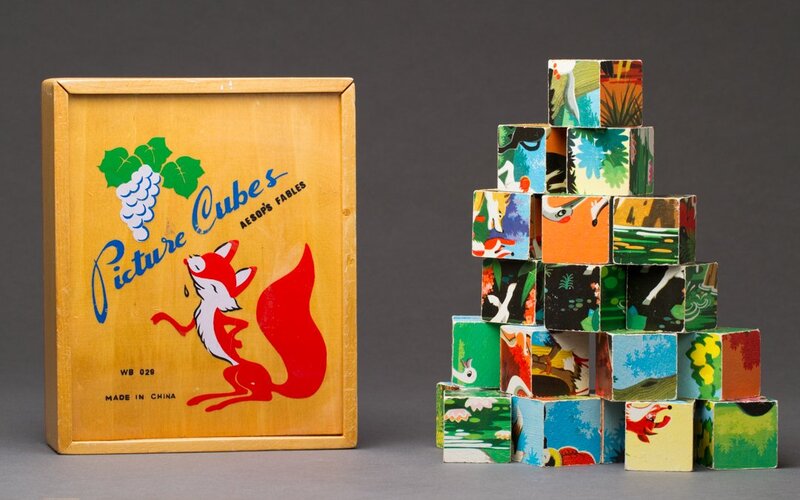
1980? Chinese story‑blocks, including FG, "The Raven and the Swans," WC, "The Wolf in Sheep's Clothing," "The Cat and the Fox," "The War Horse and the Ass."&nbs
This set of 5x4 blocks is similar to the two above, but this set always turns out to be rectangular. Several images are almost identical, but here the image is rectangular. The craftsmanship is again fine! Click on the image here to look at all six pictures.
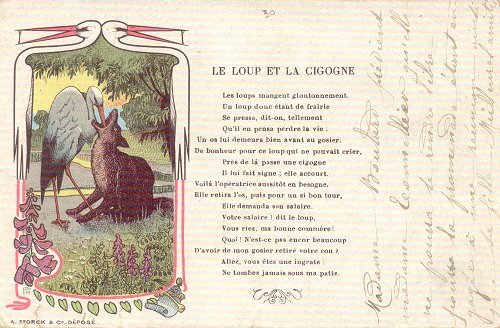
1920? Postcard presenting La Fontaine's WC text beside a colored illustration. A. Storck & Co. Deposé. €6 from ABC de la C.P.A., Lyon, at the Paris Post Card Exhibition, Jan., '05.
The illustration here may be somewhat simple and disappointing, but the border around it is very clever. Its top is formed by two storks' heads (no pun with the publisher!) holding bones in their beaks. Follow down either side, and you will find the stork's legs. Are those perhaps bones lying on the contract at the lower right of the frame? The writer of this card put a message onto its picture side.
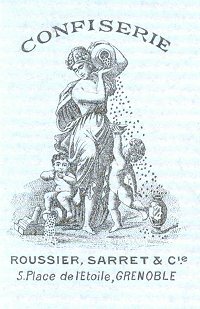
1920? Postcard presenting La Fontaine's "Le Laboureur et Ses Enfants" text beside a colored illustration. Confiserie Roussier, Sarret & Cie., Grenoble. A. Storck & Co. Deposé. €9 from Dominique Chapelon, Yronde ete Buron, at the Paris Post Card Exhibition, Jan., '05.
The card is arranged in this case to allow for an advertising strip at its top. Again, it pays to watch the frame of the rather standard picture of the man and his children at his bedside. Arranged around the picture we find wheat, grapes, vines, and finally a bag of coins. Roussier and Sarret add another design on the blue verso. A female figure of abundance pours out candy for eager children to enjoy. This design is so nice that I include it here.
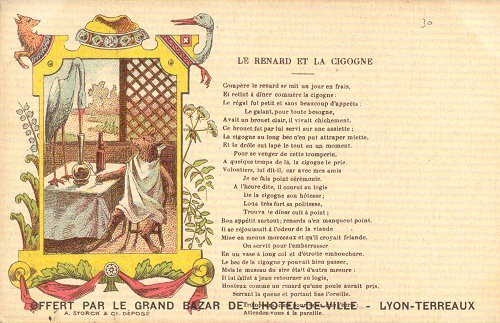
1920? Postcard presenting La Fontaine's FS text beside a colored illustration. A. Storck & Co. Deposé. €6 from ABC de la C.P.A., Lyon, at the Paris Post Card Exhibition, Jan., '05.
The illustration here is unusual in that it has the stork standing on top of the table holding the meal. The elongation of the image helps to reinforce the point of the fable. The fox's legs seem to have become quite human in their pose. The frame of the image includes heads of both principal figures. This card is stamped "Offert par le Grand Bazar de l'Hotel de Ville, Lyon-Terreaux." I guess you could use the card to write home about the glories of this hotel.
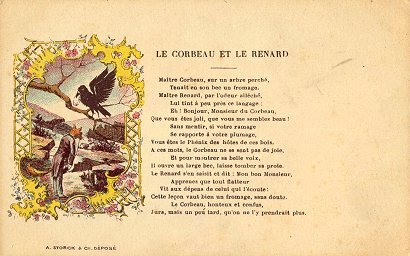
1920? Postcard presenting La Fontaine's FC text beside a colored illustration. A. Storck & Co. Deposé. 50 Francs from Annick Tilly, Clignancourt, July, '01.
This card is like another illustrated here, the parody of FC that I have guessed was published around 1932, in that it uses all of one side for an address and takes up almost all of the other side for its illustration and image. The illustration in this case dresses the fox as a gentleman and gives him eyeglasses on a cord. The figure of the crow looms as large as the figure of the fox. There is no writing at all on this card.