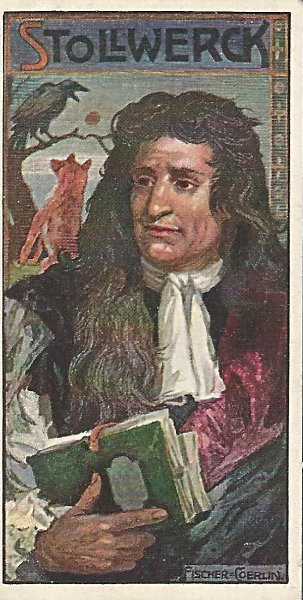
1908 1 numbered German card of Stollwerck's "Helden-Album," No. 10. Almost 2" x 3¾". "Fischer-Coerlin." Gruppe 440, No. I. "Stollwerck's Deutsche Alpenmilch-Schokolade."
On the verso of this pleasing full-color portrait-format portrait of La Fontaine is a biography of the poet. In the picture itself one can make out a fox and crow, as La Fontaine himself holds a book. Stollwerck has a celebrated history from 1839 to 2011. It was famous among other things for candy vending machines. Stollwerck's "Helden-Album," published in 1908, included some 288 cards.
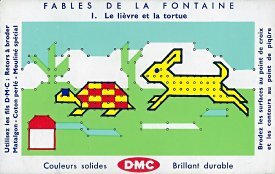
1965? Set of 20 embroidery stitching cards plus four extras. Complete set. Fables de La Fontaine. Numbered 1-20. DMC.
Now here is something unusual, even unique. I did not know that there were embroidery stitching cards. DMC is apparently a thread manufacturer. These are advertisements for their thread, as the cards promise "solid colors, brilliant, durable." I wonder what one would then do with the 24 fable panels embroidered with the help of these cards? And would the sewing happen on the very card itself? I learned on the web that "DMC has been developing award-winning fine threads and specialist yarns for makers since 1746, when artist Jean-Henri Dollfus joined forces with a pair of equally visionary entrepreneurs. Today DMC produces their natural yarns in Italy and France, collaborating with some of Europe’s most prestigious fashion houses, venerable art galleries, up-and-coming designers and needlecraft bloggers."
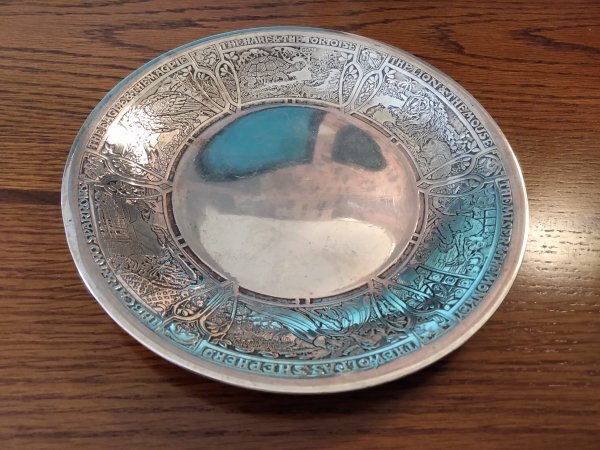
1910? Sterling bowl labelled "Sterling E S C." 6½" in diameter. With six fable titles and images around its inner rim. $200 from maxbernat through Ebay, March, '22.
The six segments are particularly well done. Even the transition sections, each in three parts, follow a theme but vary it in each case. Lovely! The choice of fables to offer departs from the usual here in several cases.
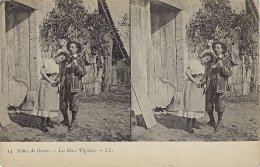
1910? Seven stereoscopic photographic postcards of La Fontaine fables. "Scènes de Genre." Paris: L'Imprimerie Nouvelle Photographique. $60 from Bertrand Cocq, Calonne Ricouart, France, Sept., '18. Another from Bertrand for $8, Sept., '20.
What a fascinating find! One finds that interpretations offered elsewhere are confirmed here, for example, that people interpret WL often in terms of romantic relationships between the sexes, and that "Two Doves" is regularly seen the same way. Some of the fun with these cards is that the characters and even their dress seem to repeat from story to story. Apparently the photographer had a small stable of actors and costumes to work with! It is surprising that GA appears twice, in apparently different conceptions of where the encounter takes place. The cicada has a shawl in one depiction that she does not have in the other. And is it supposed to be winter? My favorite among the cards is MSA: the characters have good poses revealing their attitudes.
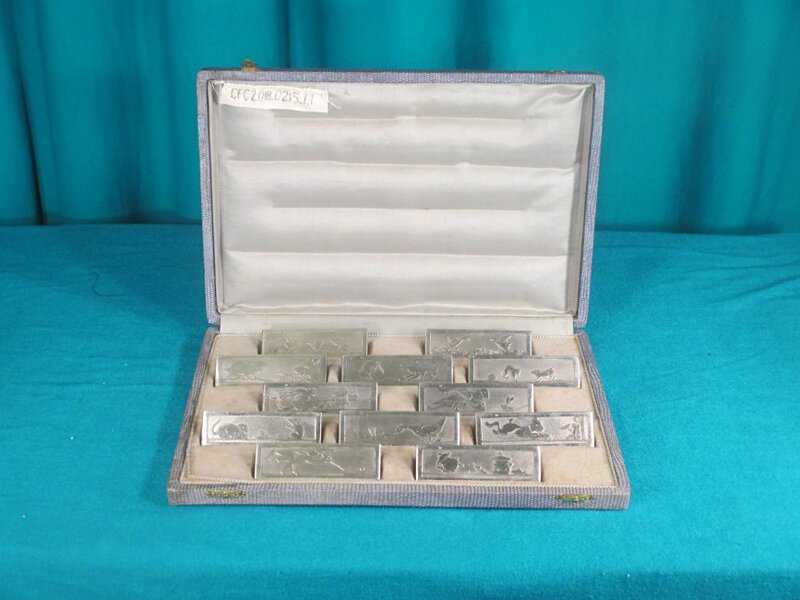
1930 Complete set of twelve silver plated kniferests (portes couteaux) by Stephane Prudhomme illustrating favorite fables. Apparently in the original box. $154.71 from brocs_en_stock on Ebay, Jan., '18.
Each knife rest is a panel 3¼" wide and 1" high supported by triangles on the edges, whose other two sides are ¾" and 11/16". A sale on the internet was helpful for identifying this set as coming from Prudhomme. The small square towards the left edge in the top frame presents Prudhomme's mark, S and P around a caduceus. It took a high-resolution scan to produce the picture below of that mark. The twelve fables presented include expected standards like TMCM, CJ, GA, FS, WL, 2P, "The Hares and the Frogs," and "The Heron." There is also Florian's "The Monkey and the Magic Lantern. Three others are harder, at least for me, to identify. Is one "The Fox and the Cat"? What is the small object in their image? In another, two fowl seem to be arguing over a snail. In a final knife-rest there are three birds: might they be the mother lark and her young?
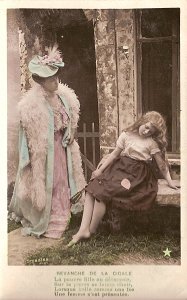
1905? Five photographic postcards presenting "Revanche de la Cigale," apparently a sequel to "La Cigale et la Fourmi," presumably after La Fontaine. VBC Série No. 3046. Stebbing Photographic Studios. All were sent to Mademoiselle Marie Louise Bruyère (chez ses Parents), Grande rue à St Genis, Laval, Rhône. At least one card is clearly dated 1907. $9.99 from Joachim Montbord, La Sauve, France, through eBay, March, '04.
Series #3046 is five cards on the cicada's revenge on the niggardly ant. The story follows up on Series #3045, "La Cigale et la Fourmi." The cicada character is the same in all cards of both sets. Here the rejected cicada finds a fairy godmother who trains her musically. The cicada, now rich, returns to the ant, who has been thrown out of her home and needs to sell everything. The ant is the same actress as in the other set, and the venue is the same, except for the "For Sale" sign here. The gracious cicada takes no revenge but rather opens her purse for the unfortunate ant. There is extensive pink and green coloring of these black-and-white pictures. I wonder how that was done.
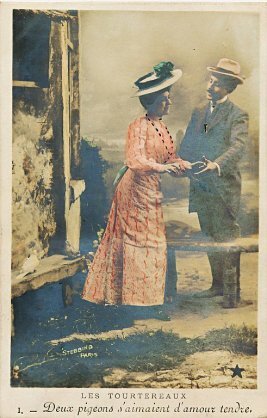
1905 Complete set of 5 colored photographic postcards "Lex Tourtereaux" after La Fontaine's fable "Two Doves." Stebbing, Paris. $60 from Bertrand Cocq, Calonne Ricouart, France, Sept., '18.
This portrayal of La Fontaine's fable follows the traditional interpretation but not, I would say, the original story. La Fontaine's fable is of two deeply befriended birds, one of whom feels the need to travel. That bird does so, but undergoes frightening experiences and a good deal of suffering before returning to the welcoming bird-friend. This portrayal links two human lovers with two nearby birds but contents itself with simple lines matching the photographs. "Two doves love each other with a tender love." "They cannot live one without the other." "They were always cooing." "They embraced each other without stopping." "They loved each other….they were happy."
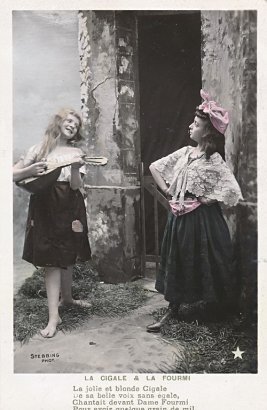
1905? Complete set of five photographic postcards presenting "La Cigale et la Fourmi," VBC Series Number 3045. Stebbing Photographic Studios. Five cards and two extras for #35 from Bertrand Cocq, Calonne Ricouart, France, Sept., '18. Extra of the first card in the series for $3 from Elsa Pinto, Paco de Arcos, Portugal, June, '13. Extra of #5 for $1.50 from Joachim Montbord, La Sauve, France, through eBay, March, '04.
The story here follows La Fontaine but stresses the emotional experience of the cicada. It is hard to be sure of the order of the cards. I presume the sequence runs like this: (1) The lovely cicada sings before the ant requesting food. (2) With trembling hand, she then asks out of her poverty for charity and compassion. (3) But asking this neighbor is useless. (4) "You have sung well, but you have not amassed things as I have. You will have to dance." (5) Poor cicada, abandoned! How sad! There is extensive pink coloring of these black-and-white pictures. I wonder how that was done. Stebbing follows up with a sequel, "Revanche de la Cigale," VBC Series #3046, using the same characters, actors, and setting.
2000 Statuette of FG. 2½" x 3" x 4¼" high. Made in China. Dundee, MI: Young's Inc.
How nice to see that people keep on making things reminiscent of fables! The box even tells the fable on two of its sides.
1930? 9 colored La Fontaine prints signed "Starling." 100 Francs each at a Buchinist along the Seine, August, '99.
Each 9.5" x 6.2" print has an image on the left, including the title of La Fontaine's fable. On the right is the text. Each is mounted on stiff paper almost 16" x 11". The fables are FC, FS, GA, MM, OF, TB, TMCM, WL, and 2P. They use color very nicely and have a cartoon quality in their conception. My favorite is OF. In it there is a bathing-beauty frogette, and the about-to-explode frog wears swimming shorts that only emphasize the balloon-like character of his chest. I always knew it: the cheese lost by the crow to the fox is a Camembert! See also a collection of postcards using these same images.
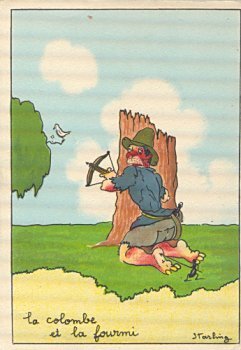
1947? Fables of La Fontaine. Nineteen full-color postcards displaying favorite La Fontaine fables, all with a "Starling" signature at the bottom. 4 1/8" x 5 7/8". Imprimé en France. Paris: M. Barré and J. Doyez. €3 each from Collections N. et F. Murtin at Paris post card fair, Jan., '05. One other card, "L'Âne Vetu de la Peau de Lion," and extra copies of six cards for €4 each from Gérard Crucy, at the same Paris post card fair, Jan., '05. Extra copy of "Wolf versus Fox before Monkey" for € from bouquiniste Claire Leriche, Paris, June, '23.
The art is delightful, as in the fuller versions of the same images. The verso of each card fills the message section with a cursive version of the La Fontaine fable. At about the same time, Barré and Doyez also published a collection using children to illustrate La Fontaine's fables. Sadly many of the cards here are poorly cut. I like Starling's visual approach. See also a collection of larger prints using these same images.
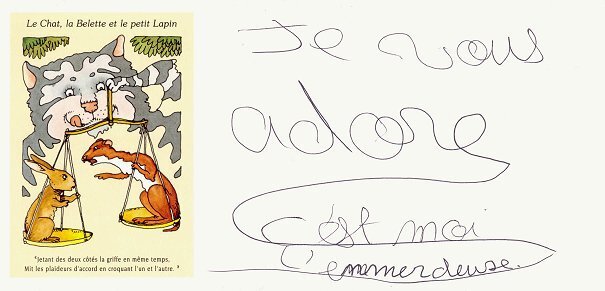
1995 5 notecards, made to match their appropriate envelopes by placing an enlarged image of the fable stamp at the left edge of the landscape paper. Almost 4" x 8¼". The stamps in question are the Fables of La Fontaine stamps issued on June 24, 1995. $15 for the cards and envelopes from Loic Marchat, Villeurbanne, France, through Ebay, Jan., '02.
The five notecards are all inscribed by a young hand, most with warm messages like "Je vous aime" or "Je vous adore." The cards are unusual in having no apparent identifying marks. Other than a title, a picture, and a verse or two, there is nothing printed on either side of these cards.
1995 6 small envelopes, each featuring in its upper left corner a cartoon in the same style as the stamp but showing a different scene. Its stamp is then from the same fable in the series of La Fontaine fable stamps issued on June 24, 1995. All are postmarked on that day, and each envelope is noted as "Premier Jour d'Émission." On the back of each envelope is La Fontaine's fable and acknowledgement of Claudine and Roland Sabatier as the creators of both the stamp and the illustration on the envelope. $24 from Loic Marchat, Villeurbanne, France, Sept., '04.
Now here is yet another incarnation of the designs of this series. Here the stamps' artists create another scene from the same fable in the same style as the stamp that they created. The tortoise checking his watch as he goes is especially cute. FC's scene seems to be a daylight counterpart to the stamp's night-time scene. The grasshopper in this series comes off as not just an artist but a weirdo!
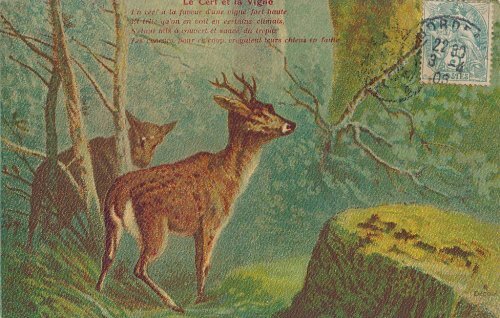
1906? Colored postcard of "Le Cerf et la Vigne." $8 from Bertrand Cocq, Calonne Ricouart, France, Sept., '18.
A curious feature of this early colored postcard is the presence of a second animal in the scene. In the fable, it is hunters that discover the stag because he disturbed the vine. It is perhaps one of the hunters' dogs. If so, it is quite a large dog. The stag is also surprisingly here out in the open. That situation makes it easier for the artist, I suppose, but is not so true to the fable.
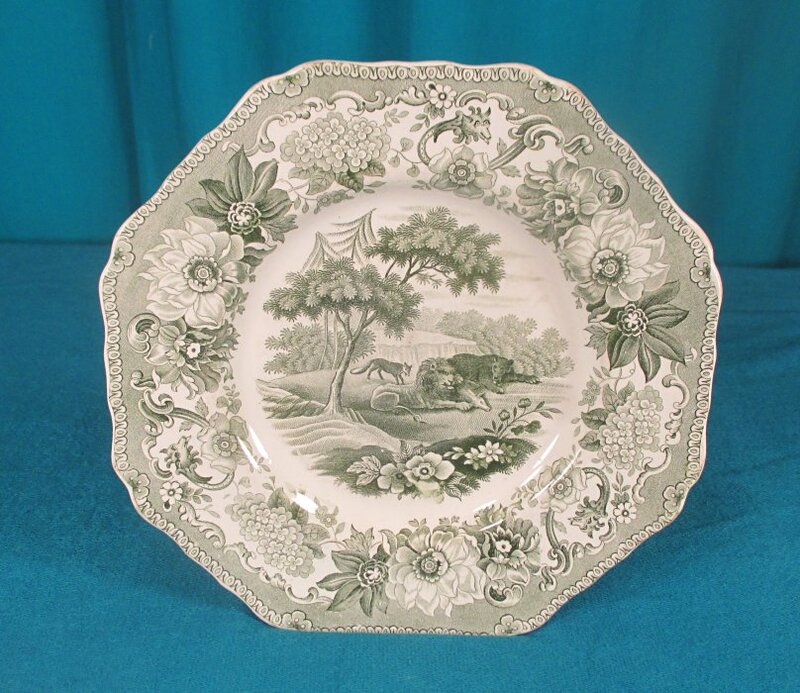
1835 Staffordshire Plate "The Lion, the Bear, & the Fox." 8¼" diameter. "Aesop's Fables." Copeland and Garrett. $50 from Alphabetiques, Montague, MA, through Ebay, Sept., '19.
Here is a lovely presentation in green of the fable in which the lion and bear wear each other out in struggling over the carcass of a deer. Exhausted, the two need to lie and watch as a fox carries away the prey that they have fought over. The verso has clear markings of "Spode" and the quoted titles above.
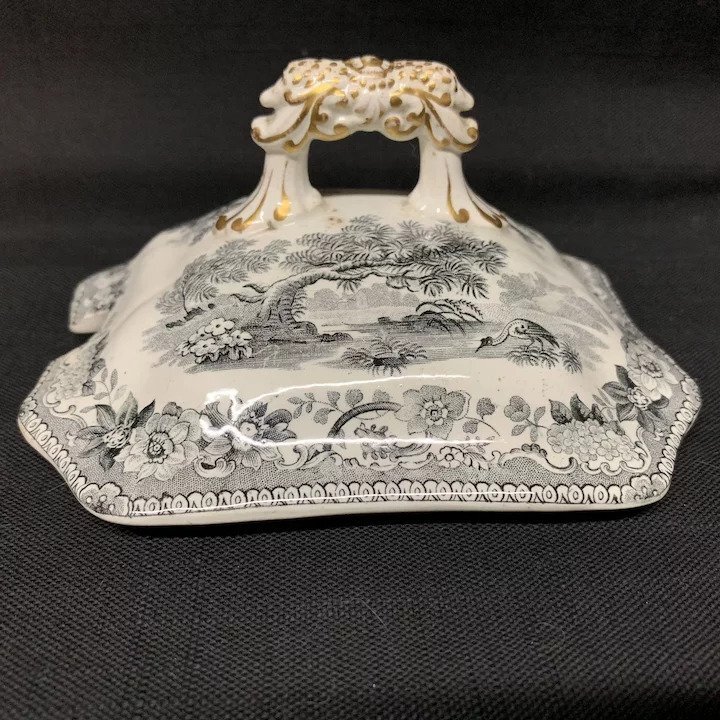
1835 Spode tureen lid featuring OR. About 4¼: x 5½" x 2¾". $75 from AestheticAntiques.com, Nov., '20.
Bentley Chappell and Nancy Barshter at Aesthetic Antiques have a wide offering of fable materials. This was the least expensive. I am unsure of how we are to understand the side opposite the clear presentation of OR. The main side itself is puzzling. Is the oak bending over in the wind? If so, the bird further in the foreground seems unaffected, and the tree seems to be holding its own.
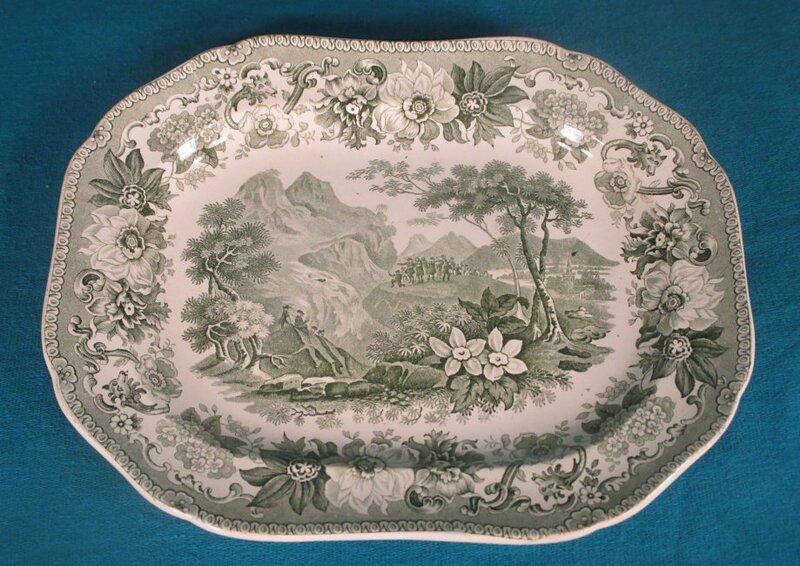
1835? Spode medium-sized platter picturing "The Mountain in Labour" in their series "Aesop's Fables." 10¼" x 8". $150 from Aesthetic Transferware, May, '20.
The mouse is appropriately difficult to find at first in this grand scene. There are several people in the left foreground who seem to be uninvolved or uninterested in the "big doings" that have brought a group of people out of the town on the far right. These people have come some distance, only to be disappointed. I offer a detail of the central image below the platter.
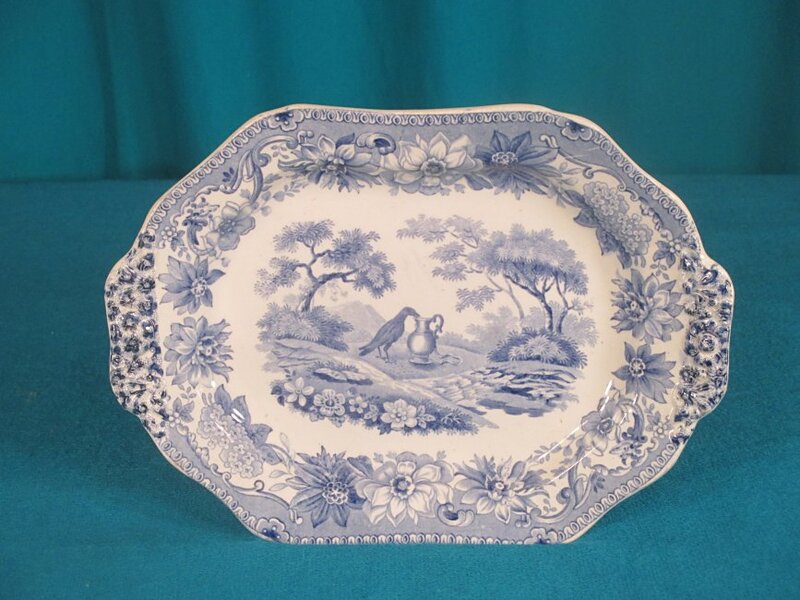
1835? Spode ashette or medium-sized platter picturing "The Crow and the Pitcher" in their series "Aesop's Fables." 8½" x 6". £28 from newcowper through Ebay, Nov., '19.
As with each 19th-century Spode piece I see, the design here is exquisite. I would have to check with the sort of people who ran Downton Abbey to know just when an ashette like this would be used, but it would be lovely, even though I wonder about people taking food off of platters showing crows and rocks!
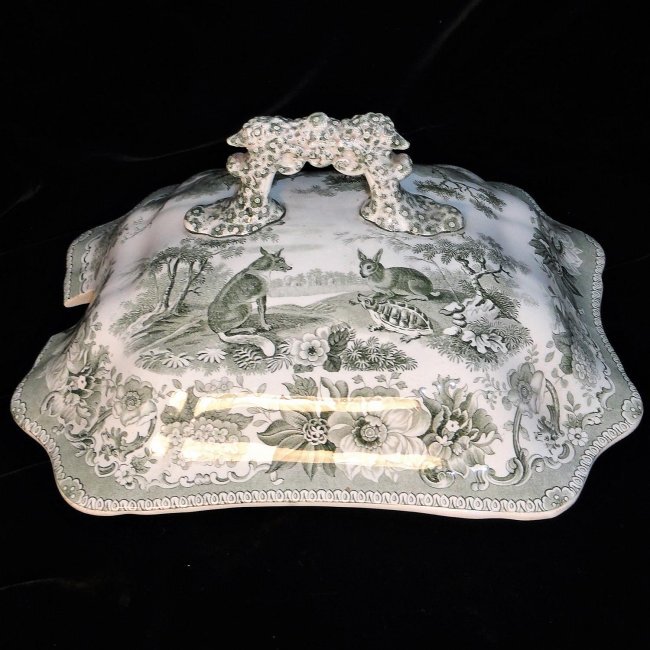
1835 Spode large soup tureen lid featuring TH. Staffordshire green transferware. Copeland and Garrett -- New Blanche Potteries. 11" long x 9" wide x 4¾" tall. $150 from AestheticAntiques.com, Oct., '22.
As Bentley Chappell and Nancy Barshter at Aesthetic Antiques wrote, "Ornate moulded handle, a plethora of oversized flowers, a famous fable, does it get any better than this?"
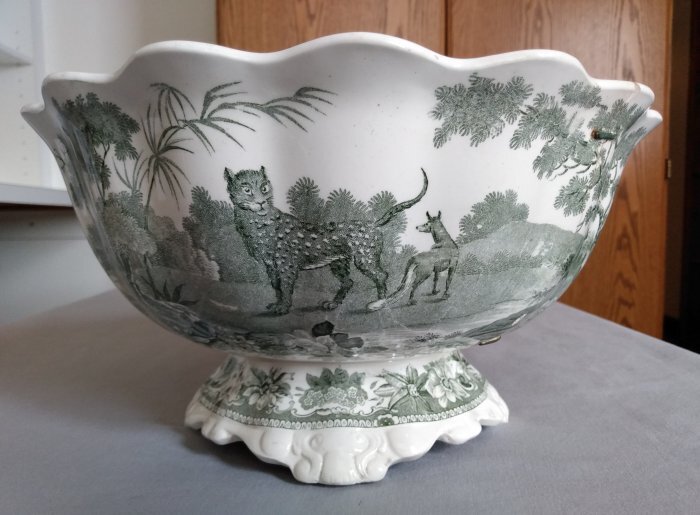
1835 Spode Aesop's Fables Large Fruit Bowl Comport. Center: Lion and Fox. Rim: Leopard and Fox. Staffordshire Green Transferware. Staffordshire, England: Copeland and Garrett: New Blanche Potteries. 11" wide. 5½" tall. $140 from Aesthetic Transferware, Montague, MA, April, '22.
I agree with the seller that this large bowl is crisply transfer printed in the best green color. It features oversized flowers with hidden fox heads. The center has the fox wary of the supposedly sick lion. The outside has a repeated scene of the leopard bragging about his beautiful skin and the fox answering in terms of the beauty of his mind. As the seller noted, a large piece had been reapplied with glue and staples, one of only a few that probably still survive. "We rarely add a damaged piece to our shop unless it’s worthy of merit." I agree with that too!
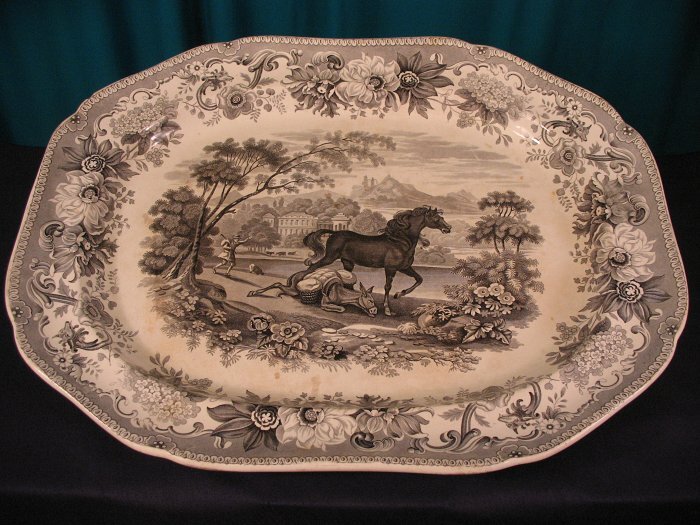
1831? A serving platter, 20¼" x 15½", showing "The Horse and the Loaded Ass." "Aesop's Fables." Spode. England. Gift of Barbara Markuson, Glenwood, IA. August, '10.
This platter is done in the relatively rare black style. Barbara gave it to me in honor of her deceased husband Stanley, who carried the large platter back in his lap as he returned by airplane from Barbados. Barbara had taken the platter to the Antiques Road Show, where the antiques expert mentioned the particularly fine rendition of the horse and the relatively rare black. She valued it at $250. I wonder if it belongs to Spode's original "Aesop's Fables" series, apparently issued in 1831. The fable is apparently Perry #181. I present here Babrius #7, which seems to be the first to do the fable exactly this way: A man had a horse which he used to lead along with him free of any burden. He put the burden upon an aged ass. So the latter, worn out by much toil, went up to the horse and spoke with him about it: “If you are willing to share a part of my load, I may, perhaps, come through alive, but otherwise I shall die.” “Go along," replied the horse, “don't bother me." The ass plodded on in silence, but presently, spent with toil, he fell down and lay dead, as he had foretold. Immediately the master drew up the horse beside him and, unfastening the entire load, put upon the horse not only the packsaddle of the poor drudge, with all its burden, but in addition also, after flaying him, the ass's skin.” Alas," said the horse, “how poor was my judgment; that very burden, of which I was unwilling to share even a small part, has now of necessity been put upon me in its entirety."