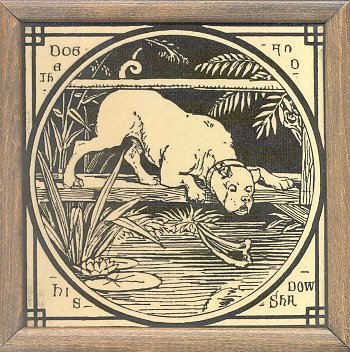
1875? Six-inch square tile titled "The Dog and His Shadow." Manufactured by Mintons China Works, Stoke on Trent. Designed by John Moyr Smith. Framed. $150 from The Jewelsmith, Tempe, AZ, through Ebay, Jan., '00.
Again, lovely brown and cream colors. The title is read in curious fashion, starting from nine o'clock and reading toward three o'clock, and then restarting from eight and reading toward four. In the upper left and lower right, one needs to read going up; the key is to start as far left as possible and always move right. The dog has let go of his large piece of meat, the shadowy reflection of which falls just inside the image's circular frame. A railing on the bridge helps define the heavy horizontal framing of the scene, but leaves his tail above its line.
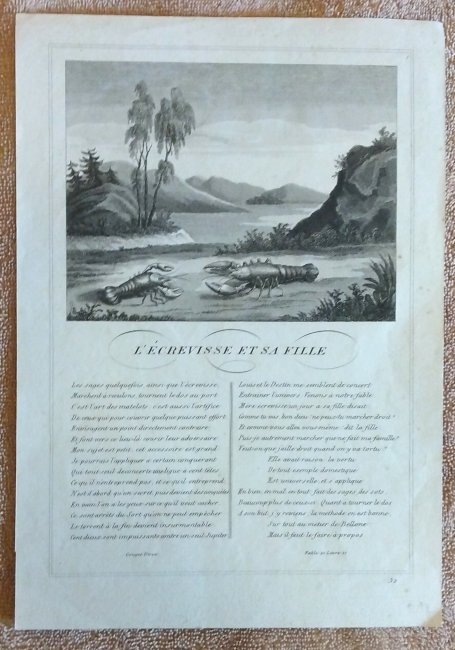
In my short time in Paris in the summer of 2014, I managed to find a number of fable materials. Among them are broadsides or separated pages from Gouget's edition of La Fontaine in 1834 (Bodemann #279.1). There are two groups.
One group of five is carefully matted but without decoration around the page of text and illustration. They are slightly colored. The seller labeled them "1834" and that was the first clue that these are Gouget's work. Gouget's signature is at the bottom of most texts. The illustrations here are slightly colored. These five are the following. And now I have found a sixth, "The Lobster and Her Young," for €20 from Albert van den Bosch, June, '23.
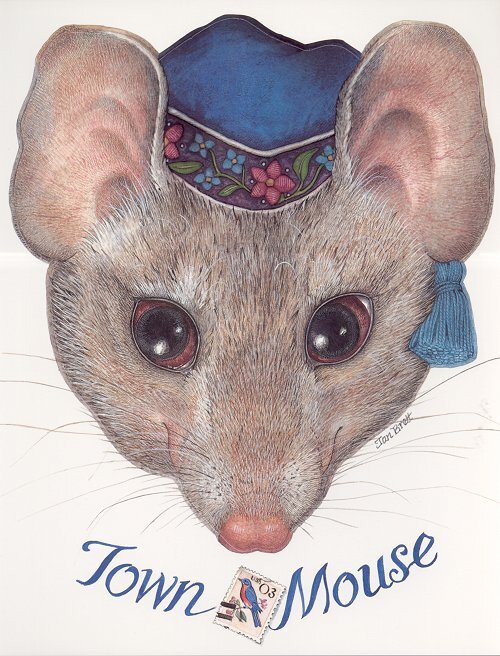
1994 Six paper masks from G.P. Putnam's Sons as a promotion in connection with Jan Brett's Town Mouse/Country Mouse
The back of each mask identifies its character's name and offers apt quotations and commentary, which I show below. See also, on an advertisements page, stickers that reproduce in smaller format the four mice masks.
1930? Six pages of Florian “devinettes,” sets of four hidden picture fable illustrations. $6 each from Bertrand Cocq, Calonne-Ricouart, France, Sept., ’20.
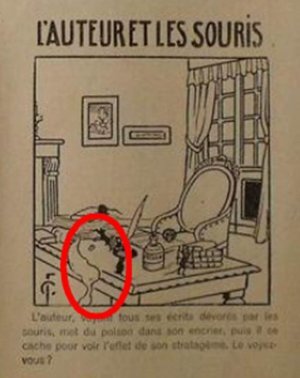
These pages have the look of pages taken from a magazine, though they do not have page numbers. The verso of each presents a cartoon strip of a children’s story. Two of them are “Les Aventures de Nanette.” Bertrand sent along a sample solution, pictured just below. I find some of the pictures hard to solve!
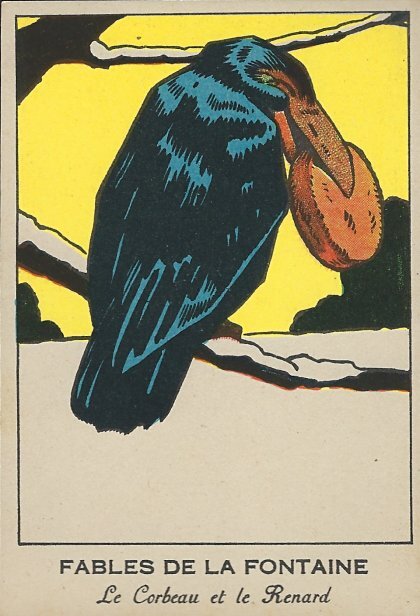
1960? 6 cards each illustrating in strong, simple color one fable of La Fontaine. 3¼" x 4¾". €3 each from Jacky Mabilat, Boutigny sur Essonne, at the Paris Post Card Exhibition, Jan.,' 05. GGE and TT for €10 from Albert van den Bosch, Antwerp, June, '23.
These are simple, strong presentations of the fables. The picture side includes the large illustration, "Fables de la Fontaine," and a title beneath. The verso contains the title again and the text of the fable. Simple forms and dramatic action are the chief qualities here.
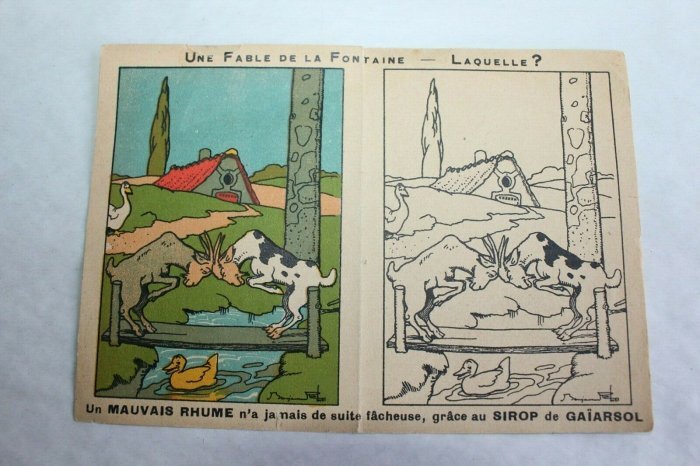
1930? Six advertising leaflets for Le Sirop de Gaïarsol by Laboratoires Bouty in Paris. Benjamin Rabier colored illustration on the left and the same image as a line drawing on the right. Série D. "Une Fable de la fontaine -- Laquelle?" €4.50 each from mathilde9662 through Ebay, Oct.,'21.
These leaflets are a curious reiteration of the series "Le Sirop de Gaïarsol" among non-stock series of trade cards. On those portrait-formatted cards a small colored version gave the color clues for coloring the larger line drawings. Here in leaflets the colored version is the same size as the version to be colored. The illustrations in this series are identical with those in that series.
1953? Sirop Melangé Pomona. Illustrating "The Cat, the Weasel, and the Hare." Art signed L. Ruymen/53. R.C. Verviers, Belgium, Sept., '08.
This syrup tin presents the fable in engaging fashion. The top of the tin has the two disputants before the cat "Grippeminaud, le bon apôtre," seated on top of an inverted bushel-basket. The short sides show the three characters standing or sitting tall. The long sides reveal, in La Fontaine's French and in Walloon, that the cat "gets the two contestants in accord -- by munching on the one and the other."
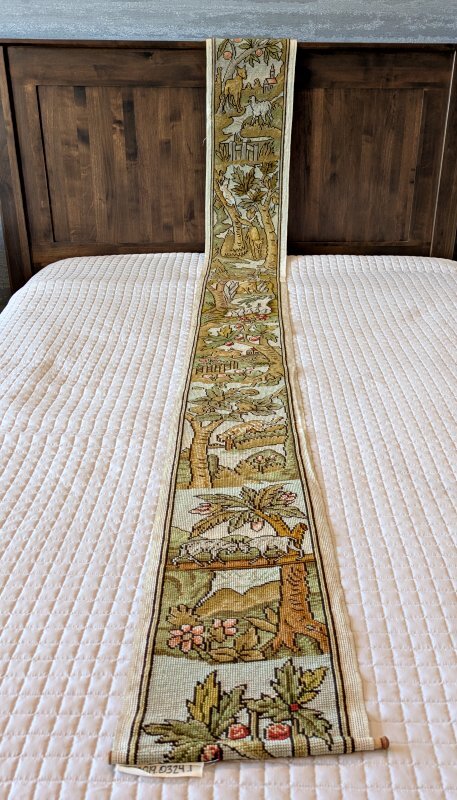
1900? Single tapestry of fables of La Fontaine. 8” x 8.5’. Total width 10”. Unknown source.
As in the matching pair of tapestries, this long, slender, exquisite tapestry contains six fable scenes. In order, they are WL; “The Fox and the Cat”; “The Hare and the Frogs”; TH; DS; and “Two Goats.” These are the same six subjects – and the same six images – as on Tapestry B above, but in different order. And the canvas backing of the tapestry remains at the sides of this tapestry. It is again noteworthy that none of these subjects or images occur on the broader single tapestry above.
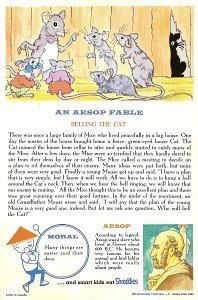
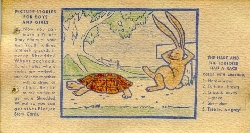
1935? Shredded Wheat Picture Story Album. Twelve 3" x 7" cards of familiar rhymes, stories, and foreign places, several colored in. $.25 at the Omaha Antique Center, Winter, '89. Included is TH. Also, though without fables, an incomplete set of Tony Sarg's Animal Circus.
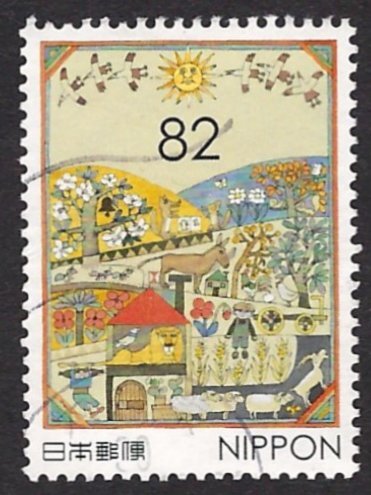
2016 Sheet of Japan Scott's 4064a-j, featuring the work of Mitsumasa Anno, including "Anno's Aesop." $6 from The Plastic Card Collector, Wakefield, MA, through Ebay, March, '23.
Now, this is fascinating! I would never have expected a stamp commemorating a fable book, and especially not from Japan. What a surprise! The book was, of course, published first in Japan in 1987 and then in the USA in English in 1989. This acquisition marks the 29th country to have contributed fable-themed stamps to our collection!
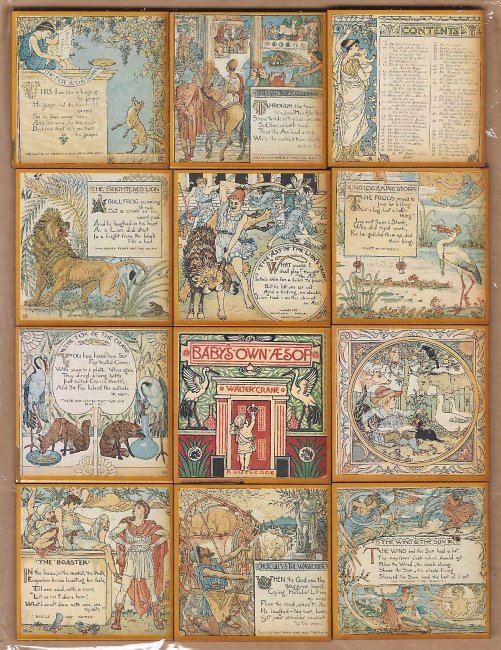
2023? Shapeshifter wooden and paper tiles of "Baby's Own Aesop." 12 pieces. About 1¾" square. $10.43 from ShapeShifterUK, London, through Etsy, April, '23.
Now here is something different. Paper facsimiles of Walter Crane's illustrations in "Baby's Own Aesop" are glued onto original wooden backings 45 mm square. Well done! We show them here in threes.
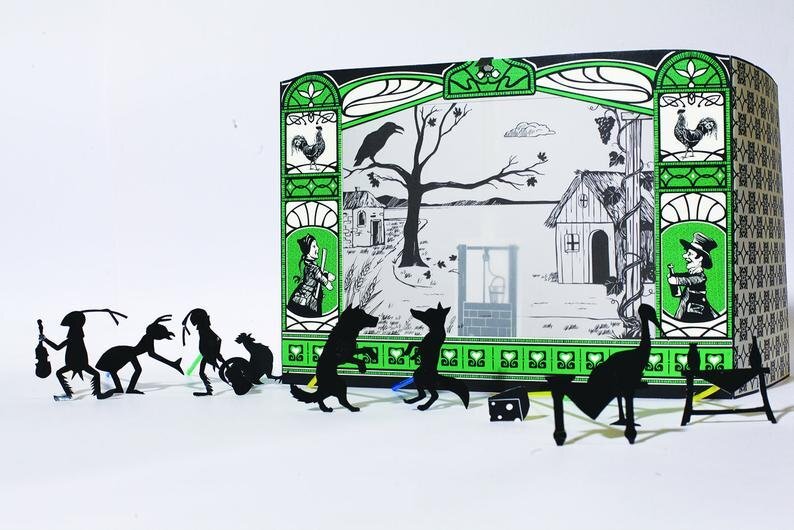
2008? Shadow Theater: Fables. For stories from Aesop, La Fontaine and other animal tales. Budapest, Hungary: Manufaktor Studio. $19 from the manufacturer through Etsy, June, '20.
This is a very creative and engaging set of materials. The materials, which take some shaping and assembling, include a stage with a translucent backdrop, for a shadow show, a number of characters, about a dozen stiff cardboard characters and props to cut out and attach to a set of thin straws. There are scripts in six different languages for GA; FC; "The Wolf and the Fox"; FS, FG, and UP. So clever and so well made!
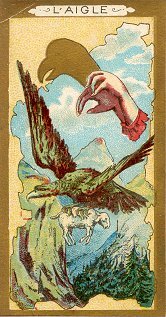
1900? 2 cards from a larger French set depicting shadows created by hands in front of a screen or wall. The two images here are of "Tortue" and "Aigle."
The image beneath the shadow in each case is a fable image. In the former, we sit near the finish line and see the tortoise cross in front of the hare. In the latter, we see the eagle sustain the stolen lamb in mid air. No text and blank back.
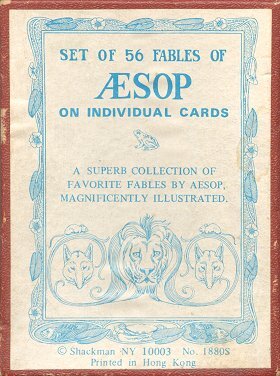
1965? "Set of 56 Fables of Aesop on Individual Cards" A Superb Collection of Favorite Fables by Aesop, Magnificently Illustrated." Illustrations from Percy Billinghurst, not acknowledged. No. 1880S. Printed in Hong Kong. Shackman, NY 10001. Four sets in varying condition, one with a box without a label, another in a box missing one side. $25.07 from JoAnn Jeffreys, Overland, MO, through Ebay, July, '00. $15 from Frank Scott, Elizabeth City, NC, through Ebay, August, '00. $9.95 from Dorothy Buhrman, Cambria, CA, through Ebay, Feb., '01. $20 from Lee Shepherd, Lake Mary, FL, through Ebay, March, '01.
These sets all look much older than the 1960's, but there is a card with each deck providing Aesop's history and a sense of the fables. It includes at its bottom the ZIP code I have included above, and that gives us a terminus post quem. I almost believe that Shackman had someone "antique" the boxes by throwing them around and roughing them up! Some of the narrower Billinghurst designs have an added symbol or ornament outside the picture, like DS at the right. At first, I thought that these cards constituted a game to play, but I see no hint of that within the package. Now that I have at last had a chance to catalogue these cards and learned that the sets are all the same, I can stop buying them!
1960? Severin Original Wooden Box Purse Presenting TH. 6.5" x 3.75" x 3.75". Signed "Severin" on the inside cover. Unknown source.
Here is one of the more unusual objects in the collection. I learned what it is only by going online and seeing another instance for sale, with a price of $150 discounted to $75. I had wondered whether it might be a lunchbox. The four sides track the race from the starter's line to the finish, where the hare is sleeping five feet from the finish! The pictures seem to be carefully applied decals. The artist signs the last image "Carl." I wondered if the images themselves might be found on the web, but there I had no luck. I ask myself what the occasion might be for carrying a TH purse.
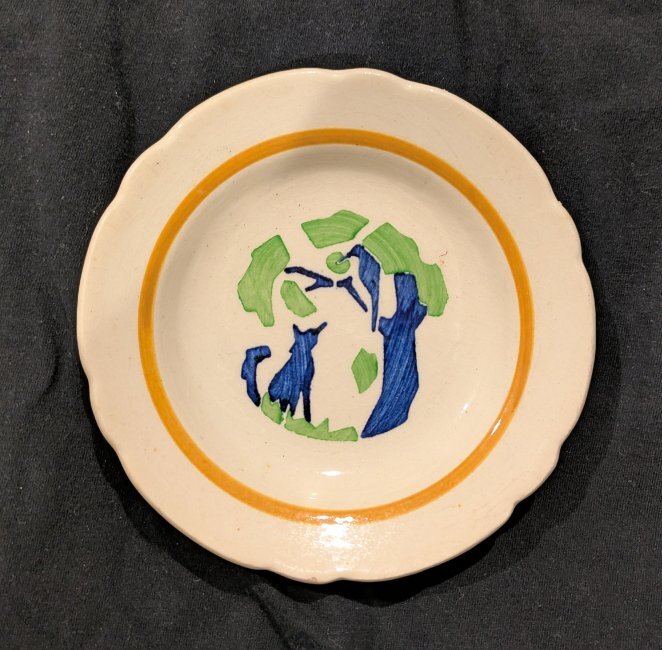
17 further pieces of earthenware from the same set for €129.90 from La Lanterne Rouge through Ebay, March, '25.
How nice to find more of the set 25 years later! And now, of course, I wonder how big the complete set might be. A quick Google search came up empty-handed.
1925? Seven Original Gouaches on La Fontaine's "Lion and Mouse" 12.5" x 9.75". Meant originally apparently for a book project. €250 from Sebastian Bailly, Paris, Jan., '25.
The "ci Bienfait" illustration is a second attempt pasted over the original. Might it be that #3 of 8 was planned but was either never done or became separated from these lovely depictions? Sebastian Bailly could give no further information on the source of these. His estimate was that they were created in the 1920's or 1930's.
1880? 7 cards depicting fables of Florian, including a text of very small print in two columns at the top of the back of the card and a simple colored picture on the front. 4 3/8" x 3 1/8".
The first six from Clignancourt are cropped. At present I have full versions of all seven cards except "Le Lion et le Léopard," for which my only examplar is cropped. How wonderful to have something from an institution like "Aux Deux Magots" right at St. Germain des Pres! The colors are strong and the animals well dressed. Most humans would need a magnifying glass to read these fable texts! They were kept deliberately small, one suspects, to make room for the advertiser's information. "La Guenon, le Singe et la Noix" may have the strongest illustration of the lot. The printer for both LP and ER is "Publicité Roussette, 65 Faub. St. Denis, Paris, while the printer for AQF and ADM is "Ass. d'Ouv. lith., Romanet et Cie, 27bis, r. Corbeau. While some cards have only the image on one side and the text of the fable with its title on the other, the other cards represent several advertisers.
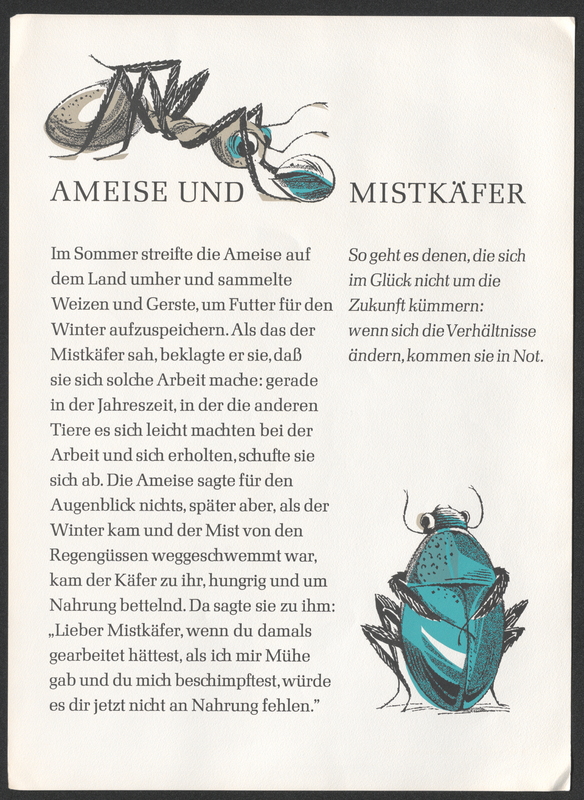
1963 Seven “Fabeln” by Erwin Poell, Mannheim. Texts from “Antike Fabeln” by Wolfgang Mader (1951). D. Stempel Verlag. Size. Cost? Source unknown.
These very large prints feature a variety of typefaces, almost as though the publisher was advertising the possibilities he could offer. I find the mixture of text and image strong. This set is available online these days and is not expensive. Sellers seem to me to presume that these are “fables of Aesop.” I do not see that attribution here. Among the best are: “Der Esel und der Hund”; “Krebs und Schlange”; “Der Löwe und der Hase”; and “Die Tanzenden Affen.” What a joy, after years to bring these to our website!
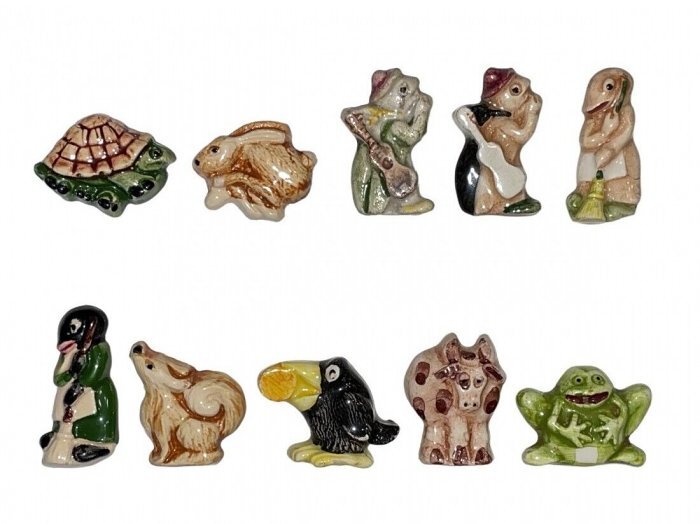
2000? Série complète de 10 fèves Fables de la Fontaine. Two dimensional.
The unusual characteristic of this otherwise unidentified set of 10 fèves is that each has a flat side and is thus two-dimensional. It is also unusual that two pairs out of the ten figurines use the same form but are colored differently. Is there a black ant and a white ant? And are there two cicadas? Otherwise we have OF, TH, and FC.