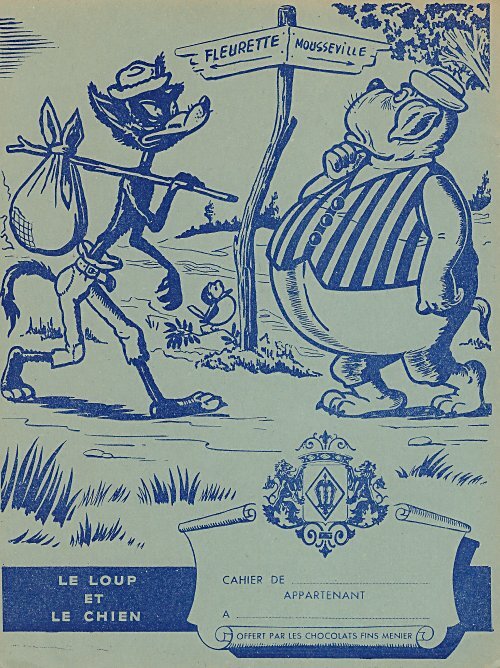
1950? School dust jacket "Le Loup et le Chien" offert par les Chocolats Fins Menier. Imp. Typo Noisiel. About 7" x 9½". €1 from French Vintage Shop, Paris, through eBay, Feb., '13.
This blotter nicely exaggerates the rotundity of the dog on the right and the famished skinniness of the wolf on the left. They meet at a crossroads, where roads lead to Fleurette and Mousseville, respectively. On the verso, the smiling dog advertises the "Fables de La Fontaine" cards one can get in Menier chocolate bars and other Menier products.
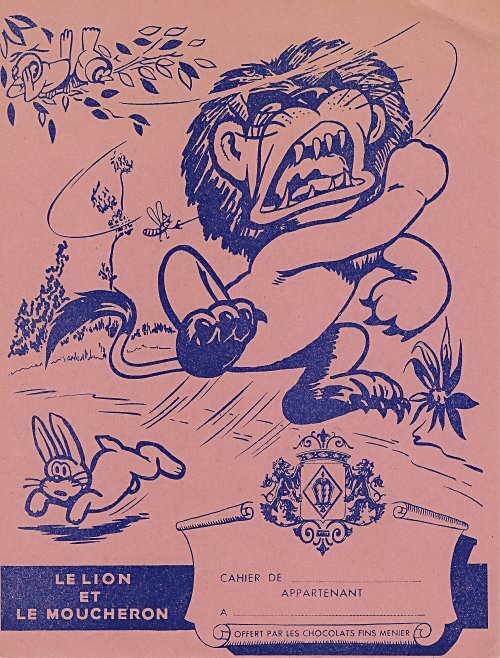
1950? School dust jacket "Le Lion et le Moucheron" offert par les Chocolats Fins Menier. Imp. Typo Noisiel. About 7" x 9½". €1 from French Vintage Shop, Paris, through eBay, Feb., '13.
The mosquito almost gets lost in this picture as he flies into the upper left corner of the cover of this "Cahier." The viewer might be more drawn to the rabbit who ruins by while the lion takes a missing swing at the mosquito. On the verso the lion is smiling, perhaps because he has just enjoyed some Menier chocolate. The mosquito seems to be enjoying a chocolate himself as he rests on a mushroom.
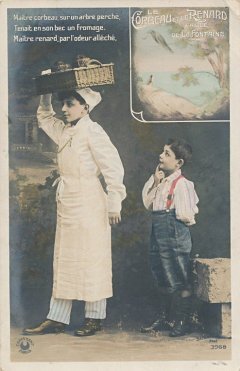
1910? Three colored photographic postcards from a set (of 6?) using children to portray La Fontaine's FC. Sozerac 3968. Paris: Croissant. Card #3 for $9.99 from Stefano Nels, Columbia, SC, through eBay, July, '05. Cards #1 and #2 for $20 from Bertrand Cocq, Calonne Ricouart, France, Sept., '18.
The human story is utterly consistent with the fable, as a child sees bakery in the tray on the baker's head and flatters him to get some of the bakery. As in the "Croissant" version of TH, there is a portion of each card's picture given to a colored rendition of the original fable, the first of them announcing the title. These three cards present the first nine lines of La Fontaine's fable, and thus I have labelled them Cards #1 through #3 of the set. Are these cards hand-tinted? The coloring of FC in the upper right of Card #3 is particularly nice.
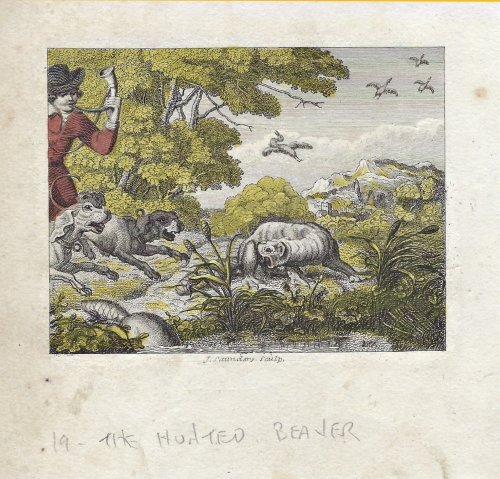
1800? Two lively 5” x 5” duochrome (hand-painted?) illustrations. Image 3.8” x 3.2”. “Saunders Sculp”. From LaArtier, Portslade, West Sussex, England.
It is hard to know whether these are separated book pages or separate prints.
“Beaver” is a less told tale, partly because of its subject matter. The action of the beaver is here quite unmistakable. Well colored!
The range of browns in this rendition of UP is particularly strong. The artist includes the dogs, which I believe are a fiction of the clever rooster’s mind.
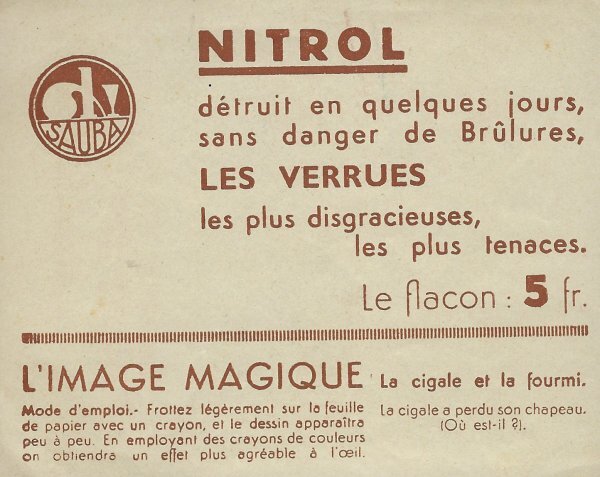
1935? Two frictographic “Image Magique” hidden page slips advertising Sauba syrups to counteract worms and warts. A child should rub a crayon on the “blank” verso and an image will appear – an image with a hidden item to find. 4⅞” x 3⅞”.
These two slips combine elements this collection has encountered before: hidden images and frictography. Surprises keep coming! I am so tempted to “violate” these ephemeral treasures by trying to bring out their pictures!
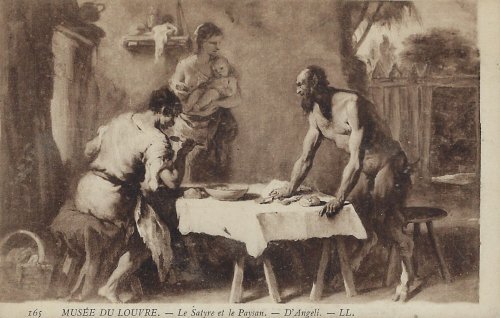
1900? Black-and-white postcard with a photograph of D’Angeli’s “The Satyr and the Peasant.” “165 Musée du Louvre. LL.” $5 from Bertrand Cocq, Calonne-Ricouart, France, Sept., ’20.
Do I understand correctly that this presentation of the fable departs from other presentations of the time chiefly in the expressive stance of the Satyr? Is he at the point of getting up to leave this place of double-speak? “LL” correlates with one of our presentations by Jordeans of the same fable.
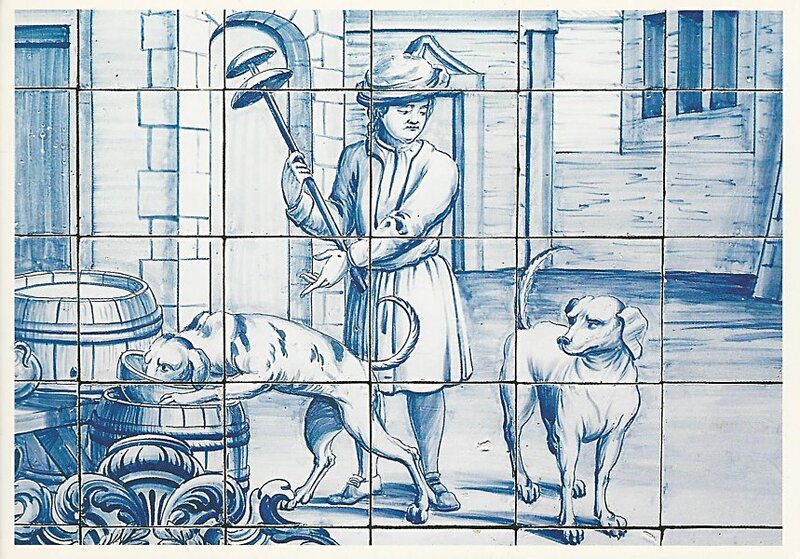
2008 Mosteiro de São Vicente de Fora. Fabula de La Fontaine. "A Educação." Gabriel Somogyi, Floresti, Romania.
Here is a detail of the glorious tiles in this monastery representing La Fontaine's fables. This particular fable seems to have a master teaching one dog by the example of the other.
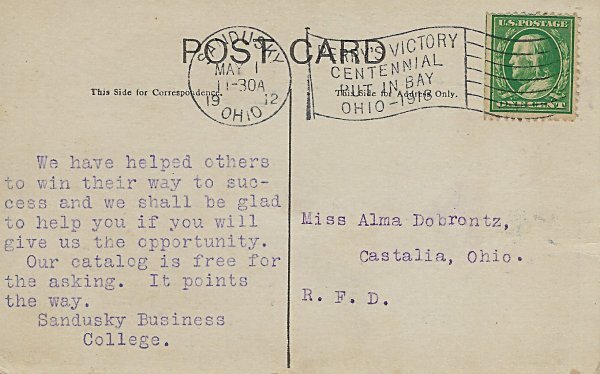
1912 Penny postcard using TH and the month of May 1912 to advertise Sandusky Business College in Sandusky Ohio. The card was mailed to Miss Alma Dobrontz of Castalia, Ohio. Unknown source.
This card is actually fascinating. TH turns into "The Race of Life" and success is the sun gleaming at the end of the road. The hare sleeps at the base of a sign pointing to "Business College." The interpretation of the fable stresses determination and effort as the keys to success. The obverse presents Sandusky's claim to Miss Dobrontz: "We have helped others…."
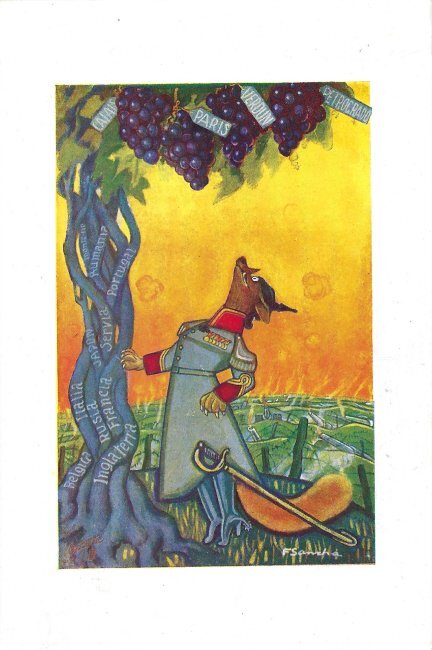
1915? Six prints offering the same illustrations as Tuck's "Up-to-Date" "Oilette" postcards by Tuck and Sons. €70 from Albert van den Bosch, Antwerp, June, '23.
I was surprised to find these six images in other than postcard form. As I describe a propos of the postcards, fables are used in this instance to satirize Germany. The fable texts on the message side there appear in Dutch, Spanish, Italian, Portuguese, or English on individual cards; words printed on the image side shift correspondingly. There are no indications of a source for these, except perhaps that they appear to be in Spanish. My, things get around!
1989? Aesop's Fables . Five full-color postcards displaying BF, "The Cat and Two Sparrows," CP, LM, and "The Kite and the Pigeons." 5" x 7". "Pleasure Print." Printed in Ireland. Denver: The Sanbourn Souvenir Company of Denver, apparently a firm held by John Hinde Ltd of Dublin. Gift of David Alvey, June, '90.
The art is not exceptional, but the size of these postcards is! The fact that there are post cards of Aesop was first announced to me with this splendid gift. I wrote the company to find out more, but never received an answer. The verso of each card contains a long version of its fable.
1957 Ten cards displaying colored paintings of Saltykov-Shchedrin's fables by E.M. Rayev. 4⅛" x 5⅞". Editor H.A. Glorlienko. Moscow: Sovietski Hudorzuik. $6.50 from Rosfilclub, through Ebay, Dec., '03. Extra set from Alex Sourtaev, Moscow, through eBay, June, '05.
Here is Rayev's delightful encounter with ten of Saltykov-Schedrin's fables illustrations. For now, I have matched them up as well as I can with what I know of Saltykov-Schedrin's fables, but the identifications are far from reliable. Help
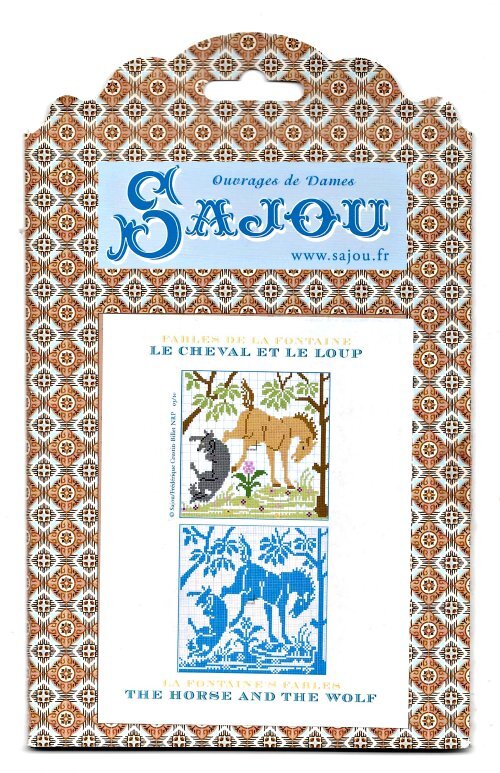
Sajou Needlepoint Fable Kits. 14 of 24 available kits. From an unknown source.
The manufacturer’s description for these charming designs includes this information: “To embroider on natural linen to obtain a band measuring 20cm wide and 1m50 high. Kit contents:
1.60m of natural linen band width 20cm; 22 cards of Retors du Nord: 2004, 2005, 2009, 2013, 2024, 2033, 2034, 2039, 2041, 2190, 2221, 2302, 2317, 2332, 2350, 2409, 2443, 2445 x 2, 2570, 2777, 2876; a Sajou “Créé par moi” label; full-colour pattern chart with explanations.” The latter might be the most important inclusion. As they say, it is presented in a lovely Sajou re-usable packet. Of the 24 kits, we have 14.
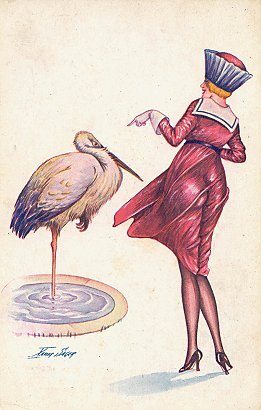
1925 "Le Cygne et la Grue" par Xavier Sager. Fantaisies trichromes. Série n° 103. 546. Fabrication française. 15000 Lire at the Porta Portese flea market, August, '98.
I am not sure that I have ever read a fable of the swan and the crane. Once I learned that "grue" means not only a crane but a prostitute, I am not sure that the artist had ever read one either! In any case, a crane in a very small pool eyes a jauntily and thinly clad young woman. I never thought I would have one of "those" French postcards in this collection!
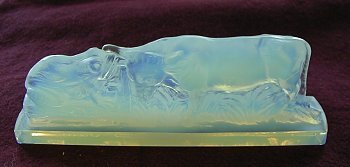
1990? Sabino "The Frog and the Ox" opalescent figurine paperweight. 4½" long, slightly less than 1½" high, and less than 1" wide in its base. Mint. Signed. Original box. Paris: Sabino.
Though this work is beautiful for its milk-and-gold coloring, I do not catch the fun of the fable in it. Is there any suggestion of the frog's exploding? The two molded halves may be meant to present different scenes, but so far I can read only that the frog is whispering into the ox's ear. Nothing from the artist--not the work itself nor the box nor the enclosed brochure--identifies this scene as from an Aesopic fable, much less from this particular fable. The Sabino brochure says that his work exemplifies "Art Deco."
1995 6 cards each stamped with the scene it portrays from La Fontaine's fables. R. & C. Sabatier in the larger format of a post card. $19.50 from Alexandre Prozopiorski, Lyon, July, '99. And a version of GA signed by Sabatier for $4 from Topical Paradise, July, '16.
The more I see of these designs, the more I like them. They play with the fables. As far as I can tell, there is little or no difference from the stamps themselves. The result is that one can see here in larger scale what happens on the smaller stamp. "La Cigale et la Fourmi" has the grasshopper playing an accordion and a tambourine. "La Grenouille qui se veut fair aussi grosse que le Boef" manages to present the nose-holding frog as being as big as the steer in the background. "Le Loup et l'Agneau" is one of the best; the wolf leers at the lamb, but as a reflection seen by the lamb in the water. "Le Corbeau et le Renard" gives the fox a violin. "Le Chat, la Belette et le petit Lapin" shows a cat already licking his chops as he holds a scale with one of the contestants in each pan. "Le Lièvre et la Tortue" shows the tortoise breaking the finish-line tape while the hare chases a butterfly with a net.
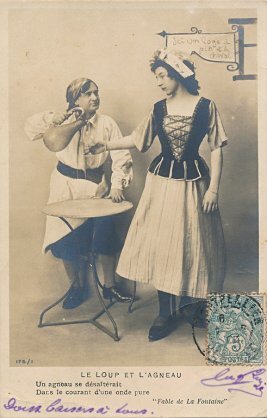
1905? Four photographic postcards – from perhaps a set of six? – depicting "Le Loup et l'Agneau." S.I.P. 175/1-6? $40 from Bertrand Cocq, Calonne Ricouart, France, Sept., '18.
It can be hard to understand the interpretation and the sequencing of this story as it is presented here. The problem is exacerbated by the fact that, on one card, the stamp covers the card's numbering. The other three cards are all in Series 175 and are numbered 1, 3, and 4, respectively. A major clue toward resolving some of the quandary comes in recognizing that this card changes La Fontaine's text at a crucial point. La Fontaine starts his fable with the promythium that the argument of the stronger is always the better and then says immediately: "Nous l'allons montrer tout à l'heure": "we will show that right now." The card with a hidden identifying number has rather "Nous l'avons montré tout à l'heure": "we have shown that right now." I presume therefore that this is the last card in the series. I still have trouble understanding the role of the male in the first and last photos. Is he just a friend sympathizing with an abused maid? What does his gesture portend in the last photo?
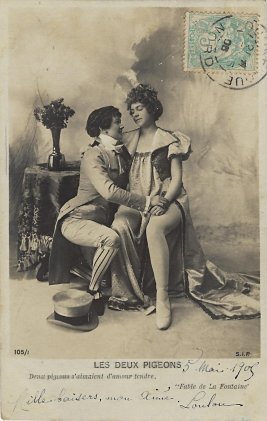
1904? Les Deux Pigeons. Set of 8 numbered photographic postcards by S.I.P. 105/1-8. $5 each from Bertrand Cocq, Calonne-Ricouart, France, Sept., '20.
This is a remarkable set in several ways. This collection does not have many sets of eight cards. Six seems to have been the standard size, with a few including ten cards. At least some of the photographic series try to include the whole text of a fable. With this fable's long text, that is impossible. The editors here make a clever shift. What in the text is part of the stay-at-home's plea for the friend not to depart here becomes a solitary statement of concern while the friend is gone. Perhaps the most fascinating thing about this series has to do with its handling of gender. La Fontaine's text, as far as I can tell, speaks of male friends. French illustrators of the fable appear, at least to me, to have interpreted it frequently and even regularly in heterosexual and romantic terms, with a male leaving a female behind and returning to her. Here, to help complexify matters, a female plays the departing male, with little attempt to disguise her femininity. Hmmm….. The last seven cards were sent to an Yvonne Ronard. The first card has a cancelling date of 1905. By the way, this bird does come home as wounded and battered as I think the dove does in La Fontaine's fable!
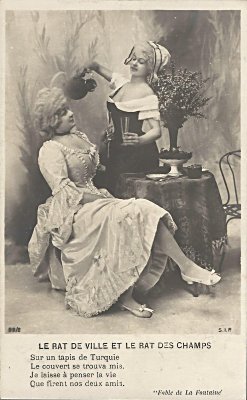
1905? "Le Rat de Ville et le Rat des Champs." 3 photographic cards out of a set of 5(?). $2.50 each from Elsa Pinto, Paço de Arcos, Portugal, June, '13.
Cards #2, #3, and #5 show scenes in which two distinctively clad women -- with significant décolletage -- present scenes from TMCM. In the first, the country woman is pouring wine for the woman in a sophisticated dress. In the second, both are alarmed by something offstage. In the third the country woman is bidding the courtly woman adieu. Each card's front quotes four not necessarily continuous lines from La Fontaine's fable. There seems to have been a certain fascination with portraying La Fontaine's fables through the relatively new medium of photography. Are these also exemplars of the French "girly" postcard? If so, they are quite tame by present-day standards. This series is consistent with a single card we have from a GA series by S.I.P.
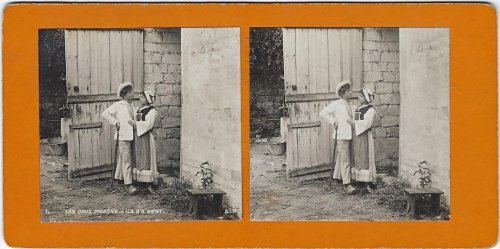
1900? Three stereopticon cards by S.I.P. of "Two Doves." S.I.P.
We have cards #1, #2, and #4 of this set. Might it include six? The first card presents the two birds lovingly together – at the same door used in cards #4, #5, and #6 of the stereopticon series of GA! This is a matter of killing two doves with one stone! The female or "stay at home" dove seems to be the same actress as in both the ant in that GA series and as Perrette in MM. In card #2, is the male dove feeling bored or perhaps some form of wanderlust? What, we might ask, is his female friend doing? By card #4, she is waving good-bye with her kerchief. Perhaps in cards #5 and #6, he will experience the trials of the world and return to her loving arms.