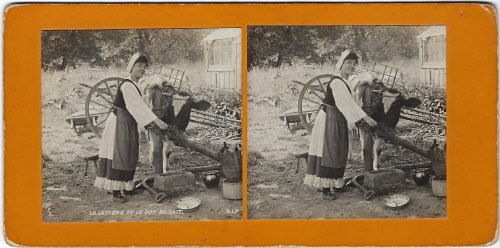
1900? Complete set of six stereopticon cards by S.I.P. of MM. S.I.P.
This set starts with Perrette attending the cow on the farm. In #2 she milks the cow. In #3 she has her pot of milk in her hands before she departs. In #4 she is proceeding down the road to market. In #5, the pot has fallen and is smashed, and her milk is all gone. In #6 she laments her loss. These stereopticon cards are in good condition! Do we have the same actress as Perrette here, the ant in GA, and the home dove in "Two Doves"? And is she wearing almost the same costume?
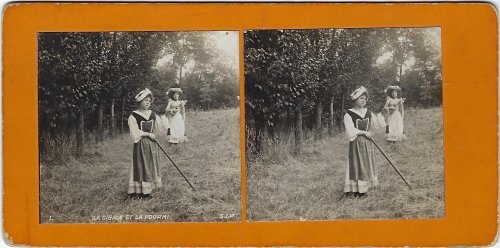
1900? Complete set of six stereopticon cards by S.I.P. of GA. S.I.P.
This set starts, unusually for French postcard presentations, with the countryside as the venue for the grasshopper's encounter with an ant. The time is summer. The ant works the soil. The grasshopper is lavishly dressed. And she plays music happily. Suddenly it is winter. With hat in hand, she knocks at the ant's (barn)door. The ant opens, and the grasshopper extends an open hand in request for food. The ant rejects the grasshopper, telling her to go dance.
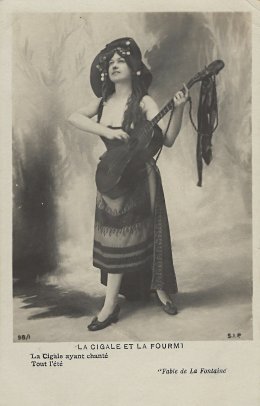
1900? Five black-and-white photographic postcards presenting GA. "98/1" through "98/5." S.I.P. Neither written on nor sent through the post office. $60 from Bertrand Cocq, Calonne Ricouart, France, Sept., '18. Extra copy of 98/2 for $2.99 from Cathy Merdji-Barlet, Luriecz, France, through eBay, May, '15. A second copy of 98/4 with curious added coloring from Joan Beldean Bogdan, Cluj, Romania, through Ebay, July, '16. Extra uncolored copy of #4 for €6 from akpool.de, January, '23.
These cards are consistent with the S.I.P. series on TMCM. The whole verso is, both cases, dedicated to the addressee. Is a series like this something of a "French girly" card offering an excuse to present an attractive woman in less than usual clothing? Was a headdress like that fashionable at the time of the photograph? I had written after finding two cards from the set "Let's see if we can find some more photos from this series!" Good work, Bertrand! The whole set! I include as an extra the colored version of 98/4.
1960 Eight single matchbox labels, each giving the title and an illustration for a fable of Ivan Krylov. About 2" x 1¼". Each cover has a tiny "1960" inscribed outside the border of the scene itself. $2.99 from Alexander Basoc, Highland Park, IL, through Ebay, May, '00. Extra set for €20 from Albert van den Bosch, Antwerp. June, '23.
Each item includes this Cyrillic information at the bottom or right, whichever is the smaller edge: "AEH.CHX Φ ПРOΛETAРCKOE 3HAMЯ ГOCT 1820-56*50WГ." This is now my third set of matchbox labels. This is getting serious! The illustrations here are simple and contain three colors: black, beige, and brown. The characters are identified with simple nouns.
1990? Russian scene mostly of wood illustrating FS. There is one more hole, and something -- perhaps a vase? -- may be missing.
What lovely shapes! FS is the unusual fable that has become a staple of Russian culture's stories, even their myths but certainly their legends.
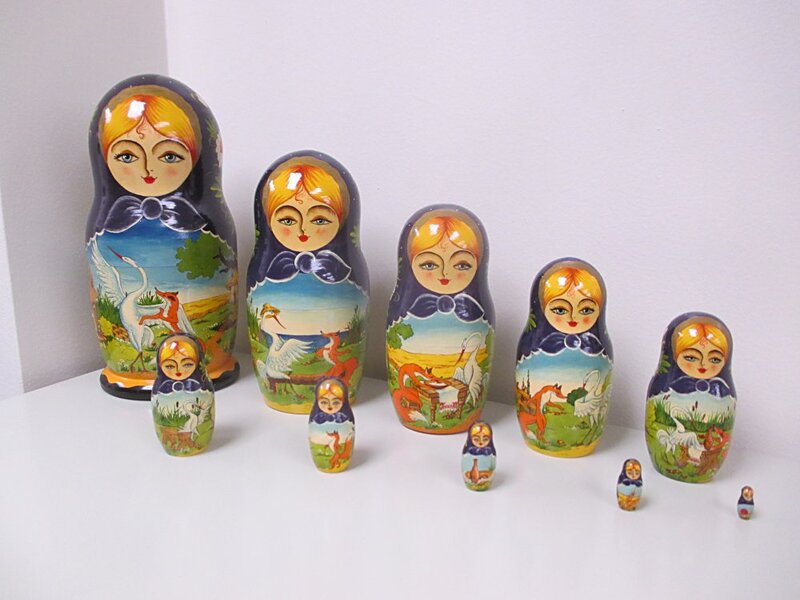
1993 Russian matryoshka set of 10 dolls representing FS.
This remarkable matryoshka, signed "Surko L"on the bottom of the largest doll, by the artist, is, according to the Ebay seller, an "authentic hand painted Russian Nesting Doll" originally purchased for $900. As the seller claims, the colors are indeed vivid. 11" tall. The diminishing dolls tell the story of FS, which is beloved as a folktale among Russians. All that is left after the the unfortunate tit-for-tat encounter is an empty soup bowl and an empty vase. Though the display below allows us to follow the story, viewers are reminded that each successive doll is about an inch shorter than the preceding doll. Click on any doll to see a full-screen image.
1992? Eighteen matchboxes, each giving the title and an illustration for a fable of Ivan Krylov.
Here are the same matchbox labels mentioned in the previous item, but now gathered as a set in a lovely presentation box. It turns out that there is one more member of the set that was not present in the individual pairs of illustrations: "The Fox and the Grapes." The designs are simple and appealing, always featuring a white label at the top. Fables included are:
The Broom
The Cat and the Cook
The Cock and the Pearl
The Cuckoo and the Cock
The Dragonfly and the Ant
The Eagle and the Mole
The Elephant and the Pug
The Fox and the Grapes
The Industrious Bear
The Lion and the Fox
The Mirror and the Monkey
The Monkey and the Spectacles
The Quartet
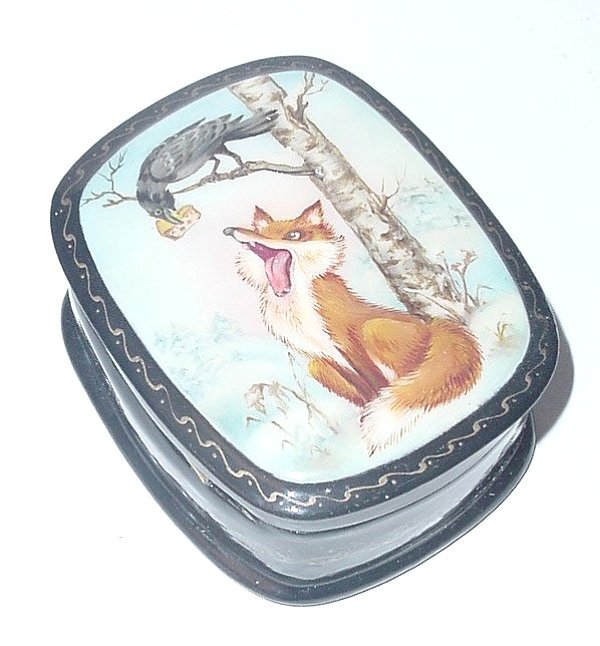
The Raven and the Fox
The Swan, the Pike and the Crayfish
The Swine Under the Oak
The Two Dogs
The Wolf and the Stork.
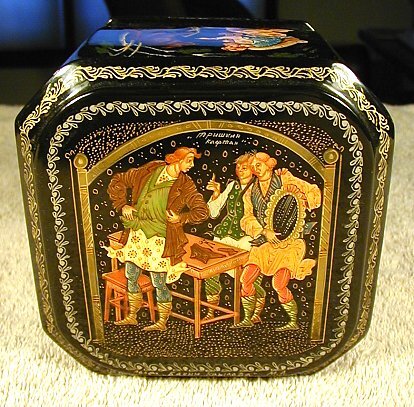
1980? Russian lacquer box from the village of Palekh illustrating five different stories by Ivan Krylov. Paper mache, gold ink, handmade and handpainted, signed by the artist. 4½" x 4½" x 3½". Excellent condition.
This black box is octagonal, with each of the square's edges turned into a very short side. The colors are lovely. Each of the images has a gold-ink background, and each of the short sides a gold-ink branch pattern. The inside is painted a simple bright red. The five fables--each labelled in Russian with a title--are, if one faces the box, "Trishkin's Kaftan" (top), "Demianov's Fish Soup" (front), "The Cat and the Cook" (right), "The Peasant and the Bear" (back), and "The Wolf in the Kennel" (left). I presume that this is a one-of-a-kind item. It is simply exquisite!
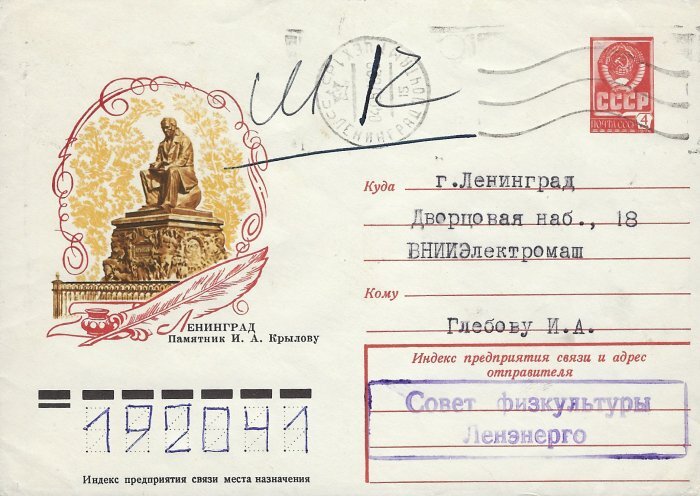
1978 Russian envelope picturing statue of Krylov seated. Unknown source, before July, '21.
The artistry around the Krylov estatue -- in tan and red -- is lovely. The envelope apparently came already stamped. Its glue is or was so good that it seems permanently sealed. I trust that there are no valuables inside!
1900? Seventeen pairs of matchbox labels, each giving the title and an illustration for a fable of Ivan Krylov. Described only as "old and extremely rare" by the seller on Ebay. $16 from Vladislav Pronin, Brooklyn, Feb., '00.
What a hoot! I never knew that such a thing existed! I presume that each of these pairs would be cut in two and pasted onto a box of matches. I never thought of finding fables on matchbooks! The designs are simple and appealing, always featuring a white label at the top.
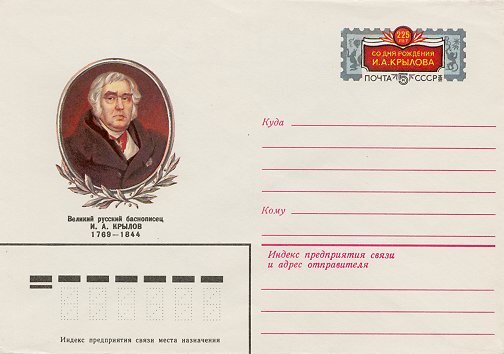
1983 Russian cover with original stamp dedicated to Ivan A. Krylov. $5 from Vladislav Pronin, Brooklyn, through Ebay, Oct., '99.
The printed stamp shows animals around the name of Krylov and notes that it is 225 years since Krylov's birth in 1769. The value of the stamp is 5 Kopeks. On the left of the envelope is a lovely colored oval bust portrait of Krylov.
1970? Russian carved wooden toy depicting WC. Button-activated movement. $20 Canadian from 2013reh001 through Ebay, July, ’21.
This is one of the most successful of Russia’s lovely active carved wooden toys, and it portrays a fable I wish were presented more often. Good operating condition!
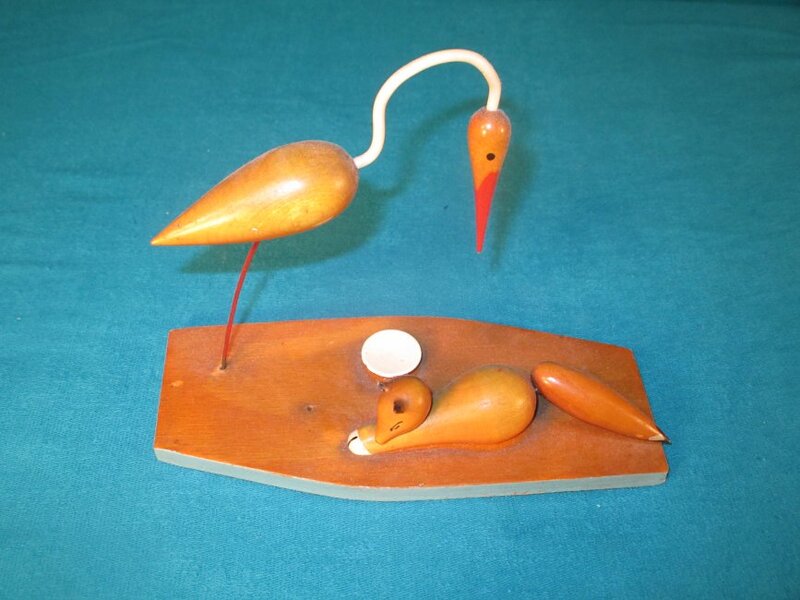
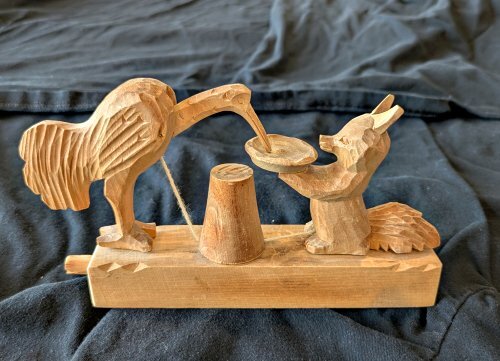
1985 Russian carved FS toy, with push button. $10 at Victor Kamkin, NY, April, '98.
Push the button and the fox backs up while the stork raises his head; then the fox offers the stork food in a very shallow dish. Well executed. I saw this in the Kamkin window and asked for it. I was told that they could not get at their display window, but they would let me know the next time they changed their display. On a chance, I called a year later and they had laid it aside for me. Through Roseann Fitzgerald and a friend, I got it--and played with it so much that Tom Greener had to repair it for me when I broke its string.
1990 Russian carved FG toy, with handle and ball-and-string. Gift of Mary Pat Ryan, Christmas, '90.
Get the ball going in a circular movement, and the fox will wag his tail. The "grape" may actually be an apple or a cherry! Ingenious and well executed.
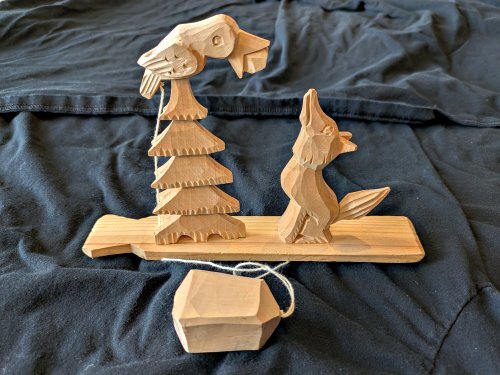
1992 Russian carved FC toy, with handle and ball-and-string. Gift of Margaret Carlson Lytton from the Rose Bowl Swap Meet, Christmas, '92. Extra exemplar, labelled, signed, and tagged as a "Rezcik Collectible" from Heritage International, Ltd., as a gift from Donna Eddy, June, '99. Another exemplar a gift from Simon Mogilevsky, July, '99.
Get the ball going in a circular movement, and the fox will wag his tail and the crow will bob with the cheese in his mouth! Another ingenious and well executed gift from Meg! And now we see that the Russians are becoming more self-conscious about marketing their excellent toys! The other exemplars have the same great action as the original!
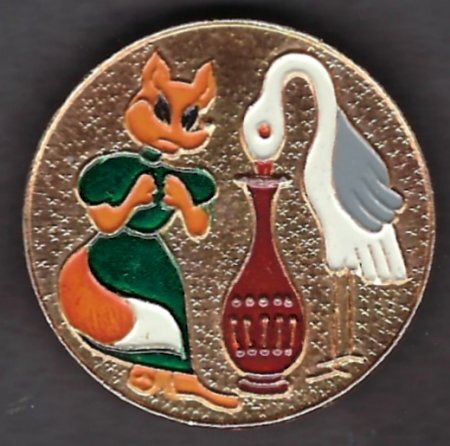
1970? Russian Badge illustrating Krylov's FS. Made in USSR. "IL 25." $5 from Vintage USSR Gifts through Etsy, May, '23.
This is a colorful portrayal of the popular Russian fable, similar to but not as heavy as the pins in a series of multicolored metal pins of Krylov's fables from about 2000.
1960? Ruelle Chocolate Cards Album. Complete album of 24 sets of 5 cards each for €175 from Albert van den Bosch, Antwerp, Dec., '22.
I had earlier found several individual papers. They are here. And I have also included the album as a book under "1960?" What a delightful set! The artist(s) really had fun with the fables!
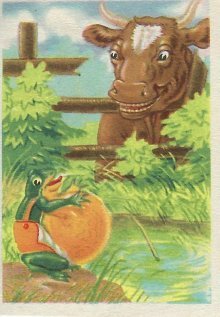
1960? Ten small (2" x 2¾") numbered papers advertising Ruelle "Chcolats-Bonbons" and "Bonbons/Chocolade." Even the title of the collection is bilingual: "Fabels van La Fontaine" and "Fables de La Fontaine." $8.95 for #5 OF from Vintadv, August, '18. Eight further cards for $6 each from Bertrand Cocq, Calonne Ricouart, France, Sept., '20. FC (#24) from an unknown source, Nov., '22.
These pictures are fun and exceptionally detailed. In #5, a huge bull looks through a broken fence section at a frog in a swimming suit on his back, perhaps because he has just burst. One can even make out the ox's teeth! I wonder if this collection goes beyond fables. Might it be that the verso of the first of several cards illustrating a single fable offers a bilingual title for the fable? That approach might explain why some of these slips have titles and some do not. Now the collection also includes the complete album of Ruelle slips, also listed under books at "1960?"
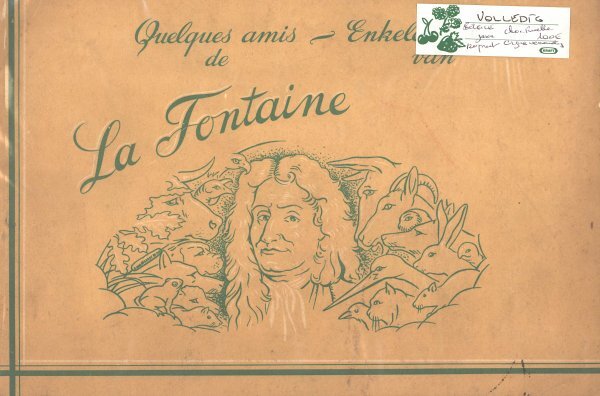
1950? Quelques amis de La Fontaine. Paperbound. Ruelle Chocolate. €100 from Albert van den Bosch, Antwerp, July, '23.
I have fallen in love with this landscape formatted booklet. It is an album completely filled with Ruelle chocolate slips. Each of the 24 pages offers five illustrations for a single fable. They are quite playful and creative! Some of my favorites include the exploded frog; the wolf's challenging fist after the crane has removed the bone from his throat; the owl's view of the bones that were his children; the rat captured in the oyster. I could go on. It is a rare treasure. I had previously put together a random sampling of ten of these cards. How nice to get all 120! 11¾" x 8". I am happy to present them all here!
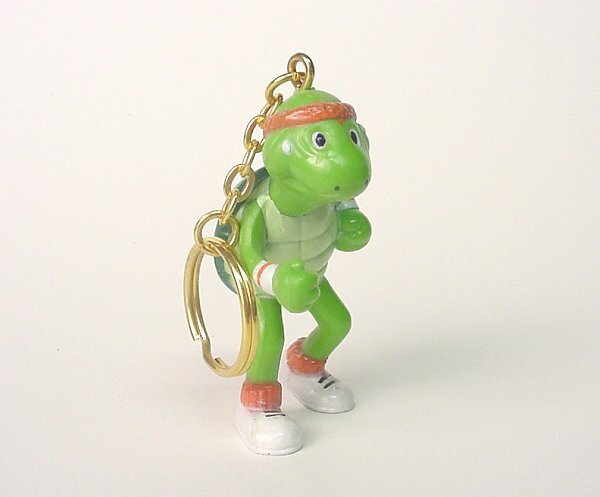
1970? Rubber keychain figure of jogging tortoise. 1¼" x 1¾" x 2¾" high. Unknown source.
I cannot remember where or when I found this keychain figure. He is perhaps unusual for such figurines in that he stands up well.
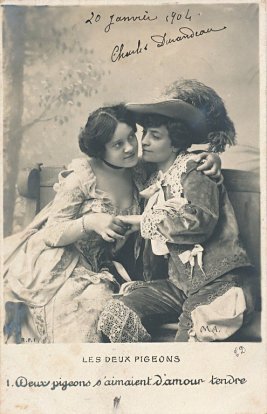
1903? Complete set of ten numbered photographic postcards presenting "Les Deux Pigeons." RPI. $120 from Bertrand Cocq, Callone Ricouart, France, Sept., '18.
Many levels of interpretation are at play in the presentation of this fable. La Fontaine writes this story about two male doves, one of whom has wanderlust and, against the urgings of his dear friend, goes off to experience the world so that, as he sees it, he can return and relate to his dear friend his adventures abroad. The trip turns out to be uncomfortable and dangerous, and the traveler returns wounded. The two are happy to be reunited. La Fontaine himself reflects then, at the age of 68, wondering whether he will ever experience the flames of passion that he did earlier. His last line is "Have I passed the time for loving?" That is, he himself, seems to see a deeply romantic and even erotic theme in the story. Interpreters of La Fontaine have been quick, in my experience, to portray the story as about two lovers. Here we are presented with a male friend who needs to travel, to the pain of his stay-at-home female friend. (Is the male traveler being portrayed here actually by a female?) The set of ten cards tracks the interaction with sensitivity. Notice the eighth card, where the solitary friend waits and hopes for the return of her dear friend. The cards were all posted to the same party during January and February, 1904. All but two are signed by Charles Durandeau. The cursive writing of La Fontaine's phrases on each card is curious.