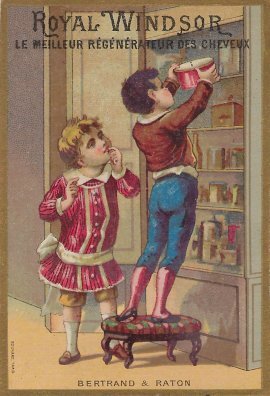
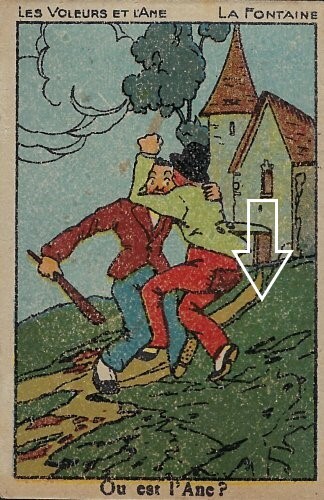
1900? Six trade cards advertising Royal Windsor hair restorer, as found at Maison Louis Urseau in Angers. Paris: Bognard.
These cards are in unusually good condition, and they are carefully done. The scene of WL is repeated with less shown on every side of the image in a single card advertising Houet in Brou.
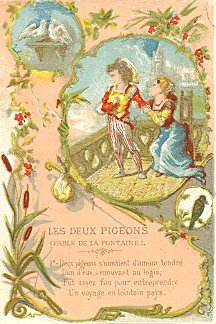
1890? 3 colored cards of La Fontaine's fable "Les Deux Pigeons." All three give the full verso to Rousset's instant soups Manioc-Rousset and Consommé Rousset. One extra of card #4, better printed by Abbadie in Paris and advertising instead Réaux in the Grande-Rue in Lisieux.
Each card quotes four to six lines of La Fontaine's fable at the bottom of the picture side and offers about four images above and alongside separated by swirling floral borders. There is a number before the verse, giving the card's place in a sequential set that must have numbered six to eight cards. Those here are numbered 1, 3, and 4. The first of these pictures the fable's beginning, when one pigeon decides to leave the other for a trip: a pair of pigeons is juxtaposed to a young man and woman. Card #3 pictures the moment at which an eagle attacks a vulture which is about to attack the pigeon; in the human translation, a horse-rider attacks a man about to attack the young traveler. Card #4 shows the very next phase, a cruel shot of a stone by a boy; here the young man holds his head, stunned by a blow from a sling-shooting youth. Rousset, in the Rue de la République in Lyon, also makes Café Moka for instant Café au Lait. Réaux seems to offer so many products that it is hard to specify what kind of store it is!
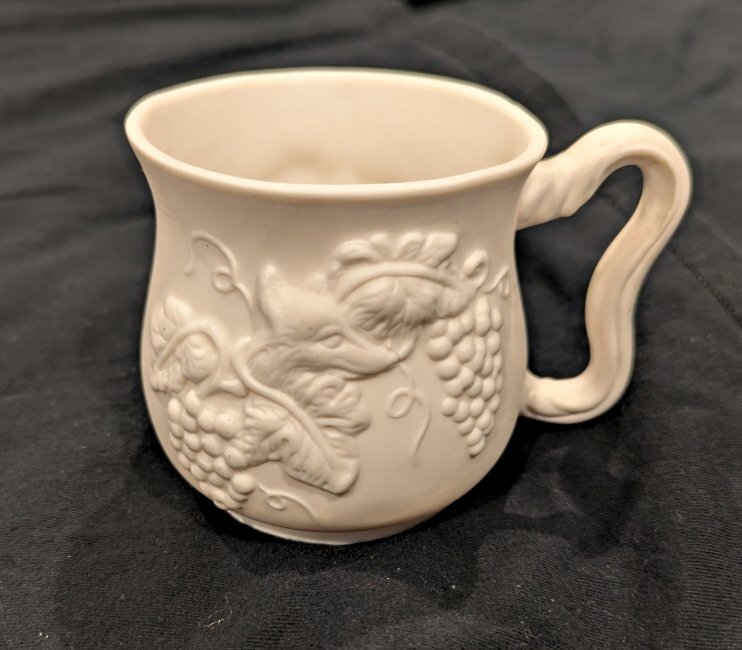
1920 Rouse Parian Mug with FG. 2.5" x 2.5". Trenton, NJ: Rouse Pottery. Unknown source.
I was surprised to find an identical mug in the Henry R. Luce Center for the Study of American Art at the Metropolitan Museum of Art. "Rouse Parian" is stamped on the bottom. As often with the motif of "Fox and Grapes," the fable's emphasis that the fox cannot get the grapes is missed as the two are brought together in image.
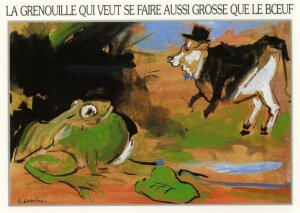
2008? Six cards featuring paintings of La Fontaine's fables by Rotislas Loukine. Editions Combier-Macon. €3 each at St. Ouen, August, '13.
These are dramatic oil-paintings! Can we call the style "impressionistic"? One needs to know the fable, but then the picture comments wonderfully on the fable's message!
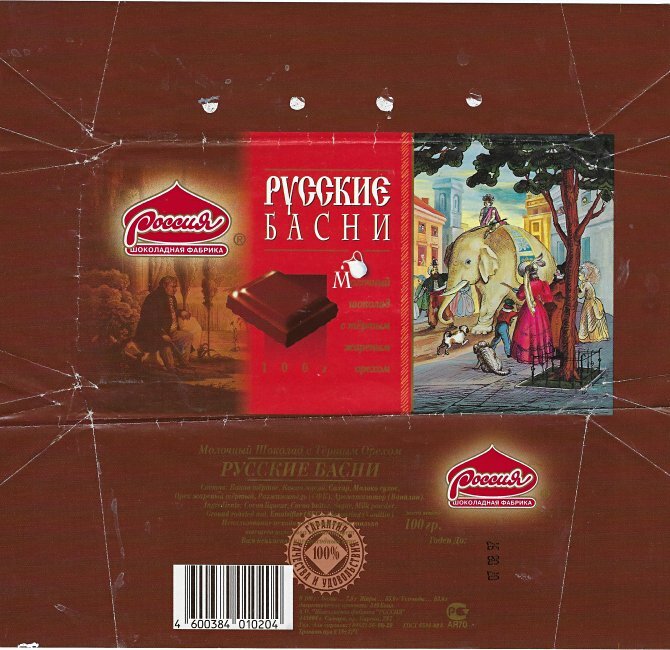
Four labels come from smaller pieces – 18 grams --of chocolate. The color scheme is different on each, though the format remains the same. By contrast with the larger chocolate bars above, these wrappers seem to be shut, as though the top and bottom have become pasted together. I have not had the heart to re-open them! One verso below gives a sense of the similar siblings.
These four large (8½" x 8") wrappers include a lovely fable picture, which I offer here in each case as a detail. Do not miss what I believe is a double fable representation in the last wrapper. I believe that the artist is representing two fables at once. Might the human figure there suggest even a third fable?
Besides the large maroon wrappers, Rossia also offered gold wrappers in two different sizes: 8½" x 8" (100 gram) and 6¼" x 6" (50 gram). We have two of the former and one of the latter.
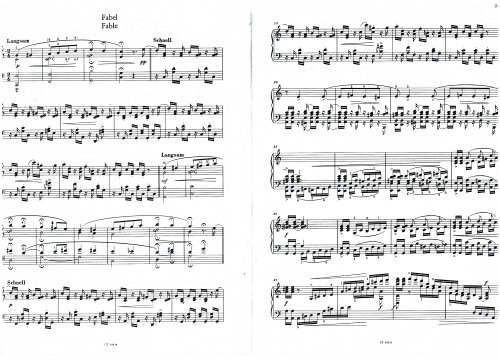
1855? Xerox copy of Robert Schumann's "Fabel" from Fantasiestücke," Wiener Urtext Edition. 4 pages. With an accompanying personal letter from Gert-Jan van Dyck. Sept., '92.
What could be lovelier than this sensitive gift from one of my favorite "fable friends." Gert-Jan knows better than anyone what it is to be a "vrai collectioneur."
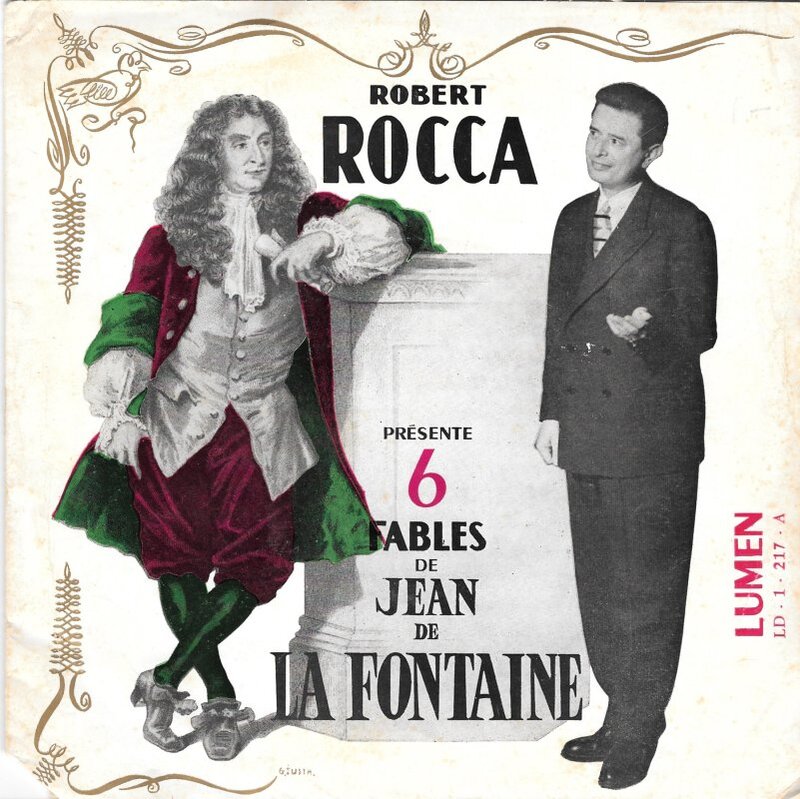
1961 Robert Rocca Presénte 6 Fables de Jean de La Fontaine. Vinyl record 7" x 7". $5, March, '03.
The back cover of this vinyl disc states, in French, “A songwriter that is tired of the fables actually recited aloud.” Presumably, Robert Rocco is a songwriter who adapted the classic Jean de la Fontaine fables that were popular in France and set them to music. The fables include “Le savetier et le financier”, “L’alouette et ses petits”, “ Le Renard et les Raisins”, “Les animaux maladies de la peste”, La vielle et les deux servants”, and “Le petit poisson et le pecheur”.
1950? This complete set of 84 cards was a special find on a January day when I was passing through Paris. I stopped at a postcard show. As I was leaving, I asked a vendor whom I had not met if she had any fables. She asked "Including complete sets?" I was thrilled to find this set of postcard-sized trade cards, which advertises at the bottom of each text page "Les Gaufrettes Rivoire & Jeandet - Tarare."
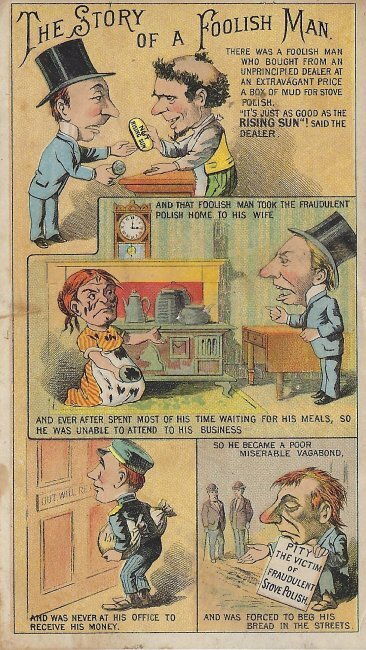
1920? Two cards presenting two contrasting stories about Rising Sun Stove Cleaner, manufactured by Morse Brothers in Canton, Massachusetts.
The continuity of style is striking between the two light-stock cards. Is it fair to see these stories as fables?
1999 Ring Dish Celebrating the International Renard Society. Poitiers, August 23-27, 1999. 3.5" x 4.5". Porcelain produced by Yves Deshoulières in France.
Here is a lovely gift made for those attending one of the Renard Society's meetings. As it happened, I could attend this meeting because it was not too deep into the American fall semester. I was called away after offering my presentation because of a death among relatives, and I was sad. The image of Renard reading is a favorite one Renardians!
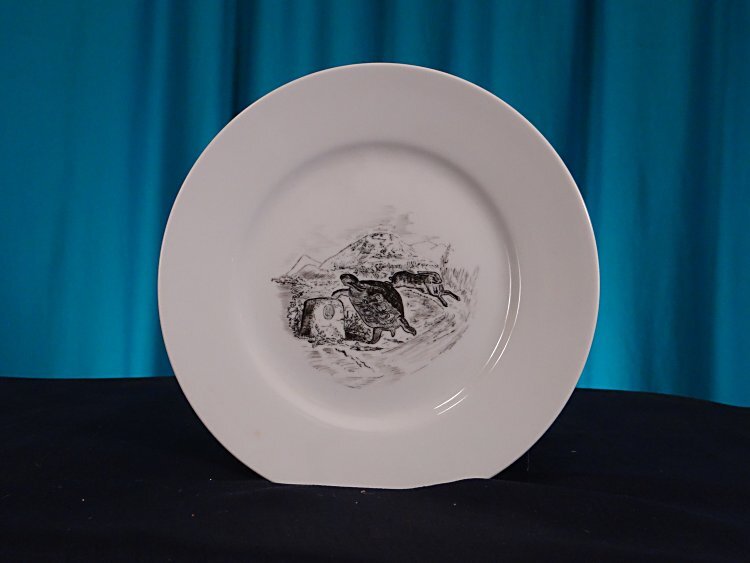
1960 China plate of TH by Richard Ginori, Italy. Almost 10" in diameter. Decoration by M. Praquin of Crépy. Exlusivity of "L'or et l'argent," Chateau-Thierry, France. $9.95 from Shayna Prentice, San Diego, CA, through ebay, April, '04.
This delightful plate is inscribed in a delicate longhand on its back "Le Lièvre et la Tortue." The front of the plate is unadorned except for the rendering of the finish line of TH after J.J. Grandville. Grandville's initials are still on the milepost marking the finish.
In 1988 and 1989, Funrise marketed as "Rhymekins" in various packaging a number of storybook plastic figurines together with matching storybooks. Some of these are fables, while others are nursery rhymes or fairytales. Maximum height or length 4". Made in China. Except for one, the source is unknown.
I am surprised to see fables so well represented among these figurines. TH, LM, and TMCM are all featured, as well "The Emperor Without Clothes." As I rediscovered these figurines, I found three of them apt for fables but then learned they are designed to go with fairytales. Now I have to find the Rhymekins TMCM pair!
LM: Scale was clearly not a goal here!
"The Emperor Without Clothes": I am pleased that they thought that meant that he was in his underwear! He originally came with the truth-telling child. He has disappeared, but we can hope that he has not disappeared in our life!
TH: Both figures are lively. The tortoise, whose source I happen to know, has a great smile! Tortoise $3 from Frances Thompson, Fremont, CA, through Ebay, July, '00. Frances writes that Funrise put out a line of storybook characters from fairy tales and fables. Now I have found many of them!
These three figures are part of the Rhymekins sets. As I discovered them, I thought easily of each of them as a fable character. Does not the little fellow on the left – who turned out to be Jack from "Jack and Jill" -- perfectly represent the attitude of the rich man who buried his treasure and then discovered that it was stolen? And could not that middle character be the farmer whose goose suddenly produced golden eggs? (I wonder if he is the giant or Jack.) And that little fellow on the right: Could he not be La Fontaine's "Gregoire" returning the sack of cash to the financier? For his makers, he was Jack, with his bag of seeds.
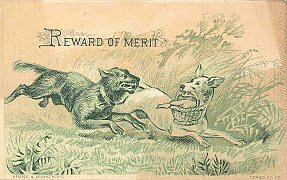
1880? 2 cards from the green set by Wemple and Kronheim, stamped "Reward of Merit."
These cards of "The Two Dogs" and "The Dog and His Master's Dinner" include a prose text of the fable on the back side. I believe that the two cards did not come from the same printing, since they use different typeface for "Reward of Merit" and since their ink's hue tends to green and to blue, respectively.