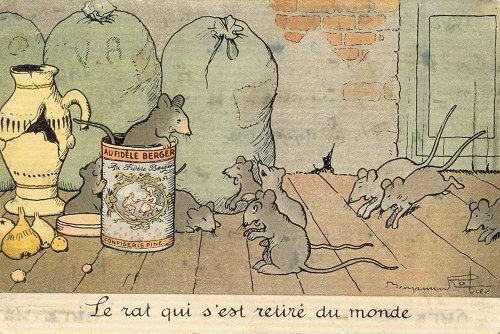
1905? Benjamin Rabier, "Le Rat qui s'est retiré du monde." Chocolate Lombart, Paris. €12 from Les Larmes d'Éros, Éditions Astarté at Paris Post Card Exhibition, Jan., '05.
Instead of living in a big Dutch cheese, the hermit rat here lives in a tin of fine chocolate from Lombard. As with the other Rabier card I have found, this one was expensive. It came from a dealer in erotic cards who had proclaimed that he had nothing to offer me. It always pays to search!
I have found two cards designed by Benjamin Rabier to advertise Lombard Chocolate. I found them in very different places in the world! Click on either card to see it enlarged and to learn more about it.
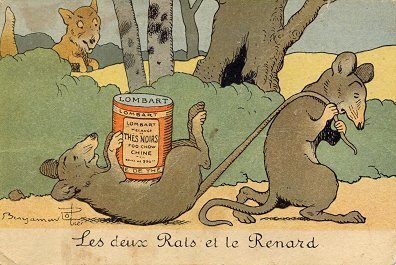
1905? Benjamin Rabier, "Le deux Rats et le Renard." Chocolate Lombart, Paris. $35 at Foster City, Feb., '97.
Instead of carrying an egg, the rat being pulled by his tale in this version carries on his belly a large can of Lombart's "Melange de Thés Noirs"—and smiles! The upper right corner is creased. I was aware of paying a lot of money for this card, and I still think it is worth it!
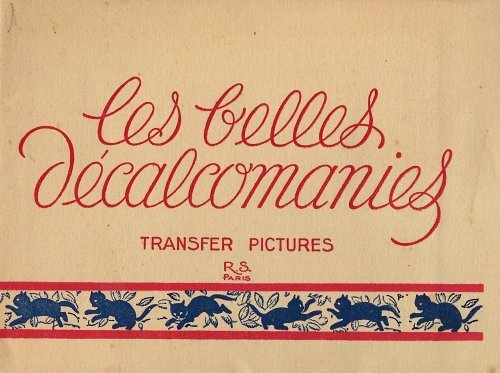
1950? "les belles décalcomanies," two sets, each with 16 "transfer pictures" of La Fontaine's fables. R.S. Paris. €6 each from labuandrie, through Ebay, Oct., '23.
The seller designates these two folders in good repair as coming from 1910, but I believe they are more likely from about 1950. At first I thought these images were what we called "transfers," instant tattoos. I changed my mind when the instructions urged "coating with varnish the next day to make them permanent"! Though there are two sets, there are repeaters between the two sets. There are repeat images even within the same collection.
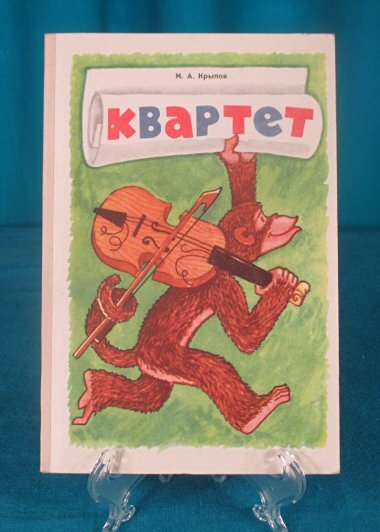
1973 Pop-out card of Ivan Krylov's "Quartet." Artist: B. Andreveo. Mapisha: Ezdatelvstvo Knuska. Rostov-on-Don. $5 from Valentina Kudinova, Kharkiv, Ukraine, through eBay, Nov., '11.
One of the recurrent mysteries for a collector is: "What was this object made for?" Here is a wonderfully pleasant and creative presentation of Krylov's "Quartet" with a cover, a canvas binding, and two pages that spread out to let the musicians find their space. Of course, in this fable they never do! The text is on the back cover, along with way too much bibliographical information!
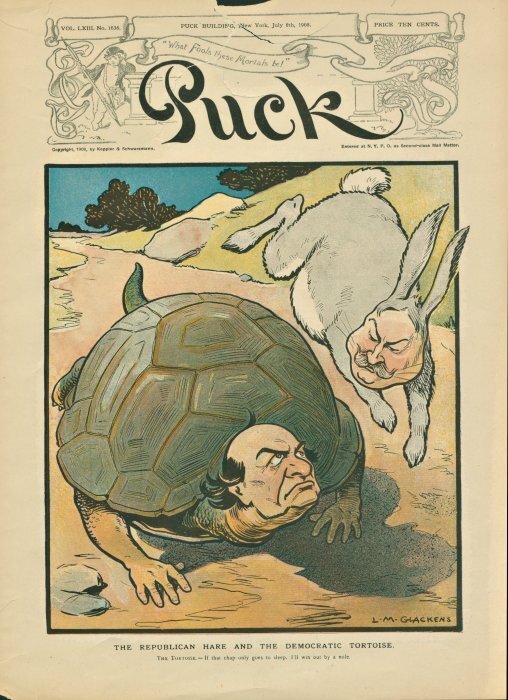
1908 Puck cartoon cover “The Republican Hare and the Democratic Tortoise.” L.M. Glackens. Vol. LXIII, No. 1636. July 8, 1908. 10” x 13.7”.
The tortoise says “If that chap only goes to sleep, I’ll win out by a mile.” Viewers may want to notice the tortoise’s hands. The two faces are very well done. Are they Democratic tortoise William Jennings Bryan and Republican hare William Howard Taft? Apparently Taft did not go to sleep!
1930? "Proverbes - Série de six sujets chromos. 4. La raison du plus fort est toujours la meilleure." WL. $6 from Bertrand Cocq, Nov., '20.
In style, this card seems like Liebig cards. Scrollwork on the upper left and far right reveals two different scenes of bullying by the stronger. Apparently the boy is making off with the girl's lunch. The verso features the text of La Fontaine's WL.
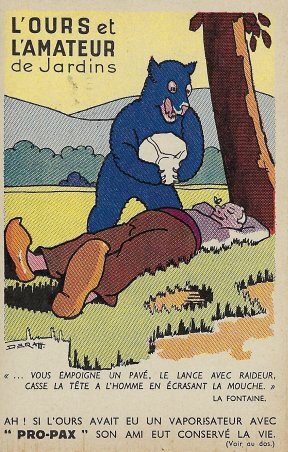
1950? Two postcards advertising Pro-Pax Insecticide. "The Lion and the Gnat" and "The Gardener and the Bear." €9.50 each from Gil Derudet, Saint Cloud, France, through Ebay, April, '22.
Lovely art work, which the seller describes as art nouveau, particularly in "The Gardener and the Bear." The artist seems to sign his or her name "Deratt." So now: Are there more cards in this series?
2002? Prints of LM and TH by Adam Rhine. $15 each from Adam Rhine, March, '03.
LM has the mouse holding a large chainsaw labeled “Rat-N-Decker”. The vibrant colors make for a very appealing fable illustration -- and a humorous glance back at the fable's rope-chopping element.
TH shows the hare resting by a tree and reading a newspaper with the headline “Hare Favored to Win Race”. He is alerted by the sound of tortoise whizzing by on a motorcycle. This drawing humorously reflects the moral behind the original Aesop fable. Is there in fact something of the tortoise's shell in the image of a hard riding motorcyclist?
2000? Page from “The Book of Fables. XIVth Century. Animal Scenes” from “Turkey 1621.” Paris: UNESCO World Art Series. New York Graphic Society. Printed in Italy. 13.1” x 18.6”. Unknown source.
The two images are familiar: the lion king speak with a jackal and the lion king converses with his mother. The images seem so peaceful. There is bloodthirsty work going on in them!
2023? Print of WC by MarkesArt. 16" x 12". $18.88 through Redbubble, Dec., '24.
The artist describes this as the climactic moment of the fable. I would say that it is the dramatic moment. I believe that the climactic moment is when the crane is not looking into the wolf's throat but rather when he is waiting for his reward and gets the wolf's snarl instead. Good, dramatic black-and-white artistry suitable for use in a lecture.
1920? Print of “La Cigale” by E(mile) Metzmacher, painted in 1886. With slipsheet offering “La Cigale” by Marton. $30 from pdiddyt through Ebay, Jan., ’26.
This piece touches on some unusual history. I had acquitted two prints of Metzmacher’s “The Grasshopper and the Ant,” in black and white. Researching the original, I was surprised to learn that Metzmacher has done a colored oil painting rather similar but featuring only one person instead of two. I was happy to purchase a copy. We have that copy, and it quotes a poem “Cigale,” which is a poem about returning home after a tragic betrayal. As far as I can tell, this grasshopper has nothing to do with a fable. I did my own lamenting, but checked again, and several responsible sources on the web immediately relate this painting to La Fontaine’s fable. Maybe I can add to the next researcher’s surprise and discovery!
1957 Print Facsimile of Marc Chagall's Etching "Wolf and Fox Before Monkey Judge." Printed in West Germany in 1957 based on Chagall's 1952 etching. Mounted in acid free black board. Overall size 12" x 15". $149 from TxArtGallery through Ebay.
This is a nice representation of Chagall's work, well framed and matted. We will need to compare someday to the original. The Ebay seller describes it as "facsimile ink signed." I wonder what that means.
1994 Press Photo of Texas Mime Theatre Members in Production of "Aesop's Fables," July 22, 194, at Heinen Theater. Houston Chronicle, July 22, 1994. Photo by Alvin Gee. $10 from Historic Images, Nov., '16.
This show had already run two days, apparently. One cannot tell much about the fable presentation from these costumes!
1890? 7 French cards of La Fontaine fables from Chocolat Poulain Orange. 2½" x slightly more than 4". Imp. A. Norgeu, Paris. $28 from Bertrand Cocq, Calonne-Ricouart, France, March, '01.
These small portrait-formatted cards command "Exigez Chocolat Poulain Orange" at the top in brown against a green background and then comment "C'est le meilleur." Just beneath is a circular illustration in full color. Beneath that is a brown-on-green design and sometimes a (long) fable title. Two elements finish the downward movement of the card: from six to fifteen lines of the fable and, in the bottom right, a card number. Four of the seven cards present "L'Homme qui court après la Fortune et l'Homme qui l'attend dans son Lit." They are numbered 1, 4, 5, and 6. Two others present "Le Savetier et le Financier" and are numbered 3 and 6. The final card presents TMCM and is numbered 1. I presume that there were six in each set. How many sets might have existed? The two illustrations on one card allow for some good effects, as when TMCM #1 shows in the larger colored circle a pair of humans--city and country dwellers, to judge from their clothing--but presents the mice in the lower design. Again, the first view of the differing friends shows them together inside a building, while the design shows a stagecoach ready to leave. The backs of the cards are uniform in picturing a can of Cacao Poulain and praising its contents. These cards are identical in design with those in a set I list under Norgeu; the latter cards lack mention of Poulain
1935? Two dust-jackets provided by La Poudre St. Eloi against wheat-decay. "The Little Fish and the Angler" and MM, both designed by J.T. Péras. The back cover of each dust-jacket offers a map of districts of France. The former has a claim that Colorado Beetle is radically destroyed by Doryx St. Eloi. "The Little Fish and the Angler" for $5 from Mme Denise Debuigne, Rennes, France, Feb., '05. MM for $6 from Bertrand Cocq, Calonne-Ricouart, France, Sept., '20.
The flaps on the inside of the dust-jacket offer tables of addition, subtraction, multiplication, and division. Both fable illustrations are done with red and green coloring, and offer a rich background to their foreground focus.
1890? Four cards displaying La Fontaine fables for Poudre Cap mineral water. Slightly more than 6¼ " x slightly less than 4½ ". $30 for the four from Bertrand Cocq, Calonne-Ricouart, France, March, '01.
"L'Huitre et les Plaideurs, " Le Laboureur et ses Enfants, "; MM, and WL. These are large cards! The approach to each scene comes from traditional sources, like Dor é for the oyster scene on the beach and the river scene between wolf and lamb. Notice that the wolf's neck here is so elongated that he may look more like a horse! The scene of the old worker on his deathbed is strongly reminiscent of the classic painting of Socrates in his last hours. The milkmaid seems quite nattily dressed up to be carrying some milk to town! I am not sure that I have ever seen the two oyster-finders clad as monks before. Click on any of the four pictures to see it full-size.
1960? "Le Lion et le Rat." Advertising postcard sponsored by Poudre "Le Dain," rat poison, and sent by Au Père Cafard in Paris. Artist is something like "Derattt." Gift of Susan Carlson, Dec., '23.
Here is a simple, pleasing image. One might ask: "To whom does a business send out a lovely fable postcard concerning rat poison?" I know that the answer of some will be "Customers!"