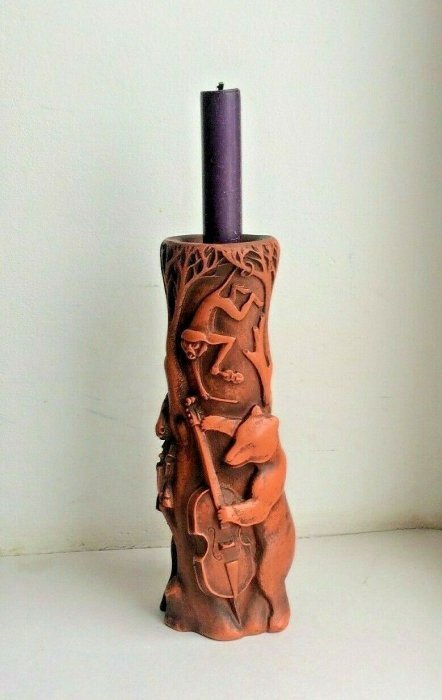
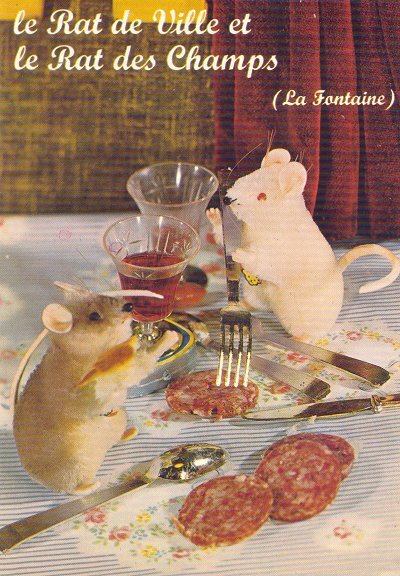
1970? Pillar candlestick based on Krylov's fable "Quartet." 9" high.
This is a substantial candlestick. It may be the first in our collection. The fable is a great one to put onto a pillar. The four "musicians" keep blaming their positions for their poor music. They do not recognize the real reason they are poor musicians!
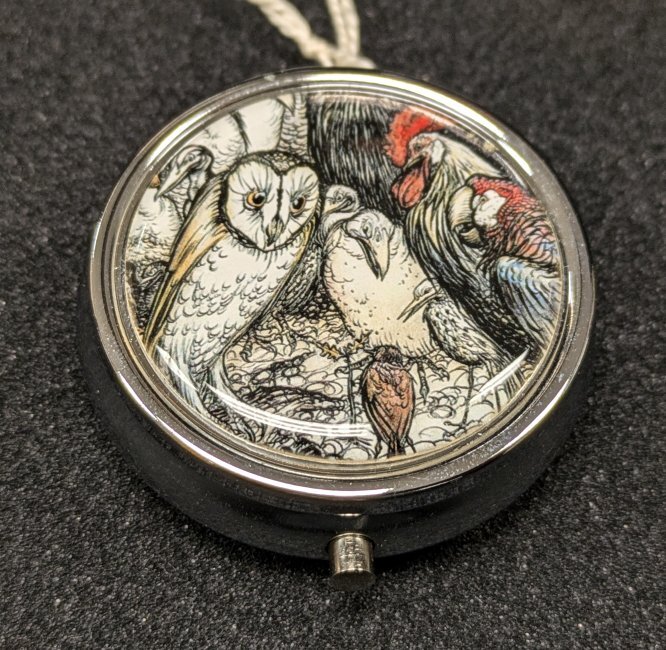
2015? Pill Box. Cover features colored detail from Arthur Rackham's "The Owl and the Birds." Perhaps from che655 on Etsy for $9.99, who is selling it for that price now in Dec., '24.
I had to do a little online checking to find out that this is in fact a pill box. Might I have bought this through Ebay rather than Etsy? Rackham's work went out of copyright in 1989. It is a fruitful source of designs for work like this.
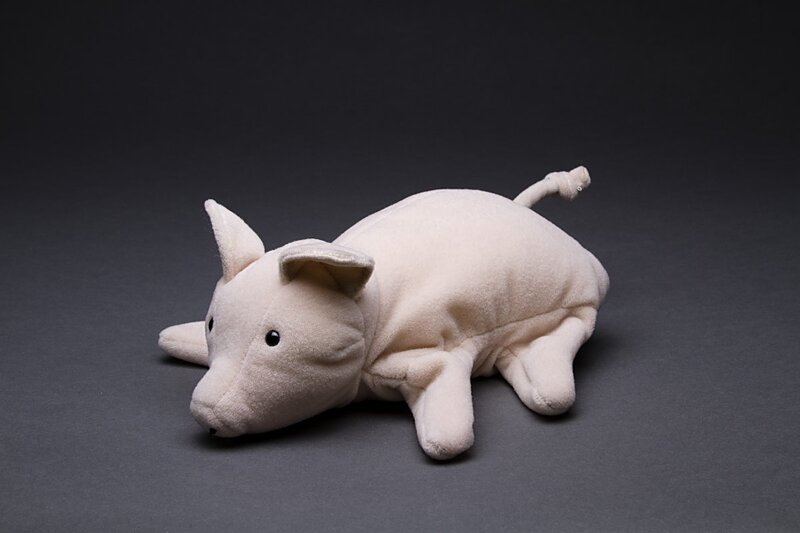
1990? Pig puppet with attached Aesop's fable "The Pig and the Sheep." Puppets with a Tale: Folktails: Folkmanis, Inc., Emeryville, CA. Made in Korea. Gift of John and Susan Carlson, Christmas, 1991.
The tale on the card attached to this puppet tells of the pig who happened among sheep and was upbraided for all his squealing when the shepherd caught him. The pig answers the sheep: “He nly wants you for your wool, but he wants me for bacon.” A clever manipulator can get fingers into all four legs and the face.
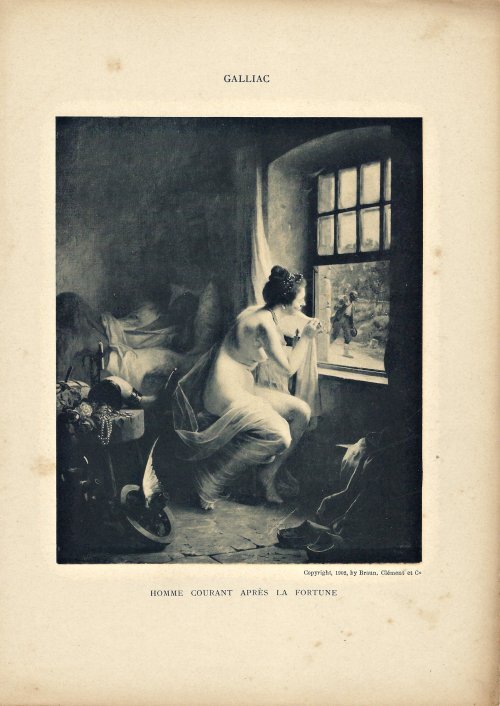
1902 Photograph of Louis Galliac’s “Homme Courant après la Fortune.” 8” x 11.4”. Braun, Clément et Cie. Unknown source.
This is a touching scene of La Fontaine’s Fable (Book 7, Fable 12). One of a pair needs to seek his fortune; the other prefers to stay home. The former has a tough time of it and comes home to find his fortune. One can ask in this depiction whether the wandering partner is leaving or returning. In either case, the stay-at-home partner is eager for his return. Was this a colored painting? I cannot locate an original on the web.
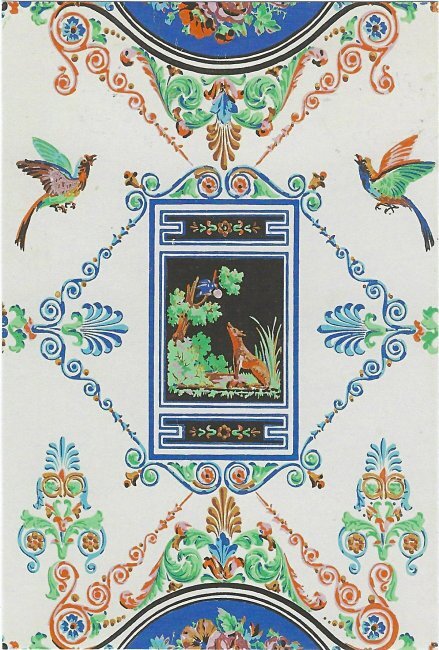
2000? Photo Print Reproduction of Aesop's Fable of the Fox and Crow. Wallpaper? £2.50 from J. Williams, Essex, UK, through BidStart, Nov., '17.
This is a curious image of FC in the midst of a pleasing geometric design. The arrangement reminds me of walls in Pompeii. I wonder where this segment (?) might be.
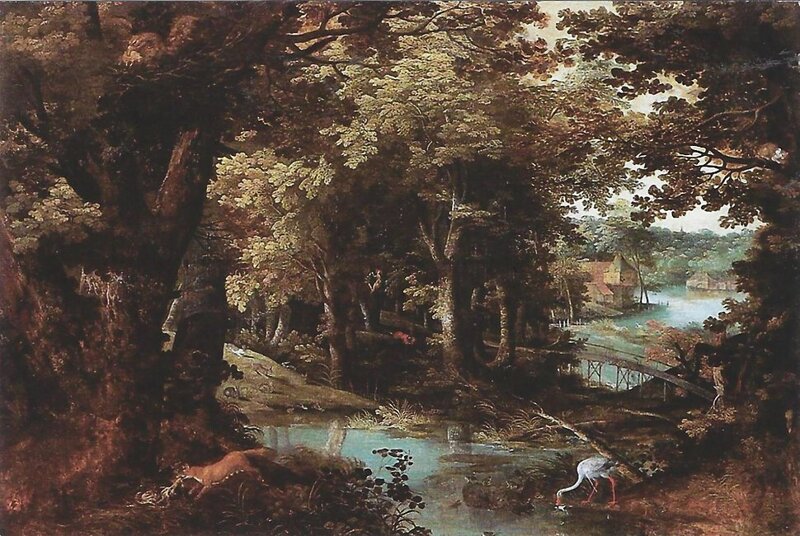
2000? Photo Print Reproduction of Adriaan Van Stalbemt, "Landscape with Fables," 1620. Royal Museum of Fine Arts Antwerp: oil on panel. Photo £2.50 from J. Williams, Essex, UK, through BidStart, Nov., '17.
This detailed landscape invites a search for known fables. I can identify the eagle who has flown off with a lamb in the upper left and the frogs desiring a king in the right foreground. I am not sure what animal is biting into an object in the left foreground. I am surprised not to find more fables. Are there more hidden here?
1910? Twelve 7½" x 5¼" cards engraved by Devambez in Paris, picturing and presenting Florian's fables but not in full color, as in an otherwise almost identical set, but rather in monochrome. "Édité par la Phosphatine Falières." Gift of Bertrand Cocq, Calonne-Ricouart, France, August, '15. Now six further cards for $6 each from Bertrand, Sept., '21.
The pictures used are identical with those used in the colored set, and the same texts and printer's designs are also used, but the setup of each card, front and verso, is slightly different. These cards are not numbered as are those in the colored series. What a curious repetition! And how strange that I have not come across it until now! Each verso contains its fable text bordered on three sides by a floral display.
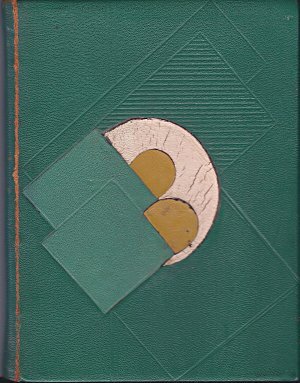
1910? Phosphatine Falières Trade Cards. Maurice Leloir. Handmade. Hardbound. Edite par la Phosphatine Falières. $112 from Broli, Miami, FL, through abe, Dec., '13.
This is a handmade book containing 22 of 24 trade cards issued by Phosphatine Falières presenting Florian's fables. Cards 1 and 10 are missing. As it happens, I have twenty-two of the cards of this series; all twenty-two are pictured in the Phosphatine Falières section of non-stock fable cards. Those twenty-two fortunately include the missing #1 and #10. There is one mistake in the order of the cards; the sequence at the middle of this book follows the order 8, 9, 12, 11, 13, 14. A hand put a date of mcmxxxix and some notes on the bottom of each page. The front and back green leather covers present a curious inlaid geometric design. The book is boxed. I have put copies of the two missing cards into the front of the book. The book of course supplies the two missing cards, #11 -- "L'Avare et son Fils" -- and #19 -- "Les deux Chats." I will include the Broli description: "Preciosa colección de tarjetones editados por Phosphatine Falieres c/1910. Son 22 fábulas de Florian (de un total de 24) bellamente ilustradas a color por Maurice Leloir al frente, y al dorso el texto de las mismas en francés. Cada una tiene al pie una pequeña dedicatoria manuscrita en español y fechadas todas 1939. Encuadernadas en cuero verde con diseños geométricos combinados y labrados (c/1940). Con caja. Muy curioso. Castellano Hardcover Leather Bound (Cuero Pleno) Very good condition (Muy buen estado)." "Muy curioso" is right!
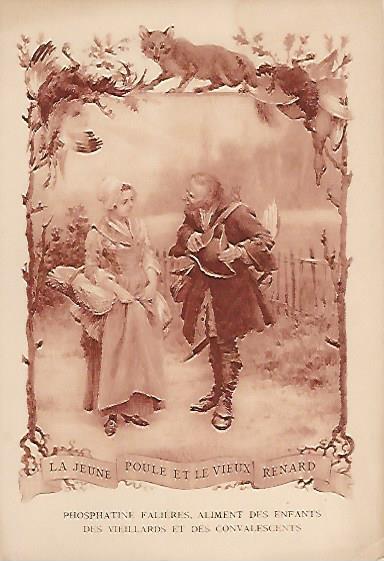
1910? Ten 7½" x 5¼" cards engraved by Devambez in Paris, picturing and presenting Florian's fables. The pictures are numbered "1" through "10." Each illustration is signed by Maurice Leloir. $35 for the set from Jalilstamps through eBay, April, '07. Several more cards, including the missing #11, from Caveron Devey, Paris, August, '14. Extra copy of "La Mère, l'Enfant et les Sarigues" for $7 from Bertrand Cocq, Calonne-Ricouart, France, Sept., '21. Seven extra copies for €20 from Aux Vieux Papier, Anchenoncourt, Oct., '25.
How fortunate to find twelve more -- and perhaps to complete the set! My comments on the first set apply to these cards. "Le Grillon," "La Jeune Poule et le Vieux Renard," and "Le Danseur de Corde et le Balancier" have perhaps the strongest colored illustrations. The last of these wonderfully pictures the falling balancier in mid-air! The floral displays on the versos are here all in red, while they were all in something like a silvery green on the other cards. A good sample of the strong verso illustrations is "Le Danseur de Corde et le Balancier": the fallen artist scratches his perhaps wounded head. The cards are again in very good condition.
1910? Twenty-six 7" x 4¾" cards printed by Typogravure Goupil, Paris, picturing and presenting La Fontaine fables. Each card is signed by J. Shalon or Chalon. Group A: Seven for 80 Francs each from Annick Tilly at the Clignancourt flea market, August, '99. Group B: Eleven for $8 each from Bertrand Cocq, Calonne-Ricouart, France, March, '01. Four cropped cards for $18.05 from Andrea Evans, Red Bank, NJ, through eBay, Oct., '02. Further cards for €7-€10 at St. Ouen, August, '15. Three further Group A cards and an extra of LM for $7 each from Bertrand Cocq, Calonne-Ricoouart, France, Sept., '21. 2P for €15 from Albert van den Bosch, Antwerp, June, '23.
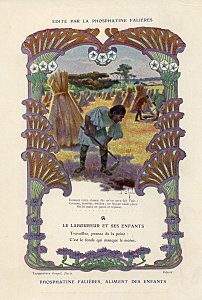
The front of each of the cards has "Édité par la Phosphatine Falières" at the top. Beneath that is a large rectangular section. In all of Group A and the first two of Group B, this rectangle is bordered with straight lines enclosing a gray background. In the rest of Group B, there are no lines and no gray background. In either case, a delightful and varied floral border frames a large, delicately colored human scene. The lower portion of the framed section includes a moral, a title, and sometimes the first lines of the fable. Beneath the rectangle is the indication of Goupil and "Phosphatine Falières, Aliment des Enfants." The backs continue the fable. Many of the Group A cards are severely damaged by scrapbook glue, but all in Group B are in very good condition. On the back, those with a gray background on the front have a red floral border surrounding the text of the fable and a detailed blue-and-white rendition of the animal scene. Those without the gray have a blue floral border and a rendition of the animal scene in the same color. In each case for both groups the framing border is again unique, as it was on the front. Beneath it all is the same closing text as on the front: "Phosphatine Falières, Aliment des Enfants."
2010? Five postal souvenirs of the Fables of de La Fontaine, each with a perforated section to be removed from the surrounding image. GA; FG; CJ; “The Worker and His Children”; “The Snake and the File.” Benjamin Rabier. About 5.5" x 7". $5 each from Bertrand Cocq, Calonne-Ricouart, France, Sept., ’20.
I believe I have never seen something like this. And I can find no exemplars on the web. The reprinting of Rabier’s pages is exquisite; it is of the sort one would expect from the makers of postage stamps. The choice of the portion perfectly circumscribed with perforation is fascinating, as when CJ focuses on the bumpkin ready to sell his valuable book. Similarly, “The Worker and His Children” focuses on a sickle ready to be wielded in bringing in the bumper crop. Some searching on the web revealed other such philatelic productions, particularly in France. The “stamps” generated here have apparently no value for the posting of a letter. Curious!
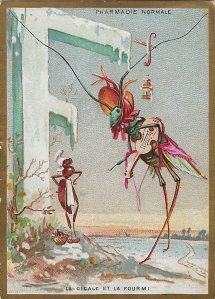
1890? Two colored trade cards from a series of six, illustrating GA and “The Lion and the Gnat.” Pharmacie Normale. Paris: J. Chèret.
Bertrand tells me that this set is extremely rare and that the other four cards do not illustrate fables. The representation of the lion is regal, but is this a lion? The frozen background in GA sets a good scene. One may need a minute or two to notice the grasshopper’s guitar.
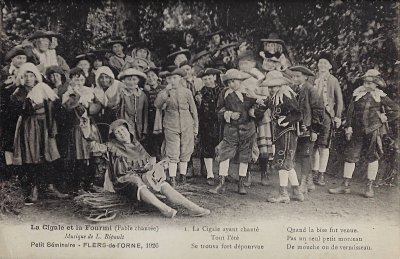
1926 Series of six photographic postcards representing a musical performance of GA by Petit Séminaire Flers-de-l'Orne. Music by L, Ripault. €60 from histoirepostale83 through Ebay, Dec. '19.
The six numbered photographic postcards show the cast at six moments in the presentation, marked by a portion of text from La Fontaine's fable. The scenes show summertime singing, wintertime hunger, pleading for food, declaration by the grasshopper of singing for the pleasure of any listener, rejection by the ant, and "Choeur Final." Blank versoes.
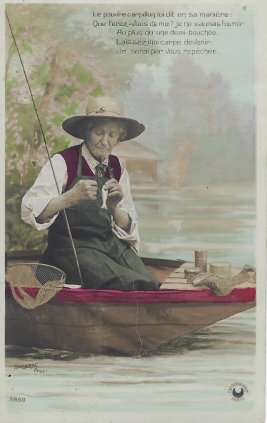
1910 “Le Petit Poisson et le Pécheur: Fable de La Fontaine.” Complete two-card set of colored photographic postcards. “Croissant Paris.” “3850.” Complete colored series of 2 portrait postcards photographed by Sazerac (“Sazerac phot.”) and published by Croissant in Paris. $5 each from Bertrand Cocq, Calonne Ricouart, France, Sept., '20.
This pair of cards is quite similar to the MM set by Sazerac and Croissant, especially the coloration of the photographs against a colored background screen. As Bertrand notes, a two-card set seems quite unusual!
Art print “Slow & Steady Wins the Race – The Tortoise and the Hare.” 8½” x 11”. $18.48 from Peter Pan Prints through Etsy, August, ’18.
The artist here places the hare’s white against the tortoise’s larger green space. I am delighted to see Etsy’s artists taking up Aesop!
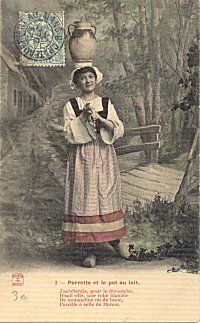
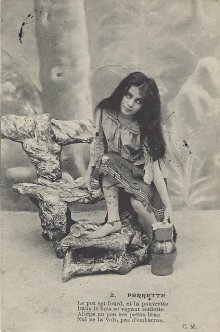
1905? Perrette et le Pot au Lait. Three postcards of J. de Montrut's version of "Perrette et le Pot au Lait" presented with black-and-white photographs. Several colors have been added. Beneath each picture is a number ("2," "4," and "5" respectively) and a few lines of text, apparently from a version by J. de Montrut. €3 each from Eclair Collections, Angers, at the Paris Post Card Exhibition, Jan., '05.
The photographs are the ultimate in posed photographs taken before large sheet-like backgrounds. Here one can see the ripples in the cloth background. The three scenes show, progressively, the joy of the dreaming milkmaid as she dreams of buying a new dress, her dismay at seeing the broken pot and spilled milk, and her regret. The pot seems more broken in the third picture than it was in the second! Portions of the maid's clothes are colored red. Is some of the background a light green? My guess is that there are only five cards in this series, since card #5 seems to end the text, with an attribution to J. du Montrut. Will I ever have a chance at the missing two cards?
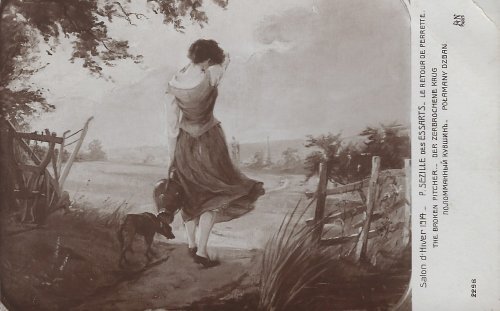
1914 One photographic postcard presenting “The Return of Perrette.” P(ierre) Sezille des Essarts. Salon d’Hiver 1914. 2298. Paris: Albert Noyer. $8 from Bertrand Cocq, Calonne-Ricouart, France, Sept., ‘’20.
This is a different view of MM, namely the return back home with the broken or dropped pitcher. Depicting Perrette from the back is appropriate here, as is the accompanying gesture. She has raised an arm to her head or face in a gesture of frustration and regret. Auguste Frédéric Pierre Sezille des Essarts was born in 1867. He has a variety of works represented on the internet, including an old favorite of mine showing a young couple escaping a rainstorm.
1905? Set of ten photographic postcards of "Perrette." All addressed to Mademoiselle Hebert in Rouen and Veules-les-Roses. $40 from Bertrand Cocq, Calonne-Ricouart, France, Sept., '20.
The cards are postmarked in 1906. The approach to the story known perhaps best through LaFontaine's fable is slightly different, especially as it involves a dog. 1. This Perrette is thinking as she goes about her dear old father. 2. She stops in the woods to put down the heavy pot. 3. It even seems a good idea to take a nap in the heat; she can catch up afterward. 4. Perrette dreams of the profits and their purchases, including clothes and jewels. 5. She wakes to find she has been joined by a dog. 6. She shares her lunch with her new friend. 7. Ah, but when you eat you must drink. The dog seems to point to the pot as the answer to her need. 8. Oh, my, that will lessen the value of this pot of milk. 9. In the meantime, the pot breaks. What bad luck! 10. Perrette and the dog pray together for God to restore the pot. One surprise is that there are some stamps for five centimes and some for ten. The text is attributed to C.M. I cannot find "C.M." online. Here is another example of using a simple photographic background and photographic postcards of children to offer a variant on a well-known La Fontaine fable.