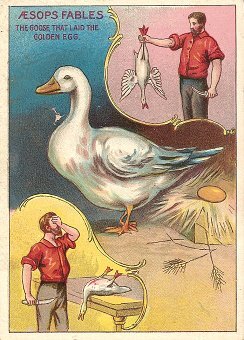
1908? One colored "The Man and His Goose" card advertising Stapler Crackers from the Original Trenton Cracker Company. "3⅛ x 4⅜"
Sickle-like arcs divide the colored image into three sections. The large center portion shows the goose having laid a golden egg. Arcs enclosing the upper right separate a picture of the man having killed the goose. The arcs at the lower left show the repentant man having found nothing unusual inside the goose. The picture uses a different title: "The Goose That Laid the Golden Egg." It does not punctuate "Aesops." The text side has "Printed in Germany." It introduces a long description of its product with this question: "Do You Use the Cracker Stamped 'Stapler'? If not, why not?"
In a curious way, the cards from this series come in two different sizes: 3⅛" x 4⅜" and 2¾" x 4"
"3⅛ x 4⅜"
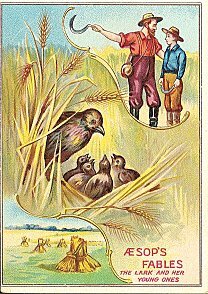
1908? One colored "The Lark and Her Young Ones" card advertising Sauer's Flavoring Extracts from C. F. Sauer Co., of Richmond, VA. 2¾" x almost 4".
One of the loveliest trade cards I have. Sickle-like arcs divide the colored image into three sections moving from the farmer and his son in the upper right to the lark mother and her chicks in the center to the harvested sheaves in the lower left. Sauer's 32 flavors are "Guaranteed under Food and Drug Act, June 30, 1906."
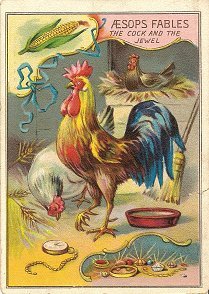
1908? One colored "The Cock and the Jewel " card advertising Heydt's "Yankee" bread. 2¾" x almost 4".
The card is slightly torn on its right side. Again, the artist creates a composite picture, with the real life scene in the center. In this scene, a rooster and a chicken stand over a gold pocket watch while a third fowl nests in the background. The two additional scenes show, in the upper left, an ear of corn and, in the lower right, an array of gleaming jewels. Sickle-like arcs and ribbons divide the sections. This card has no indication of being printed in Germany. The message for Heydt's "Yankee" bread seems to vary with each picture. Here it is "All Bread is not alike. Try Heydt's 'Yankee' Bread and note the difference."
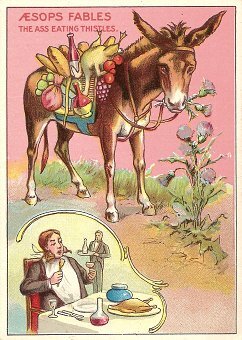
1908? One colored "The Ass Eating Thistles " card advertising Stapler Crackers from the Original Trenton Cracker Company. "3⅛ x 4⅜"
Sickle-like arcs divide the colored image into two sections. The large upper portion shows the ass eating thistles. Arcs enclosing the lower left separate a picture of a man being served fine food. The picture does not punctuate "Aesops." The text side has "Printed in Germany." It introduces a long description of its product with this question: "Do You Use the Cracker Stamped 'Stapler'? If not, why not?" It is quite surprising that I found two cards independently--and within a couple of months of each other--advertising the same local firm in Trenton.
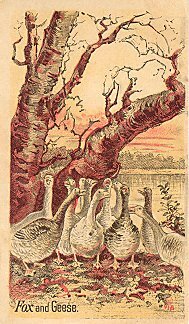
1910? One colored "Fox and Geese" card advertising The Beaham Mfg. Co. of Kansas City, Mo., makers of "Faultless Starch." A bit less than 2½" x a bit more than 4".
I doubt that this is really a fable card. It is a hidden-picture card, with a fox to be found by the clever observer. The back makes an offer "Mail us 10 for Comic Pictures, Mail us 25 for Beautiful Pictures." I take it this is one of the former, cheaper variety! Browns and reds. A small symbol at the lower right of the picture says "N 718."
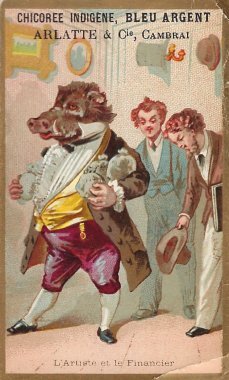
1890? Here is a mystery. The same image as "le sanglier et le rossignol" is presented in this unusual card as "L'Artiste t le Financier." No one has been able to point me to a text with this name or even subject. It took more than a little hunting to recognize where in our collection these Florian images have occurred.
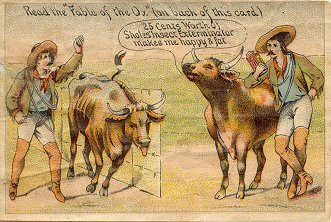
1880? One card advertising Sholes' Insect Exterminator by means of the "Fable of the Ox" on the back of a card; the front of the card tells us to read it. The colored picture shows an emaciated and exhausted ox next to a healthy one who proclaims "25 Cents Worth of Sholes' Insect Exterminator makes me happy and fat." 3" x 4½".
Some fable! Sholes' is manufactured by the American Chemical Mfg. Co. of Rochester, NY. The card is in poor condition.
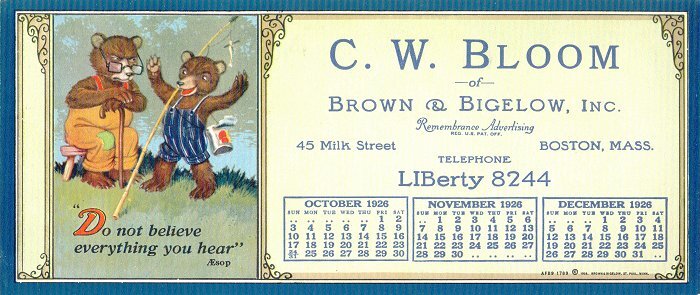
1926 One blotter almost 4" x 9" for the months from October through December, 1926. The blotter advertises "Remembrance Advertising." Apparently the maker of this series is C.W. Bloom of Brown & Bigelow on Milk Street in Boston. $10.95 from Carolyn Dias of Norfolk, VA, through eBay, Sept., '05.
This long landscape-formatted blotter has a picture on the left that seems to be in the same series as the pictures on the two blotters found earlier. Once again, I am not sure that I recognize which fable is being presented here. Is a young bear telling a fish story to an older bear? The moral attributed to Aesop here is "Do not believe everything you hear."
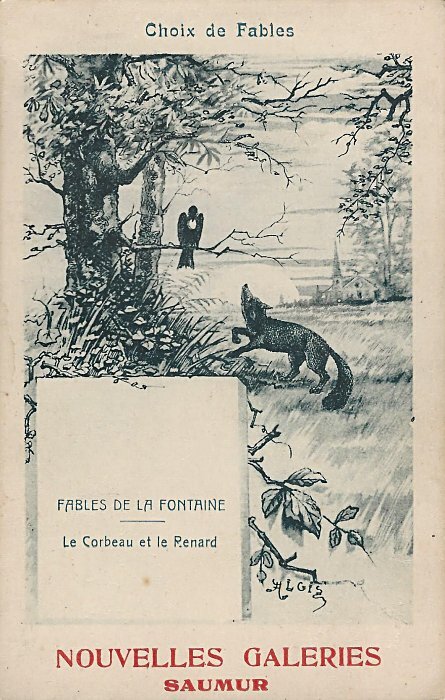
1900? One black-and-white portrait-format card illustrating La Fontaine's FC with "Nouvelles Galeries, Saumur" printed in red under the bottom of the picture. Cpaphil, Saint-Fargeau, France.
At the top of the picture side of this card is "Choix de Fables." It is extremely similar to a postcard in the series Collection Charier. Indeed, the verso of this card reads "Bons Points Instructifs: Collection C. Charier" above the text of La Fontaine's fable. The image here, as in Collection Charier, includes a tombstone-like tableau for listing both "Fables de La Fontaine" and the fable's title.
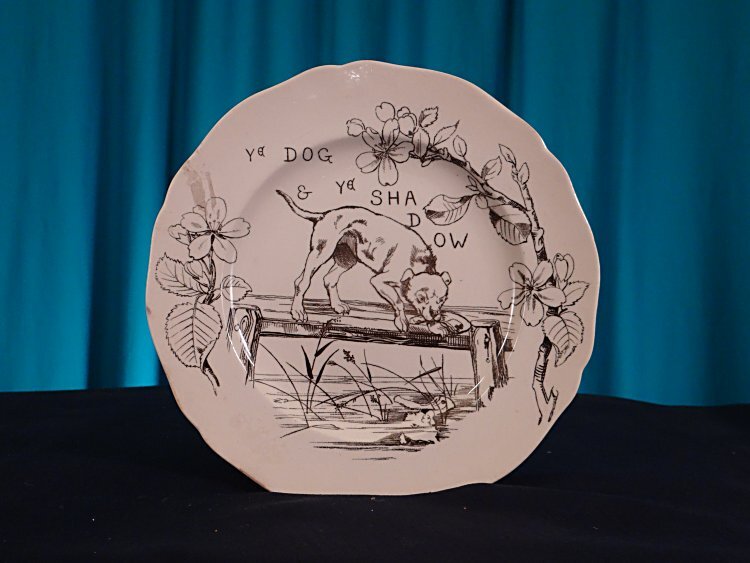
1880? One black-and-white DS plate. 10¼" in diameter. Slightly scalloped rim. "Ye Dog and ye Shadow." $14.99 from Nancy Wolf, Brookfield, WI, through eBay, Oct., '06.
The emphasis in this strong illustration is on the match between the aggressive dog with a chop in his mouth and the reflection in the water, beautifully positioned along the rim between the center and outside of the plate. The title makes its way toward the center of the plate from about 11 o'clock. On either side are branches with leaves and blossoms. Would this plate have been colored in some versions, like the plate of FS? There is a curious burn in the finish of this plate around 7 o'clock. The "Rd" of the trademark is here surrounded, clockwise from the top, by 28, Y, C, and 11, with IV over the whole mark.
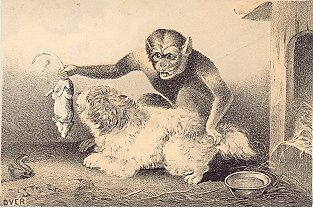
1900? One black-and-white card advertising a plow manufactured by the J. I. Case Plow Company, of Racine. Just over 2½" x 4".
A monkey apparently holds a dog with one paw while presenting with the other a mouse right before the dog's nose. A small insert in the left lower corner says simply "OVER." The scene is similar to that on a Coat card, where the monkey dangles a fish before a cat.
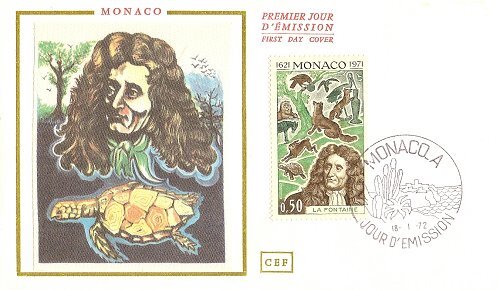
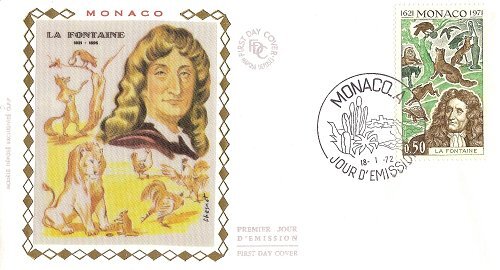
1972 One 3½ x 6½" hologram FDC envelope depicting the head of La Fontaine with a turtle. Postmarked Monaco, Jan. 18, 1972. $8 from Loic Marchat, Villeurbane, France, through eBay, April, '04.
The hologram cloth has the same image, framed with a gold stripe, that one finds on the maxicard issued at the same time as the stamp. Perhaps the background pictures the Château-Thierry countryside where LaFontaine grew up. The envelope mentions CEF.
1972 One 3½ x 6½" hologram FDC envelope depicting the head of La Fontaine and several animal groups. Postmarked Monaco, Jan. 18, 1972. $3 from psoriano75 through eBay, May, '04.
The hologram cloth is signed "Thesmot." The likeness of LaFontaine seems to depart from the normal depiction, including the depiction on the stamp on this envelope. The animal groups are FC, LM, and perhaps CJ.
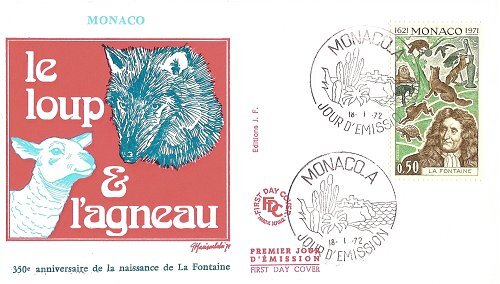
1972 One 3½ x 6½" FDC envelope depicting a wolf and lamb. Postmarked Monaco, Jan. 18, 1972. Editions J.F. $7 from Philaatelicpassion, Paris, through eBay, Oct., '06.
By comparison with the other two FDC envelopes done in Monaco at the time, this envelope seems rather plain. A red rectangle encloses the white lamb and the green wolf. The art is signed with a difficult-to-read name, perhaps "G. Mauscalchi, '71." The envelope notes that it is the 350th anniversary of La Fontaine's birth.
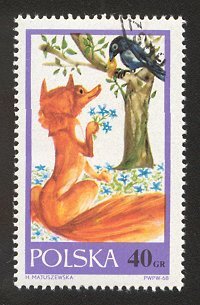
1980? One "Polska" stamp displaying FC. Good copy uncancelled. Extra copy cancelled. In a series with Puss n' Boots, Red Riding Hood and two other popular tales. H. Matuszewska. 40 GR. $1.50 from J.R. Stamps, Chelsea Antiques Building, NY, April, '97. Extra copy for 1000 Lire at the Porta Portese flea market, July, '98.
The crow clearly holds something in his mouth, and the fox seems to offer flowers picked from the surrounding lawn. Bravo, Crow!
1969 One "I.A. Krilov" Russian stamp and cover with a rare special cancellation on Feb. 13, '59, the two hundredth anniversary of Krylov's birth. $2.25 from Vladislav Pronin, Brooklyn, through Ebay, March, '99. Extra copy for $.95 from Edward Bubis, Ipswich, MA, Sept., '00. One further extra.
The stamp itself shows a colored head-and-shoulders portrait of Krylov and gives his dates (1769-1844). The envelope shows the full statue of him standing with arms crossed behind his back. My, the things one finds on Ebay!
1987 Once Upon a Fable. 52 minutes. Wembley, Middlesex: Visionpower, Ltd./Crestshaw, Ltd. £2 from Video Vault, through Ebay, Feb., '02.
Unfortunately, this videotape seems to contain no fables at all. The items featured on the tape are "The Magic Mirror," "Three Clumsy Hunters," "Brave Whistle Stop," "Sleepy Keeper," "Dinosaur Hunt," "The Two Magicians," "The Santa Visit," "Wheels," and "Life in Dogywood."
1930? Old Fables in New Rhymes. Marian B. Cochrane and Florence A. Camp. No. 8475. Springfield, MA: Milton Bradley Company. Unknown source.
This is a curious game. Fifteen (of sixteen?) heavy cardboard cards are still here, each representing a verse version of a childhood story. The first and third line of each quatrain is blank. The child needs to substitute a word that makes sense and rhymes with its partner two lines away. Two of the cards (#4 and #8 in the hand-numbering here) present FC and TH. Someone (a teacher perhaps?) has filled out a smaller card for each of the numbered stories: the card contains correct words for filling the blanks. One of those words, according to the scribe, is “unsterstand.” Actually the verse version of FC here is quite good. I may use it soon in some oral presentation!
2012 Offenbach: Un mari à la porte; Les fables de la Fontaine. Musical CD. Anaïk Morel. Gabrielle Philiponet, Stephane Malbec-Garcia, and Marc Canturri. Royal Liverpool Philharmonic Orchestra. Unknown source.
This offering of six fables of La Fontaine has as its chief feature that it uses different singers for each fable. The fable accompaniment seems limited to piano. There seems to be some difficulties with the transcription of the French and its translation into English. I enjoyed FC, GA, and MM.
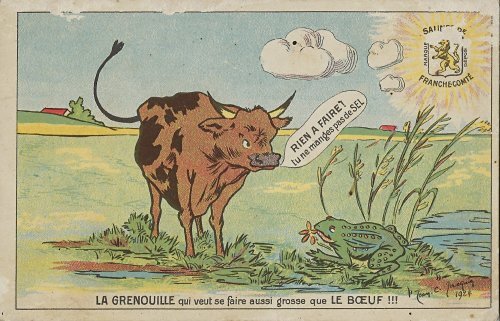
1924 Colored humorous postcard advertising Sel through OF. Jean C. Jacquez (?). Besançon: C. Lardier. $8 from Bertrand Cocq, Calonne Ricouart, France, Sept., '18.
Here the bull responds, apparently as the frog tries to blow herself up larger, "It's no use! You don't eat SEL." It appears that this advertisement card, signed by the artist, is pre-stamped. That artist's name is difficult to decipher. I could not find that artist on the web. "Sel" alone is salt. I have wondered if this is not rather a product name, but that product would have been known a hundred years ago, and I cannot find reference to it on the web.