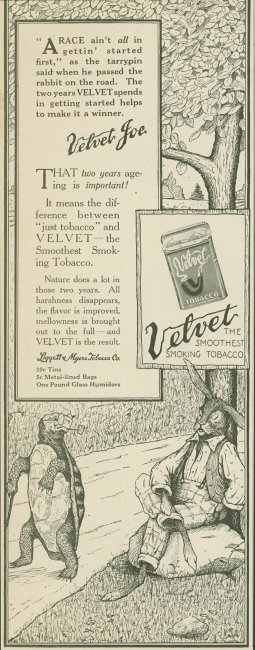
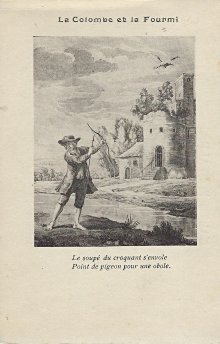
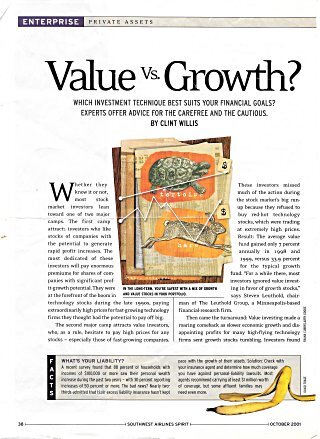
1925? Velvet Smoking Tobacco. Unknown magazine. $10 from an unknown source, Feb., '24.
"A race ain't all in getting' started first" says the terrapin as he passes the rabbit on the road. The bespectacled terrapin is of course smoking a pipe as he passes the sleeping hare. It has been fun trying to date this advertisement. Clues include the reference to "Velvet Joe" and the markings on the tobacco tin. Velvet is boasting of the slow start their tobacco gets by being aged two years.
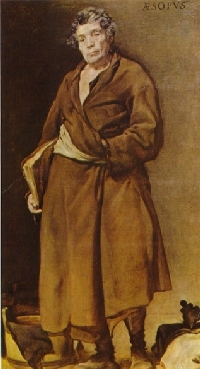
Velazquez' portrait of Aesop (large format) from the Prado. From the Milwaukee Antique Center, Jan., '88. Who would ever think that someone would make a poster of Aesop!
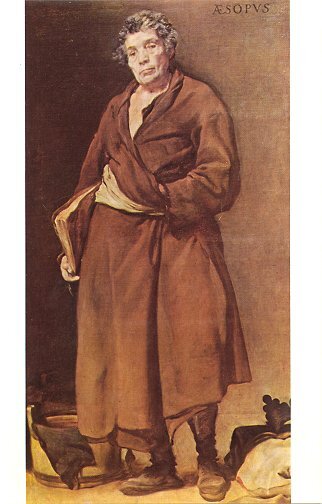
1977? Postcard reproduction of Velazquez' portrait of Aesop. Museo del Prado. Printed in Spain. Madrid: Ediciones Artisticas. $.50 at the Prado, July, '86.
This is an evocative full-length portrait of "Aesopus." One hand holds a book, while the other is inside his very simple wrap-around cloak. He looks directly into the viewer's eye. His look scrutinizes. His face is anything but pretty!
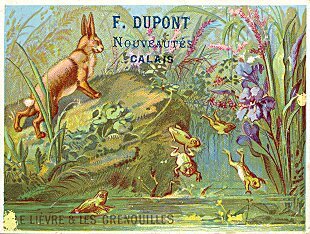
1895? 2 full-color landscape-formatted cards illustrating the La Fontaine fables "Le Lièvre et les Grenouilles" and WL. 3" x 4 1/8". Both display large block-print fable titles on the picture side. The former advertises F. Dupont in Calais and is marked "Lith. Van Seleyn (?)" with an indecipherable Paris address.
These are two very pretty cards in good condition. The colors in WL particularly create a 3-D effect. The WL card has no further markings other than the title, and its verso is blank. The card displaying "Le Lièvre et les Grenouilles" gives the full fable text in two columns on the upper half of the verso, and offers a full ad for F. Dupont's new offerings in all genres at the Place d'Armes in Calais.
1900? Two portrait postcards with black-and-white illustrations and a moral. Illustrations after Oudry and Gheeraerts? €4 from ABC de la C.P.A., Lyon, at the Paris Post Card Exhibition, Jan., '05 and for €3 from St. Ouen, August, '13.
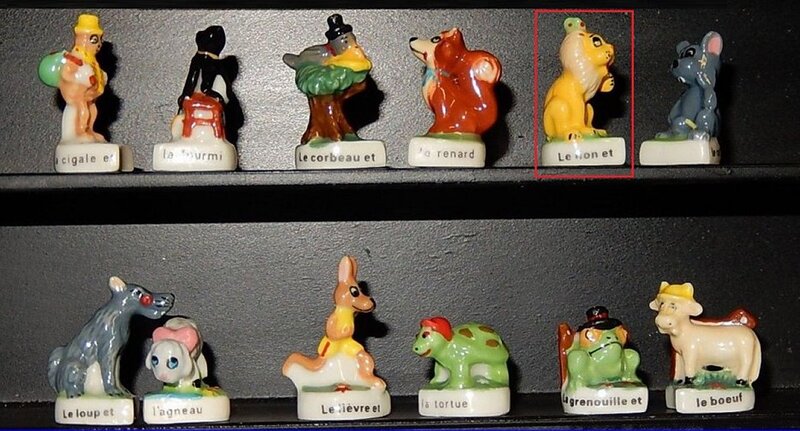
2008 Set of 12 fèves of the fables of La Fontaine by Vahine.
This group of fèves is unusual for being paired. Fables are of course often about pairs encountering each other. In this case, each little statue is shaped to fit alongside its partner. So I offer photos of the "couples."
1950? Fables of La Fontaine. Twenty-three (out of a series apparently of twenty-four) full-color postcards displaying favorite La Fontaine fables, with young people playing appropriate human roles. V. Spahn signs the cards. Card #17 is missing. €62 for the set from Serge Ferry at the Paris Post Card Exhibition, Jan., '05. Extra copy of #12 from Suzanne Botti, Le Bono, at the Paris Post Card Exhibition, Jan., '05. Extra copy of FK for $9.99 from Gold-Coast, Brentwood, TN, Nov., '13. Extra copies of #7 and #15 for €1 apiece from Akpool, Berlin, August, '18. TH for €4 from collecman through Ebay, June, '22.
The text of the fable takes up most of the message-space on the verso of the cards. Under the picture is "Fables de la Fontaine" in Italics at he lower left and a block-print title at the lower right. The modes of translating the fables into children's life are fascinating here. The emphasis is not on simple "cuteness." The children can play the fable straight, as in "L'Huitre et les Plaideurs" and GGE. FC is thus about one child stealing a ball while another sits up a tree and watches his ball stolen. Or a child can assume an unpleasantly animalistic role, as when TMCM shows an imperious girl chasing two boys away from a table full of food. The picture opens up whole new categories of interpretation when "The Wolf Become a Shepherd" shows a child picking up play sheep on the lawn. Again, there are whole new interpretations at work when FK shows a girl in a bathing suit with a frog clinging to her shoulder. Is she queen of the frogs? A few cards perhaps hardly make sense. What does the boy falling into the water have to do with OR? The set hits a low point, I believe, when it offers a black male child wearing feathers as "Le Geai Paré des Plumes du Paon." Perhaps the cards are meant simply as fun and not to be interpreted at all. Card #15 adds a false number to its fable title: "XIV." All the cards here seem to have been sent or addressed to the same party--but never to have been mailed with a stamp. Finally getting #17, TH, in June of 2022 completes the set.
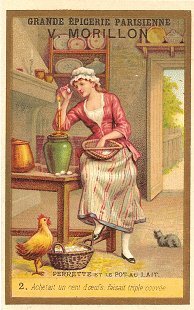
1891? Perrette et le Pot au Lait. Grande Épicerie Parisienne V. Morillon. Three numbered cards, each with a section of La Fontaine's text under the illustration. Publishers: Paris: Imp. Romanet et Cie.
These three cards, #2, #4, and #5 of a set of six, are almost identical with the cards in Liebig's 1889 series of the same name. These cards are thinner by about a quarter-inch. They thus measure about 2½" x 4⅛". The artist here carefully removes from each scene the object that advertises Liebig. Thus in the second scene, the candle by which the milkmaid examines an egg rests not on a giant can of Liebig but rather on a vase. In the fourth scene, the can of Liebig resting up on a shelf has disappeared. In the fifth scene, the directional sign that once pointed to "Cie Liebig" now is blank. The title of the series and a short section of La Fontaine's text are printed near the bottom of each illustration. The backs of the three cards are identical. They advertise "Chocolat Morillon," guaranteed to be pure. Apparently Morillon won the golden medal, the "Grand Diplôme d'Honneur" at the Grand Concours d'Alimentation in Paris in 1891 for, as the card says, the superiority of its products. Prices for chocolate and vanilla are given.
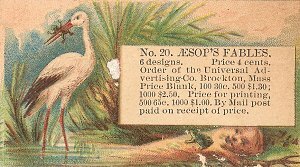
1885? One colored card of FK advertising the Universal Advertising Company of Brockton, MA.
Here text-box is utilized to advertise a series of six designs of Aesop's Fables, labeled "No. 20." The series sells for 4¢! This card gives prices for blank and printed versions. Enough of the picture shows through to let us see the face of the log-king as well as the frog-eating crane.
The card came with a companion card in the same format advertising "No. 21: Scenery Chromos, 2d Series."
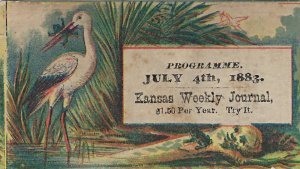
1883 FK card advertising "Programme, July 4th, 1883. Kansas Weekly Journal. $1.50 Per Year. Try It."
This card's picture echoes that of another by Universal Advertising Company advertising their Aesop's Fable Cards, including six designs. The date of the program anchors the production of these cards in the early 1880's.
This program on the verso runs from the morning parade at 10 a.m. to the the evening's fireworks and open-air concert. A hint at the target audience comes from the advertising comment on the verso starting "When in the city to-day."
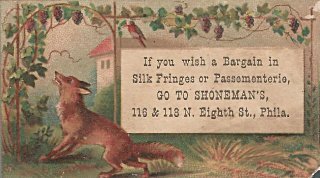
1885? One colored card with FG and an open space advertising Shoneman's in Philadelphia. 3⅛" x 1¾".
The same small card as above is filled in differently. The text design here is more pedestrian.
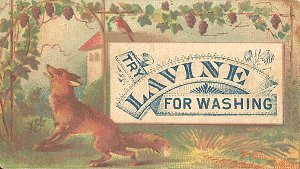
1885? One colored card with FG and an open space declaring "Try Lavine for Washing." 3⅛" x 1¾".
This may be the smallest trade card I have found. The scene depicted may be more European than American. The design for the text is quite elaborate and intricate.
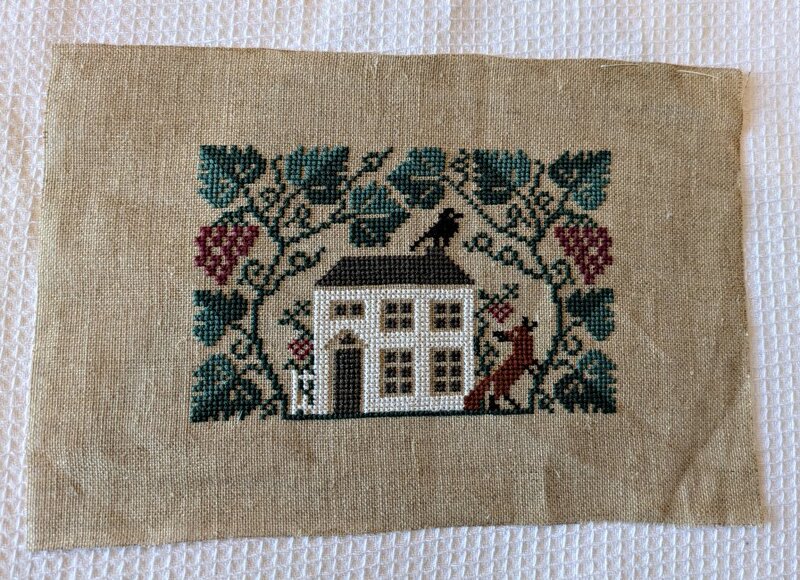
2004 Unframed Cross stitch of FC. 11.2" x 7.5". Image 6.6" x 4.25". Unknown source.
Imagine my surprise when I found an exact copy unframed. Can we assume that a pattern was somewhere published and many people followed the pattern? Like the framed copy above, this is very nice work! As there, the crow is perched on top of a roof rather than in a tree. The composition is lovely. Trees on either side frame the house together with the two characters.
1990? Two dimensional Fève illustrating GGE. €2 from collecstore 13 through Ebay, March, '24.
The golden egg helps to define the not-so-easy-to-define hen here. I continue to be amazed at how many different sets of fèves there are. They keep appearing!
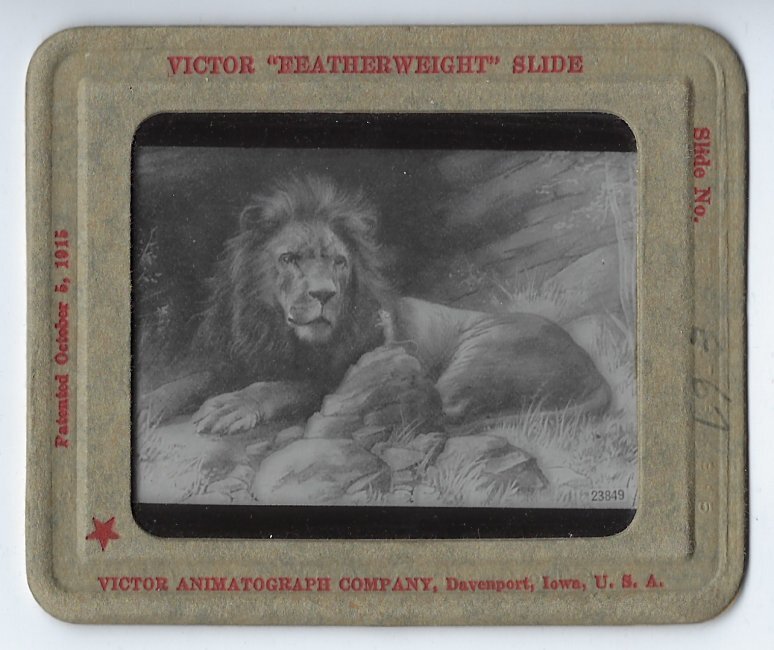
2018? Two Victor "Featherweight" Slides by Victor Animatograph Company, Davenport, Iowa.
3¼" x almost 4". These slides are indeed light. It seems that the glass of the slides is very thin. I am still seeking the best solution for illuminating slides like these for web presentation. Patented Oct. 5, 1915.
As we compare these two cards printed a year apart by the same publisher, are we looking at the work of one person copying his own work? Or a second person copying a first's work? For me, the first discrepancy to notice lies in the background behind the two characters.
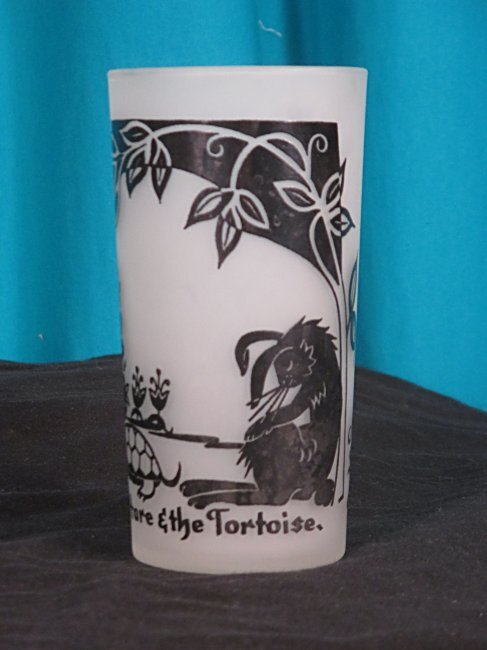
1990? Two tall water glasses with bold black designs and morals. FG and TH.
The hare is nicely slumped over as he sits leaning against a tree. The TH moral is a clever adaptation of the usual moral: "Slow but sure is quickest in the end."
The inspiration for the FG design looks very much like Artzybasheff's squirming fox. The moral is, I would say, surprising: "Don't try to fool yourself." I gather you will not succeed.