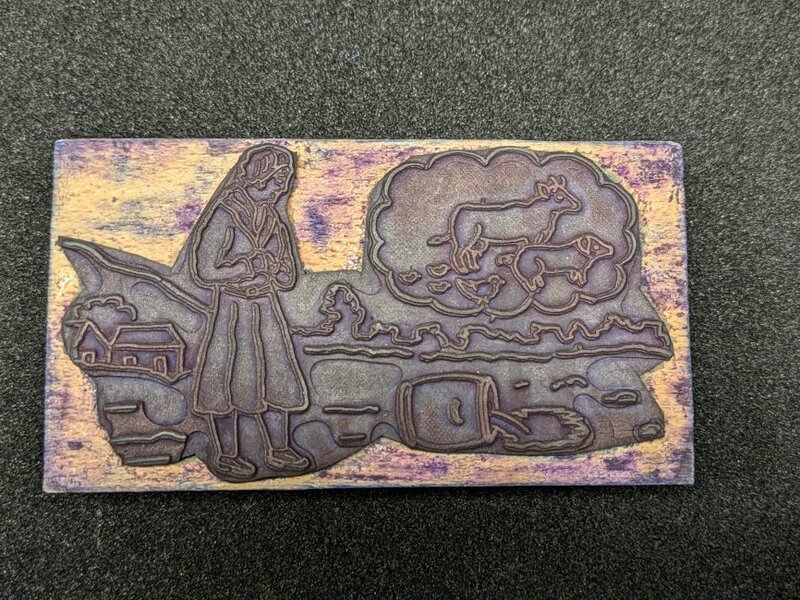
1950 Rubber stamp for MM. 6" x 3". Wooden backing shows the stamp's design. Unknown source, date, or cost.
The rubber side of the stamp shows the image more clearly than the stamped version, worn perhaps from use. One can see clearly the chickens, pig, and cow that the milkmaid dreamed of along the way to the market. See also the "Thank You" stamp under "Household."
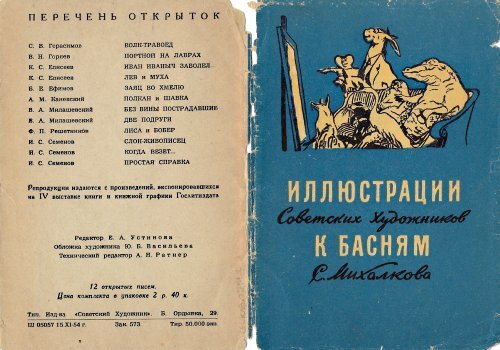
1954 Illustrations of S(ergei) Mikhalkov's Fables by Soviet Artists. 12 postcards. Soviet Artist. Two copies, one lacking "Simple Help." Unknown source.
Lively illustrations by a variety of artists. I had mistaken "When You're Lucky" for TH. Somehow this series did not get catalogued a long time ago. It is a pleasure to do so now! For some reason, "Elephant Painter" was done without the usual white strip at the bottom of the card.
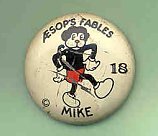
1930? One pinback 15/16" in diameter, labelled "Aesop's Fables - Mike - 18."
Against a white background we find "Aesop's Fables" at the top, "Mike" at the bottom, and "18" on the right side. In the center is a dancing mouse. Printed around the rim of the back: "Western Theater Premium Co., 1956 S. Vermont Ave., Los Angeles, Cal." I presume these pinbacks were theater give-aways. Again, I got lucky on the price!
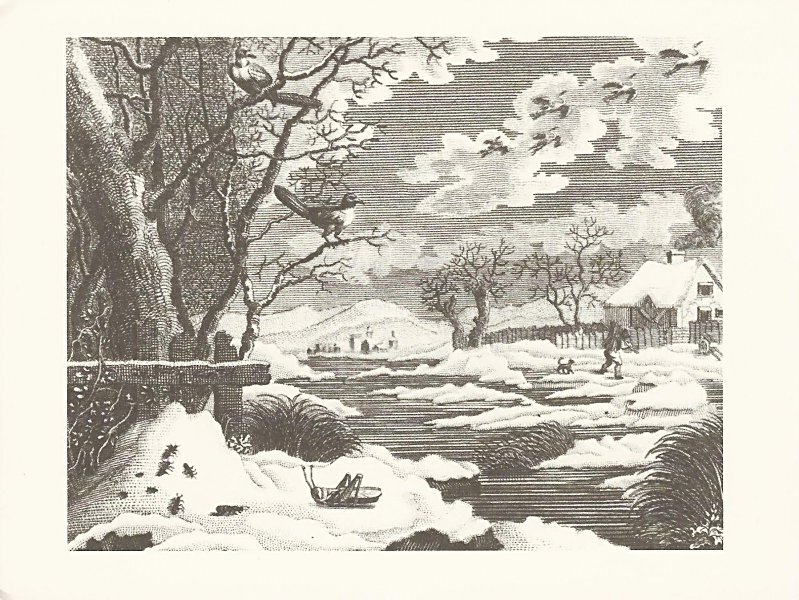
1989 Four different postcards representing 1793 Stockdale illustrations. Published by the Friends of The University of Michigan Library. Three copies of each.
TH, OR, GA, and "The Swallow and Other Birds." I leave it to others to discern whether these black-and-whie reproductions of the Stockdale 1793 illustrations really bring them alive.
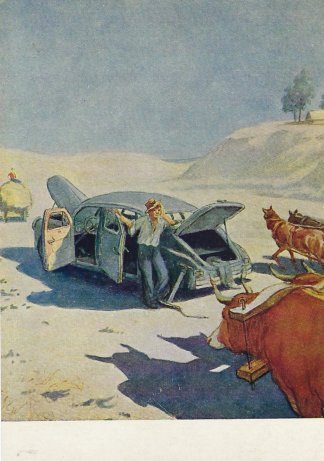
1954 Colored postcard of a broken-down car being passed by animals. Alexander Semenov. Published by Sovetsky Khudozhnik. $13.50 from Postcardworld through HipPostcard, April, '23.
The card identifies this as a Michalkov story. It could as well be TH. Is that poor driver trying to hitchhike?
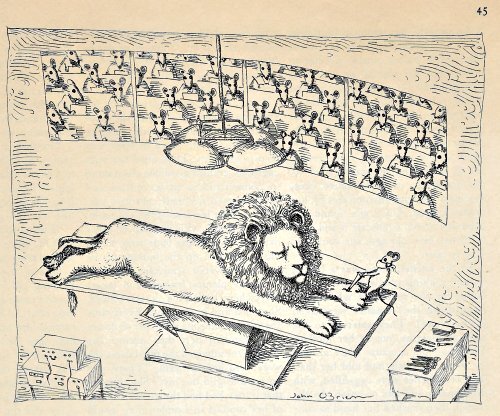
1991 Mice Medical Amphitheater. John O'Brien. New Yorker. Nov. 4, 1991. Unknown source.
I am trying to take this occasion to track down the source of the version in which it is a mouse that removes the thorn from the lion's paw. AI only restates my question when it refers people to "Androcles and the Lion" and "The Lion and the Mouse." If it is a version of AL, does the lion repay the mouse's kindness at some point? If it is a version of LM, are we to presume the first phase of the mouse running over the sleeping lion. Help!
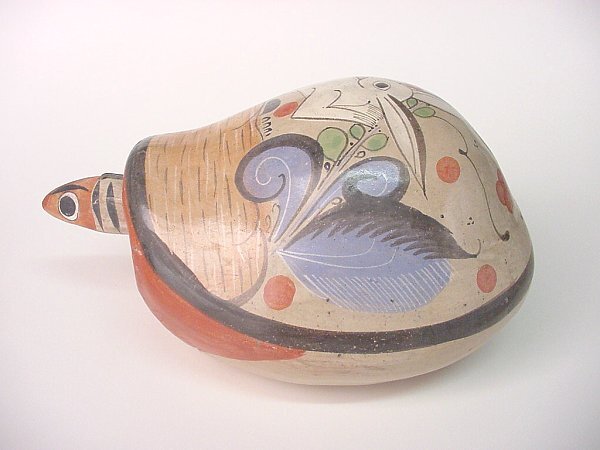
1992 Mexican ceramic tortoise with a moving head. A scene of the hare running is painted on his back. 8" x 5½" x 4½" high.
The head of the tortoise bobs laboriously whenever he is touched. What a happy thought to paint the hare right onto the back of the tortoise!
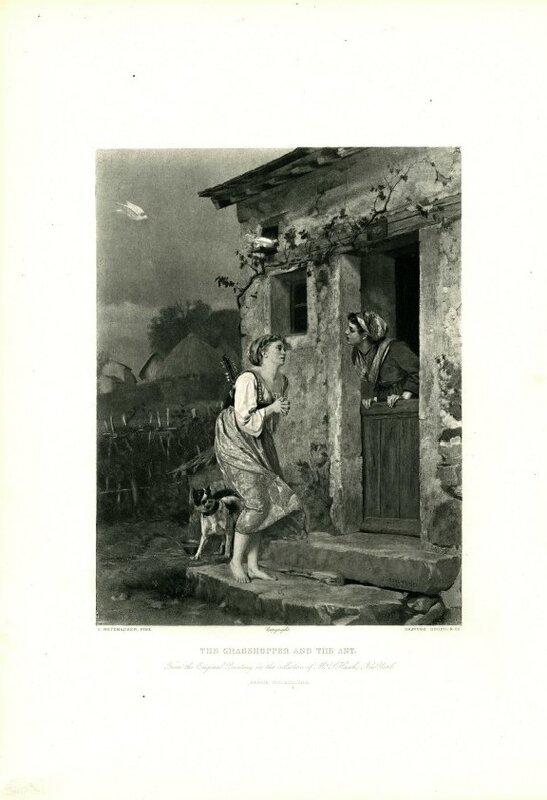
1890? "The Grasshopper and the Ant." Print of an original painting titled “The Grasshopper and the Ant” by E. Metzmacher. 11” x 16”. $17.85 from Paula Carlson, May, '05.
The owner’s name is given as L. Hawk and the work was copyrighted by Gravure Goupil & Co. Hawk’s collection is given as in New York. The print’s date is unknown, but the original painting was completed in 1869 and was signed by the artist himself in the bottom right corner. Painted in the image are two women, a dog, and several doves. An American collector and an American publisher have picked up the French tradition of sympathy with the mendicant artist, here harassed by the dog as well as the ant-like housewife. The dog and the doves find shelter here, but the artist finds nothing but rejection. I have found a trace of a second Metzmacher "Cigale." It seems to show the grasshopper after her rejection. An image of this now unavailable painting is below.
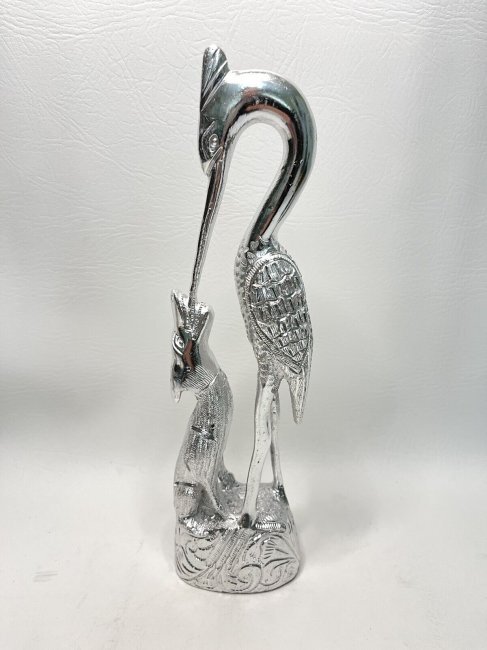
2000? Metal sculpture of Wolf and Crane. Perhaps steel or aluminum? 12" high.
What a dramatic presentation of WC! It is also a substantial piece of work! The textures of fur and feather are particularly well done, and they contrast with the smooth portions of the sculpture nicely. I believe this sculpture is a "must" for the next "fable objects" presentation!
1950? Metal printer’s block of TH. 1” x 5/8”. Wooden base. Unknown source.
Unusual in that the hare seems to be watching the tortoise strain by. I wonder what a printer’s block like this might be used for.
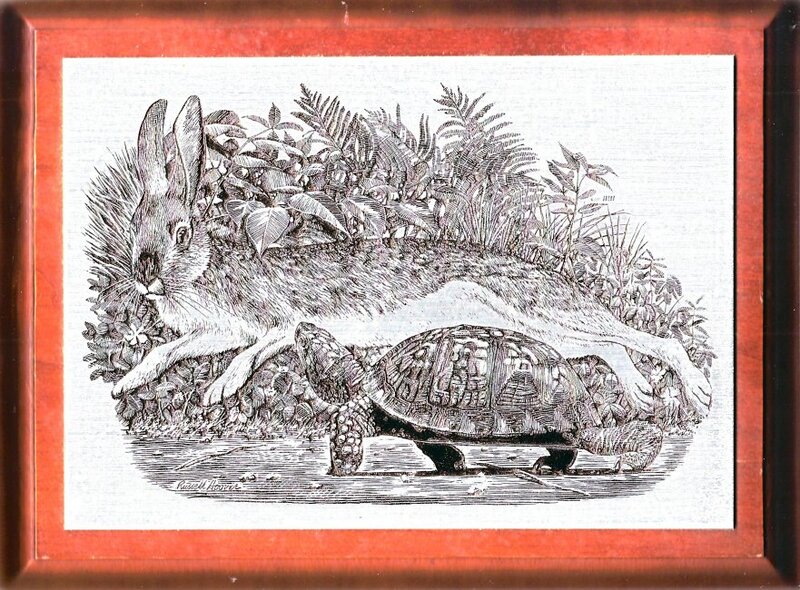
2015? Metal engraving of TH on cherry wood signed by Russell Hoover. Registered engraving No. 0283. 9" x 6¾". Unknown source and date of acquisition.
The position of the two heads and the two bodies is well done. The body of the hare half-surrounds that of the tortoise. Is the hare lying still? The tortoise is certainly not! The tortoise looks up at the hard. Is that a surprised look by the hare? A wary one? Well done!
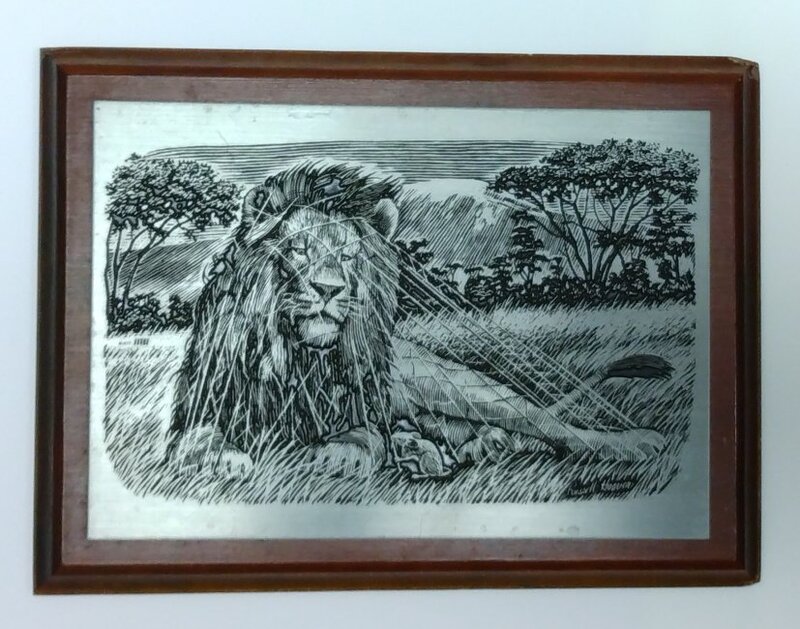
2015? Metal engraving of LM on cherry wood signed by Russell Hoover. Registered engraving No. 0223. 9" x 6¾". Unknown source and date of acquisition.
This lion seems the perfect image of patience. The many cords of the net structure the scene well against the curves of the hills, the horizontal line of the plain, and the vertical lines of the trees. This engraving refused to be scanned well. I doubt that the photograph does it justice.
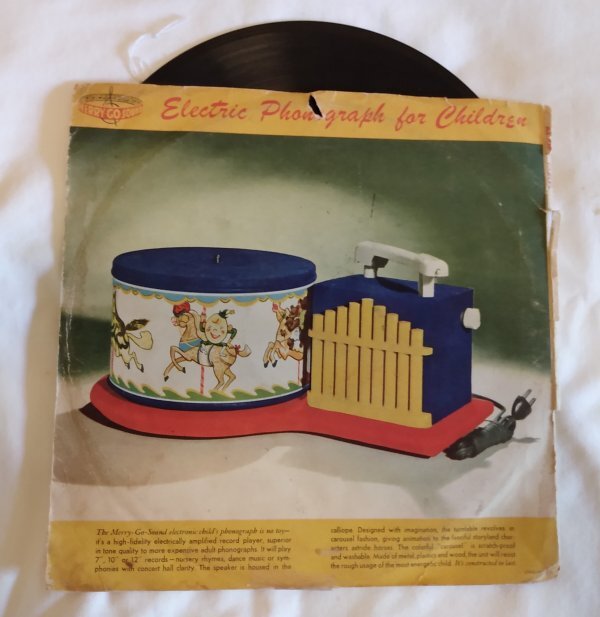
1948? Merry-Go-Sound: Aesop's Fables in Song Sides 3 and 4 of 4. For use with an electric phonograph for children. Tone Products Corporation of America. Unknown source.
The verso of the dust-jacket presents a strong illustration of WS, apparently by R. Feldstein. It is curious to find the dust-jacket presenting an advertisement for a phonograph and an illustration for a fable -- without mentioning the record of fables inside the package. This might have been a part of a set with further packaging that would have offered better orientation.
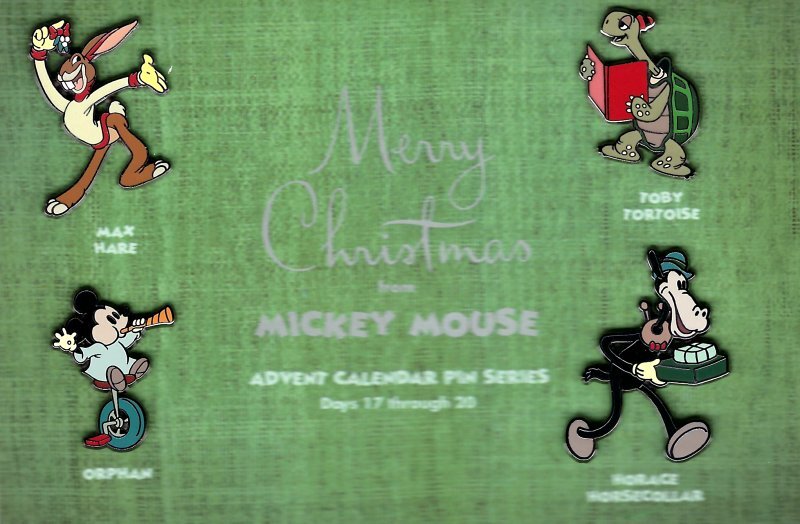
2000? “Merry Christmas from Mickey Mouse: Advent Calendar Pin Series, Days 17 through 20.” Limited edition of 1500. Max Hare, Toby Tortoise, Orphan, and Horace Horsecollar. Overland Park, KS: Disney Direct.
I cannot believe that I am cataloguing these pins over seventeen years after getting them! The two fable pins are particularly well done. Heavy jewelry! Did Disney actually market sets of pins for every four days in December?
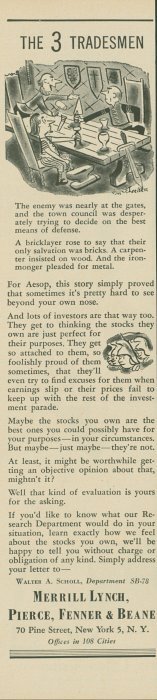
Once again the advertisement honors the fable's lesson well. Each of the three men sees the city in his own terms. Such a confined view will always be dangerous in life!
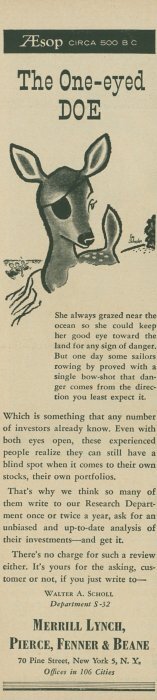
Danger comes from the direction you least expect it. Now Walter is in Department S-32. In another ad, he was in S-44. I hope all those inquiries found him!
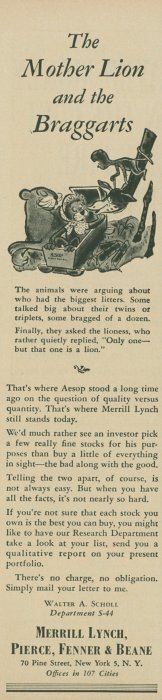
The advertisement understands the fable well as about quality versus quantity. These ads generally direct an inquisitive potential client to the same person, Walter Scholl. Did Walter get a lot of mail?
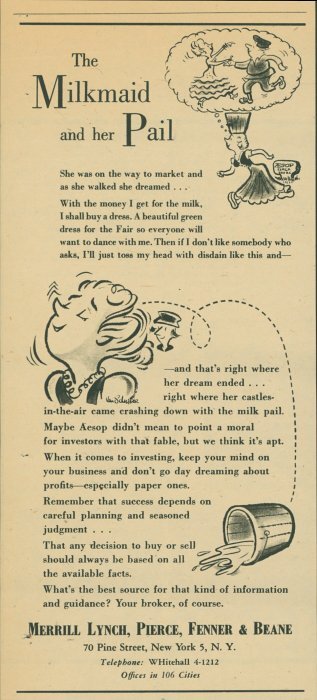
Here there are three parts to the illustration. The story is told as I like to tell it, about daydreaming and a dress. "Keep your mind on your business and don't go day dreaming about profits -- especially paper ones…. What's the best source for that kind of information and guidance? Your broker, of course."
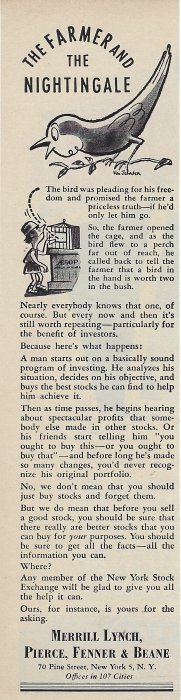
The point drawn is that of the traditional fable. A bird in the hand is worth two in the bush, as the nightingale tells the farmer -- after the farmer has released him to reveal a priceless truth.
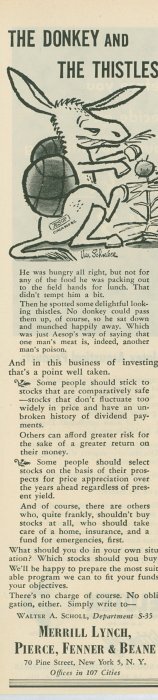
Since one man's meat is another man's poison, each of us should consult Merrill Lynch about how to invest our money. Here the artist signs his work. Is that Van Schreiber?
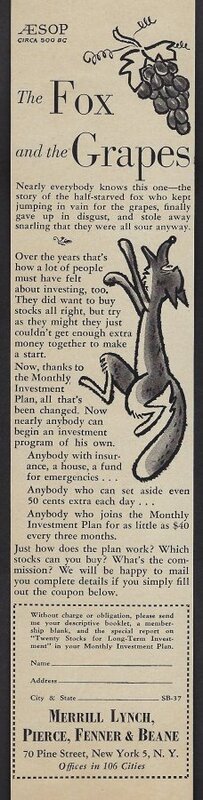
The point drawn is not far from that of the fable this time. People walk away from investing because they cannot raise the necessary money, as the fox walked away from the grapes he could not reach. Merrill Lynch has a program that allows you to save up a little bit at a time. Do not go away! Start saving now! 50 cents a day will do it! There may be a helpful cultural tip in this advertisement. It starts “Nearly everybody knows this one….” Could we say that now 65 years later?
The point drawn is not far from that of the fable this time. People walk away from investing because they cannot raise the necessary money, as the fox walked away from the grapes he could not reach. Merrill Lynch has a program that allows you to save up a little bit at a time. Do not go away! Start saving now! 50 cents a day will do it! There may be a helpful cultural tip in this advertisement. It starts “Nearly everybody knows this one….” Could we say that now 65 years later?