1941? Mercury advertisement “Here’s The Simple, Sensible Idea That Makes MERCURY Different! Get Yourself A Flying License!” 8.35” x 11.5”. Unknown source.
There is a simple illustration of the tortoise and hare in the upper left. “Fleet-footed, nimble and alert, the hare can beat the turtle every time – no matter what the fable says!” The advertisement, found several times elsewhere on the web, seems to spread to the very end of the page left and right. Google recognized this ad immediately and correctly deciphered it as comparing the car to a fast airplane.
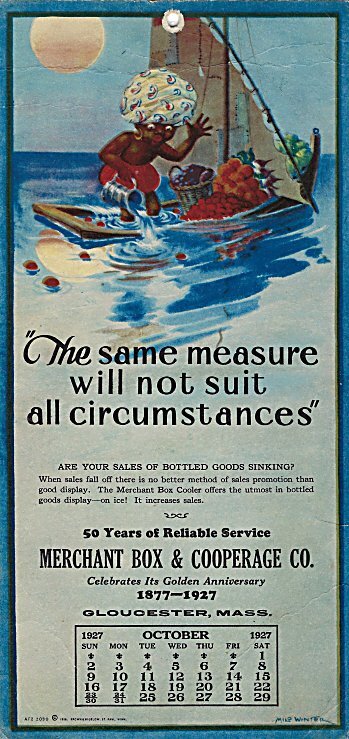
1927 Merchant Box and Cooperage Company of Gloucester, MA. Brown and Bigelow calendar for October, 1927 with illustration by Milo Winter. $16.99 from The Jumping Frog through Ebay, Jan., '25.
The formatting and approach of this blotter is remarkably similar -- and by the same artist -- as our various calendars designed by Winter and printed by Brown and Bigelow. The design has a boat operator emptying water out of his boat. After the highlighted maxim, the calendar asks "Are your sales of bottled goods sinking?" I have trouble identifying a known image or story.
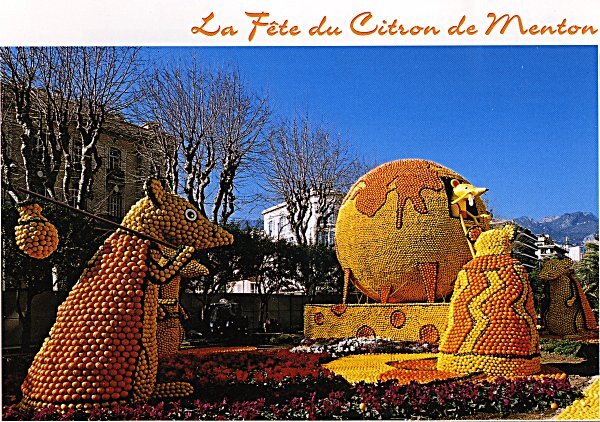
2000? "La Fete du Citron de Menton: Les Fables de La Fontaine." Landscape colored postcard for €2 from Cpaphil, Saint-Fargeau, France, through eBay, August, '13.
Lemons and oranges go to make up this splendid float of the Hermit Rat" who rejects the pleas for help of his fellow rats. He is holed up and happy in a Dutch cheese!
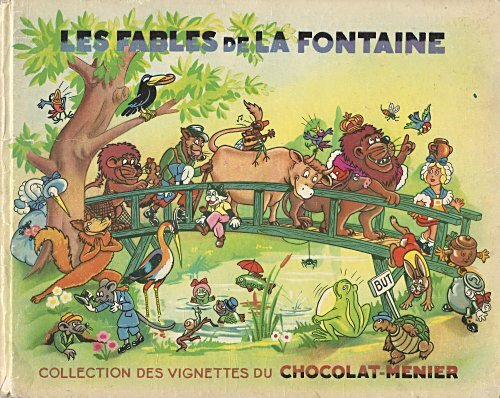
Album cards for "Les Fables de La Fontaine: Collection des Vignettes du Chocolat-Menier." 13 missing cards from Album 2 for $2 each from Bertrand Cocq, Calonne Ricouart, France, Sept., '20.
Bertrand noticed that I was short just thirteen of the cards to complete one of my albums, and so he went out and found those thirteen! One recognizes the familiar stories of "Stag and Vine"; DLS; "Beetle and Eagle"; TB; and "Wagon Driver and Hercules."
1950? Les Fables de La Fontaine: Collection des Vignettes du Chocolat-Menier. Vignettes Nos 1 a 90. Album including 90 numbered cards pasted in around La Fontaine's text. Puteaux: L'Isle de France. 240 francs on the Quai de la Seine, May, '97. Extra copy with taped binding and considerable interior staining and foxing for 100 francs elsewhere on the Quai at the same time. A third copy with about half of the cards pasted in for €9.99 from Bertrand Beauvais through eBay, August, '04.
Both of these albums are complete. Each fable has six colored cartoon-cards, except for the centerpiece, "Les Animaux Malades de la Peste," which has twelve cards. The animals are dressed and playful. The exploding frog makes a "pouf" sound (#29). The fish rejected by the picky heron wear women's hats (#68)! The inside of the back cover gives a history of chocolate. Of course, in this history Jean-Antoine Brutus Menier stands out. The good copy belonged to a Georgette Lerche when she was in the sixth class. The first extra copy spent some time in someone's wet basement! 1950?
Menier Chocolate Card Advertisements
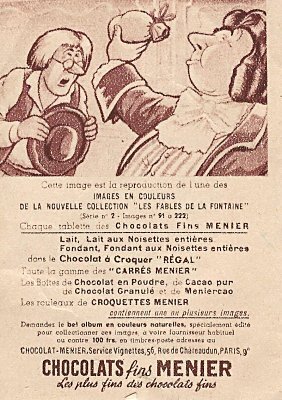
1950? Here is a curious set of three cards, with one duplicate. They are brown-and-white advertisements for the colored cards that are suitable for pasting into one's album. They show "The Cat, the Weasel, and the Rabbit," "The Cobbler and the Banker," and – with a duplicate – DW. The text for each includes "This image is the reproduction of one of the colored images of the new collection 'Les Fables de La Fontaine.' There is even an address for "Service Vignettes" in Paris.
I have found not only two Menier Chocolate albums and loose cards to be pasted into the albums. I have also found monochrome advertisements for the cards.
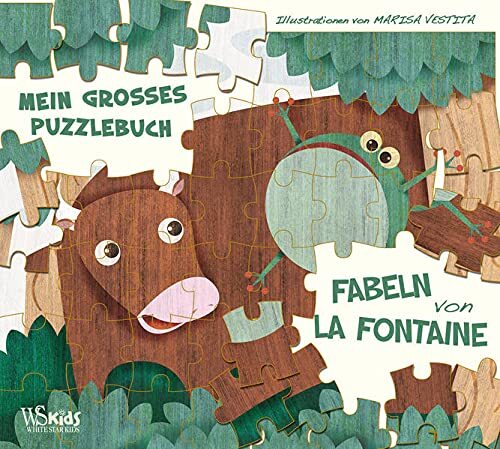
2021 Mein Grosses Puzzlebuch Fabeln von La Fontaine. Translated by Britta Kholer. Illustrations by Marisa Vestita. Hardbound. Milan: White Star Kids: White Star. €14.95 from Froehlich & Kaufmann, April, '22.
What a different sort of book! What one notices first about this 12" x 11" book is its heaviness. Take off the wrapper, and it is clear that we have five heavy-stock picture puzzle pages inside with about 56 pieces each. The simple designs are pleasant and help make for easier rather than harder placement of the pieces. I recognize the artistic approach from the seven other other Vestita books from White Star in the collection. This is an impressive piece of book engineering! I am not sure I have seen the likes of it before. I will cross-reference it among puzzles under "Toys.
1890? Chromolithographs. NIY: McLoughlin Brothers. 9.7” x 12.” Prose text along with, on the verso, two other texts and their illustrations. Unknown source.
WL
Gorgeous color work of the lamb, a crying child, backed up against a wall. The ed-eyed wolf points an accusing paw at this child.
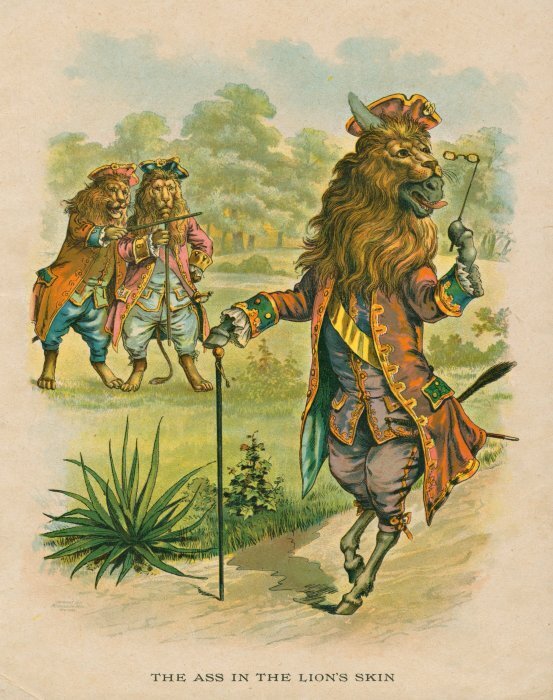
DLS
The spectacles are the crowning feature of this satirical illustration. Two aristocratic lions in the background point a hand in criticism. Though beautifully decked out in a combination of aristocratic finery and the lion’s skin, the ass manages to look through the lion’’s eye-holes – or perhaps to fake it? Gorgeous color lithography!
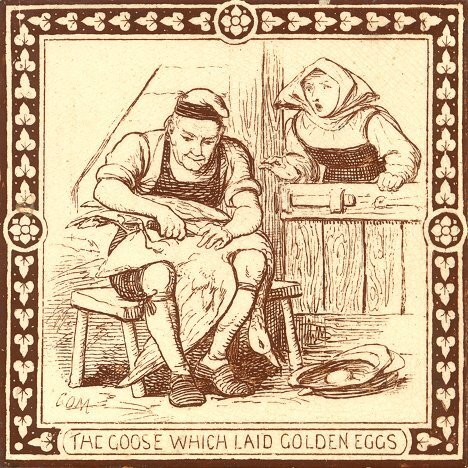
1880? Two tiles, GGE and MSA, done by Maw & Co. $75 each through Ebay from Howard Zar, Oct., '99. "The Doctors and the Dying Man" for $45 from UtterClutter1973 on Etsy, Dec., '20.
These tiles are done in a brown-and-white format. I have not yet succeeded in identifying the artist but the images seem so familiar! Each tile is signed "COM." So far I have three tiles in a series reported to include twelve tiles. The miller in MSA is so serious! For me the greatest interest in GGE lies in the surprise on the woman's face as she looks on."The Doctors" is a rather unusual fable to illustrate but absolutely true to experience, not just in medicine!
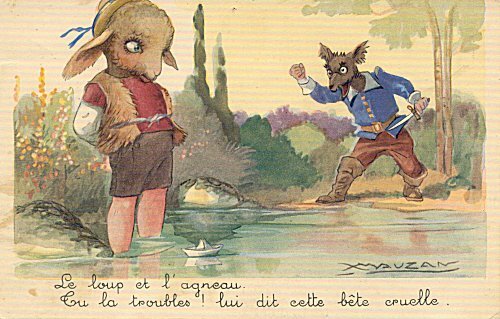
1920? X. Mauzan, "Le loup et l'agneau." "Tu la troubles! lui dit cette bête cruelle." €6 from Dominique Chapelon, Yronde et Buron, at the Paris Post Card Exhibition, Jan., '05.
The lamb in the foreground is very well done. Wading in the water, she is the picture of innocence. He or she is been playing with a paper sailboat. The illustration puts the wolf some distance away. The verso has been written on but apparently never sent, at least as an independent postcard.
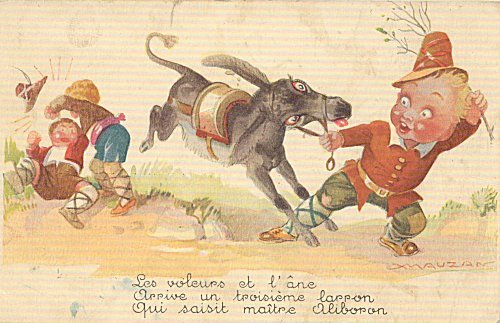
1920? X. Mauzan, "Les voleurs et l'âne." "Arrive un troisième larron/Qui saisit maître Aliboron." €6 from Dominique Chapelon, Yronde et Buron, at the Paris Post Card Exhibition, Jan., '05. Extra for €6 from Recto-Verso, Strasbourg, July, '19.
The shift to children may not be entirely successful here. The scene thus loses most of its serious bearing. Exploiting each possible element of the scene leads to having the ass fight against the lead of the third thief.
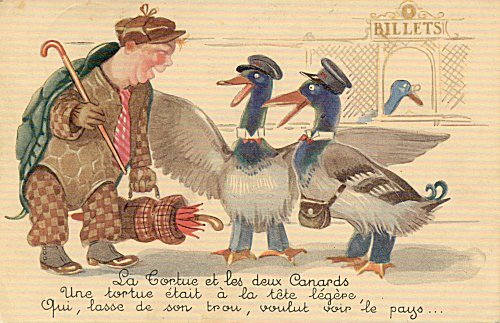
1920? X. Mauzan, "La Tortue et les deux Canards." "Une tortue était à la tête légère,/Qui, lasse de son trou, voulut voir le pays..." €6 from Dominique Chapelon, Yronde et Buron, at the Paris Post Card Exhibition, Jan., '05.
This tortoise is a real pip! He may be the best human tortoise I have seen. One might have to look twice to notice that he is a tortoise. His dress may give him away as out of control, as plaids, checkerboards, and patterns clash terribly. He is also apparently quite a load!
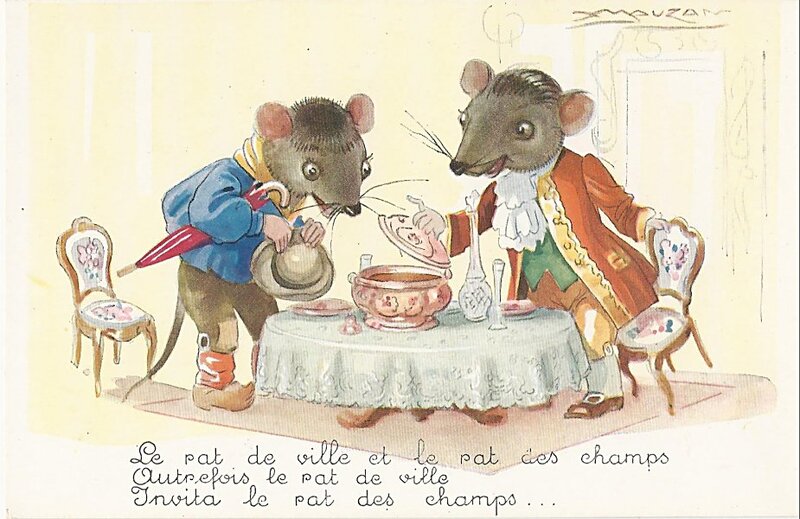
1920? X. Mauzan, TMCM. Gift of Bertrand Cocq, Calonne-Ricouart, France, August, '15
The clothes of the two mice are nicely contrasted. The script and characterization are typical of Mauzan.
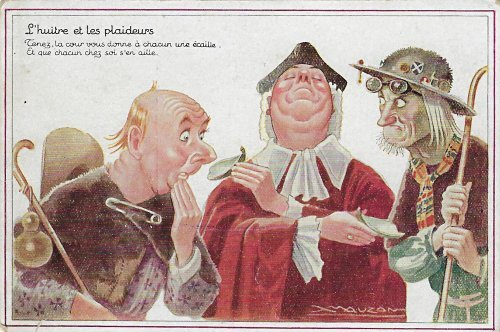
1920? X. Mauzan, "The Oyster and Litigants." €5 from Akpool, Berlin, Sept., '19
The expressions on all three characters' faces are excellent. The exaggerated mode of dress for each emphasizes the roles well. It is easy to enjoy Mauzan's presentation of each fable!
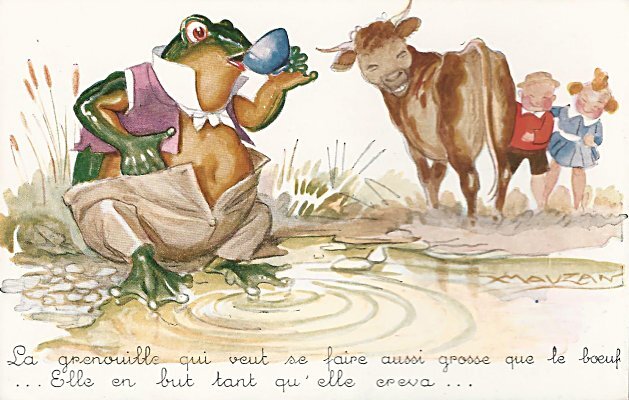
1920? X. Mauzan, OF. From Bertrand Cocq, Calonne-Ricouart, France, August, '15.
The frog in this rendition is drinking himself out of pants. The bull looks suspiciously like the "Vache qui rie." Two children enjoy the craziness.
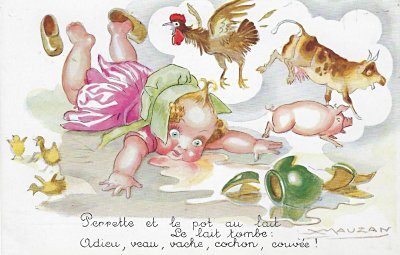
1920? "Perrette et le Pot au Lait." X. Mauzan. $7 from Bertrand Cocq, Calonne Ricouart, France, Sept., '18. Extra for €6.60 from Akpool, March, '19.
This further card in the series of Mauzan's work has the same dynamism and emotionality one sees in his other cards. Her wooden shoes are still flying off, her jug is broken, and she lands on her face. All three of her dreamed of animals are fleeing. Well done! Bertrand tells me that this card completes this series. A German postcard trader knows that I have collected Mauzan and sends me regularly other work of Mauzan, some of it tending toward the pornographic…..
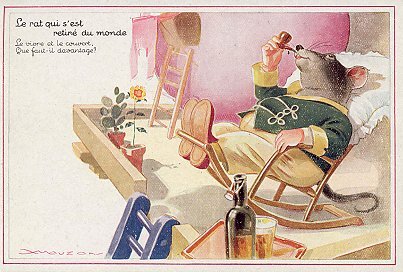
1920? X. Mauzan, "Le rat qui s'est retiré du monde." French handwritten message on the back. Imprimé en France. 20 Francs from Normand Antiquités at the Marché Dauphine, Saint-Ouen Clignancourt, May, '97.
The rat sits in a pillowed rocker outside his Dutch cheese. He smokes a pipe, and there is a glass of beer nearby. The couplet under the title in the upper left corner of this picture side of the card asks: "Le vivre et le couvert,/Que faut-il davantage?"
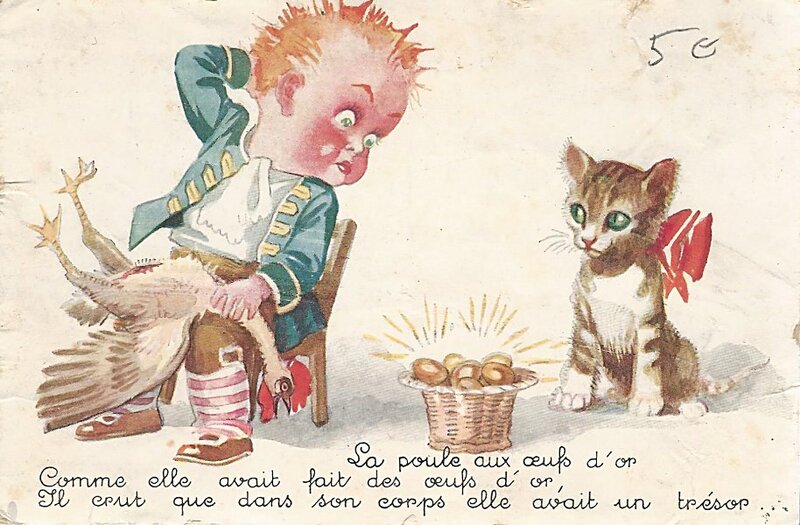
1920? X. Mauzan, GGE. From Librairie Prologue, St. Ouen, for €5, August, '15.
Another strong effort by Mauzan. When Mauzan turns to humans, he uses children. Here the red-faced killer of the hen seems more amazed at the collection of the golden eggs than at the empty dead chicken in his lap.
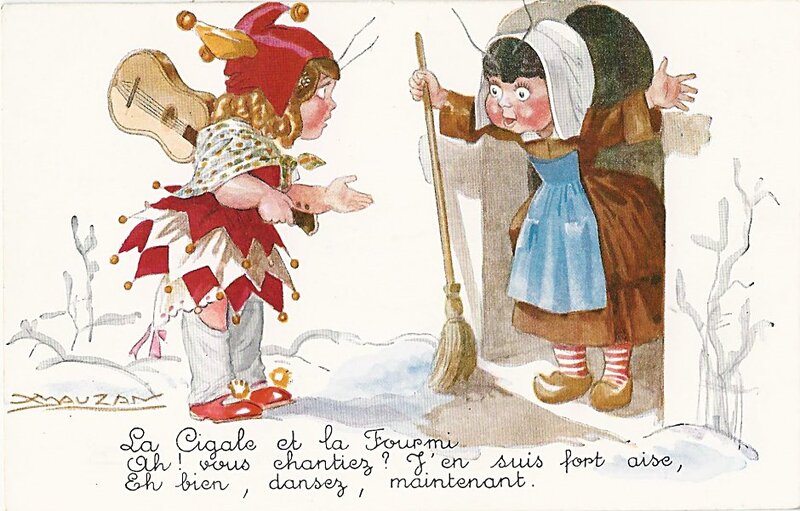
1920? X. Mauzan, GA. Gift of Bertrand Cocq, Calonne-Ricouart, France, August, '15.
Very nice contrast in clothing and gesture. The white winter world of the GA dominates the picture, with color suggested in the warm inside of the ant's home.
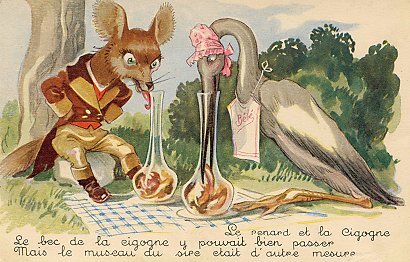
1920? X. Mauzan, "Le Renard et la Cigogne." $15 at Foster City, Feb., '97.
The dealer has identified this art as by Mauzan. There are two lines of La Fontaine's fable at the bottom of the lovely colored picture under the title. Curiously, the stork has a napkin around her neck with "Bébé" on it. What difference does the stork's age make? The stork and fox are pictured with vases before them; the stork eats while the fox licks.
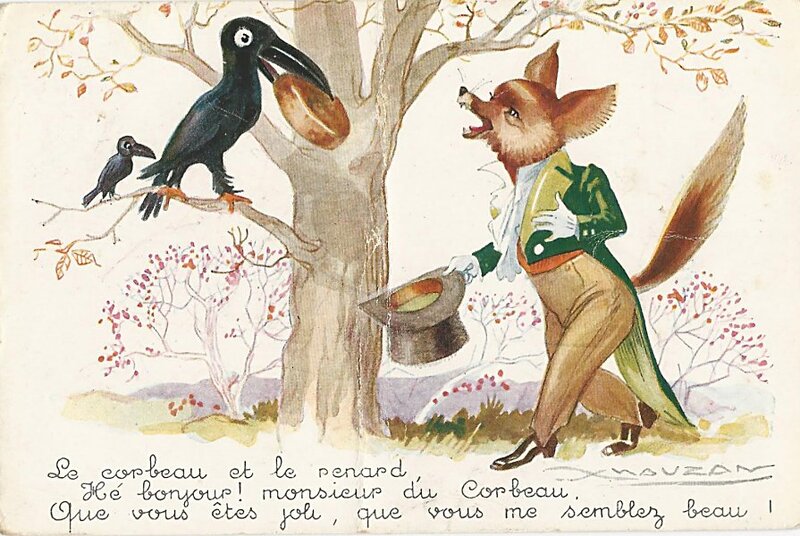
1920? X. Mauzan, FC. Gift of Bernard Cocq, Calonne-Ricouart, France, August, '15. One extra for €4 from Recto-Verso, Strasbourg, July, '19.
The fox gains in power by being dressed, and nattily at that. The crow is just his natural self. The script and characterization seem typical for Mauzan.
1983 Postcard memorializing the centenary of the birth of Achille Lucien Mauzan. Éditions Carnevale-Mauzan. $10 from S. Millus, Waterville, OH, July, '12.
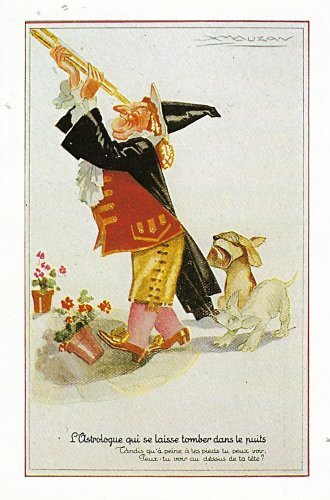
Several things make this card unusual for me. First, it falls outside the series of Mauzan cards I had already gathered. Secondly, it dates this card – and so helps with the others – in 1944. Thirdly, trying to find out more led me to learn his first names and so to correct what seemed to be an "X" in his signature on cards. Finally, I am cataloguing this card in December of 2020 and presumed that I had received it recently. I was astounded to look at the envelope and see a postmark of 2012! The card is full of Mauzan's typical humor and gift for satiric exaggeration.