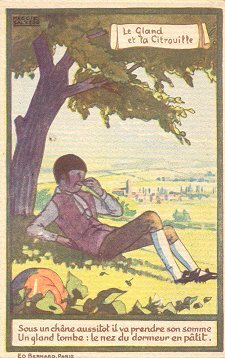
1925? Twelve postcards using images of Maggie Salzedo for La Fontaine's fables and advertising Ricqlès mint alcohol. €5.45 each from Suzanne Botti, Le Bono, at the Paris Post Card Exhibition, Jan., '05. Five extras for €15 from Recto-Verso, Strasbourg, July, '19.
The cards have a consistent pattern: an art deco scene in soft pastels covers 85% of the card and includes an open scroll showing the title. Somewhere in the image is an artist's mark in block letters "Maggie Salzedo." Beneath the image is a segment of the fable consisting of two or three verses. Underneath it all is "Ed. Bernard, Paris." The milk-carrier in MM seems so graceful that it is hard to believe that she would spill her milk! The effect of the art is in many cases simply striking, e.g., "Le Villageois et le Serpent" and "Le Paon se plaignant à Junon." Are some images, like "L'Huitre et les Plaideurs," harmed by inexact printing? The verso is that of a standard postcard but for two features. The center line dividing the two halves of the card culminates at the bottom in a bottle of Ricqlès. And across the top of the message-section is the message "Alcool de menthe de Ricqlès--87 années de succès." I checked the web; if Henri de Ricqlès created a new drink in 1838 and it boasted of eighty-seven years of success, we might be looking at a card from about 1925. Two of the cards have some writing in pencil on the verso. None were mailed.
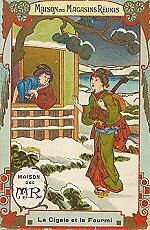
1900? 3 lavishly colored French cards about 3" x 5" advertising "Maison des Magasins Réunis." Printed by J.E. Goossens, Lille. 60 Francs each from Annick Tilly at the Clignancourt flea market, August, '99. Click on any image to see it full-size.
Human characters are used for GA and are clad in Japanese kimonos; this image is particularly strong, I believe. It includes beautiful snow on the ground, bushes, and trees; the "Cigale" has a guitar on her back. The woodman of "Death and the Woodman" wears a bamboo hat and a robe, while death is dressed in white. The two rats of TMCM scamper down from the table, which has a tea set on it. "Maison des MR" is added inside an oval seal on each picture. The back of each card repeats "Maison des Magasins Réunis" and locates the operation in Paris. It then gives the title and text of the fable, the printer, and an address of Paris, 20, Rue Gérando. Would that be the address of the printer or of the business? These cards are similar in style but different in size and format from a set of orientalizing cards done by Bon Marché. None of these cards overlap in subject with cards I have from that set. Both sets were done by the same printer.
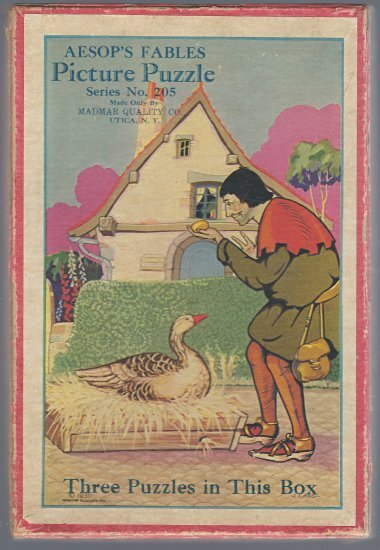
1931 Aesop's Fables Picture Puzzle. Three puzzles. Apparently by J. Lang. Heavy cardboard. 5½" x 8½". Series No. 205. Utica: Madmar Quality Co. $25 from Robert Watts, Fairfield, VA, through Ebay, March, '00.
Three twelve-piece puzzles: GGE, "The Squealing Pig," and TH. The style of the pictures reminds me of Milo Winter's work. The puzzles are complete but slightly warped. What a great find!
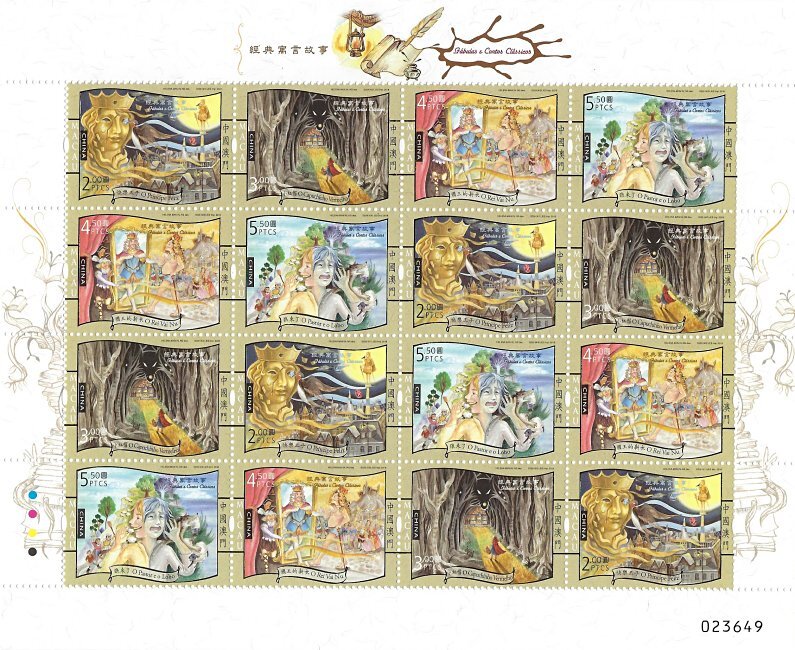
2018 Macau China set of four by four stamps of "Fables and Classic Stories," including BW and "The Emperor's New Clothes." $14.99 from starlightcity99 through Ebay, Oct., '18 Combination stamp picturing all four individual stories for €3.99 from W4 Stamps and Collectables, Falmouth, UK, May, '20. Extra of one strip and of the combination stamp from Chan Yue Kong, Hong Kong, perhaps in March, '19.
The additional two tales are "The Happy Prince" and "Red Riding Hood." I recognized "The Emperor's New Clothes" readily but was surprised by the creative presentation of BW. A little research online showed that there is a combined sheet with just one usable stamp in the middle, which I have just ordered. As so often in stamps, so here: the detail of the artistry is excellent! I offer here close-up views of the two fable stamps -- and now of the combined sheet I ordered earlier..
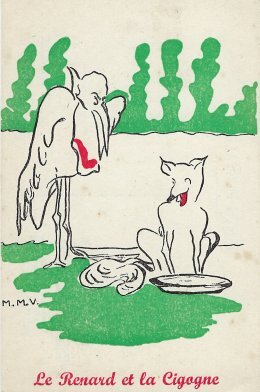
1955? Two numbered postcards using green, red, and black for their images. Illustrations signed by “M.M.V.” Campagne pour la Sauvegarde de l’Enfance et de l’Adolescence. MM (#1) and FS (#5). $7 each from Bertrand Cocq, Calonne-Ricouart, France, Sept., ’20. TH for €5 from Bartko-Reher OHG, July, '21.
The artistry in these cards is surprisingly similar to that in the series done for the “Semaine Nationale de l’Enfance.” The verso of each card has a pointed remark to the reader drawn from the fable and the campaign. For MM it is “Would you have bought Perrette a new pot?” and for FS “Do not fool your children if you want to keep their trust.” I have found one other card on the web and hope to add it to the series. Perhaps Bertrand can find me the rest of the series, however large it may be!
2020? Ten cards featuring orientalizing images of La Fontaine's fables originally distributed as trade cards for Bon Marché. €7 each for the first two from Albert van den Bosch, Antwerp, June, '23. €1.20 each for the last eight from the maker, Ludom Édition, Ollieres, France.
I am delighted to see someone reproduce these favorite images. Ludom here reproduces them well! I am glad that I took the opportunity of finding two to seek out the rest. I do wonder why they are reprinting only ten of the original twelve cards from Bon Marché.
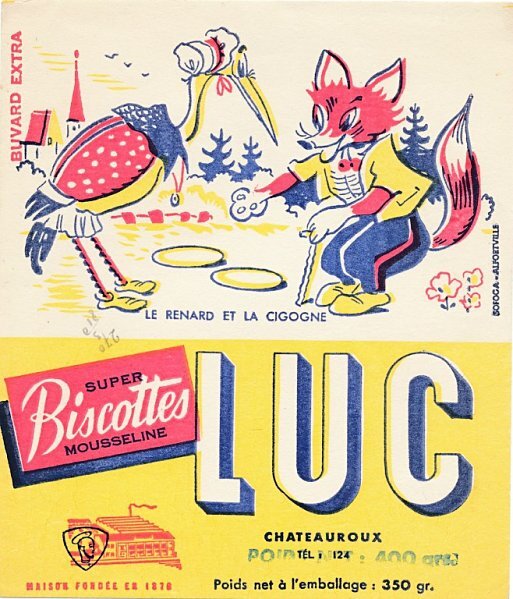
1950? One blotter for "Super Mousseline Biscottes LUC" of Chateauroux, depicting FS. 6" x 7". Printed by Sofoga, Alfortville. $6 from Bertrand Cocq, Calonne Ricouart, France, Sept., '18. LUC TMCM for $5 from Mme Denise Debuigne, Rennes, France, Feb., '05.
By contrast with other LUC blotters, these blotters are labeled "Buvard Extra." Its format -- white background behind an image of, e.g., FS on the upper half, with bright yellow background behind the product and company name on the lower half -- reverses the format of three three other blotters printed for LUC by Sofoga. I presume that one blotter came in each box of cookies.
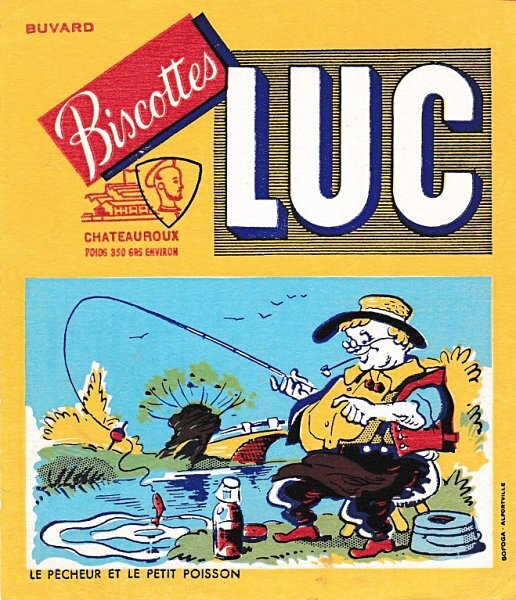
1950? Three blotters for "Biscottes LUC" of Chateauroux, each depicting a single La Fontaine fable. 6" x 7". Printed by Sofoga, Alfortville. $18 from Bertrand Cocq, Calonne Ricouart, France, Sept., '18. LUC GGE and "Cock and Fox" for $5 each from Mme Denise Debuigne, Rennes, France, Feb., '05.
Bright colors and dramatic action characterize these three blotters, presenting "The Angler and the Small Fish"; TB; and "The Cat, Weasel, and Small Rabbit." I presume that one blatter came in each box of cookies.
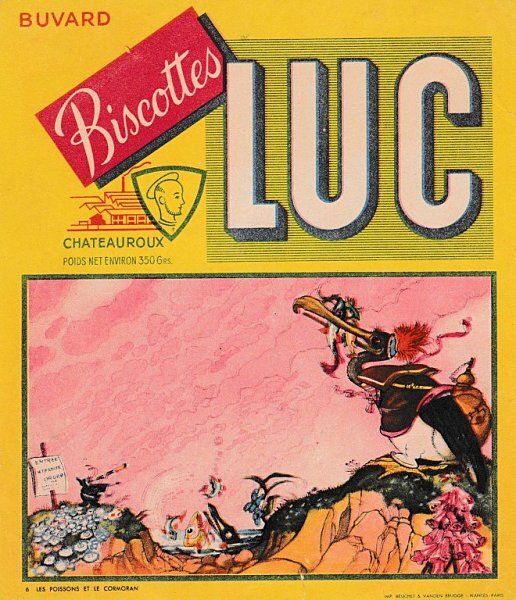
1950? Three numbered blotters for "Biscottes LUC" of Chateauroux, each depicting a single La Fontaine fable. 6" x 7". Printed by Beuchet & Vanden Brugge, Nantes and Paris. $18 from Bertrand Cocq, Calonne Ricouart, France, Sept., '18.
These blotters are similar in format to the blotters printed by Sofoga in Alfortville, but with different artistry, different typeface for the fable titles, and added numbering. These three present "The Fish and the Cormorant" (#6); "The Magpie and the Dove" (#10); and "The Rabbit and the Frogs" (13). I presume that one blotter came in each box of cookies.
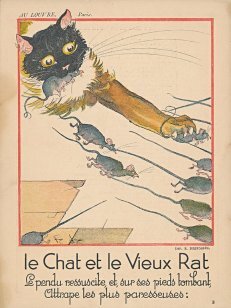
1900? Eleven numbered large (5⅜" x 7⅛") La Fontaine and five Florian fable cards illustrated by Felix Lorioux and distributed apparently by or for the Louvre Museum. $110 from Bertrand Cocq, Calonne Ricouart, France, Sept., '18. Six additional cards for 48 Euros from Anne-Marie Kucharski, Saint-Ouen, June, '19. One additional card from an unknown source, July, '19. Additional cards from a bouquinist in Paris, June, '25.
The verso contains the title and fable, perhaps with one or two vocabulary footnotes. The front features "Au Louvre," though in different typeface. The major portion of the front is taken up with Lorioux' glorious colored illustration, often with "E. Desfossés" below the La Fontaine illustration. At the bottom is the fable's title and a selection of two or three lines from the poem. The lively work of Lorioux has been a favorite of mine for a long time. I was not aware of this series of cards, done perhaps as something of a promotion for the Louvre Museum. I cannot yet make sense of the numbering system. Part of the puzzle is that many cards fit into some system using "1" through "4." Then there are some with no numbers and one with the number "9." Part of the puzzle here is that several fables occur twice in this series, with different quotations and illustrations, and always in different number groups. Does each fable represent a "family" of cards, perhaps generally four cards to a family? Some day it will come clear how the cards are numbered and how big the series might be. "Retired Rat #3" is the only duplicate card here. "Cat and Sparrow" includes a card marked "9." One of the three cards representing "The Fish and the Cormorant" has no number but seems to fit what the #2 card must be.
2015? Lotte Reinigers Märchen & Fabeln. AbsolutMedien. 2 DVD discs offering Reiniger's short silhouette films from 1921 through 1961.
This pair of DVD's present the delightful and awe-inspiring silhouette films of Reiniger, from early silent films into the more developed silhouette films of the 1950's. Among the latter is the only fable I find among these offerings, "Der Heuschreck und die Ameise," apparently produced in London in 1953/54. As the accompanying booklet by Absolutmedien points out, Reiniger adapts this story quite substantially. The ant dismisses the grasshopper in summer and in winter. As he lies dying in the snow, a mouse and a squirrel carry him into their home and revive him. He immediately starts fiddling. The ant hears and stops by to enjoy interaction. Though the mouse and squirrel reject her, the Heuschreck accepts her in. "You worked all summer; now you can dance in winter!"
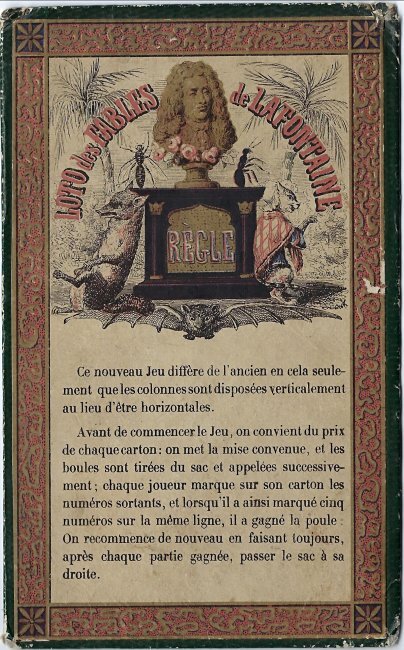
1860? "Loto des Fables de LaFontaine." Twenty-four stiff 4½" x 7¼" cards using illustrations after those of J.J. Grandville. $120 from François Binetruy, Versailles, France, through Ebay, Dec., '00.
The upper 2½" of each card is taken up with a good rendition after Grandville of an individual fable illustration over a block-print title. The lower 4¼" is taken up with La Fontaine's text and three columns of bingo-like numbers. (The middle column splits the text in cumbersome fashion.) Some cards have one or two footnotes on difficult or antiquated vocabulary. One of the twenty-four cards is outside the pattern. Its upper portion gives the game's title around a bust of La Fontaine, supported by a cabinet. At the center of this cabinet, which is flanked by a fox and a cat, stands "Regle." This card tells us that this "new" game differs from the old one only in its vertical rather than horizontal columns. Apparently, one agrees on the price of each card and pays for his/her cards. Then number-balls are drawn from a sack and called out. For a win, one needs to cover the five numbers in any one column. Unfortunately, there is no real connection between the fables and the game…. I remember seeing this game--I cannot remember where--at a price I could not dream of. I think my favorite fable-collector picked up that copy. I am delighted to find this other copy now!
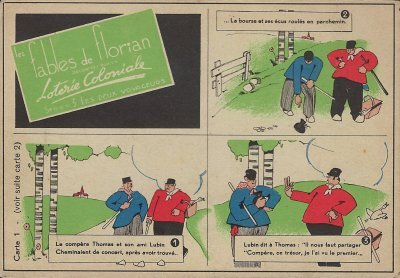
1936? One four-panel three-colored cartoon postcard offering the first half of Florian’s “The Two Travelers.” #1 of a 2-card series produced by the Belgian Post Office. $10 from Bertrand Cocq, Calonne-Ricouart, France, Sept., ’20.
From references and images on the web, I conclude that this is #3 of three series done by the post office in 1936, including probably both postcards and stamps in a booklet. (A recent winning bid for such a booklet was $275.) The first series seems to be La Fontaine’s MM. This Florian fable itself portrays the age-old argument. When two are travelling, does a found object belong to the pair or only to the first to possess it? Thomas here tells Lubin: “It’s me, not we!” The two travelers soon encounter thieves, and Thomas says to Lubin “We are lost!” Lubin answers “It is you, not we!” Still, both manage to escape. Thomas soon gives the wallet away. Think only of yourself in good fortune and you will find that you have no friends.
1930? Fifty numbered small⅝ slips (identified on the verso as "Chromos" on both languages) 1⅝" by 2¾" featuring La Fontaine's fables with titles in French and Flemish. Each verso has identical French and Flemish advertisements for Lecocq chocolate and candies and mention of albums in which to put these fifty chromos. AU$17.50 from 191Scazna through Ebay, August, '20.
What a lovely find! I cannot discover a single reference to these engaging bilingually labeled pictures on the web. I will try to find an album of them after finding this surprising and inexpensive offer on Ebay. I would love to spend some time tracing the sources of the simple images presented here. I suspect Doré may be the source for many, but I would love to track down the visual references. These slips of paper are so thin that they are not really cards, but still I believe the best place for them in the collection is among the many "chocolate" card sets, along with likely competitors like Menier and especially Ruelle, which similarly used paper rather than card stock. I will put them there for now and hope to find an album somewhere sometime…. Apparently a child could collect eleven of these chromos and send them in for an album for all of his other fable chromos.
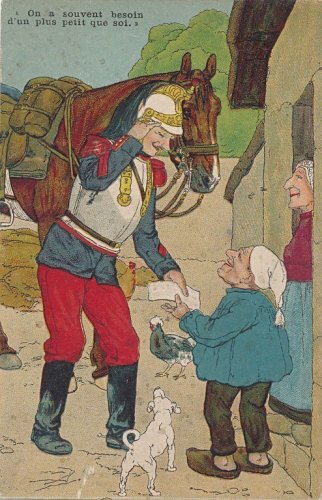
1900? Full-color postcard of LM showing a Prussian (?) soldier helping a dwarf-size person. "On a souvent besoin d'un plus petit que soi." $8 from Bertrand Cocq, Calonne Ricouart, France, Sept., '18.
As far as I can tell, the military uniform shown here goes back to about 1870. Is this a bit of propaganda that the German officers are appreciative of French "little people"? The postcard is unusually well colored. This is an unusual find. Well done, Bertrand!
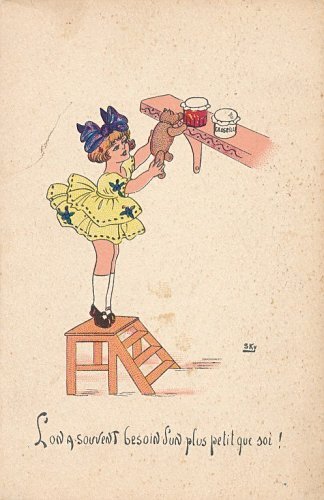
1913? Fructine-Vichy postcard featuring a girl on a ladder using her toy to reach jam on the shelf. LM: "On a souvent besoin d'un plus petit que soi." SKy. $8 from Bertrand Cocq, Calonne Ricouart, France, Sept., '18. Second copy for $6 from Bertrand Cocq, Calonne Ricouart, France, Sept., '20.
This collection has other contributions from Fructine-Vichy. This effort is both cute and well executed. The color work is excellent. We succumb to advertising today. Here in 1913 someone is succumbing to send a cute laxative postcard to a presumed friend! The second copy seems to have been colored in with crayons in a way far less professional than was true of the first copy. This is one of many postcards celebrating aphoristic phrases from La Fontaine's fables.
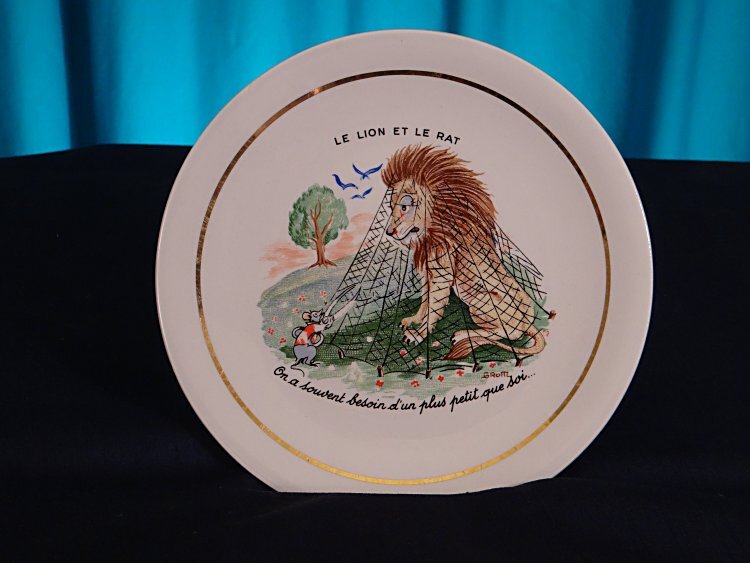
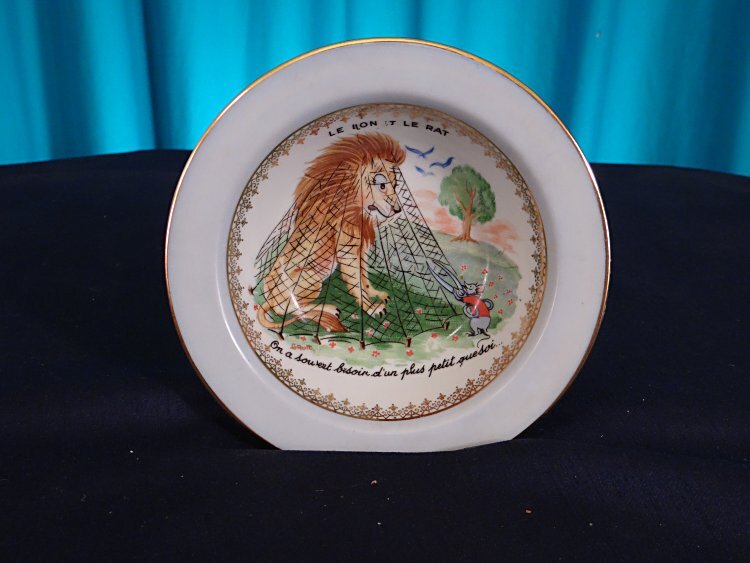
The rat in this rendition of LM uses a scissors to cut the lion's elaborate net, pegged to the ground in over a dozen places. The lion sits expectantly on all fours.
The rat in this rendition of LM uses a scissors to cut the lion's elaborate net, pegged to the ground in over a dozen places. The lion sits expectantly on all fours.
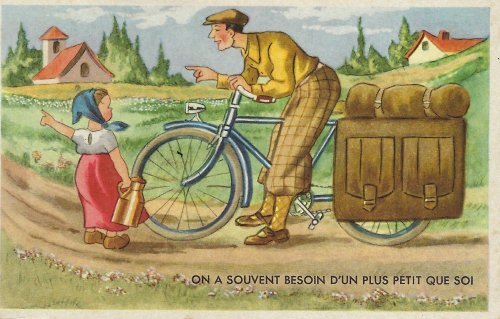
1980? "On a souvelnt besoin d'un plus petit que soi." Colored postcard with a bicyclist asking a child for directions. Éditions Univers Paris H-5. $5 from an unknown source, Feb., '22.
The bicycle rider here might well be a deliveryman or a long-range tourist, since he has such huge paniers! The child points the way. Well done!