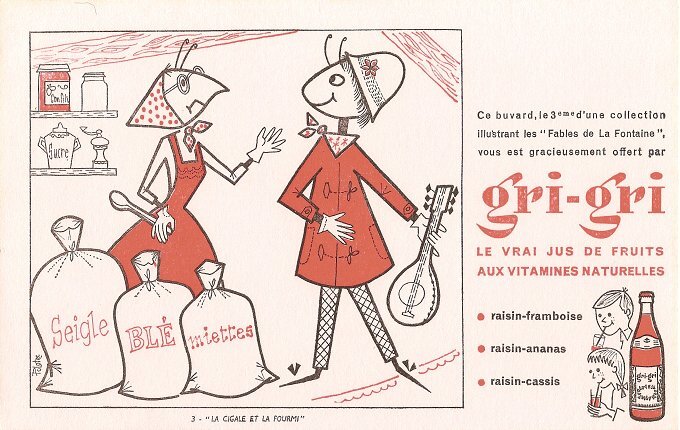
1960? 'La Cigale et la Fourmi,' Buvard #3 d'une collection illustrant les 'Fables de La Fontaine.' Gri-gri, le vrai jus de fruits aux vitamines naturelles. Illustration signed by Polotec. Red and black on pink paper. 8¼' x 5¼'. $5 from Mme Denise Debuigne, Rennes, France, May, '03.
The sketch again takes up two-thirds of this blotter. The ant, dressed in a house dress and kerchief and carrying a spoon in her hand, addresses the jaunty cicada as he holds a lute or guitar. Of course I still would like to know how many blotters there were in this collection and get hold of the rest.
1900 Exposition Universelle "La Cigale et la Fourmi." Six 6½" x 4½" cards printed by Imp. E Dufrénoy of Paris. Each scene signed by P. Kauffmann. 80 Francs each from Annick Tilly at the Clignancourt flea market, August, '99. Extra copy of card 6 for €5 from St. Ouen, August, '13. Extras of the last four cards for $50 from Bertrand Cocq, Calonne Ricouart, France, Sept., '18.
The back of each card shows a design of the actual department store buildings under the name "Maison Aristide Boucicaut" and invites guests at the Exposition Universelle 1900 to shop at this store. Each card promises "Interpretes dans toutes les langues" and proudly claims "Hors concours - membre du jury"! The colors are a bit faint, but this is a classy set.
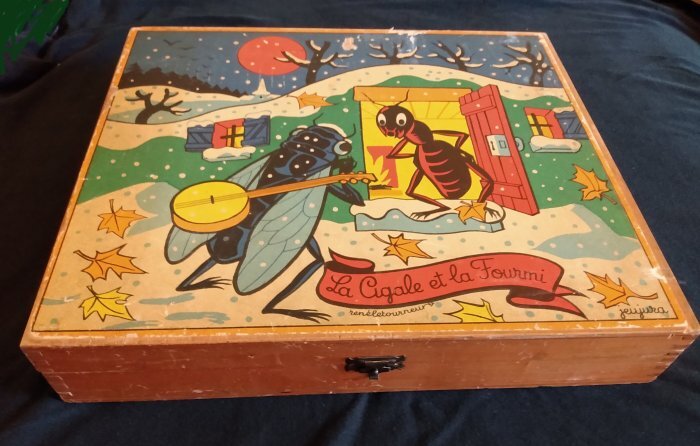
1950? La Cigale et la Fourmi. 42 cubes en bois. Jeujura. €25 from loupnoir69 through Ebay, Sept., '21.
Here is a large puzzle -- the largest in our collection -- in a box about 12" x 10½". Seven blocks across and six high. Each of the six scenes is a different La Fontaine fable, appropriate labeled. The other five pictures survive! It is not easy to guess when this puzzle was made. Jeujura has apparently been around for a long time! GA; TH; MM; OF; FC; and "The Heron."
1924 Twenty-three advertisements (and three duplicates) for various products using the artistry of Benjamin Rabier. All printed sometime in 1924 in L'Illustration. Products include Dentol, Regnauld Cream, and Goudron Guyot.
What is so lovely about these advertisements is that each uses the well-known fable situation to work in a claim for the advertised product. So the "talkative turtle" could not sustain his flight holding on to the stick carried by the two ducks because he did not use Dentol to make his teeth strong. The tortoise was besting the hare because he took Goudron Guyot. The rat who retired from the world secure himself inside not a big wheel of cheese but a wheel of Dentol. The lamb that is normally eaten by the wolf offers him instead a some paste for his cough. Enjoy the twist of the fable in each case and click on the saying or picture to see a bigger rendition.
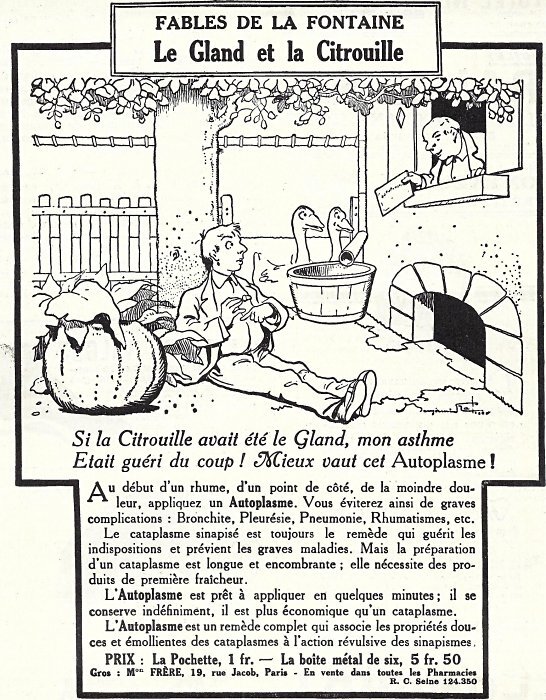
Acorn and Pumpkin: "If the pumpkin had been an acorn, my asthma would have been cured as a result. This Autoplasme works better."
DS: Do not be as stupid as this dog. Do not take some other toothpaste and let go of your Dentol!
FC: Renard: "Bravo! For my bronchial tubes! Thank you for the Autoplasme!"
FG: "Climb up there? Never! I'm not so stupid…. Still, for teeth, Dentol is famous!
FS: Do you hear my tongue lapping? It's from the elixir of the strong, Quinium Labarraque.
GGE: Wife: "What have you done! This hen was laying eggs of gold for us, namely Dentol!"
Rat Retired from the World: Retired Rat: "I have found this way to care better for my teeth: to live in the middle of Dentol!
Snake and File: Snake: "Sure, this metal is hard, but it seems to me soft because my teeth are hard as steel, thanks to Dentol."
TH: Tortoise: "I have breath and I am running! My secret is to have taken some Goudron Guyot."
TMCM: "In order never to cough, you need to drink this good Goudron Guyot."
TT: First duck: "Sky, look what happens to someone who was just scraping the sun." Second duck: "Alas, he weak mouth was ignorant of Dentol."
Two Cocks: The hen will offer the winner this gift: to fight a cough, some Regnauld Cream.
Two Rats, Fox, and Dentrol: Fox: "What a singular means of transport! My teeth, not theirs, will have this good Dentol that they are transporting!"
WL: Lamb: "Monsieur Wolf, you have a cough. Let me offer you Regnauld Paste."
GA: "You cough? Okay. Here's my last word: Dance! You will not get any of my Goudron Guyot."
Cobbler and Financier: "If I seem cheerful, it's because as solid as a rock, I have a good stomach, thanks to Charbon de Belloc."
Wolf Become Shepherd: "Let's make up our face and adjust our collar and then brush our teeth with Dentrol!"
The Two Doves: "I'll take care of you. I have a band-aid."
OF: "Don't inflate yourself so. Listen. I'll just give you Goudron-Guyot."
DW: "You can ask my master. That does not trouble me. I am seldom there, thanks to Charbon de Belloc."
2P: Unlucky Clay Pot! Cracks over the first hit! Why didn't he take some Quinium Labarraque?
WC: "To relieve your throat, take a bonbon of Pate Regnauld."
Animals Sick in the Plague: The monkey's advice: "To cure what ails us, we need to take Labarraque Quinine."
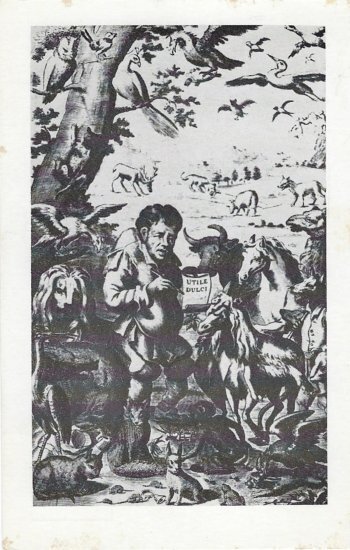
1950? One portrait postcard reproducing the frontispiece of Aesop from Roger L'Estrange's 1699 "Fables of Aesop and other Eminent Mythologists with Morals and Reflexions." From the Walter B. Sheppard Collection at Berea College Library, Berea, Kentucky. Berea College Press, Berea, Kentucky. $1.33 from HipPostcard, Ocoee, FL, Feb., '23.
Aesop proudly displays "Utile Dulci" on a page. He is surrounded by animals and birds under a large tree. What a great connection with an important college through Aesop. How delightful that they chose him for their postcard!
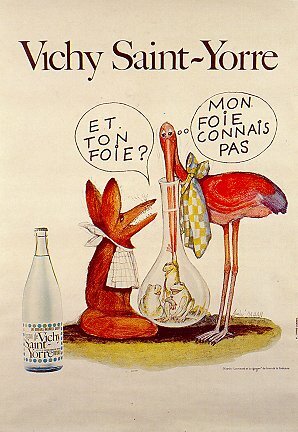
Le Renard et la Cicogne (fable de La Fontaine). Affiche de André Dahan pour l'eau de Vichy, 1970. Bibliothéque Forney E 198283. Edité par la Société des Amis de la Bibliothéque Forney, Paris.
1890? 17 colored French cards picturing human scenes for La Fontaine's fables. Just over 4¼ " x 3 ". Titles are printed in block letters, often in a circle or in unusual spaces within the illustration. Five cards advertise Delorme-Gauthier (DG) on both picture and--with the fable's text--verso. One card advertises New Home (NH) sewing machines on both picture and--with the fable's text--verso. Two blank-backed cards (B) lack the red border stripe, have a white border, offer no fable text, and are printed on thinner cardboard stock. Five DG cards for $40 from Bertrand Cocq, Calonne-Ricouart, France, March, '01. The remaining three for 60 Francs each from Annick Tilly at the Clignancourt flea market, August, '99. Two more for €1 each in St. Ouen, August, '13. Six further cards advertising “Biscuits Pernot – Dijon” for $10.28 each from S.O.L. on Ebay, Jan., ’21. One further "Pernot" card from S.O.L. for €9, Sept., '21. "Ass and Robbers" for €9 from s.o.l* through Ebay, August, '22. Four slender cards advertising Belle Jardinière Chicoree at C. Beriot in Lille for €1.50 each from pier-mont through Ebay, Spt., '23: one new (Fox and Goat); and three with differently placed title-circles (Lion in Love; GGE; AD).
These cards choose dramatic moments, especially in fables featuring human actors. In one of the two exceptions, "Les Deux Chèvres " is translated into a dramatic human scene of two men fighting each other on a narrow bridge. (The other exception is DJ, mentioned below.) This card has several other interesting points. One of them is that a French card advertises an English (or American?) machine in French. Another is that it gives a terminus post quem for the card. The front proclaims "Il faut dans chaque famille la Machine Type New Home Standard. Adoptée dans les Écoles de France. Médaille d'Or Paris 1889. " Like three other cards, this card presents the fable title in the form of a circle. The verso includes the text, various advertising, and "Imp. de l'Agence Générale, Standard, Paris. " This is the only indication of a printer of any of the cards. The two B cards-- "L'Ivrogne et sa Femme, " and "Le Berger et la Mer "--have lighter paper, smaller images, and larger margins. Delorme-Gauthier seems to be a cloth merchant in Vichy. The DG cards feature a MM in which the woman has fallen, a dressed-up human cock who waits while the jeweler assesses what he has found, a lion having his nails clipped, a traveler struggling in mid-river, and a standard presentation of the divided oyster. The five “Biscuits Pernot” cards indicate as publisher ”Courbe-Rouzet a Dôle (Jura).” One translation here from the animal to the human sphere strikes me as inept: is the ass who doesn’t care who is his master like a playing child? That ass may be quite smart! See "L'Avare qui a perdu son Trésor " under "Stock Singles." It may well belong to this set.