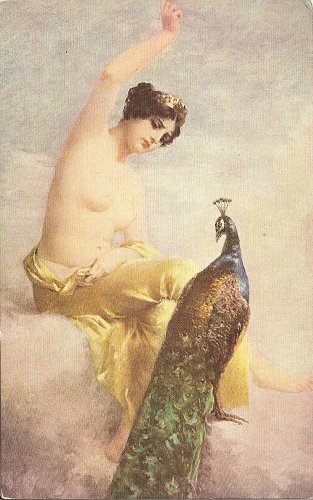
1910? "Juno Hearing Peacock's Complaint." Colored postcard displaying a painting apparently by Mme. Jehanne, Paris. Salon de Paris. Printed in Paris by Lapina. $18 from Christiane Smith, Norman, OK, through eBay.
Is this one of "those" French postcards? The composition puts Juno and the peacock in pleasing relationship to each other, but I am not sure of Juno's emotion, and this is one ancient fable whose emotional content is important! The card is numbered 905. I wonder what the series is.
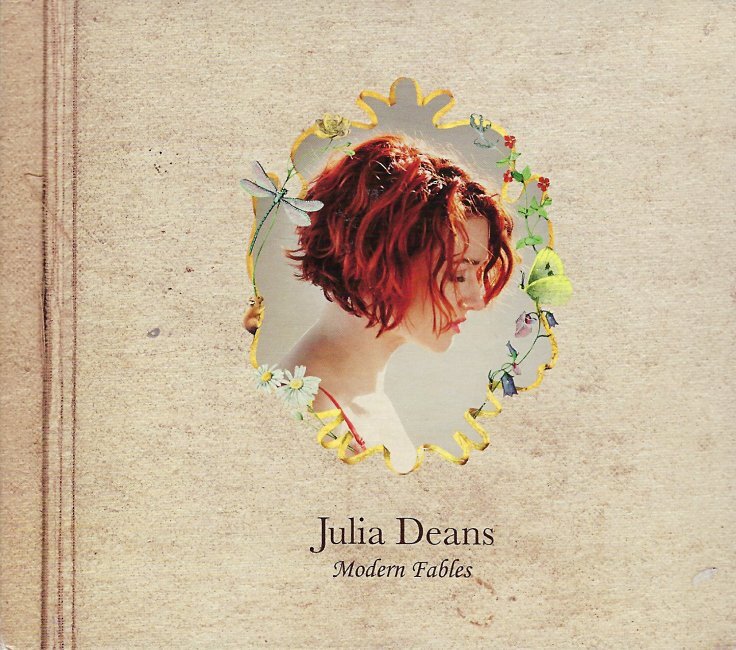
2010 Julia Deans: Modern Fables. Songs written and performed by Julia Deans, with orchestral and vocal accompaniment. Recorded in a number of places.
Ten love songs. The second is "Modern Fables." It is a challenge for me to put together.
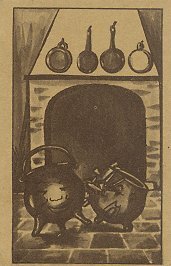
1920? Twenty-two monochromatic cards depicting fables of La Fontaine. Jubilé: "Garantit la Qualité – Waarborgt de Kwaliteit." Slightly larger than 2" x 3¼". The cards came in corners placed on loose 6¾"x 9¼" album sheets, with titles apparently cropped from the backs of identical cards.
The cards are tan, and the ink is a brownish black. The designs--many of which are signed "P.S."—seem rudimentary to me. There is enough of the scene to understand what is taking place, but little interpretation or wit expressed. The verso contains the Jubilé logo and motto at the top and the title and a moral at the bottom.
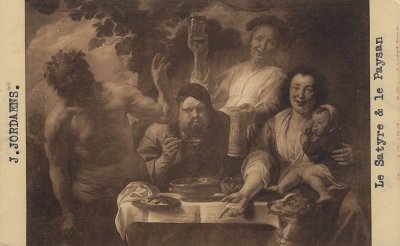
1910? Black-and-white photographic postcard of (Jacob) Jordaens’ “The Satyr and the Peasant.” Brussels Museum. Union Postale Universelle. $6 from Bertrand Cocq, Calonne-Ricouart, France, Sept., ’20.
Compare this card with a similar card below, perhaps a few years later. Does it help the image here to have it set in the upper left with a blank column at the right and a ribbon for print below? Black-and-white representations of paintings seem to us in retrospect, I believe, to be so unfair to what a painting is! We can be grateful that technology came up with colored representations!
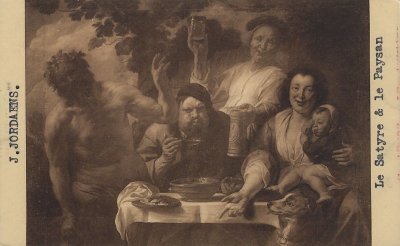
1905? Black-and-white photographic postcard of J(acob) Jordaens’ “The Satyr and the Peasant.” Brussels Museum. “123 LL.” $6 from Bertrand Cocq, Calonne-Ricouart, France, Sept., ’20.
Compare this card with a similar card below, perhaps a few years earlier. Strangely, the typeface elements at a 90 degree angle from the image seem to be typewritten! Black-and-white representations of paintings seem to us in retrospect, I believe, to be so unfair to what a painting is! We can be grateful that technology came up with colored representations!
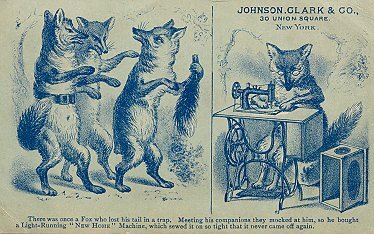
1885? One monochrome card advertising Johnson, Clark & Co. sewing machines with FWT. Two scenes, blank back, text underneath. Three copies, between $7.50 and $12.50, the last from Jeff Carr, Oakland, Spring, '97.
Each of the three cards is done in a different color. The red-ink copy adds "Leavitt & Brant" in Boston. The text (including a dangling participle) confirms the unusual approach to the story: "There was once a Fox who lost his tail in a trap. Meeting his companions they mocked at him, so he bought a Light-Running 'New Home' Machine, which sewed it on so tight that it never came off again." The second scene seems to have the tail already firmly in place while the bespectacled fox now works on a different task at the machine! The other copies are brown and blue. While these cards are not actually a series, they are too much fun together to miss!
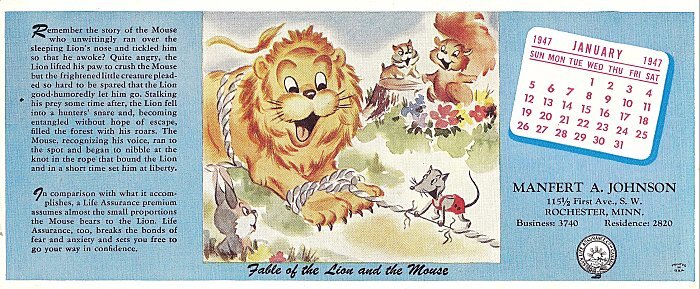
1947 Aesop's Fables. Twelve blotters 9" x 3 ¾" combining text, picture, and a monthly calendar. The blotters advertise insurance from Manfert A. Johnson in Rochester. Printed in the USA. $6.99 from Ronald Krause, Rochester, MN, through eBay, April, '04.
The text in each case has two parts. The first part recounts the particular fable pictured for this month. The second part turns the point somehow to insurance. The central panel naming and illustrating a fable is good, simple, lively full-color work. These "references" may hit a low point when, in November's blotter-calendar, the "Fable of the One-Eyed Doe" is applied to the "John Does" of fact, not fable. December offers not a fable but an account of Aesop surrounded by simple pictures of animals.
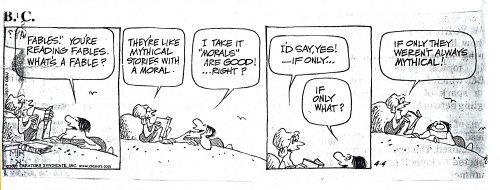
2002 B.C. Johnny Hart. Xerox copy of a four-panel cartoon strip on fables, morals, and “mythical.” Creators Syndicate. Unknown source.
This strip explains why careful critics of fables go crazy when people describe them as “you know, myths, fairy tales….”
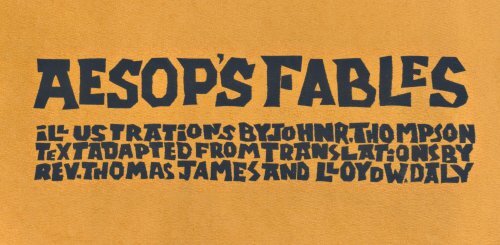
2000? Aesop's Fables. John R. Thompson Signed Artist Proof 10 Print Set with Folder. Linolcuts? $150 from indyfindings through Ebay, Dec., '24.
The seller called this portfolio rare. I am confirming his judgment, in that I cannot find another mention of it on the web. That is why I am unsure whether the excellent prints are linolcuts, woodcuts, or something else. They are dramatic and unusual. Part of their charm is that they write out the fable, whether in Lloyd Daly's or Thomas James' translation. I am delighted to bring this lovely group together with other fable treasures! Thompson died in 2011.
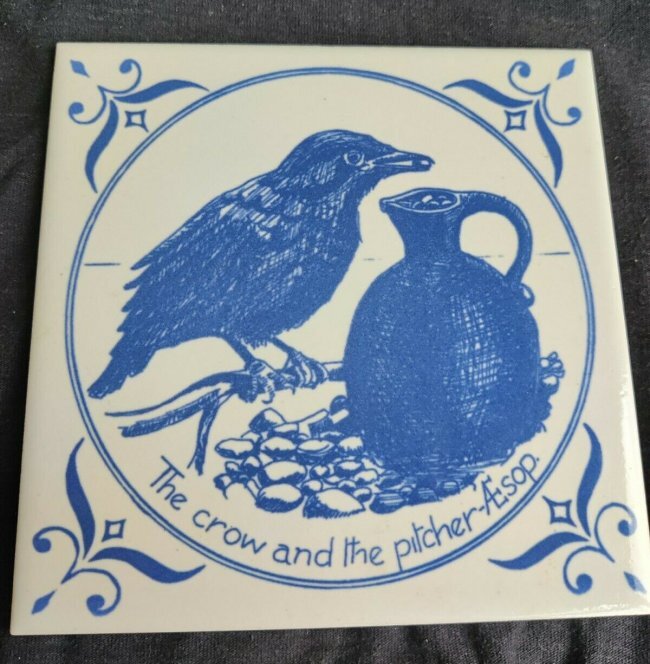
1980? Ten original decorated tiles by John Cutting of Withersdale Tiles. Harleston, Norfolk, England. 6"x 6". Drawings and decoration by Cutting. In the original individual boxes. £160 from mattbrightman1 through Ebay, Sept., '21.
"Produced in a small country workshop with the finest available material." Alas, "The Fox and the Woodcutter" got cracked in shipping. Lovely designs!
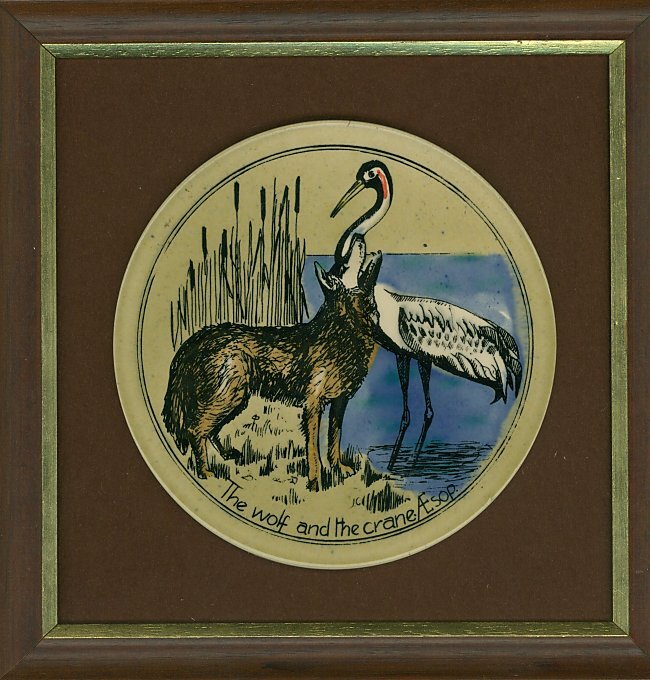
1950? Circular Withersdale Ceramic Tile of WC. John Cutting. Number 8 in a series of 12. With certificate of authenticity on the verso. Tile is 6" in diameter, frame 9.5". Unknown source and date of acquisition.
The pattern, here nicely colored, is exactly the same – down to the written title – as on the member of the 10 John Cutting Original Tiles already in the collection. Might the certificate of authority mark this as a special tile?
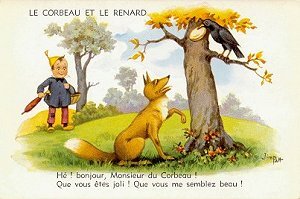
1940? Six different French postcards with colored picture on one side and room for a message and address on the other. Just over 3½" x 5½". The visual works are signed apparently by "Jim Patt." A line or two of La Fontaine appears under the picture of each card. Imprimé en France. Paris: M.D. $10 for OF at Foster City, Feb., '97. 40 Francs each for the similar two from Annick Tilly at the Clignancourt flea market, August, '99. 40 Francs for the presumably earlier version of MM with bold print from P. Bresch, Clignancourt, August, '01. €5 for TMCM from Dominique Chapelon, Yronde et Buron, at the Paris Post Card Exhibition, Jan., '05. €5 each for FS and TH at the Paris Post Card Exhibition, Jan., '05. Extra copy of TH for €4 from Akpool, Feb., '19. Extra copy of FC on thinner paper and without postcard formatting for €5 from Albert van den Bosch, Antwerp, June, '23.
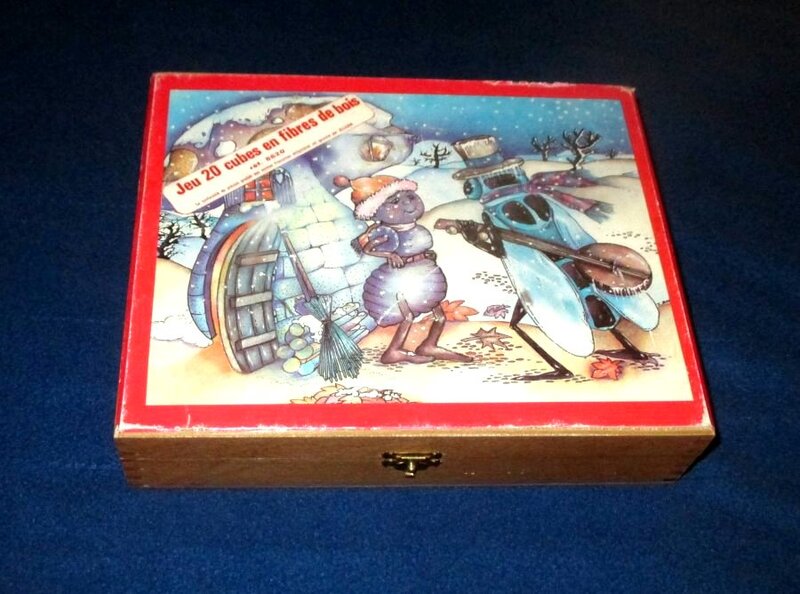
1950? Set of 20 six-sided picture cubes illustrating fables. Jeujura. Slightly larger than 1½" on each cube's side. TH; GA; WL; OF; MM; and FC. In the original box. €9.99 from ptitoys2008 through Ebay, June, '21.
Here is another lovely and well-used set of story blocks, complete with five complete pictures to work from. Jeujura is still making wooden toys today after something like a century of productivity. The artist cleverly works the chicken, pig, and cow into the picture for MM. I think the artist finds GA’s ant friendlier than La Fontaine does!
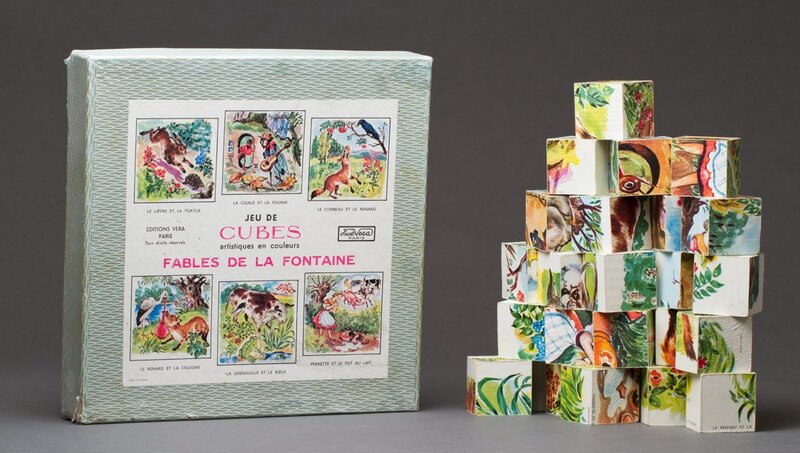
1981? Jeu de Cubes artistiques en couleurs: Fables de La Fontaine. Made in France. Paris: Jouets Vera: Éditions Vera. €40.50 from Alain Camus, Gerzat, France, through eBay, July, '04.
All the pictures here are 5 x 5. TH, GA, FC, FS, OF, MM. All six pictures are five cubes by five cubes. The six scenes are coordinated: get one and you have the key to getting them all. Each of the six completed scenes is pictured on the paper box cover.
I have found three sets of French cards, nearly identical. I will present the earlier two in writing and then in matching columns.
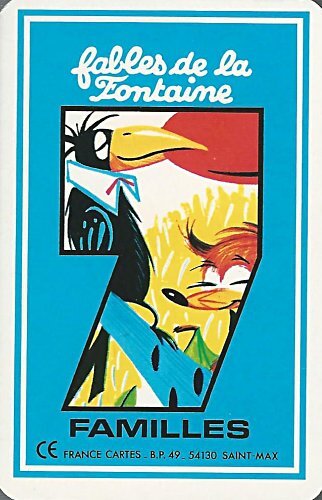
1990? "Sept Familles: Fables de La Fontaine." 42 cards featuring a backing, a number between 1 and 6, a fable title and image, and four to six lines from that fable by La Fontaine. Artist: J. Hodges. There are thus seven "families" of the six numbered cards for that fable. Cardboard-boxed. Made in France. Saint-Max: France Cartes. €9.50 from Laboutiquebeue through eBay, Feb., '06. One extra copy.
The cards trace each of the seven fables step by step: FC; FS; LM; "Le Chat et les deux Moineaux"; GA; TH. The presentations are very lively! Blue pattern on the cards' verso. There are two extra cards: a title card and a rules card. This set differs from the parallel set in having the blue verso and in having lighter colors and sketchier backgrounds.
1990? "Sept Familles: Fables de La Fontaine." 42 cards featuring a backing, a number between 1 and 6, a fable title and image, and four to six lines from that fable by La Fontaine. Artist: J. Hodges. There are thus seven "families" of the six numbered cards for that fable.
The cards trace each of the seven fables step by step: FC; FS; LM; "Le Chat et les deux Moineaux"; GA; TH. The presentations are very lively! This set differs from the parallel set in having a red-and-white bow-tie verso and heavier colors including a pink brick background on each card. There are no extra cards for rules or title. Instead, there is a cardboard organizer/label offering rules and advertising other cards. Plastic box.
2010? "Sept Familles: Fables de La Fontaine." 42 cards featuring a backing, a number between 1 and 6, a fable title and image, and four to six lines from that fable by La Fontaine. Artist: J. Hodges. There are thus seven "families" of the six numbered cards for that fable. Cardboard box. Bonux. €10 from pleant4755 through eBay, July, ‘21.
The cards’ faces are identical with the better colored version found earlier. New are the red back and the simple “Bonux” twice on each back. The package is now monochrome red with one face the same as the card back. Again, there are two extra cards: a title card and a rules card.
2010? "The Oak and The Reeds" inspired by the Aesop's Fable: reimagined Circus Themed Zine. Two-part paper construction by Jessie Wyrick. 3" x 4⅜". $10 from FleshBabies on Etsy, April, '23
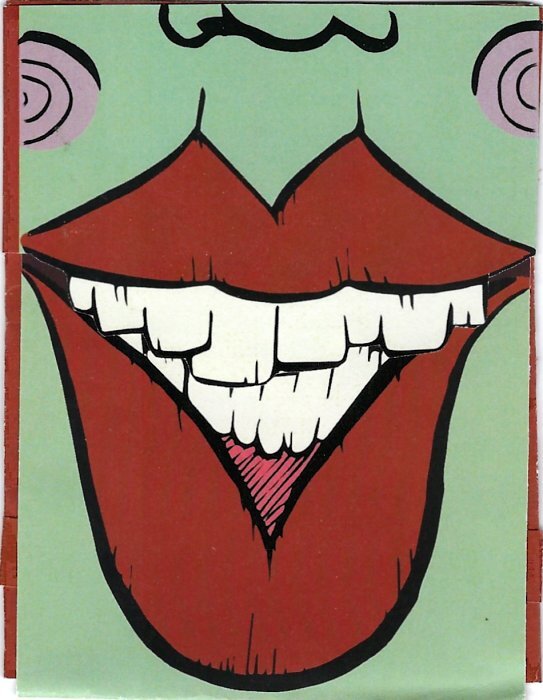
Now this is something unusual. There is first a jacket or envelope with an opening mouth that announces the title. The folded paper booklet inside this jacket goes through eight pages, one page always having a continuous design connection with the foregoing and following pages. I confess to having no idea how this is an illustration for OR! But I am happy to see Aesop celebrated. FleshBabies is Wyrick's own shop. His main construction work seems to be on fashion t-shirts. I offer below not only the sequenced pages but also the whole work as it appears before being folded into eight pages. Numbers mark the sequence in which they are to be seen.
1996? Jeep television advertisement using TH. 30 seconds. Gift of the advertising department at Jeep.
The tortoise takes a Jeep and crosses the line first. The producer of the spot advertisement assured me that no animal was harmed in the filming of this advertisement. I think she first read me on the phone as an activist against what she had done. When she found out I was only a harmless collector, she was happy to send me a copy of the advertisement. I will keep this entry also under "Advertising."
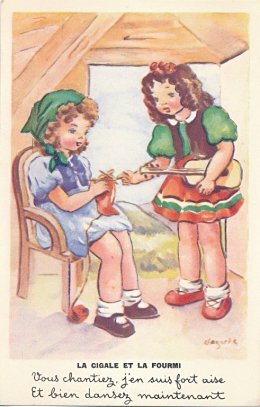
1950? Eight colored painted postcards (out of a set of ?) signed by Jeanne Lagarde and presenting children in situations recalling La Fontaine's fables. Paris: Editions Superluxe. Printed in France. $40 from Bertrand Cocq, Calonne Ricouart, France, Sept., '18. Extra copy of FC for €6 from Dominique Chapelon, Yronde et Buron, at the Paris Post Card Exhibition, Jan., '05.
The approach of these cards is uniform and, to me, unsatisfying. The children seem presented to remind one of the fable situation, not to play it out in their own world. Perhaps the foxy boy has talked the dreamy girl on a limb of a tree out of her cheese or bread; this card may come the closest to playing out the fable in the world of these children. How, however, are the boy and girl at the stream wolf and lamb? Is the girl with the potted plant teaching the boy with the shovel to love working the land? How are the characters in TMCM, one from city and one from country, playing out the fable's story? TH labors to put a house on the back of one racer and to give ears to the racer behind her. The French know their fables so well, I suppose, that they are happy to see them represented by children, even if the fable is minimally involved.
I have found two sets of Jean Vernon medallions, 2½" and 1½" in diameter.
For the 2½" medallions, two sources have been John Wiersma in Holland in Sept., '03, and Frances Trachtenberg, Massapequa Park, NY, March, '04.
The workmanship on these medallions is outstanding! The Wiersma medallions have notifications on the verso: "Crepsa - 1950 - I: Dr. M. Van de Wyer"; "Crepsa - 1952 - 2 C. Tr. - I: Le Dr. M. Van de Wyer"; and "Crepsa - 1952 - C.D. Tr. Eprs - I: Le Dr. M. Van de Wyer." Otherwise the verso tends to be blank. From what I gather on the web, our collection is missing only FG in the 2½" medallions.
1950? Five bronze medallions depicting fables of La Fontaine. Artist: Jean Vernon. Nothing on the verso.
These smaller medallions are in exactly the same style as the 2½" variety. The fiveI have are FC, FG, FS, GA, and WL. FG has something other than the title of the fable and the artist's name: "Ils sont trop verts et bons pour les goujats." Similarly, WL has the opening lines of its fable, and GA the closing line of its. The workmanship is excellent. I continue to pursue the question of whether some medallions were cast only in the smaller format and others only in the larger--or whether there were two complete sets, and how large they were. Are there more out there? I will give the "La Fontaine" medallion its own row, to show both faces.
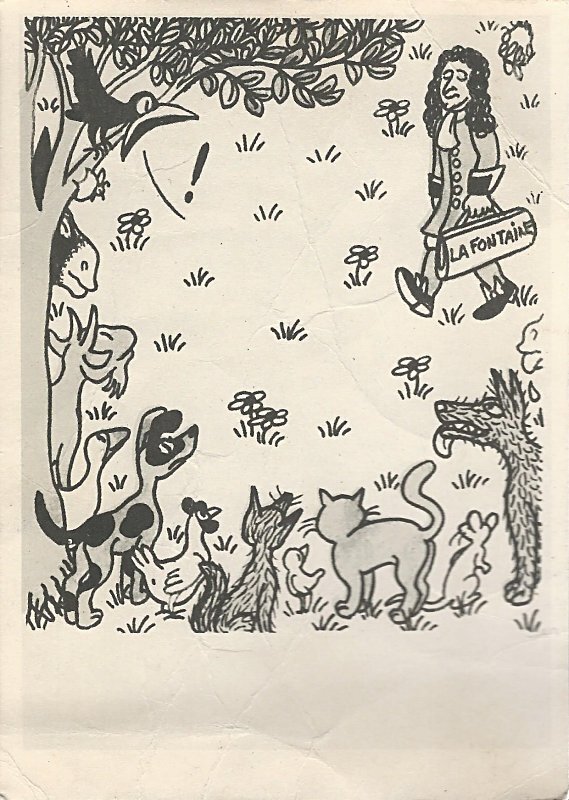
1962 "La Fontaine." Jean Effel. Russian. Unknown source and date.
I have enjoyed Jean Effel's art and am happy now to find a postcard in the same style. La Fontaine walks gingerly toward a tree where lots of animals are waiting for him. The most explicit is a crow who caws out an exclamation mark. To find out what text should go with this cartoon, go to a book Effel published in 1973 here.