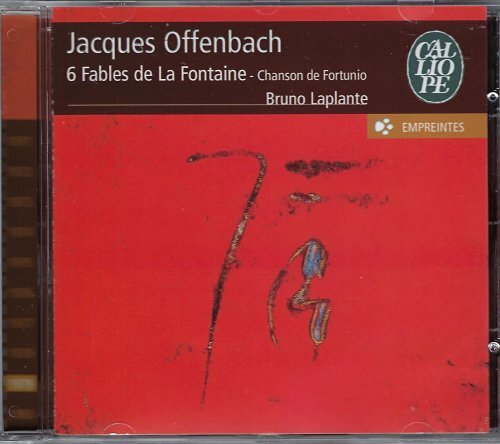
2004 Jacques Offenbach: 6 Fables de La Fontaine; Chanson de Fortunio. Musical CD. Bruno Laplante, baritone. Marc Durand, pianist. Made in France. Calliope 4881. First recorded by Arpège in 1979.
This is the first time, I believe, that I have sat and listened to these renderings. They are delightful. The music moves wonderfully in coordination with the text of La Fontaine. The silent moment, for example, in "Shepherd and Sea" comes at the time when the former flock owner has lost everything at sea and must return now to be a hired shepherd. The contrast in voices in "Cobbler and Financier" is also engaging. Likewise, the choice of phrases to be repeated supports well what is going on in the text. Besides the title pieces, there are five other offerings on this 50-minute disc. Winner of the award "Grand Prix du Disque."
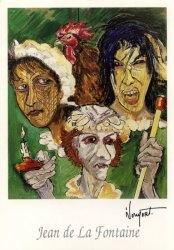
2012? Jean de La Fontaine. Twelve portrait format postcards by Souchez, France artist Jacques Nongort. €3 each at St. Ouen, August, '13.
This is some of the strongest visual work I have seen in a long time. Nongort brings out the scary underside, I believe, of several of La Fontaine's fables. His "La Cigale et la Fourmi," for example -- which appears on what seems to be his own website -- shows a dancing woman in the foreground while a burdened worker walks off into the background. Would a viewer of this card, without seeing its title, immediately associate it with the fable? Again, Nongort's "The Cat Transformed into a Woman," accents her sexuality but gives her a sinister black catface with yellow eyes. Stirring stuff! I am so glad to have found these and sorry that I cannot find out more about the artist or the series.
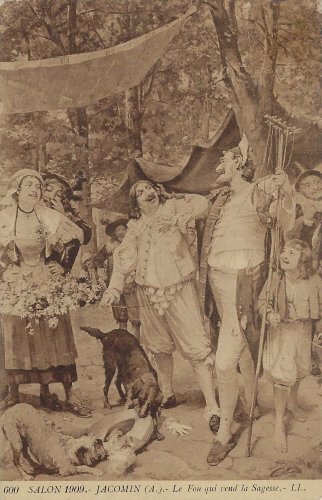
1909? One photographic postcard presenting “The Fool Who Sells Wisdom.” “600 SALON 1909. JACOMIN (A.) -- Le Fou qui vend la sagesse.- LL.” $8 from Bertrand Cocq, Calonne-Ricouart, France, Sept., ‘’20.
A closer look shows that the artist catches the story at the very moment where the “fool” is giving the buyer a box on the ear. The “fool” also has strings that are part of his marketing. I have yet to understand the significance of the dogs is in the foreground; in fact, I am not even sure what they are doing. Alfred Jacomin lived from 1842 to 1913. Christie’s and Mark Murray have offered paintings by Jacomin for sale. There are also listings of his work on MutualArt. Google offers a number of his works, not including this painting.
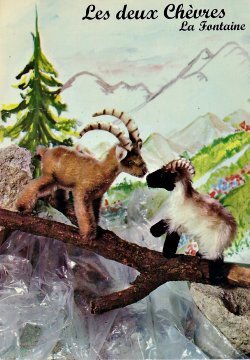
1970? Fables de La Fontaine. Eight cards of La Fontaine's fables with photographed scenes of plush animals and dolls. Numbered among a set of 114. Studio J.M. Piettre. Imprimé en France.
The photographs show Steiff-like stuffed animals and dolls engaged in the scene. All three Crucy cards contain messages from Gentilly (one is dated in 1975) written in the same hand and signed with the same name (Camard?). For me the effort to be cute costs these scenes heavily. Perhaps the most intriguing shows the two mice of TMCM dealing with wine and sausage.
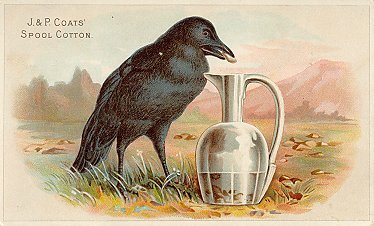
1885? 8 colored cards (apparently from a series of 8) used for J. & P. Coats Spool Cotton (unnumbered, with advertising and the fable text in various formats on the back), McPhail Pianos (each marked with the same simple number "32" and only the fable text on the back), Emerson Pianos, Eureka-Maryland Assurance and other advertisers (with various numbers introduced by "No."). Some also appear blank. 3" x 5". Multiple copies of each card, and reverses of three, as seen below.
There is an advertising booklet for Wright's Indian Vegetable Pill Company that uses seven of these eight fables and their illustrations, excluding only CP. Curiously, I purchased a set of seven "J.P. Coats" cards from Sherry Sonnett, Los Angeles, in May, '11, and CP is again the one missing card.
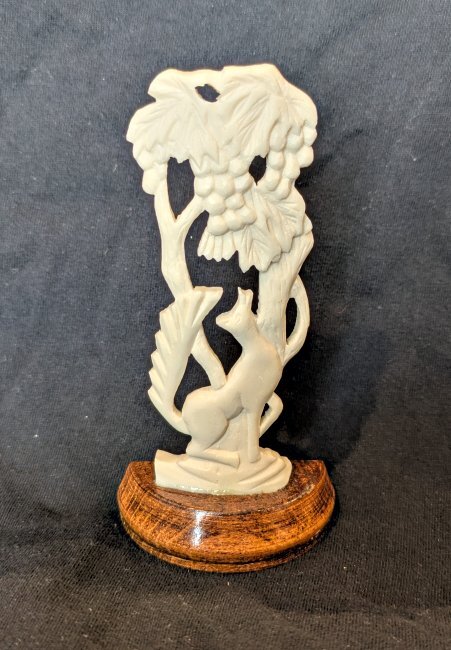
1970? Bas-relief of FG carved from bone. Albania. Modeli 8. Scene 3.5” high. Whole piece 4” high. Unknown source.
Was this someone’s souvenir from some foreign travel? The cut marks on the back suggest that the material was chiseled rather than poured. The Albania label is surprising. The scene itself shows fine work, especially in dealing with the grapes, leaves, and vines. A quick search on the web reveals many similar carvings.
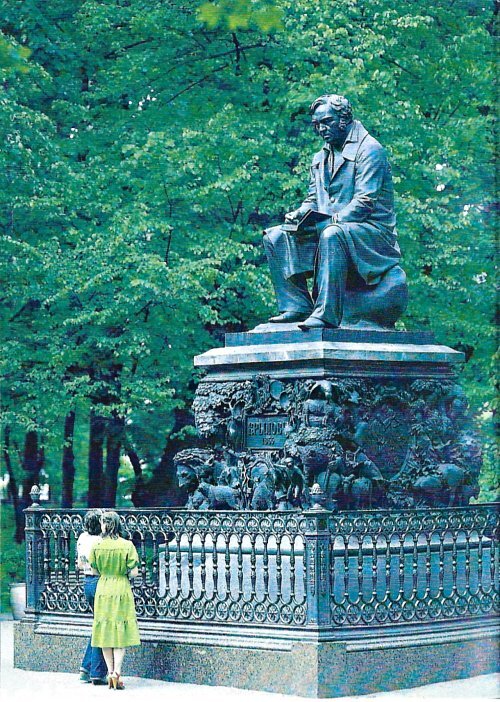
1996? Photo of the Ivan Krylov memorial in the Summer Garden, St. Petersburg. 4” x 5.7”.
This is an impressive monument and I have wanted to visit it and St. Petersburg generally. I came close in Scandinavia but could not fit in the ferry trip to spend a day there. This photograph is on paper lighter than we would use for a photo.
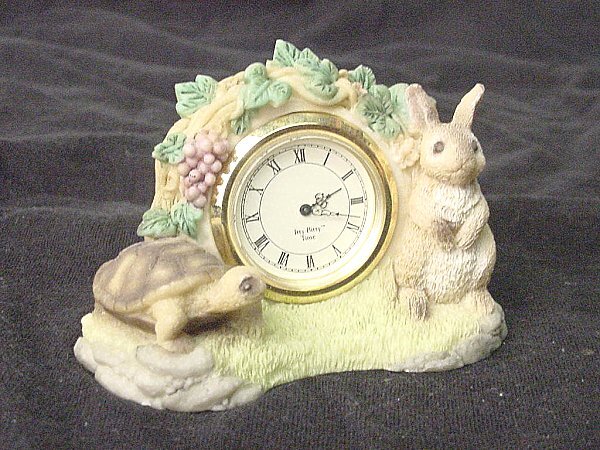
1992 Itty-Bitty TH time clock. 3½" wide and 2½" high. Battery operated. United Design Corp.
The tortoise and the hare flank the face of the timepiece. One battery seems to last a very long time.
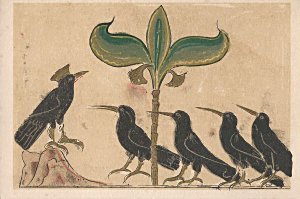
1940? Les Arts de l'Iran l'Ancienne Perse & Bagdad: 8 reproductions en couleurs de miniatures décorant les principaux manuscrits iraniens du Département des Manuscrits de la Bibliothèque Nationale. Seven postcards, hand-painted in pastels and gold with folder cover, copies of work of the Bagdad school of the thirteenth and fourteenth centuries--and an extra cover and three postcards from other Persian collections. $9.99 from David Curtiss at Old Not Sold, Sheffield, MA, through Ebay, April, '99.
1986 Into Books: Literature Pack No. 1: Brian Wildsmith's Fables. Melbourne: Oxford. AU $15 from Babyboomerbooks, Mount Gambier, Australia, through eBay, Feb., '09.
Here is a boxed literature unit meant to structure five sessions with pupils. A cover sheet details the contents, including five paperbound Wildsmith fables all contained elsewhere in the collection; a teacher's manual by Andrew Perry and Ron Thomas; two posters; a "Hare and Tortoise" board game; and reproducible bookmarks. Some teacher has also xeroxed copies of some of this material. The fables involved are: The Miller, the Boy, and the Donkey (1969/86); The North Wind and the Sun (1964/86); The Lion and the Rat (1963/86); The Rich Man and the Shoemaker (1965/86); and The Hare and the Tortoise (1982/86). Notice that all were reprinted in the year in which this pack was put together. I have all four elswhere in paperback versions; I have only a hardbound copy of The Rich Man and the Shoemaker. I will crosslist that paperback, as well as the teacher's manual but will keep all these materials together. One poster reproduces the cover of the box and the teacher's manual; the other is unrelated to fables. The six bookmarks offer different black-and-white scenes from TH. A lovely find!
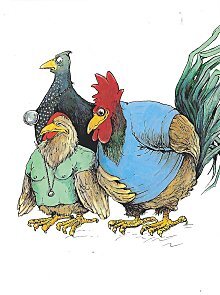
1990 Set of six cards folded over with empty insides, representing humorous views of La Fontaine’s fables. Rolf Köhler. About 4” x 5¾”. La Fontaine’s text is on the final side of each card. Die Schöne Insel-Karte. $5.52 from Buchmarie through ZVAB, Feb., ’25.
Delightful parodies of the fables. The mouse facing the netted lion has workman’s clothes and a pliers in his hand. The fox waits for the crow’s cheese to fall into his baseball cap. Not the grasshopper but the ant appears shivering with a guitar in hand. The frog sees the ox pictured on the side of a truck, while the real ox looks out the back of the truck. The old lion is a tennis player having his tail stepped on by a younger ass. The cock views a small pearl hanging from a young chicken’s breast while an old chicken with large pearl looks on with suspicion.
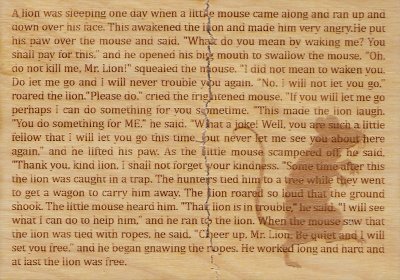
2018 Engraved wooden postcard. TMCM. Baltic Birch and natural hard wax. $9.23 from the maker, Induku, Tierp, Sweden, through Etsy, August, '18.
Now here is something I have never seen before! Unfortunately, the first exemplar sent to me arrived broken in half. I wrote and asked for a replacement, which came intact. Etsy vendors and creators tend to be very personal. As artists, they are rightly proud of what they create, and this postcard is a great example. I am delighted with the second postcard. Ronnie at Induku wrote that he "cut the card at a 5 degree angle so that the long sides do not line up with an of the grain structure." Well done!
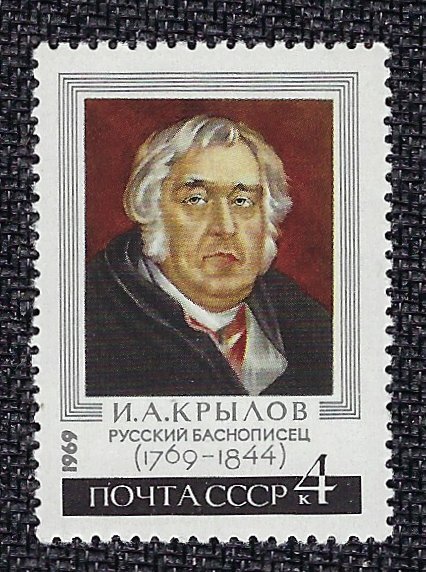
1969 Individual Russian stamp of Ivan Krylov commemorating his birth in 1769. 4 rubles. From James Reinhold, Palm Springs, CA, through eBay, Jan, '11.
Mint condition, beautiful coloring.
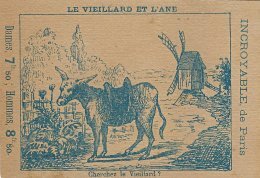
1890? Two monochrome hidden-picture trade cards advertising "Incroyable de Paris" stitched shoes for women and men. 4⅜ x 3". Paris: Imp. F. Hermet. $14 from Bertrand Cocq, Calonne Ricouart, France, Sept., '18.
TH and "The Old Man and the Ass." I think I have found the hidden picture in these; click on the separate link-opener to see it resolved. At first I thought these were most likely stock trade cards, but reflection on the fact that the advertisement takes the complete verso and two parts of the front of either card, I decided that they more a particular creation of Incroyable de Paris. Incroyable offers very inexpensive stitched shoes. Might these contrast with wooden shoes?