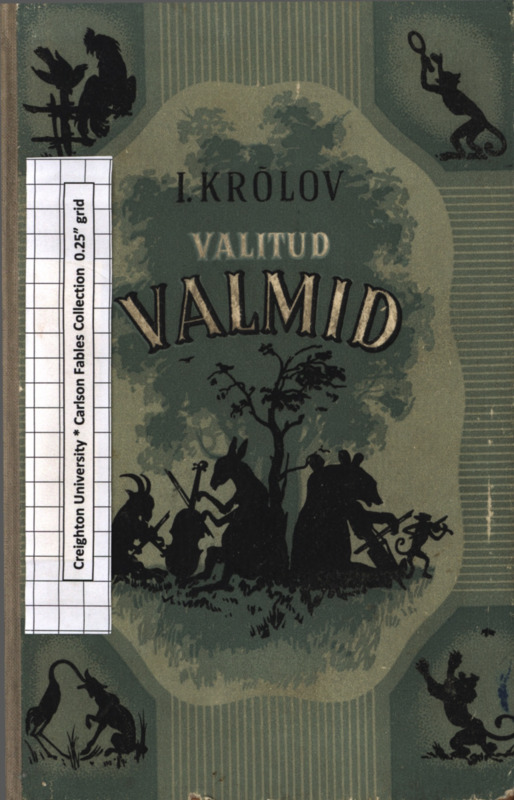
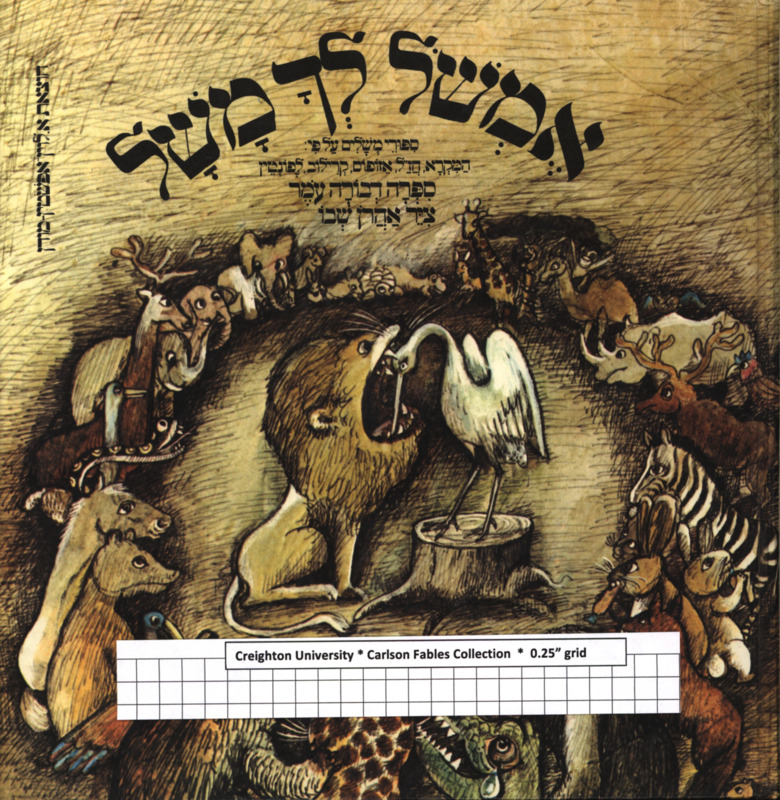
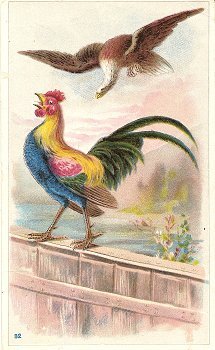
1885? 8 colored cards (apparently from a series of 8) used for Huntington Pianos with factories in Shelton, CT. "32" in the lower left of each card's picture.
Individual cards may be identical with those from a set for McPhail Pianos. They share the "32" on the front of each card. They also seem to share the unusual characteristic of having only the fable text and the company name and place on the verso of each card. They seem otherwise to be the same as the various cards I have listed under J.P. Coats. The set includes:
The Swan and the Cook
The Fighting Cocks and the Eagle
CP
FC
GGE
LM
OF
TH
Unfortunately, none of them presents a new mirror-opposite of the cards I already have. For those see the page presenting the whole set under the name Coats.
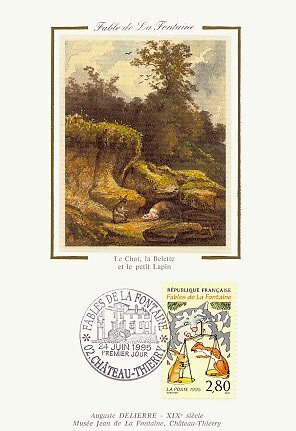
1995 Maxi-postcard depicting FC in highly humorous fashion. Monique Touvay, "Les Quatre Zéphires." Cancelled at Chateau-Thierry at noon on June 24, 1995. $4 from Topical Paradise, Ltd., August, '14.
The delight the French took in their set of 1995 La Fontaine stamps seems unlimited. I thought I had collected all the forms this issue took, but here is something new and delightful. The fox here holds out a hand to catch the round cheese as it falls. The last image has the fox sitting in his striped pants with both hands upraised in a gesture of frustration. This single card also raises the question of whether it is part of a series….
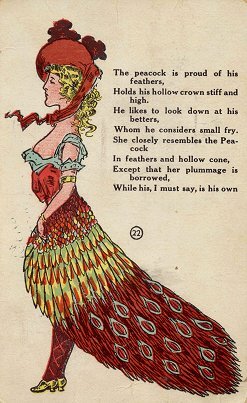
1908? Human peacock. $6 from Frank Sternad at the Sacramento Paper Fair, Dec., '96.
This card is from a series of which I saw some of the other members. It has "22" on it. Along with the multi-colored image of a woman who wears an outlandish skirt made of peacock feathers, there are eight lines of verse. The last four: "She closely resembles the Peacock/In feathers and hollow cone,/Except that her plummage is borrowed,/While his, I must say, is his own." (Did "plumage" have a double-m back then?) What we thus have is at least a lovely allusion to BF. The back has an address and a two-cent stamp. It was postmarked in 1908.
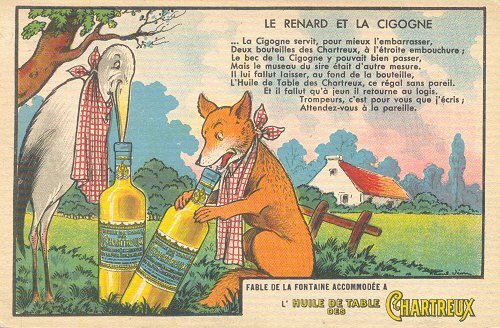
1920? Postcard presenting FS. "Fable de la Fontaine accommodée a l'Huile de Table des Chartreux." Artist Raoul Vion. €10 at Paris Post Card Exhibition, Jan., '05.
This very colorful card seems to be roughly in the style of Benjamin Rabier. The colors help to draw attention to the lovely gold of the bottled oil. The advertisement substitutes bottles for the tall vases of the fable. In a small victory for modern technology, I was able to go out and find a Raoul Vion poster on the web. The date of the poster exactly matched the date I had guessed for this postcard! The back, fully filled out in a difficult hand, adds "Inutile de vous dire qu'il n'est pas de bonne cuisine sans Huile de Table des Chartreux."
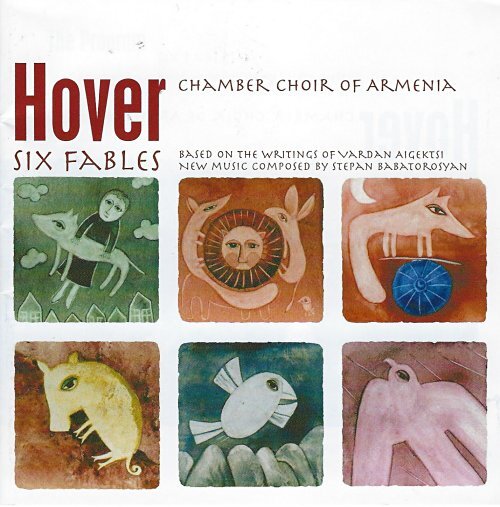
2003 Hover: Six Fables. Chamber Choir of Armenia. Based on the writings of Vardan Aigetski. New music composed by Stepan Babatorosyan. Cambridge, MA: Pomegranate Music.
This is lovely contemporary orchestral and vocal music. Beautifully, professionally executed. Of course it is all in Armenian! Three of these six fables are Aesopic in one way or another, although my sense from the texts offered here in English in the accompanying booklet is that they are more morality tales than fables. "The Eagle and the Arrow" is straight from Aesop. "The Ailing Lion and the Fox" is also straight from Aesop, though in this "Eastern" version it is a donkey's ears and heart that are in question. In Western Europe, at issue was a deer's heart that the fox eats and then tells the lion that the deer had none. In a switch from a different fable, the lion was told that he needed these things to cure his disease. The young camels and donkeys ask their mothers why they have to work for food but the pigs do not. The mothers answer that patience brings understanding. The understanding comes on slaughter day for the pigs! Aesop survives in a lot of ways in a lot of places!
1995 Set of six FDC postcards featuring a first-day postmark, one (or on the first card, three) of the La Fontaine fable stamps issued on June 24, 1995, and a hologram-like reproduction of art, especially by Auguste Delierre. FDC: Paris: Carte Philatélique. $29.50 for the set of six from Alexandre Przopiorski, Lyon, France, April, '99.
"Le Chat, la Belette et le petit Lapin," FC, TH, and WL all feature work of Delierre in a strangely irridescent medium. The illustrations for OF and GA are attributed to "Imagerie de Paris," identified as from the 19th century. The illustration for GA is perhaps the most unusual, with its red mountain and a serpent that is not mentioned in any version of the fable of which I am aware. The illustration for FC is, for my money, a piece of excellent work. Is the monkey often, as here, the judge of the race in TH?
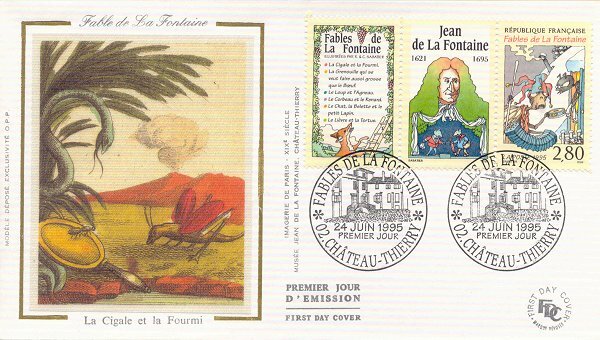
1995 Six (out of six?) FDC envelopes featuring a first-day postmark, one (or on the GA envelope, three) of the La Fontaine fable stamps issued on June 24, 1995, and a hologram-like reproduction of art, especially by Auguste Delierre. FDC: Chateau-Thierry. Set of six for $15 from Loic-in-France through eBay, June, '05. Extras of "Le Chat, la Belette et le petit Lapin," GA, OR, and WL for $9.55 from Gilles Descary, St-Jean-sur-Richelieu, Canada, through eBay, April, '04.
The illustrations on these envelopes are the same as those on the set of "hologram" postcards I catalogued earlier. Thus "Le Chat, la Belette et le petit Lapin," FC, TH, and WL feature work of Delierre in a strangely irridescent medium, while the illustrations for OR and GA, using the same medium, are attributed to "Imagerie de Paris" identified as from the 19th century. The illustration for GA is perhaps the most unusual, with its red mountain and a serpent that is not mentioned in any version of the fable of which I am aware. The verso of each envelope contains three elements: a short quotation from the fable, the first six lines from La Fontaine's verse preface to the fables on their purpose, and an identifying number after "1995/": GA has 39, OF 40, WL 41, FC 42, "Le Chat, la Belette et le petit Lapin" 43, and TH 44. It took just over a year to find the last two in the series after I had found the first four. It took three and a half years to catalogue those last two!
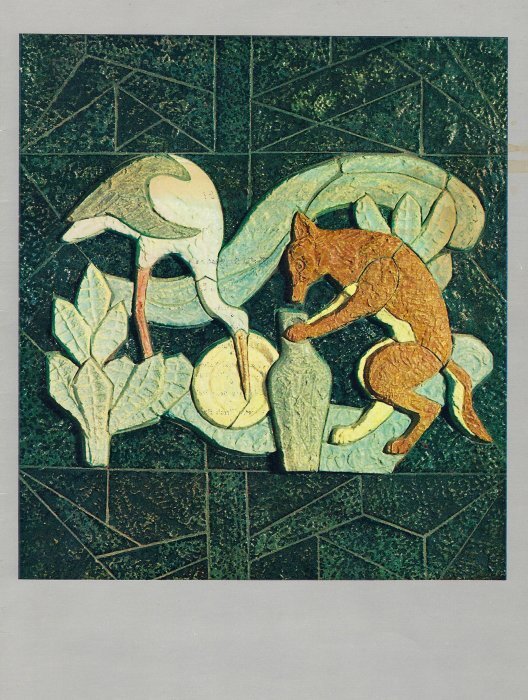
1967 Holland-America Line Menu. Monday, July 17, 1967. S.S. Statendam. Detail of the Ceramic Frieze Picturing Scenes from the Fables of La Fontaine. Nico Nagler. Delft: De Porceleyne Fles. La Fontaine Dining Room of S.S. "Rotterdam." Printed by Jan Lavics, Holland. $9.25 from Tilly's Treasure Chest through Ebay, Jan., '16.
This strongly pictured fable scene makes me wonder what other scenes might have been in the "La Fontaine Dining Room" of the Rotterdam. Some researching online revealed that the Rotterdam still exists as a hotel.
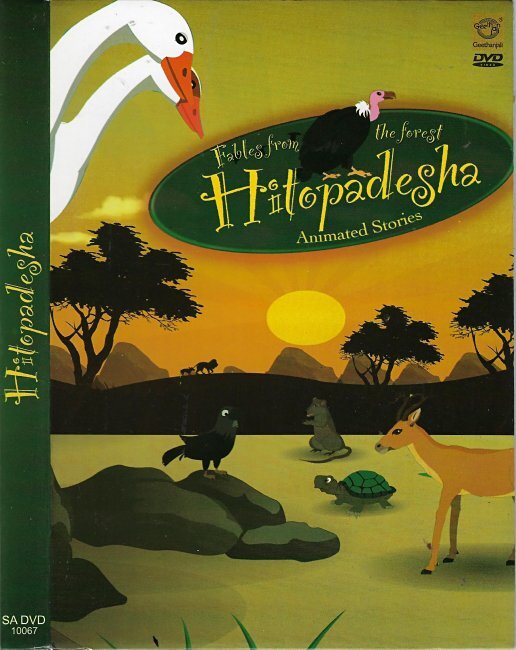
2008 Hitopadesha: Animated Stories: Fables from the forest. DVD. 60 minutes. 8 fables. Super Audio (Madras). Unknown source.
This DVD is done by the same firm that did the DVD "Aesop's Fables: Animated Moral Stories" in the same year. Here are eight stories listed on the jacket and jewel-box. Again, there is rudimentary animation. Particularly with actions like speaking, the animation here seems primitive by comparison with what one sees, for example, in the late "Silly Symphonies." I enjoyed four stories here. "A Friend in Need" picks up the key episode in the cycle of stories of four friends, the liberation of the turtle caught in a net. "The Clever Idea" comes from the fox and saves two crows, who had twice lost their eggs to a serpent. The animator here has particular fun with the snake's movement. In "The Talkative Tortoise," the tortoise himself, not identified as particularly talkative, comes up with the idea. He dies when he responds to people's question "Does he think he can fly?" In "The Lion, the Fox, and the Ass," the fox brings the ass to the old lion twice and eats his ears and his brain as a way of claiming the reward for his part in the capture. He outwits the lion, as he outwitted the ass by promising an eager bride. Good musical background and good, varied voices.
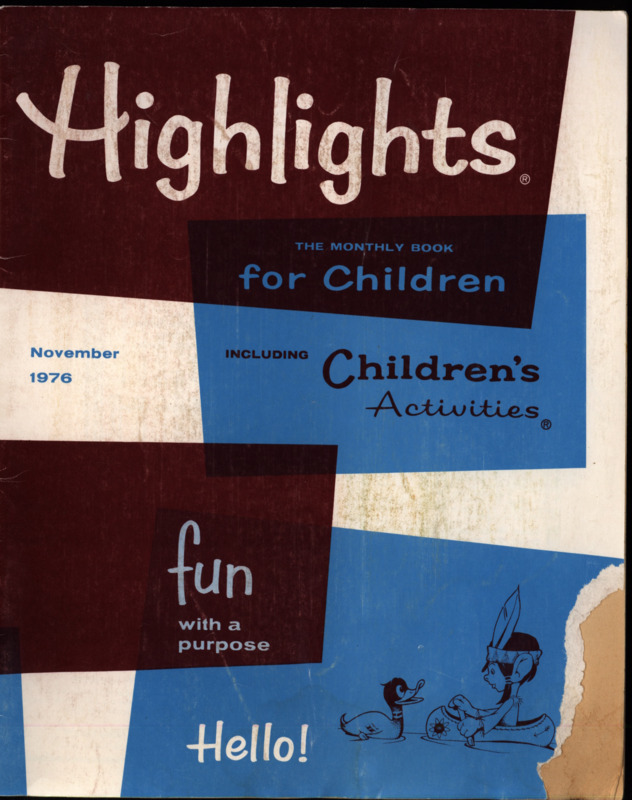
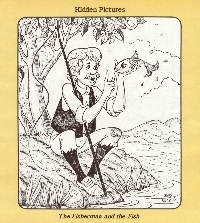
1987 Hidden Pictures Series 2. Highlights for Children, Columbus. A reusable screen-folder encloses sixteen two-sided pictures, with hidden images contained in them. Among the pictures are "The Fisherman and His Fish," FC, MM, and "The Big Race" (with other contestants besides the tortoise and the hare). These pen-and-ink drawings are by various artists.
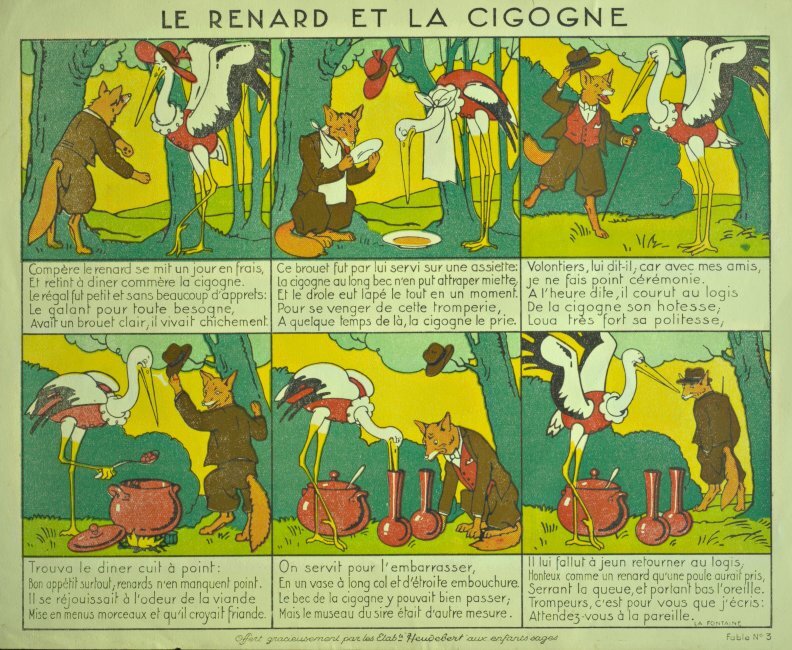
1935? Three advertising handbills for Heudebert products “Pour avoir de beaux enfants.” Numbered 1, 3, and 4. 11.5" x 8.75". €10 each from a bouquinist, Paris, June, ’25.
Very attractive colored work of 4 to 6 panels carries through the fables. The fourth panel of FS has the fox walking by the work at work on a big pot of food. He leaves his hat on a branch but then, in Panel 5, he is served a tall vase. In the sixth panel he walks away with his hate on his head. Perrette’s daydreams in MM of chasing a fox away from the chickens she has acquired. Then she will buy a big and jump for joy over her acquisition. Not a smart jump! “The Laborer and His Children” carries its message well in just four panels. The last panel has the three sons looking at a tall harvest. Heudebert seems to have offered a wide variety of products. The verso of each handbill here specifies products from normal flour, from refreshing flour, and from anti-diarrheal flour.
1960? Three fable postcards signed by (Henry) Morin. TT, FG, and WL. $6 each from Bertrand Cocq, Calonne-Ricouart, France, Sept., '20.
Morin published his great book of fables around 1904, and these scenes are presumably taken from there. WL, certainly is, with the white rectangle here used for a title there used for the text of the fable. The double scene of TT is lovely, as is the facial expression of the fox in FG. One wonders how many there might be in this set…. An added lovely feature of these three cards is that an eager sender scribbled a long message extending across all three cards and a first card before these three. And the set was never sent through the mail. There are lots of capitals and exclamation points!
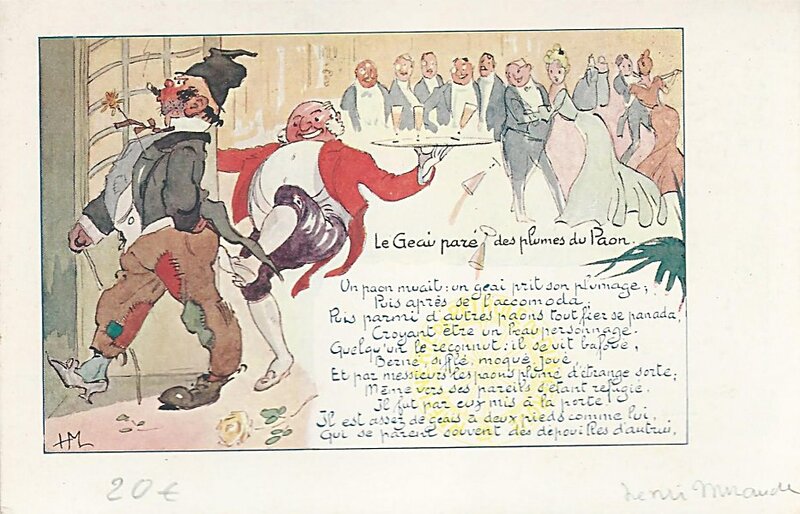
1935? Jean de La Fontaine. Nine landscape format postcards by Henri Mirande. "Etendard" Petrole and "Touriste" Essence Spéciale. E. D. Paris. €8 each from Dominique Delage, St. Ouen, August, '13. Then eight cards from the same series but as "Edition de Montre Zenith," including both LM and "Le Milan et le Rossignol." A last card picture "The Little Fish and the Angler" for $7 from Bertrand Cocq, Calonne Ricouart, France, Sept., '18. Extra of that card for €5 from Simon Rodrigues, June, '22.
I am surprised that I have not before run into any members of this strong set of cards. Of the six listed in French Wikipédia, only "Le Milan et le Rossignol" is not included among these nine. Might it have been a set of ten? The artistry is strong on caricature, and the style might best be characterized as "cartoon." Each image makes room for the handwritten fable or important portions of it. Fables are visually transposed, where necessary, into human terms. Thus the tale of the two mules becomes that of the rich man robbed, while the poor man is untouched. A rich judge holds moneybags where the one contestant has empty pockets and the other wears a nightshirt. A policeman chases the shadow of the gunman who is behind him. A rustic man leaves the groaning table behind but, like the weasel, cannot exit by the door through which he entered. A dinner jacket is not enough to get a street person into a high-society party (BF). A paraplegic rolls on ahead of a wrecked car (TH). A child cannot reach the dried raisins on the shelf. Is that a doctor carting off all the possessions of the man sick in bed? These cards are highly enjoyable! Are they really advertisements for gasoline? Now, with the second set, I have eleven different cards and wonder how many may have been in the set originally. The back of the Zenith cards transforms the first lines of La Fontaine's FC and has a design of the crow holding a Zenith watch in his beak. The last card, bringing the total to twelve, may complete the set.
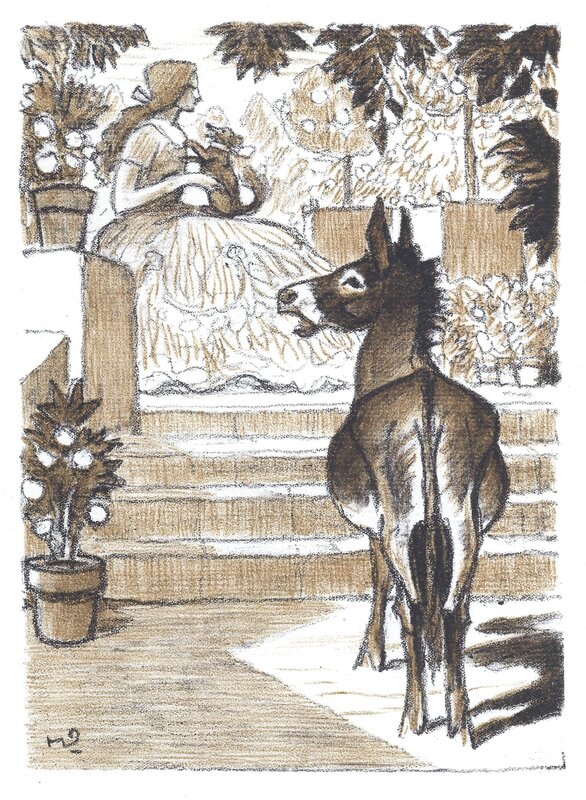
1944 Lithograph of La Fontaine fable “The Ass and Lapdog” by Henri Deluermoz.
This lithograph leapt out as I reviewed the set and compared them with the published version of the portfolio of Deluermoz’s lithographs. The work in this lithograph is finer than that in either the portfolio or the set of illustrations. Might it be the artist’s original conception? It differs, I believe, clearly from the final product. Notice, for example, the object – a ribbon perhaps? – at the back of the woman’s head. This lovely illustration is a surprise gift!