1944 84 lithographs of La Fontaine fable illustrations by Henri Deluermoz. €100 from librairie-raijepointcom through Ebay, July, ’25.
The seller writes “certainement des suites d'une édition de luxe.” That for me touches on the great question of this great acquisition. Is this a set of added “illustrations only”? Or perhaps a test printing for the artist or others? The tailpieces are correctly positioned for their place with relation to the texts. The lithographs are strong. By contrast with the published portfolio already in the collection, the images here are not accompanied by text or page numbers. They are printed on only one side. At what is page 56 in the portfolio, the images move from deft brown ink to much less deft black. Among the full-page illustrations, I appreciate “The Thieves and the Ass” (page 7 in the portfolio). The endpieces are particularly impressive, especially the exploding frog (6); the spider-web in the tree (16); SS (21); WL (24); “Fox and Goat” (38); the monkey adrift (45); and the tethered horse (52). What a terrific addition to our collection! Do not miss the apparently original drawing of "The Ass and the Lapdog" included in the portfolio. It is listed under "Paper" in "Original Art."
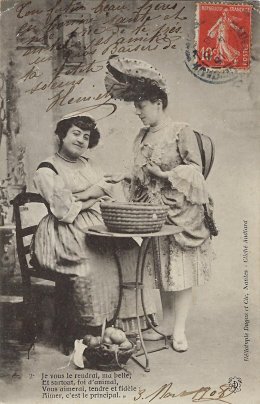
1908? Three numbered black-and-white photographic postcards (out of a series of ?) offering a milder version of GA. Cards 2-4. Nantes: Héliotypie Dugas et Cie. Cliché Audiard. $30 from Bertrand Cocq, Calonne Ricouart, France, Sept., '18.
The ant in this version seems much friendlier. She is sharing food from the start. On Card #3, she asks what the cicada did all summer. The cicada has a hat that is wonderfully outrageous! Her dress seems to depict her as living at a level beyond that of the peasant ant.
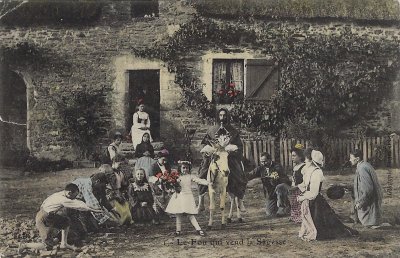
1910? 2 photographic postcards by “Héliotypie Dugas et Cie, Nantes.” “The Worker and His Children” and “The Fool Who Sells Wisdom.” $8 each from Bertrand Cocq, Calonne-Ricouart, France, Sept., ’21.
These cards present “folksy” attempts to portray the fables. The sons of the dying worker are rather advanced in years! A surprise on the “Fool” postcard is the slight coloring of many elements: red flowers, blue garments, pink skirts and headdresses. Were the colors, as I suspect, part of the original publication? If so, why are there not colors on the other card? The application of the fable to the scene is not entirely clear to me. Is the card picturing religious veneration? Is that a matter of a fool selling wisdom? The question is especially pertinent because, in the view of the fable’s wisdom figure, the fool is justified in selling the wisdom of people’s being convicted of foolishness. He is justified because people foolish enough to buy it and can learn from buying it. The verso of both cards is simple and identical.
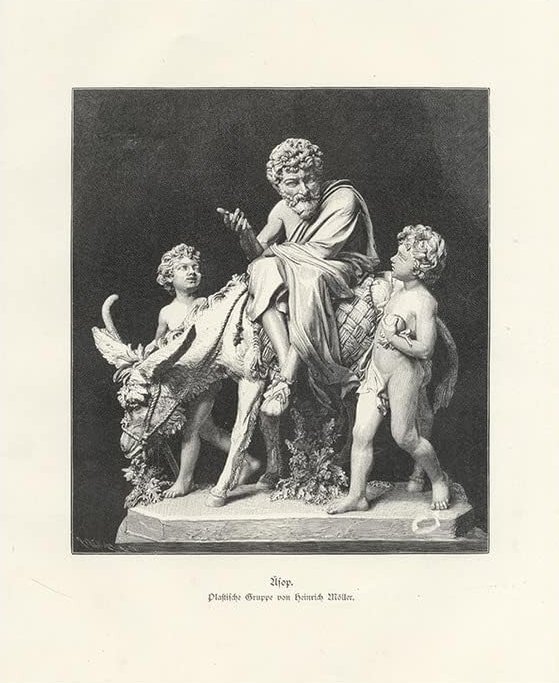
1910? Magazine excerpt featuring a line engraving of Heinrich Möller’s sculpture group of Aesop with two children. Unknown source.
Researching this piece has been fascinating. First of all the attribution here is highly misleading, since Heinrich Müller was a prominent Nazi, while Karl Heinrich Möller died in 1882 after producing this sculpture. Reproductions of this very engraving are available on the web. I feature one below the magazine excerpt.
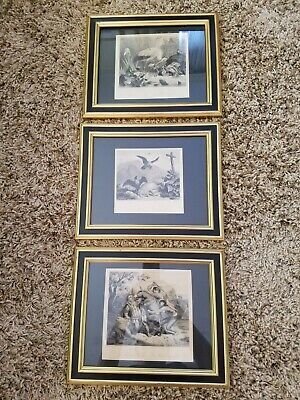
1880? Three framed Renard engravings by Henrich Leutemann. $40 from magnolia.boudoir through Ebay, March, '24.
Two of these three steel engravings are easy to identify and enjoy: FK and "The Ass and the Lapdog." The seller identifies the scenes as coming from La Fontaine. The third image puzzled me. It is identified as "Reynard and Merknau/Reineke und Meiknau." I could not identify who Merknau is until some searching through German sites brought me to "Merkenau" the talkative crow. This illustration faces page 200 in an edition of Reineke composed by Julius Eduard Hartmann and published by Payne in Leipzig. In Canto VII, Merkenau describes to King Noble how he and his wife came upon the apparently dead Reineke. Merkenau's wife came close to his snout to see if there were some sign of life. Reineke snapped off her head!
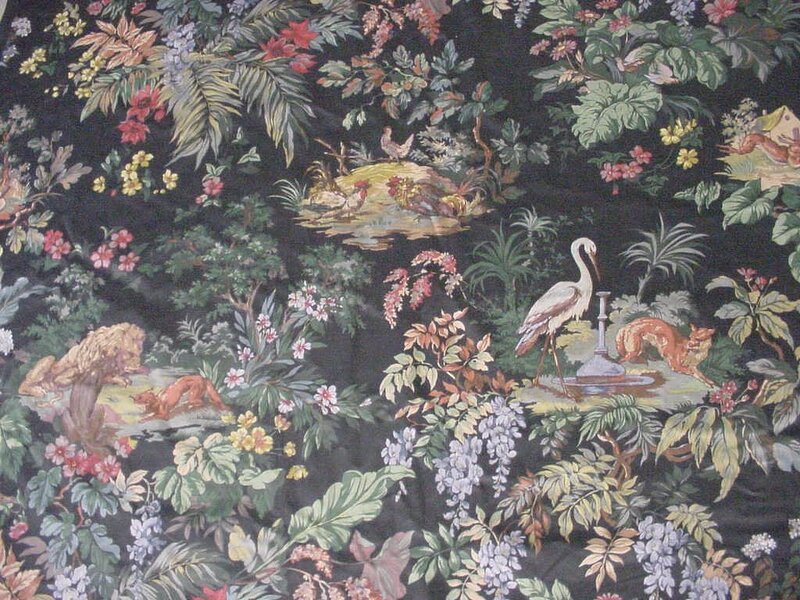
1960? Heavy cotton fabric with several fable scenes among whisteria. 9 yards x 17" x 56" wide.
Rennae is right: this is impressive fabric. The repeating scenes include FS, TH, "Two Cocks," and "The Lion, the Wolf, and the Fox." Click on the upper portion for an overview and on the lower portion for a detail of FS.
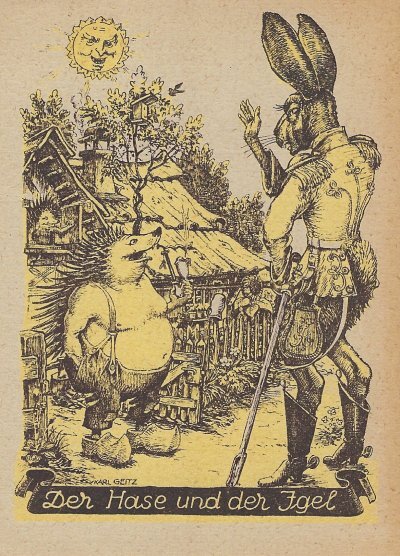
1930? One postcard featuring "Der Hase und der Igel." Karl Geitz. Kunstlerkarte. Betriebs-Nr. E 3756. Verlag: Karl Geitz, Bruchsal. €6 from Akpool, March '
The card features some gold, especially in the sun shining down on the two. The card is strong on contrast: the low class hedgehog in coveralls with bare top and big belly by contrast with the tall Prussian soldier in uniform. I have sometimes wondered whether this story is a fable at all, especially because of the phases it goes through. In the end, I am happy to accept it as a fable.
1998 Harmony Kingdom "Mutton Chops" WSC Box Figurine. Detachable top. Handmade in UK. Perhaps $30. Unknown source and date.
At first one may not notice the sheepskin tied onto the back of the wolf. Search on "Google Images" helped to identify this object.
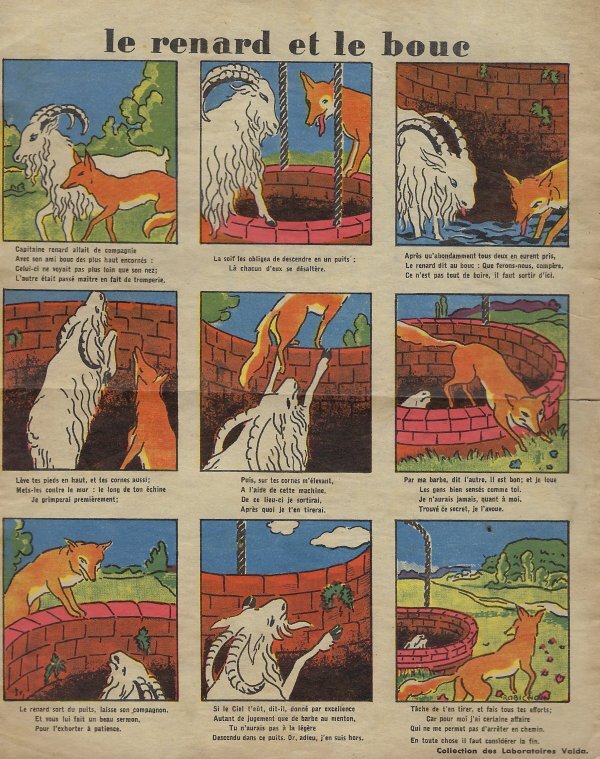
1950? Handbill with nine panels illustrating "The Fox and the Goat." Extensive advertising on verso. Laboratoires Valda. Signed "Robichon." 7⅜" x 9⅜". $5 from Bertrand Cocq, Calonne-Ricouart, France, Sept., '20.
Valda seems to be offering liquid, paste, and tablets, especially for ailments of the throat. The texts accompanying the nine panels are literally La Fontaine's version, but without acknowledgement. I find such presumption surprising! I notice that La Fontaine's version is different from many in this respect: the two jump in together."En toute chose il faut considérer la fin." The illustrations are heavy on red, brown, orange, and green. The narrow left margin shows some sloppy handling by the printer.
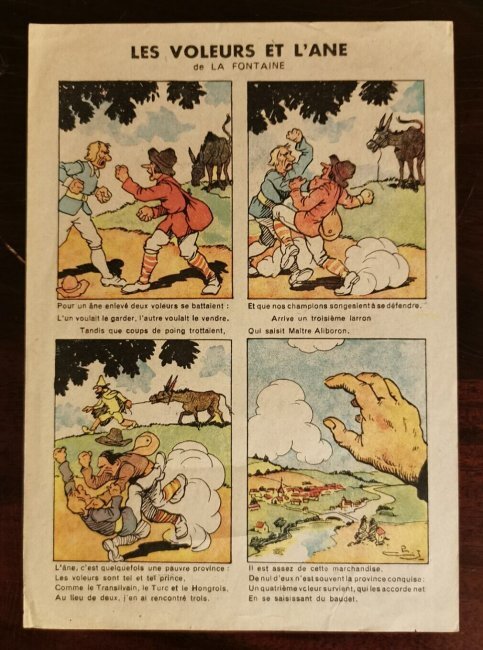
1930? Handbill offering La Fontaine's "The Thieves and the Ass" in four panels. Gaze Unita. Printed by Delrieu in Paris. 5¼" x 7½". €10 from wickedthing through Ebay, Oct., '23.
This is a lively presentation of La Fontaine's I 13 by "Unita Gauze" with its advertising for medicinal uses. The artist signs the last panel with something like "RJ." The size of a handbill like this makes me wonder how it would have been used and distributed.
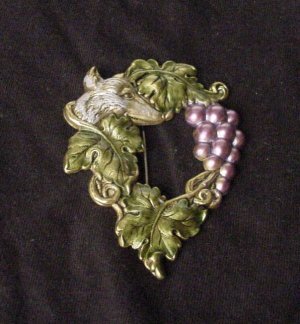
1910? Hand painted solid brass brooch of fox and grapes. $13.50 from "casajewelry" on Ebay, June, '00.
Soldered joint and catch pin assembly. "Stamped by tooling from the early 1900's," according to the Ebay seller's description. An "old gold" finish has apparently been applied to a 14kt gold plating.
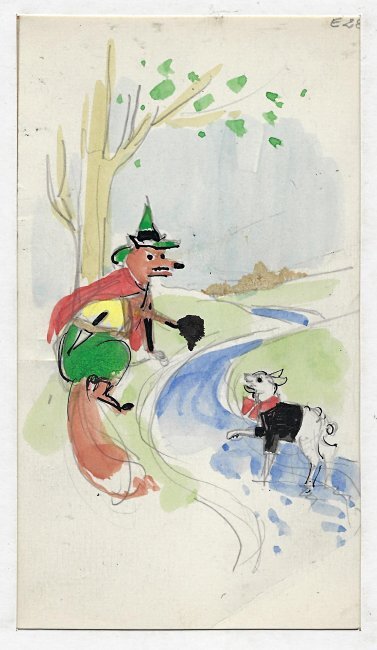
1975? Hand-painted colored picture of WL. About 4" x 7". €28 from Daniel et Lilli, Marché Dauphine, Saint-Ouen, France, June, '19.
Here was one of two surprises in a blisteringly hot weekend foray to the Marché aux Puces! "Daniel et Lilli" is basically a button shop on the first floor of the Marché Dauphine. I did find buttons, but I found more brooches and drawings. The helpful attendant just kept bringing me more things! These lovely finds made up for an otherwise not-so-successful day. I enjoy the wolf and the lamb here, but I wonder what the wolf holds in his left paw. Again, what a lovely "save" from the fate of most ephemera for this one-of-a-kind object!
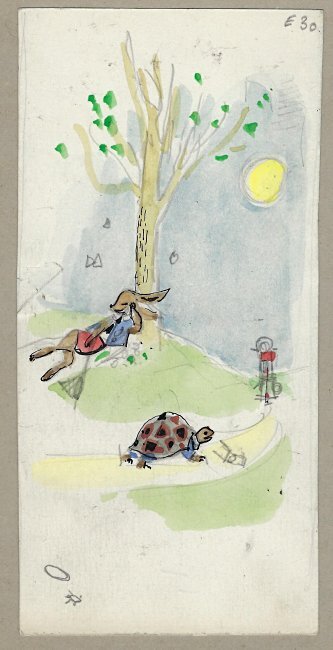
1975? Hand-painted colored picture of TH. About 3½" x 7⅛". €30 from Daniel et Lilli, Marché Dauphine, Saint-Ouen, France, June, '19.
Here was one of two surprises in a blisteringly hot weekend foray to the Marché aux Puces! "Daniel et Lilli" is basically a button shop on the first floor of the Marché Dauphine. I did find buttons, but I found more brooches and drawings. The helpful attendant just kept bringing me more things! These lovely finds made up for an otherwise not-so-successful day. The bunny sleeps blissfully against a tree while the tortoise passes by. What lovely work, and what a lovely "save" from the fate of most ephemera for this one-of-a-kind object!
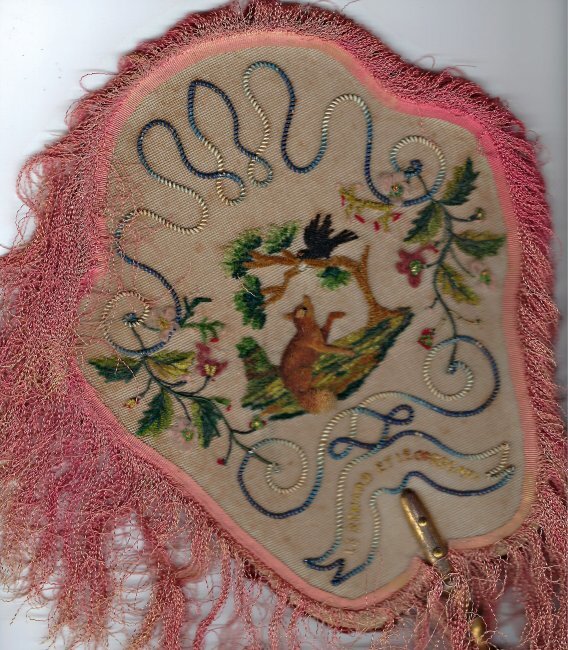
1880? Hand-Held Fire Screen Showing FS. Embroidery 8.5" long; handle adds 7". Silk backing. Unknown source.
What beautiful ornate work! Is the fox laid onto an otherwise sewn work?
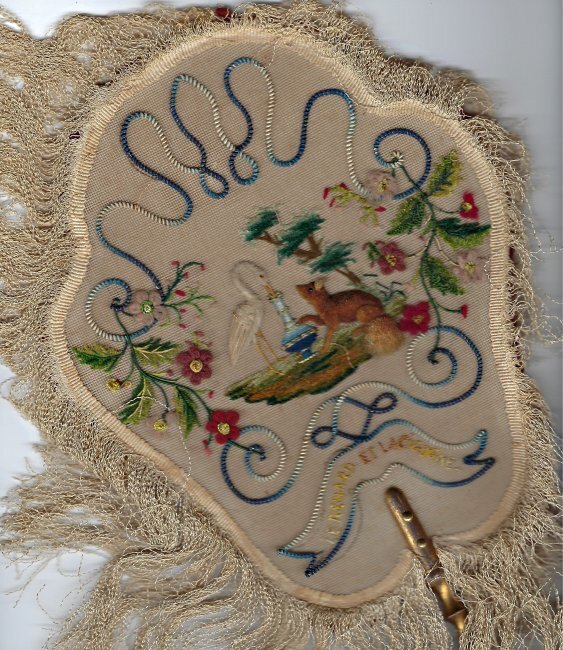
1880? Hand-Held Fire Screen Showing FC. Embroidery 8.5" long; handle adds 7". Silk backing. Unknown source.
What beautiful, ornate work! Are the fox and the stork laid onto an otherwise sewn work?
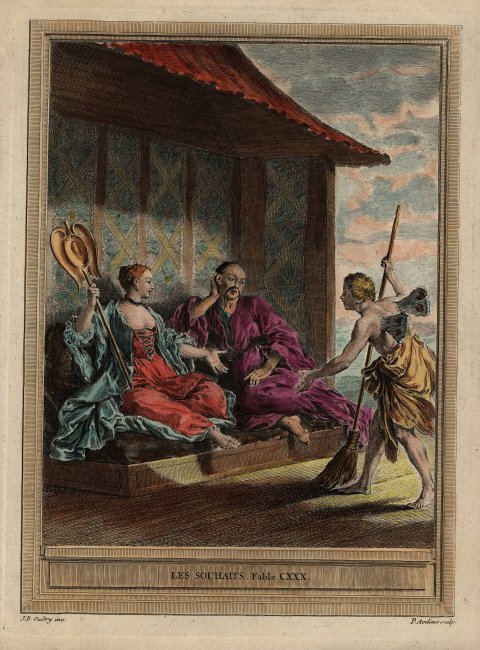
1850? Hand-colored print of J.B. Oudry's Fable CXXX: "Les Souhaits." $9.99 from abclovell through Ebay, July, '22.
Here is a strong rendition of La Fontaine's fable about a couple granted three wishes. The first two are a wish for riches and a resulting wish for poverty, to rid themselves of the burden that came with the riches. Their third wish then turns, wisely, to a wish for wisdom.
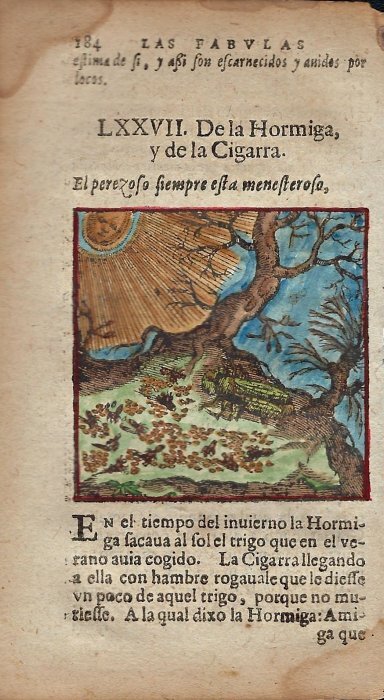
1840? Hand-colored GA page from a Spanish book of fables. Fable 77. Pages 183-84. 3” x 5.2”. Unknown source.
I am cataloguing this piece long after it came to our collection. It is one of those random parts of the collection. I find the hand-coloring very nice but the cicada hard to make out with his green buried in the image’s browns. Fine work by a careful hand!
1910? Hand painted solid brass brooch of fox and grapes.
Soldered joint and catch pin assembly. "Stamped by tooling from the early 1900's," according to the Ebay seller's description. An "old gold" finish has apparently been applied to a 14kt gold plating.
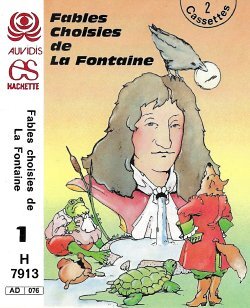
1973 Fables choisies de La Fontaine. Livres 1 à 3 et 3 à 5. Cassette 1. L'Encyclopédie Sonore Hachette sous la direction de Georges Hacquard. Illustration par Jacques Blanpain. Unknown source.
Excellent readings in French by an array of fine readers, sometimes with musical background. The readers are listed on the paper sleeve of this first tape. It surprises me that these cassettes were done so long ago.
1973 Fables choisies de La Fontaine. Livres 6 à 8 et 8 à 12. Cassette 2. L'Encyclopédie Sonore Hachette sous la direction de Georges Hacquard. Illustration par Jacques Blanpain. Unknown source.
Excellent readings in French by an array of fine readers, sometimes with musical background. The selections of both cassettes are listed on the paper sleeve of this second tape. It surprises me that these cassettes were done so long ago.
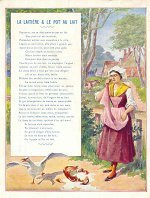
1930? 2 cards presenting scenes from two La Fontaine fables with a "Certificate of Satisfaction" on the back. Just over 7" x 5½".
These large cards might seem in our culture to bring together two disparate functions, namely of the small picture-card and of the large certificate. The scenes here are "Le Laboureur et ses Enfants" and MM. The latter is drying her eyes with her apron. One of the two certificate formulas on the back fills in a "3" to help date these cards to the very early 30's. The picture side of these cards is identical with the picture-sides of the large trade cards I have listed under Arlatte/Printemps/Jacques. The more recent four cards have hand-written testimonials on the verso, not the printed citation of the earlier found cards.
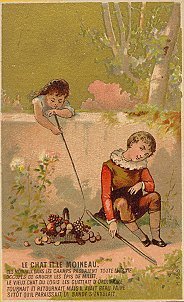
1890? Complete set of 12 cards showing children in scenes from fables of La Fontaine, Florian, and perhaps others for $50 from Carlos Rodrigues, Montigny les Cormeilles, France, through Ebay, May, '22. Earlier 8 cards (plus one cropped extra of "Le Gland et la Citrouille") showing children in scenes from fables of La Fontaine, Florian, and perhaps others. A golden sky marks each of these cards. All but one credit as printer H. Laas, 16, rue Pierre-Levée, Paris.
The Rodrigues set has no advertising on its illustrations, blank banks, and good condition. A golden sky marks each of these cards. Children act out scenes from La Fontaine's fables, from Florian's "Le Chien Coupable," (5.17), and from someone's "Le Chat et le Moineau." GA is a slightly different approach to the usual French presentation of this fable, perhaps since the actors are children. The music-player here is a young boy, and he has a violin rather than the usual guitar. Part of the cards' fascination seems to lie in dressing the children up. "Le Gland et la Citrouille" here introduces a second character. Is a smart young man explaining to a young woman that there are reasons why acorns should go with oaks? Is that candy that the little girl in FC has in her hand? How well does this illustration work on a card that ends up advertising chocolate? The script here is all capitals. Of the other cards than Rodrigues', four cards have "Bonbons Gramont" imprinted on the front ("Seul Rem ède efficace contre la Toux"!). Their backs have a uniform brown-ink advertisement for Bonbons Gramont. Three have "H 597 a" printed on the picture side, and the other has "H598 b." Two cards have "Chicorée Indigène/Arlatte & Cie, Cambrai" printed on the front. They both have "H 597 a" printed on the front, and they have a uniform black-print advertisement for the product on the back. Two cards have nothing stamped on the front, have one each "H 597 a" and "H 598 b" on the picture side, and offer a uniform advertisement in black ink on the back for Chocolaterie de l'Eure, à Menilles près Pacy-s/-Eure. Finally, the cropped card, like its larger version, has "H 597a" on the front but has no other markings, front or back. For an even fuller selection of these cards, consult Debauve & Gallais Cholocoate Cards.