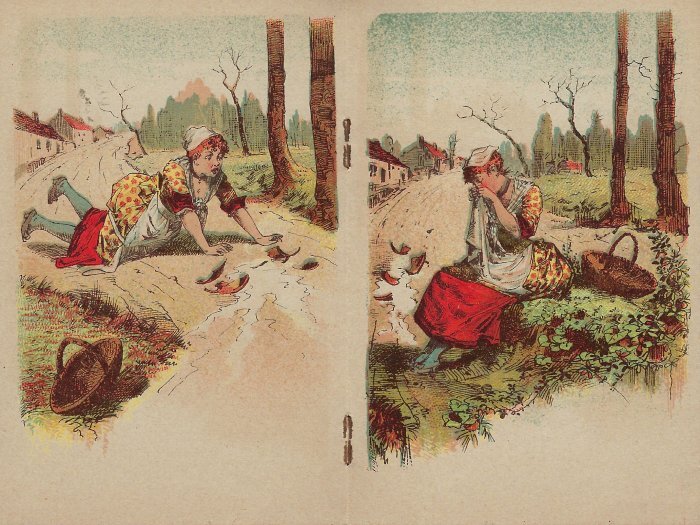
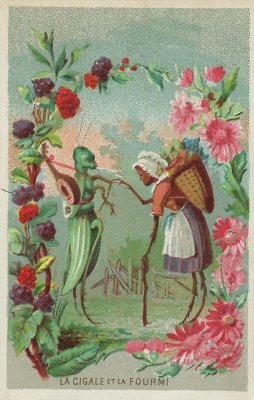
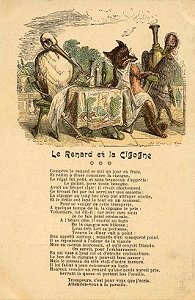
1898 Pamphlet printed by Gustave Guérin & Cie, Paris, offering La Fontaine's text of MM along with three chromolithographs of the fable.
I long considered whether this is a book, a card, or an advertisement. In the end, the last seemed most appropriate. I have not discovered these chromolithographs on cards we have. Bertrand calls this printer rare. Inscribed 1898. 3½" x 5½".
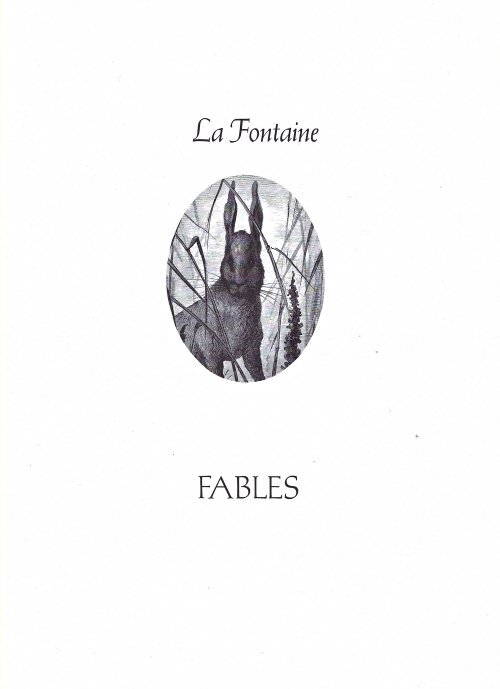
1950? La Fontaine Fables segment of a larger work. Gustave Doré. Pages 197-219. 8.9” x 12”. Unknown source.
As I make my way through uncatalogued materials from the past, this is one of the more challenging. Here are 23 pages of black-and-white reproductions of Gustave Doré with English language titles, followed on 220 by a bust of Baron Munchhausen. I presume it is a section of a larger work presenting a number of Doré’s works. The detail seems to me to be unusually well done.
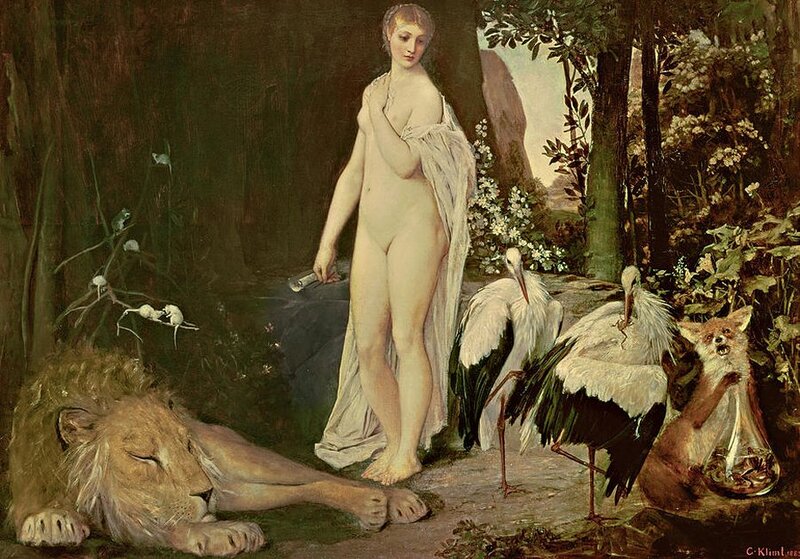
1916? Photograph of Gustav Klimt’s “Fable.” Image 12.2” x 8.7”. Overall 16.5” x 11.6”. Perhaps from fineartamerica.
Starting from the right, we find here FS; FK; perhaps “Heron”; perhaps “Lion in Love”; and perhaps TMCM. There may well be other fables hidden in the painting. d
1890? 7 French cards of La Fontaine fables from Chocolat Grondard. 2" x 3½". No publisher indicated. $16 from Bertrand Cocq, Calonne-Ricouart, France, March, '01. 3 more from St. Ouen, August, '15.
These small portrait-formatted cards announce "Chocolat Grondard" at the top in red and run a red framing stripe around a colored illustration. The stripe also frames a few lines from the fable below and, generally, a reference to La Fontaine and the specific fable. Small italic print at the top of the illustration gives its French title. Small numerals in the lower right or left may identify a series or a date ("3 18," :4 v 3 c," "4 10," "5 2," "5 5," "5 9," and "5 17"). There is also a small signature "LV&C" on several cards. See a similar set of cards under "Léopold Verger & Cie." The fables appearing here are 2P, "Le Labourer et ses Enfants," "Le Lievre et le Perdrix," "Le Chameau et les Batons Flottants," BC, "Le Chat & le Vieux Rat," and "Le Renard et le Bouc." The backs uniformly advertise Grondard on the Bd. Saint-Germain ("Spécialité pour Baptèmes"!) and the Bd. Malesherbes in Paris--in brown ink.
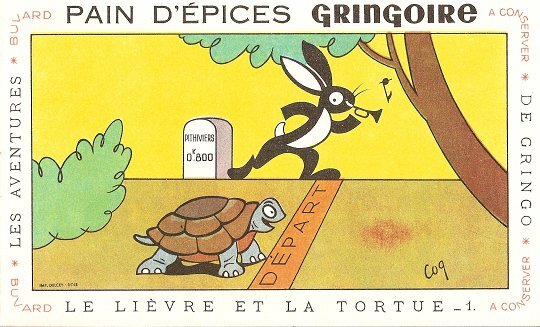
1970? Two blotters (and one extra) from Pain d'Epices Gringoire: GA (#2) and TH (#3). "Buvard a Conserver. Les Aventures de Gringo." Signed by "Coq." Imp. Delcey - Dole. One copy of GA for 50 Francs from Annick Tilly, Clignancourt, August, '99. TH and another copy of GA from Mme Denise Debuigne, Rennes, France, May, '02. Three distinct blotters of other phases of TH from Mme Denise Debuigne, Rennes, France, May, '03.
These blotters, about 4" x 7", are among the most colorful blotters I have. GA has a delightful picture of the cicada struggling through the snow, while a black-and-white bunny with a horn and something brown under his arm races across the territory. Is this bunny Gringo, and is he carrying pain d'épices? The GA blotter is marked #2, perhaps of a set of four. I now have four distinct blotters showing different phases of TH. Two distinct blotters are marked #3, but the one representing a later phase in the story has its number set up differently from those of the other three blotters. Gringo overturns the traditional fable by riding on the tortoise's back and then jumping across the finish line just ahead of the tortoise, blowing his horn all the while. A sign points to "Le Pays du Miel." These blotters are made of a very thin paper. I would not have thought of this paper as blotter material.
1979 Grillengesang: Eremiten-Kalender auf das Jahr 1979. Fabeln von Henrike Leonhardt. Graphics from eleven different artists listed on the first page. Düsseldorf: Verlag Eremiten-Presse. €15 from Antiquariat Halkyione, Hamburg, Jan, '16.
The first surprise in this calendar is its size: 4' x 17½"! Each month gets its share of a couple of lively leftist-leaning fables in block letters with art that I cannot begin to understand. I presume that the art is not related to the fables. Here is an ephemeral find of the first order!
1988? "little friends may prove great friends. Aesop." 4½" x 6". The Printery House. Conception, MO: Conception Abbey. Gift of Mary Pat Ryan, Nov., '92.
Though the saying might be most easily matched with LM, the image on the front of the card is that of a psychedelic insect. Might the image and saying both be taken from the fable of the hare, the eagle, and the dung beetle? There is no message inside the card.
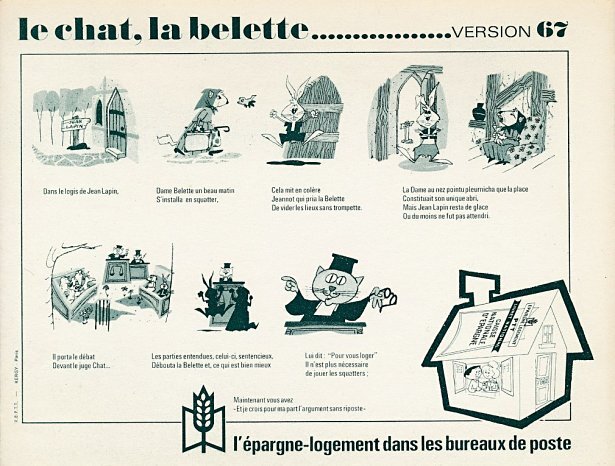
1967? A large (8" x 6⅜") green and black blotter on a cream background. "Le Chat, la belette....Version 67." R.E.P.T.T. Paris: Kergy. $7 from Bertrand Cocq, Calonne Ricouart, France, Sept., '18.
This new – 67th! – version of the fable involves, as usual, the Jean Lapin, ousted from his home, and the squatting weasel who ousted him. As usual, the two appear before the judge cat, here presented in a formal court scene. Here, however, the cat does not eat both litigants. Rather, the cat dismisses the case of the weasel and, even better, tells her that she does not need to be a squatter. All she has to do is set up an account with the post office to save up for lodging. It is that easy!
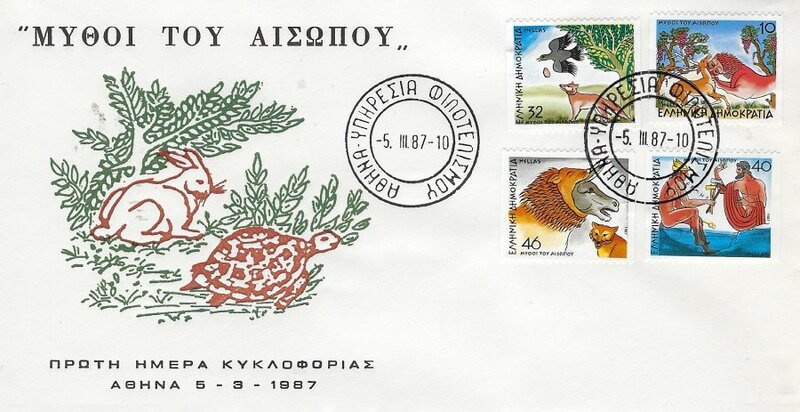
1987 Greek FDC pair of identical envelopes displaying each four of Scott 1581-88. Each is also stamped FDC in Greek and dated March 5, 1987. $21 from Dimitrios Leonidis, Peristeri, Greece, through eBay, Jan., '22.
The design here is remarkably similar to that on one of the envelopes acquired previously. Here the presentation of TH is done in green and brown.
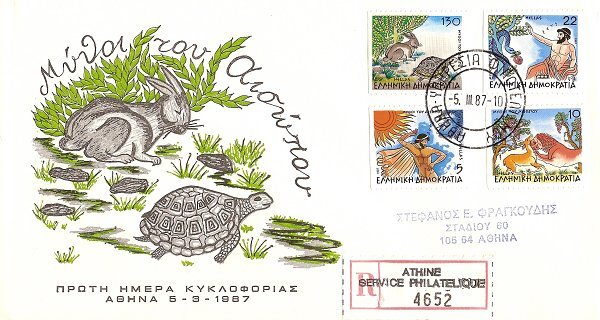
1987 Greek FDC pair of envelopes displaying Scott 1581-88. Each envelope offers four of the Aesop's Fables stamps. Each is also stamped FDC in Greek and dated March 5, 1987. One has a green-and-black duochrome illustration of TH, and the other a orange-and-green presentation of FG. $21 from Stefanidis Antonis, Filothei, Greece, through eBay, Jan., '06.
These are perhaps the liveliest and most engaging of the various FDC envelopes created for this set of stamps. Each design is a script version of "Mythoi tou Aisopou" running over it. Each also bears a stamp"Athine Service Philatelique, TH numbered 4652 and FG 4587. Both have Athenian cancellation marks on the back of the envelope. The FG envelope adds a (second) FC stamp, also cancelled in Athens on March 5, 1987.
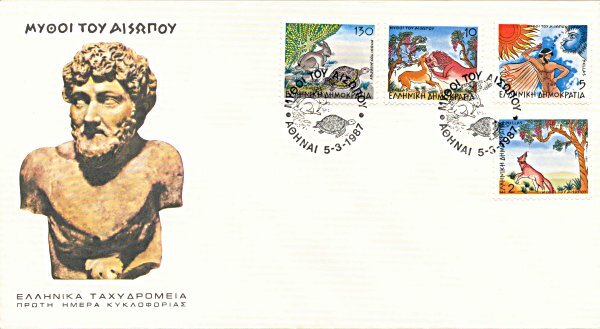
1987 Greek FDC pair of envelopes displaying Scott 1581-88. Each envelope offers four of the Aesop's Fables stamps. Each is also stamped FDC in Greek and dated March 5, 1987. One has a close-up of a bust of Aesop while the other puts his bust among animals and in a rural setting. £2.99 from Constantin Glaridis, London, through eBay, June, '05.
Here are two presentations of Aesop in bust form. One takes an illustration of Aesop's head and torso and cuts away all background. The other situates a bust of Aesop in a classical background, appropriately surrounded by animals.
1987 Greek FDC pair of envelopes displaying Scott 1581-88. Each envelope is stamped FDC in Greek and dated March 5, 1987. Each is also numbered #688 of 1000. $22 from Angelo Komatsoulis, Montreal, through Ebay, Oct., '01.
These identical envelopes are the simplest among the various FDC's I have found for these stamps. The envelope has a lovely fox turning his nose away from the golden grapes on vines with green leaves. The stamps are beautifully done in rich colors. For that reason I have presented each on a separate page with room for a larger illustration.
1990? Gray medallion of Ivan Krylov as in his famous statue in St. Petersburg. Porcelain? Verso with symbols including a dramatic mask, a lyre, a laurel wreath, and text.
The writing on the back includes "I. A. Krylov"; "Sculptor (Peter) Crodt"; and "Leningrad." Other elements seem to include something like "Lamjatnik" and "B. Detnem Sady." Sorry not to comprehend or even transliterate those better! Use of "Leningrad" rather than "St. Petersburg" puts the medallion before 1991, when the name was officially changed to "St. Petersburg." I have sought in vain to find a comparable piece on the web.
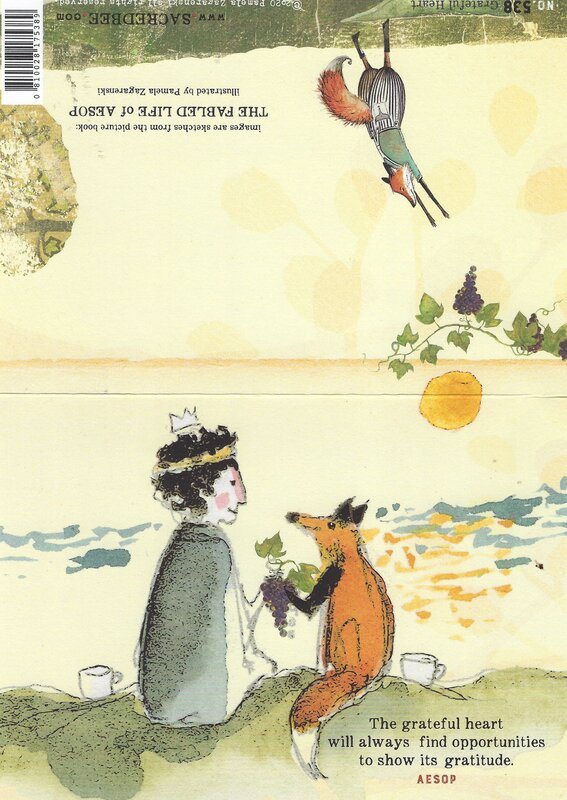
2020 Gratitude greeting card. "The grateful heart will always find opportunities to show its gratitude. Aesop." Sketches from "The Fabled Life of Aesop" by Pamela Zagarenski. No. 538. Signed by the senders, Paul and Ianthe Swensen, Dec., '21.
The scenes on the front and back of the card connect. Did the woman get the grapes for the fox?
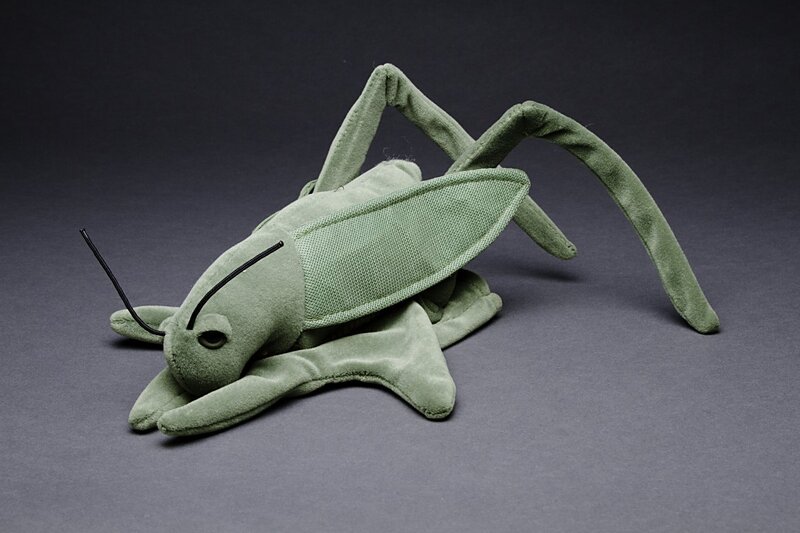
1990? Grasshopper puppet with attached Aesop's fable "The Grasshopper and the Ants." "Folktails" series by Folkmanis, Inc., Emeryville, CA. Made in Korea.
As the tag shows on this puppet in excellent condition, the puppet is meant to recall GA. The version attached to this delightful little fellow has the ants answering at the end of the fable: "If you were foolish enough to sing all summer, then you will have to go to bed without any supper in the winter." I have never seen that ending before. Two well-formed rear legs are nicely filled out, but the manipulator of this puppet has four front legs to control with four different fingers. As often in Folkmanis creations, the eyes are excellently rendered.
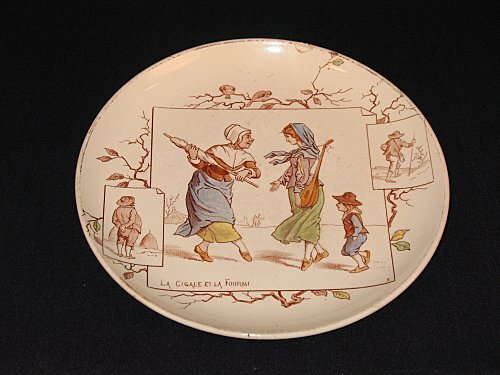
1900? Faience plate 8" in diameter showing three scenes depicting GA. Numbered "2." A mark on the back seems to combine the letters "M" and "C" and says "déposé Fables Terre de Fer." $18 from Penny Hughes, Marysville, WA, Feb., '06.
This plate features, in its side panels, the backs of two men. One seems a prosperous farmer with mounds of hay nearby. The other has poorer clothing and strides away with a walking stick carrying something -- an instrument perhaps? -- as he goes. The central panel features two women. The "ant" holds an instrument for spinning, while the lovely younger grasshopper holds a lute. A small child is jut behind her.
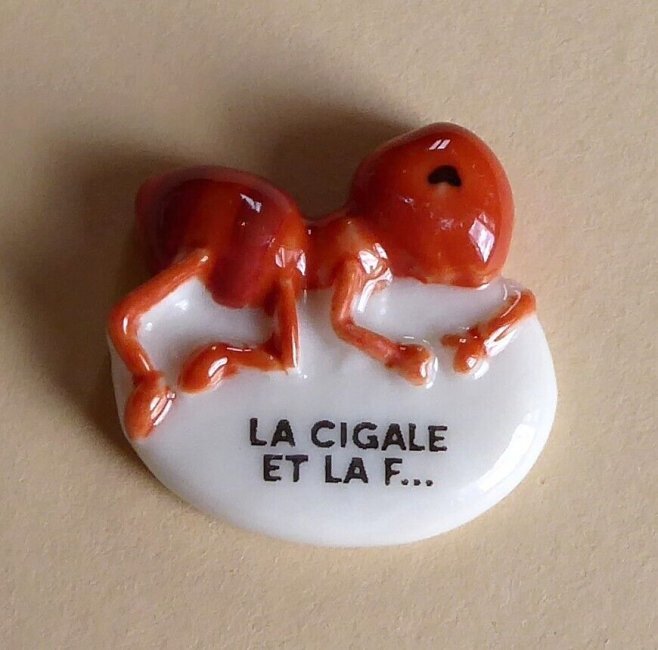
2018 Feve disk "La Cigale et la F….".
This disk is clearly to be paired with a fellow representing the cicada. Ebay represents it as a "Devinette," which I take to be a puzzle. I presume that description rests on the this feve's need to be paired with its partner.
1940? Full-colored cartoon card of GA. No acknowledgement of artist, printer, or advertiser. €9 from Albert van den Bosch, Antwerp, June, '23.
This card, 2¾" x 4¼", emphasizes the insect-character of the two actors in this story. Apparently they are meeting in the summer in the open. Perhaps the grasshopper is inviting the ant to work less and play more. Blank verso.
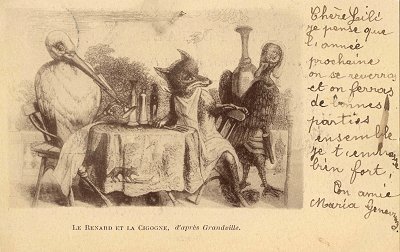
1898? Ten monochrome landscape La Fontaine fable postcards, each labeled "d'apres Grandville." Duplicates of GA and "Rat Who Retired." $143.95 from Portugalcards - Jose Monteiro, Lisbon, Feb., '10. Extra copy of FS with a message, apparently postmarked in 1908. 50 Francs from Annick tilly, Clignancourt, July, '01.
The picture side reserves generally only 20% of its space for a message. The monochrome color differs from one card to another. The dealer gives the cards a date of 1898. Only the title and "d'apres Grandville" appears on the picture side. On the verso is nothing but room for an addressee and his or her address. The packaging is still present, if somewhat fragile. Curiously, the duplicates are done in different colors from each other.
1920? La Fontaine fables GA and FS illustrated in color by J.J. Grandville on two postcards. No indication of date or publisher. There is no writing on either verso. 50 Francs each from Annick Tilly, Clignancourt, July, '01.
While the engraving is not as distinct as one would wish for Grandville's exquisite work, the coloring brings something new to his art. Both of these colored cards are done in portrait format. See also the landscape black-and-white inscribed postcard I have of Grandville's FS under individual postcards.
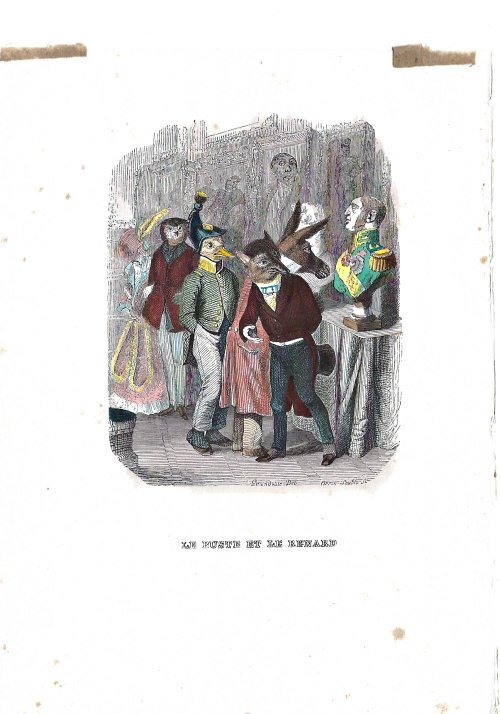
1838? Four hand-colored illustrations of La Fontaine’s fables by J.J. Grandville. 5.6" x 7.6". Unknown source.
A fascinating set of exquisitely colored illustrations. Apparently taped inside protective covers, one of which remains. A fascinating aspect of these hand-colored pages is the way the color seeps through selectively onto the verso of the page. A lovely find!