I have found the work of Emile Joseph Alexandre Gouget on three occasions and in three forms. The first two, the simplest, cost €2 apiece at a flea market in Strasbourg in July, '19.
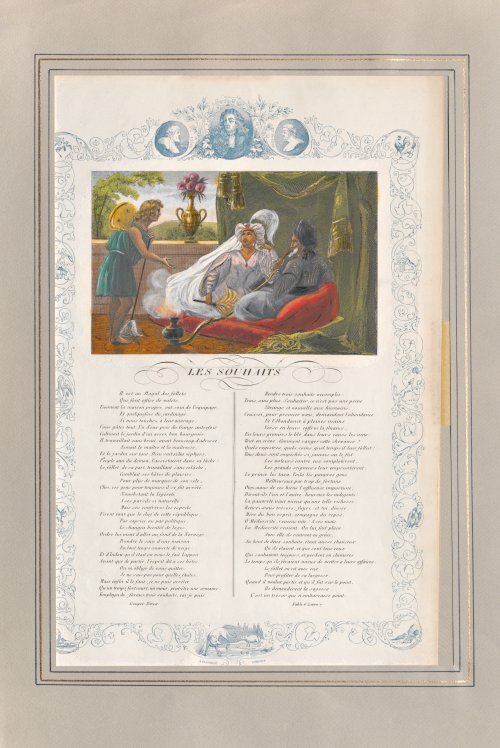
In my short time in Paris in the summer of 2014, I managed to find a number of fable materials. Among them are broadsides or separated pages from Gouget's edition of La Fontaine in 1834 (Bodemann #279.1). There are two groups.
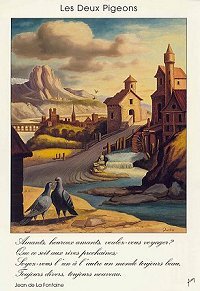
One group of five is carefully matted but without decoration around the page of text and illustration. They are slightly colored. The seller labeled them "1834" and that was the first clue that these are Gouget's work. Gouget's signature is at the bottom of most texts. The illustrations here are slightly colored. These five are the following. And now I have found a sixth, "The Lobster and Her Young," for €20 from Albert van den Bosch, June, '23. Click on any image to see it enlarged.
A third group of twelve has elaborate printer's designs around the (identical) illustration and text. Each has these three signatures: Gouget Dir. Ex"; "N. PA. Xardo Sc."; and "LeMercier."
These prints include the following. Click on any image to see it enlarged.
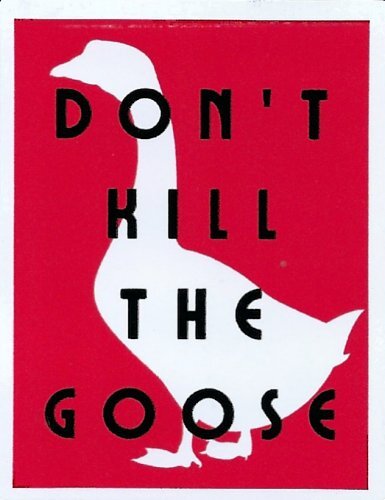
1950? Goose Holding Golden Egg Salt and Pepper Shakers. Plastic. 5.25" long. 3.5" high. Made in USA. Davis Products. Unknown source.
This set seems readily available from Ebay dealers today. Clever, though flimsy.
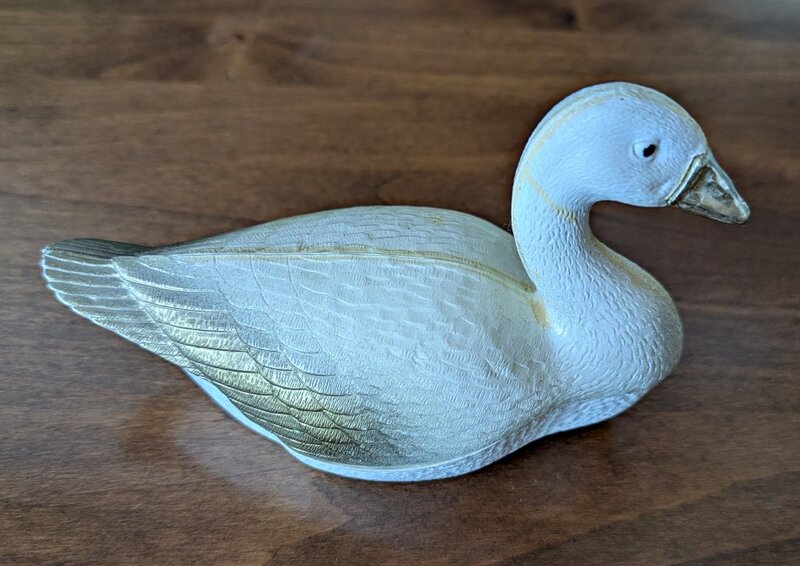
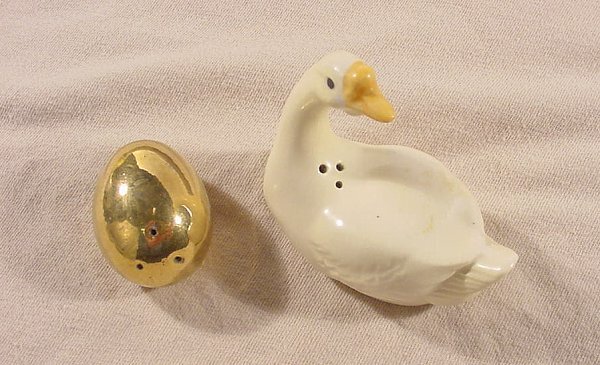
1960? Goose and Golden Egg salt and pepper shaker set. Made in Japan. The goose is almost 1½" x 2¾" x almost 2¾" high with three holes at the base of her neck. The egg is almost 1 1/8" high and wide and 1½" long with three holes on the rounded side. $5.50 from Guy Berard, Canton, NY, through Ebay, Feb., '01.
Gold luster glaze on the egg. This is a very large egg for this goose to have produced!
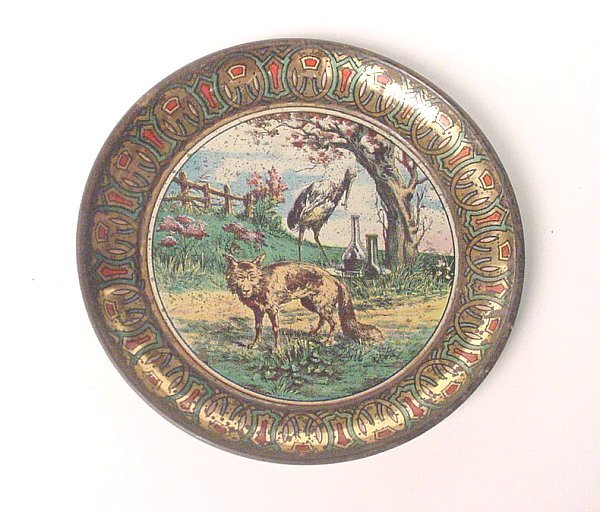
1910? Six Tin Tea Set Plates. Each 5.5" in diameter. FC, FS, OF, and WL, with extras of OF and WL. $45 each for three from Ray Hanson, Garland TX through Ebay, Feb., '99. Three further plates from another source at another time.
The curved edge of each, almost an inch in width, has a green, gold, and red pattern. Then in the center is a multicolored illustration. OF is the best preserved of the original set; it seems to lack the pock-marking of the other two. All three show some rust and staining. They may have spent some serious time in someone's attic or even sand-box! FC is the most worn of the later three. In fact, OF and WL are in very good condition. What a great and curious find!
FS: Here the disgruntled fox stands away from the stork and his vases and looks at the viewer.
OF: The composition of the design balances the two main animals, frog and ox, nicely. In a moment, this scene will not be so placid!
WL: The wolf towers over the lamb. A viewer who wants to check can find that the water is indeed moving from the wolf to the lamb. Another pleasing composition!
FC: The fox already has the cheese well in control under his paw. Might this be the place where, in La Fontaine's version, the fox is telling the crow that it is worth a cheese to learn that flatterers exist at the expense of those silly enough to believe them?
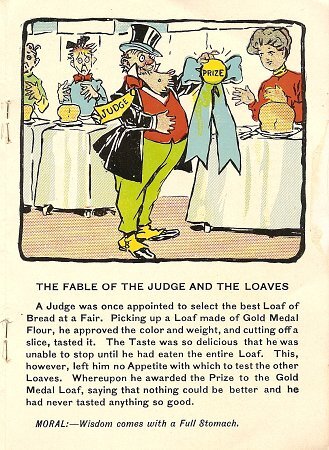
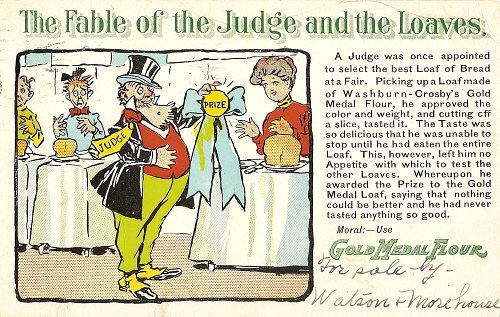
1906? "The Fable of the Judge and the Loaves." Gold Medal Flour advertising postcard. Sent to Mrs. H. Smith, Kent, Conn. and postmarked 1906 in Minneapolis. $5 from Andover, MA, through eBay, March, '08.
The picture side of this postcard has a title across its top, a strong colored picture taking about two-thirds of the remaining space, and a text of the fable climaxing in "Moral: -- Use Gold Medal Flour." A handwritten addition below goes on "For sale by - Watson and Morehouse." The picture and text -- but not the layout -- are identical with one of the center pages of Comic Fables with Morals Advertising Washburn-Crosby's Gold Medal Flour. I will crosslist this find with postcards and keep the card with other postcards. To see the pamphlet page, click here. To compare the two, click here.
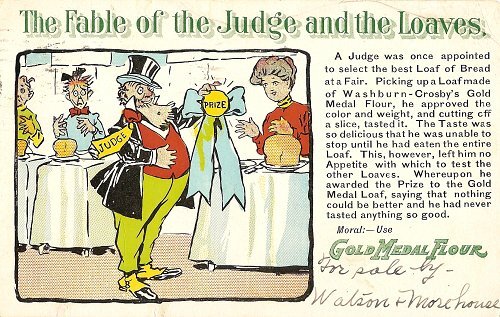
1906? "The Fable of the Judge and the Loaves." Gold Medal Flour advertising postcard. Sent to Mrs. H. Smith, Kent, Conn. and postmarked 1906 in Minneapolis. $5 from Andover, MA, through eBay, March, '08.
The picture side of this postcard has a title across its top, a strong colored picture taking about two-thirds of the remaining space, and a text of the fable climaxing in "Moral: -- Use Gold Medal Flour." A handwritten addition below goes on "For sale by - Watson and Morehouse." The picture and text -- but not the layout -- are identical with one of the center pages of Comic Fables with Morals Advertising Washburn-Crosby's Gold Medal Flour. I will crosslist this find with postcards and keep the card with other postcards. To see the pamphlet page, click here. To compare the two, click here.
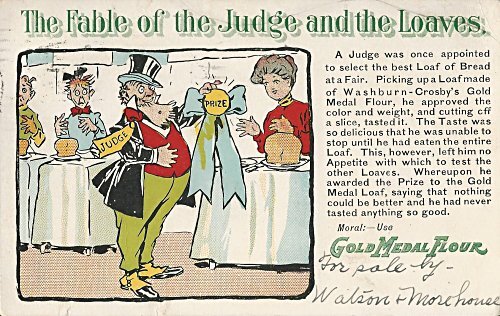
1906? "The Fable of the Judge and the Loaves." Gold Medal Flour advertising postcard. Sent to Mrs. H. Smith, Kent, Conn. and postmarked 1906 in Minneapolis. $5 from Andover, MA, through eBay, March, '08.
The picture side of this postcard has a title across its top, a strong colored picture taking about two-thirds of the remaining space, and a text of the fable climaxing in "Moral: -- Use Gold Medal Flour." A handwritten addition below goes on "For sale by - Watson and Morehouse." The picture and text -- but not the layout -- are identical with one of the center pages of Comic Fables with Morals Advertising Washburn-Crosby's Gold Medal Flour. I will crosslist this find with postcards and keep the card with other postcards.
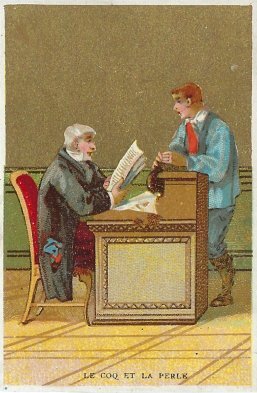
1890? 8 colored French cards, with golden background and block letters, picturing scenes from La Fontaine's fables. 2½" x 3¾". No printer acknowledged. €14 for the set from Albert van den Bosch, Antwerp, June, '23.
The images belong to a series that appear in this collection in several places: Maison Salmon, Alcide Picard, Alph. Babotte, and Verger-Haquet. They have differences from each of those groups. Verger-Haquet and Picard have colored background like sky or wallpaper where these cards have monochrome gold as part of the background of each card. By contrast with Salmon and Babotte, there is no acknowledgement here of a printer or an advisor, and there is no text of the appropriate fable. The verso of each card is blank. All six cards in this set are in good condition, better than many similar cards in the other sets. The best executed of these cards may be MM.
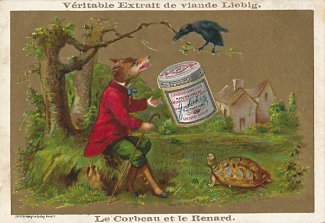
1884 Gold Background Cards. Liebig Company's Extract.
I am so happy to have found a good set of these cards that I will illustrate both the set found earlier, several in poor condition, and the set recently acquired, all in good condition. Each of the pictures is set against a solid gold background. Click on any one in the good set, and a larger version comes up on the screen.
Earlier set: FC: $5 either at Sacramento, Dec., '96 or Foster City, Feb., '97. Three other cards for a total of $5 from Janet Bernichon, Shirley, NY, through eBay, Nov., '02. $10 for the last two from Albert Van den Bosch, Antwerp, Belgium, April, '13. Later set: $118.42 from Mariotti Filatelia, Milan, through eBay, March, '18. FSII in English a gift of Susan Carlson, Dec., '23. On the verso of the earlier cards are directions in English for beef-tea, vegetable soup, and other delights. A comment printed sideways on the cards seems to claim that a first class French Chef accepted a position only when he was promised that he would be liberally supplied with Liebig's. There are several formats on the verso of the later cards. I illustrate them below the picture sides here.
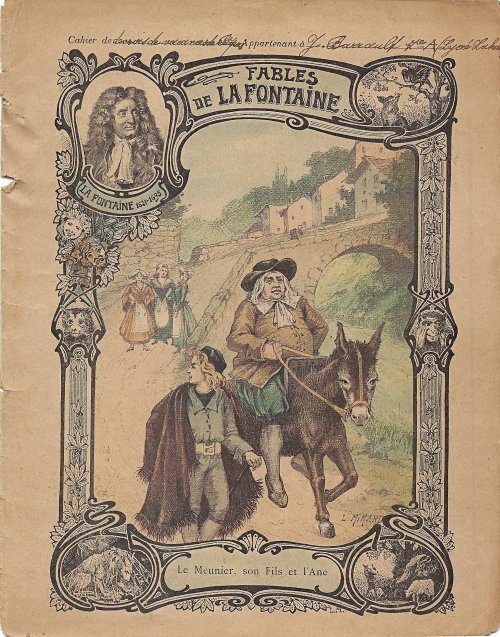
1900? 6 Dust jackets ("Couverture Cahier") "Fables de La Fontaine" by Auguste-Godchaux, Paris. Artist: L. Mimard. Colored presentations of individual fables and texts – both in ornamental frames -- on both covers. €6 each from Chromosetcollections on Ebay, Nov., '20.
Godchaux seems to be active up to the present. These colored images dramatize the fables in energetic ways, although within less energetic classical "frames." Best of the group of six might be MSA. Also good is "The Miser Who Lost His Treasure." The framework on front and back covers is identical. It includes floral patterns and several key fable images, like FC, LM, and WL.
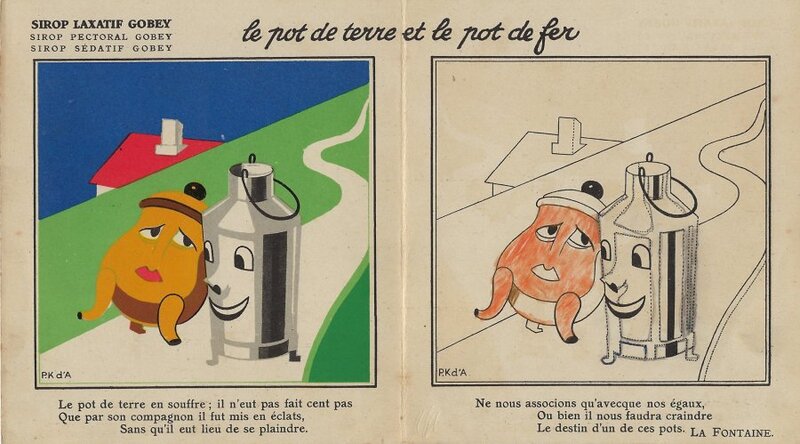
1930? Three leaflets in a series advertising Sirop Laxatif Gobey, each offering a colored image and an image to color. 2P, OF, and TMCM. Signed “P.K d’A.” Paste-over indicating either producer or distributor: Labunis, S.A., in Brussels.
It is easy to find Gobey laxatives on the web and many humorous cards they produced for their laxative syrup, meant particularly for children, young women, and older people. These cards to color do not show up among them. For me, the best of these three is the one that a young hand started to imitate but got only as far as some orange and a very little bit of brown. The coloration and facial expressions are particularly well done in this colored scene.
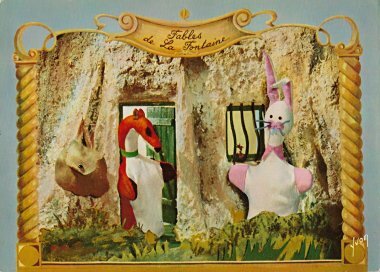
1965? Six cards from a larger group derived from a 1960's French television show presenting La Fontaine's fables through puppets: "Les 'Petites Maries' Jouent." Éditions d'art Gnoe, Arcueil. Copyright S.P.A.D.E.M. Imprimé en France. Procédé 301. Draeger, Imp. 164. $30 for the set of six from Bertrand Cocq, Calonne-Ricouart, France, Sept., '20.
The colored photographs here are uniformly framed in a puppets' stage. We have cards #2 (FC); #3 (FS); #5 ("The Cat, Weasel, and Little Rabbit," first scene); #6 ("The Cat, Weasel, and Little Rabbit," second scene); #8 (TH); and #10 (GA). Now let us find the others!
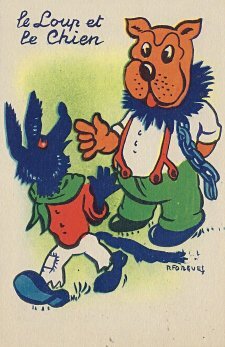
1960? Four trade cards advertising "Glucalcium à la Vitamine C Infantile" from Laboratoires Clevenot in Nogent-sur-Marne. "Fox and Goat"; "Two Doves"; DW; and TH. 3½" x 5½".
Here is a set I have not seen before. The artist's name seems to be "Forguet, perhaps with a first initial of "R." Lively cartoon scenes!
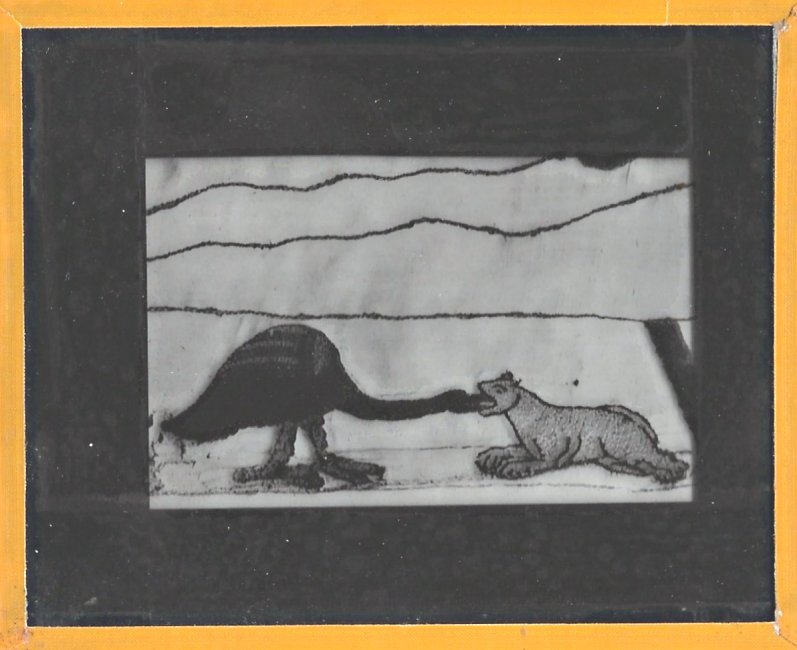
1940? Glass slide of WC from the Bayeaux Tapestry. 4” x 3.25”. Art Dept., Smith College. Unknown source.
Black-and-white glass slide, with an image 2.75” x 1.75”. Few objects in the collection have come as heavily identified as this slide, which came through the Smith College’s Art Department. It also had some involvement with the public library”. Which public library? To help identify the scene, I offer a larger swath of the tapestry that includes this pleasant little scene.