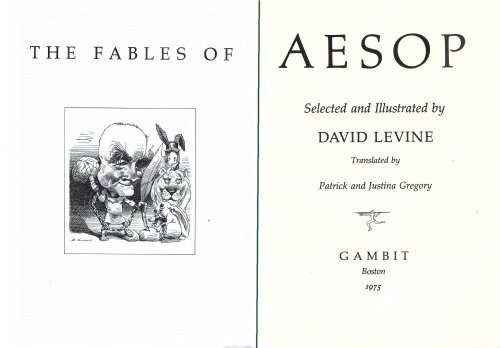
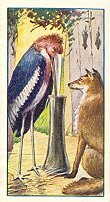
1975 Galleys of “The Fables of Aesop, Selected and Illustrated by David Levine.” Translated by Patrick and Justina Gregory. Boston: Gambit.
Our first galleys! From one of my earliest and most favorite fable books! The set is complete, 8 numbered signatures, each with a progressive mark of its place in the text and all with the number “2082. Notice these markings in the photo below. Each signature has 4 large pages folded in half to produce 16 pages 7” x 9.7”.
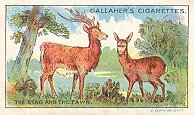
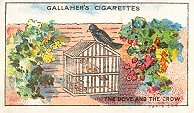
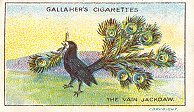
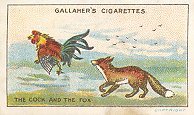
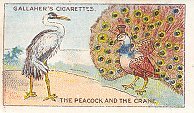
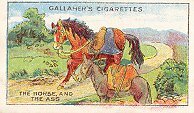
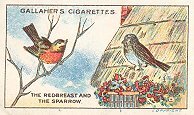
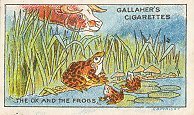
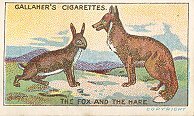
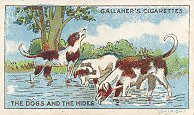
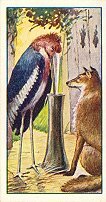
1931 Aesop's Fables. Gallaher Ltd. So called "Series of 50." $9.95 from "Warlock" through Ebay, Nov., '01.
Having heard that there was a so-called "Series of 50" that had only 25 cards in it, I was on the alert for it and at last found it. The design is exactly the same as in the series of 25 done by Gallaher, apparently in the same year. Had they planned to go further but never perhaps got around to it? A number of cards in this particular set are misprinted on the verso, so that they show a part of a column from a different card and miss part of this card's column. Might these be contemporary reproductions?
1931 Aesop's Fables. Gallaher Ltd. Series of 25. $40 from John Wyatt, Wynn Vale, South Australia, through Ebay, March, '99.
This set is exactly identical with the later Anstie set of 25, except that the back here is printed with brown ink rather than black and has "Issued by Gallaher Ltd." underneath an individual card number at the bottom of each back. John did some investigation to learn that Gallaher later in 1931 issued the same cards with "Series of 50" on the backs, but the series included only these original 25! After a good deal of time spent scanning these cards, I can say that they are unusually well cut and aligned.
Gallaher Ltd., of Belfast and London, published three sets of fable cards, the first in three forms. This first set, called "Fables and Their Morals," was a series of 100 cards. The set, called "Aesop's Fables," was a set of 25. The third is identical with the second, but was labeled a series of 50. Click on a button to see any of the sets.
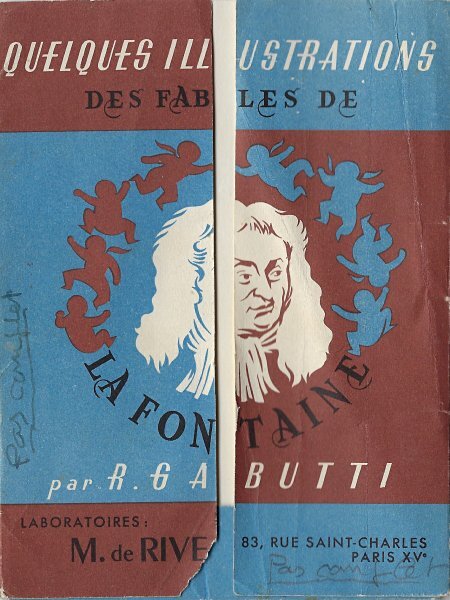
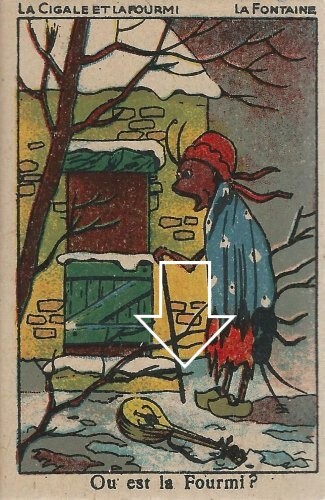
1950? Fourteen advertising cards by R. Gabutti in an envelope. All have advertising on the verso; about half also have advertising as part of the image.
I find the artistry of these advertisements spectacular! Getting them has already set me on a quest to get the others in the set of 19 listed on the flyleaves of the envelope. There is plenty of humor in these illustrations! The advertisements seem to be for various products of Laboratoires M. De Rive in Paris. One of the two TH advertisements for Strongénol – the one with brown foreground rather than green -- was actually sent as a postcard, unfortunately without a clear date stamp. The Gabutti signature is different in these two cards. The products are sometimes worked cleverly into the fable scene, as when the crane doctor brings a tube of ointment to wounded wolf. The crow is similarly dropping not a cheese to a flatterer but medicine to a sick fox with his head bandaged up. Now the full set has arrived, found on French Ebay at the time I was cataloguing the original set here. These six new cards have their own treats. The old man is trying to reveal to his sons not the glory of a well-worked family inherited plot of land but rather the glory of cash! The country mouse is recommending Voxynox to his city slicker cousin. There is lots of fun to be had here!
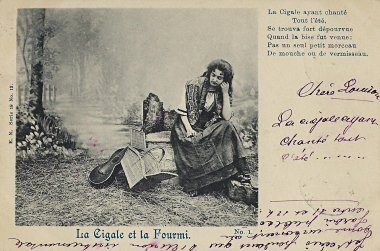
1900? "La Cigale et la Fourmi." Complete five card numbered postcard set. From various publishers. $35 from Bertrand Cocq, Calonne-Ricouart, France, Sept., '20.
This set is unusual first of all for the creativity of its sender, who wrote in various places on the five cards. All were sent with Swiss stamps to the same person in Locle, Switzerland. The set is also peculiar in that Card #3, which uses different typeface for its text, advertises "Phot. Werder, La Louviere; Ed. Nels" in Brussels. Cards #1 and 4 have "E.N. Serie 19" Numbers 12 and 15, respectively. Might the "E.N." be Ed. Nels? Cards #2 and 5 have "J. Farine, Editeur, Le Locle" with numbers 1072 and 1075. These five were already a series when the sender acquired and sent them.
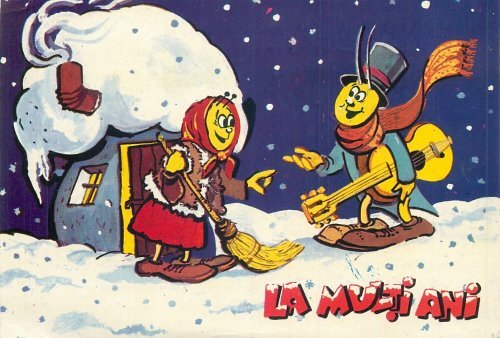
1983 Picture postcard of GA announcing "Many Years!" as an apparent holiday greeting. Romanian. I.P. Sibiu. N.I.I. 339/1983. £2.50 from cartographero through Hippostcard, March, '23.
There are several surprises here. First, this postcard is on very light paper stock; it is not really a "card." Secondly, there are questions around the use of a clear GA illustration here. The illustration does not correspond to ways in which the story is traditionally told. And what does this story have to do with holiday greetings? My, fables get around!
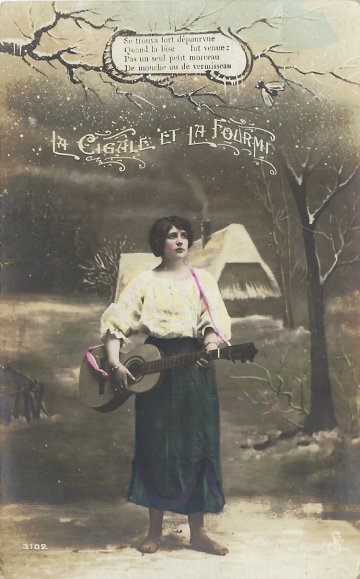
1915? GA postcard with a quotation on the grasshopper's plight in winter. Procédé au Chloro-Platine. #3102. €1 from anto-roma-ca through Ebay, August, '23.
The grasshopper's guitar-strap is rendered in red on this black-and-white card. I presume it belongs to a set of five or six cards. Our collection has a set similarly formatted of WL, also marked ". Procédé au Chloro-Platine."
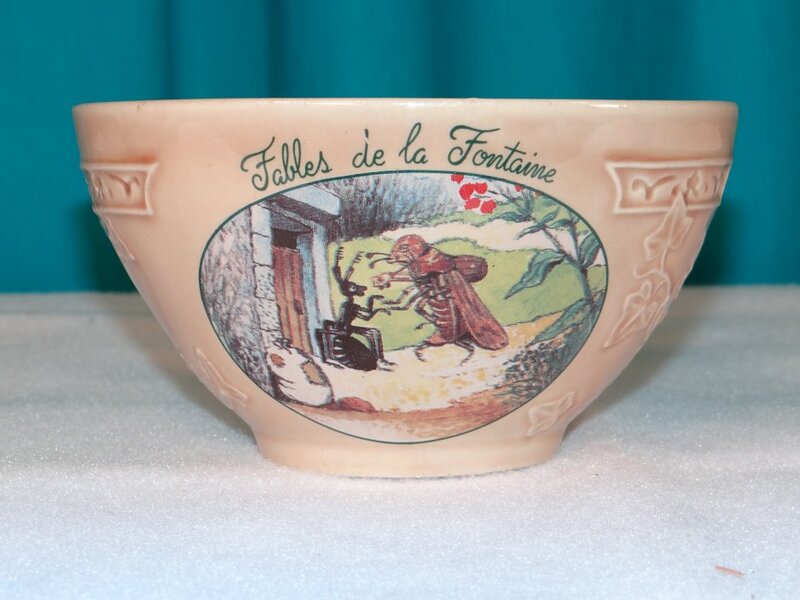
A handleless bowl 6" across featuring GA. On the opposite side there is a panel with the fable's title and moral in cursive. Around these two elements are a raised unpainted floral pattern. $15 from kalo*cstle through Ebay, Nov., '18.
This image is again something that could come from Rabier. This is good, sturdy French tableware!
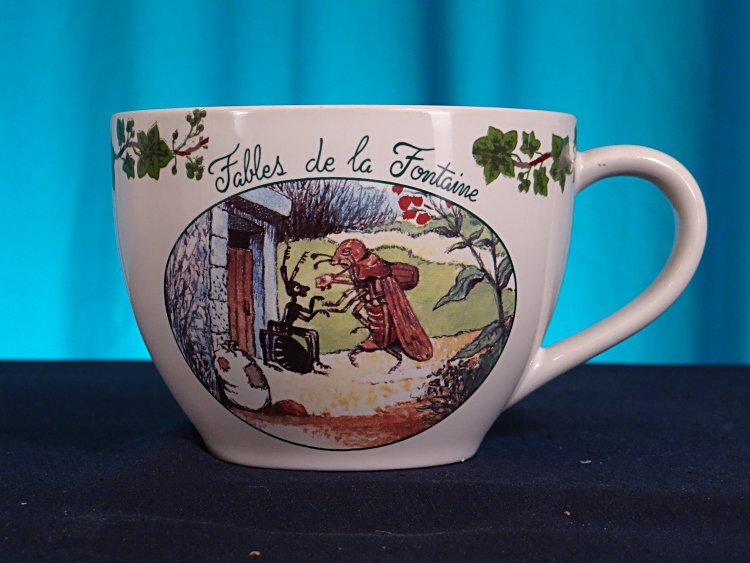
A handled cup 3 ½" high, 4 ¾" across the cup, and 6" across if one includes bowl and the handle. It features GA with the last two verses of the fable. The ant and grasshopper are distinctive in their black and brown colorings, respectively. One extra exemplar. Also one MM cup, illustrated like the bowl above.
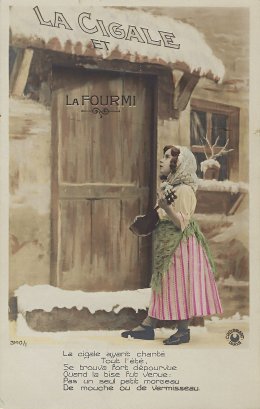
1910? Five (of apparently five) photographic postcards presenting La Fontaine's GA. Ch. Fontane, Editeur. Paris: Croissant. $50 from Bertrand Cocq, Calonne Ricouart, France, Sept., '18.
Compare this set with Croissant's similar work on both MM and TH. Here, as in TH, children carry the roles. I believe that the set includes only five cards because the lines of the verse fable are all here, in perfect order. Notice the unusual way of placing the title on the first card: one part on the snow-covered roof over the doorway and the other on the door itself. The gestures and poses of the cicada are revealing, from making music, to asking with an open hand to begging with folded hands, to turning away, to a last kneeling appeal. The color work is particularly exceptional on these cards. Are they hand-colored?
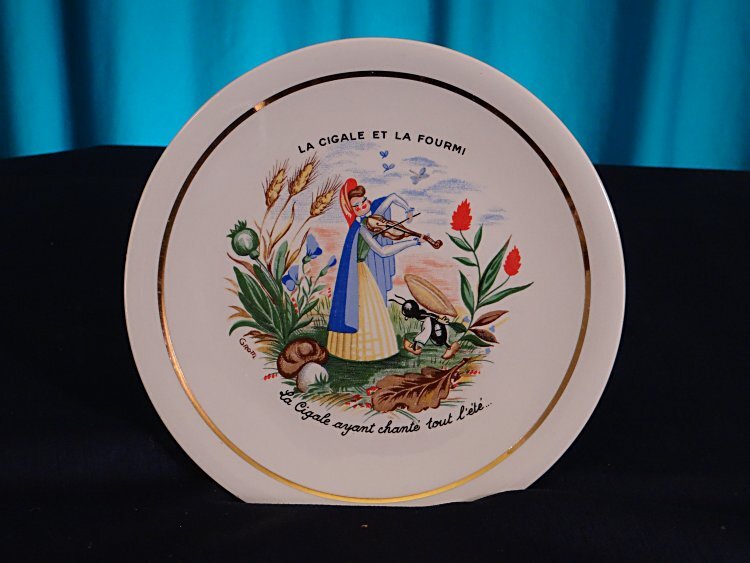
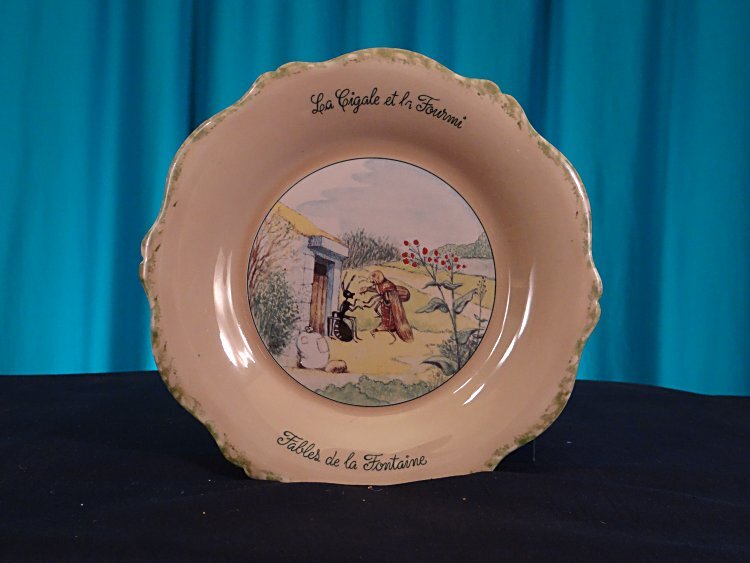
1920? Ceramic plate of GA by "Jars, France pour F & S." 10" in diameter. Scalloped rim. Tan with green edging, script, and illustration border around a circular full-color illustration of GA. "La Cigale et la Fourmi" and "Fables de la Fontaine" on the plate front. $12.87 from Charles W. Turner, through eBay, June, '04.
This colorful plate contrasts the brown of the grasshopper with the black of the ant. There is a sack, presumably of grain, in front of the ant's substantial home. Flowers and meadows seem to be blooming; is that appropriate for this scene, in which the grasshopper comes to the ant in winter?
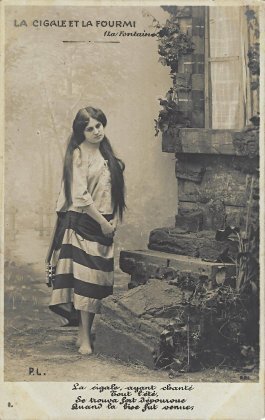
1905? Ten card photographic postcard series of GA, using the whole text of La Fontaine's fable. Numbered I-X. "P.L" and "R.P.I." on each card. $6 each from Bertrand Cocq, Calonne-Ricouart, Sept., '20.
This set is unusual for including ten cards rather than the usual six. It has every scene working from the same stage, and that arrangement may violate the fable for the cicada's summer singing, which here needs to be before the ant's window. Where did the ant get that fancy headdress? The ninth card looks as though the ant may be inviting the cicada into her protection in her cape. For me, the final scene is pictorially not clear. I believe that we are seeing the back of the ant as she walks away, rejecting the cicada and leaving her to the onslaughts of winter. The versos of all ten cards are blank. As so often, in French presentations of this fable, we see the cicada as a lovely young barefoot woman with a guitar.