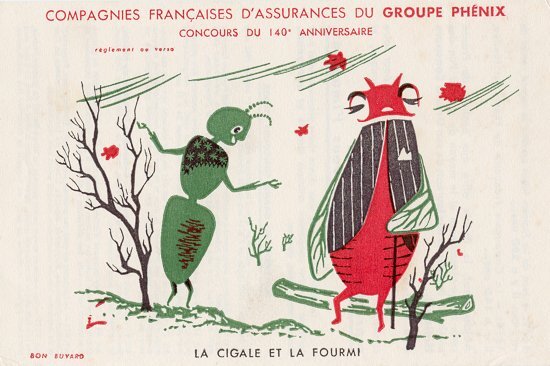
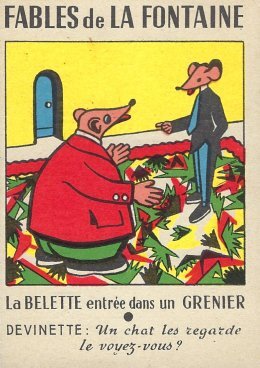
1959 GA blotter from Compagnies Françaises d'Assurances du Groupe Phénix. Concours du 140e Anniversaire. 8" x 5 3/8". $5 from Mme Denise Debuigne, Rennes, France, May, '02.
Green, black, and red paint the familiar scene, with winter's leaves sweeping about in the winds. This is one of the few blotters I have with writing on the verso. In fact there is a great deal of writing. It explains a competition for kids between seven and fourteen years old. They are to draw the phoenix of classical mythology for a variety of specific prizes. The deadline for entries (December 31, 1959) gives a rare help to someone dating a blotter like this one. I think that this is my first fable item announcing a contest!
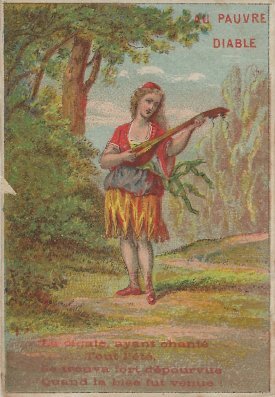
1910? Set of five GA trade cards. Two multi-colored cards featuring a young woman as the cicada in the cold and then knocking at the ant's door. Four verses of La Fontaine's fable are on the image side of each card. Earlier: "Au Gagne Petit." The second card is from C. Remontey in Paris and was printed by Clamaron.
The Remontey card is labeled "2" and the "Au Gagne Petit" card is labeled "A." I presume that the former follows a summertime card and precedes the approach to the ant's door in the "Au Gagne Petit" card. Though the formats differ slightly the coloring of the cicada's clothing seems to indicate that these two images are part of the same series. It is not clear that Card #3 belongs in t his series, even though the cicada's clothing seems consistent throughout the four images. #1, #2, and #4 are all advertisements for C. Remontey in Paris.
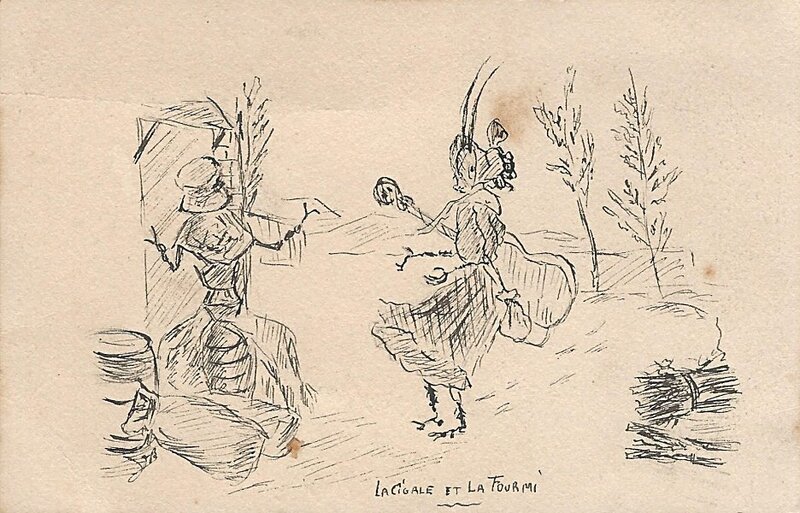
1906? Postcard featuring a black-and-white sketch of GA after Grandville. Apparently postmarked in 1906.
Might this card have been individually sketched? The copy -- or better transposition -- is quite good! It tells the usual story of the condemnation of an artist to starve.
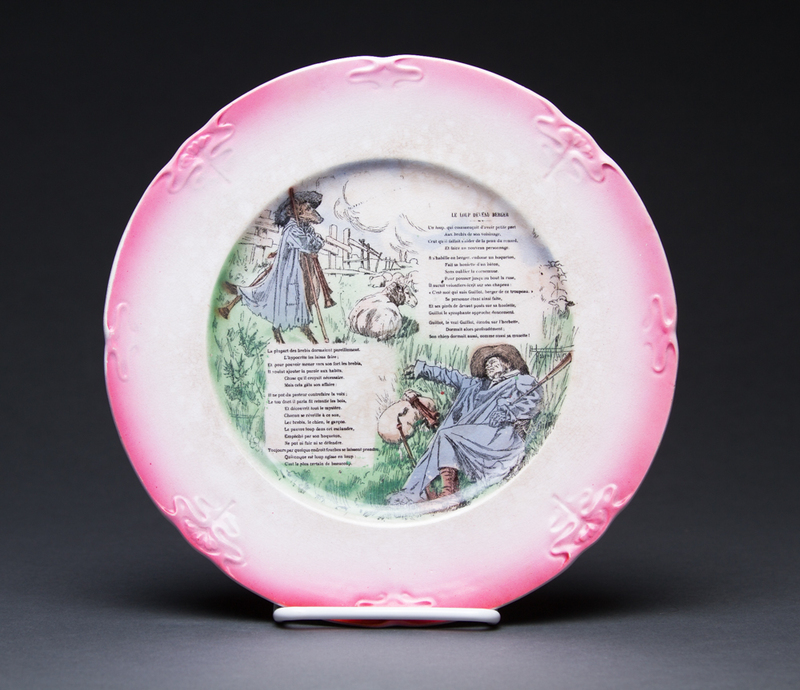
1900? 10 China plates. Robert Salles (?). Paris: G.D. $120 through Norsk European Wholesale Warehouse, Colnbrook, UK, Jan., '14. Extra exemplar of "L'Huitre et les Plaideurs"for $11.50 from Maureen Reese, Fleetville, PA, through eBay, Dec., '03.
Ms Reese guesses a date in the late 1800's or early 1900's for these lovely plates. She describes the piece as a vintage porcelain/ceramic plate measuring about 8¼" in diameter. There is a painted pink rim with an embossed floral design. In each plate's center is a fine colored depiction of a fable scene. Lovely hues -- maroon, tan, yellow, blue, flesh, and green -- color the scenes nicely. The fable texts are arranged in unusual fashion. They are divided into sections and appear at various places on various plates. The artist's signature is, as Ms. Reese notes, quite difficult to decipher. "Robert" seems clear, but the last name is presented in such an affected style that it is hard to decipher. The back has one or two apparent registry marks besides the "G.D. Paris" stamp. Several plates have clear numbers between "1" and "10" but on others, if they exist, they are hard to find. A lovely set!
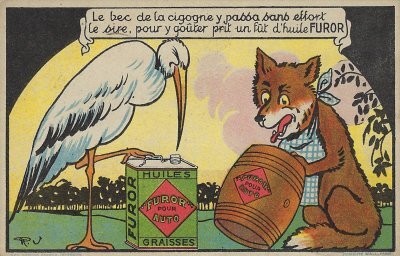
1924 Colored postcard advertising Furor Oil through FS. Signed by artist “R.V.” $12 from Bertrand Cocq, Calonne-Ricouart, France, Sept.,’ 20.
Bertrand describes the card as rare. The fox speaks: “The stork’s beak passes without effort here, Sir, but to taste itit takes a barrel of Furor Oil!” I wonder if “appreciate” might be a better translation of “gouter” here. The cartoon-work and the approach reminds one of Benjamin Rabier.
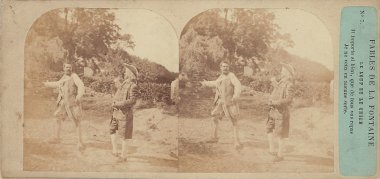
1900? DW stereopticon scene by Furne Fils et H. Tournier, Paris. No. 7.
Do I understand correctly that the left-hand figure is the wolf starting to run away? As La Fontaine says, he is still running! I acted too slowly when several stereopticon cards came up at once. This was the only one left!
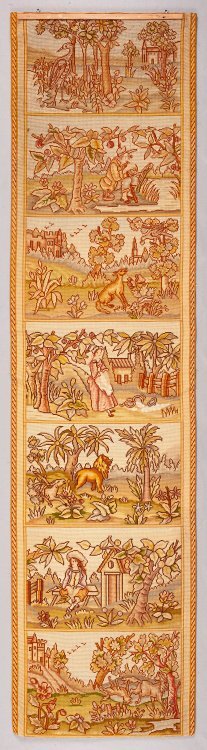
1900? Two long tapestries formed from panels presenting fables of La Fontaine. About 10' x 18". Backed substantially.
In the 1980's I visited, among other New Orleans antiques stories, Wirthmore Antiques, specializing in French country antiques. I noticed two tapestries. I asked the owner, Gay Wirth, if she knew that these were representations of the fables of La Fontaine, and I walked through the fables pictured there. Were the tapestries, I asked, for sale? "No," she answered. "They are for now part of our décor. But I will be happy to get in touch with you when we change the décor." I was happy to look forward to that day! In 2018, I happened to be visiting New Orleans again. In the midst of an enjoyable visit, I wondered whatever had happened to Wirthmore Antiques. It turned out that they still were in business, though they had moved from their original venue. I called, and Ms. Wirth was delighted that I did. "Oh, Father, we had lost your name. We still have the tapestries. Could you come tomorrow?" I came and she laid out those two lovely tapestries that I had loved at first sight. Ms. Wirth said she was impressed with the fable collection and wanted to contribute the two tapestries! What a great gift! On the train ride home, when I needed to move to visit the dining car, I remember carrying the tapestries, nicely bundled at the antiques store, on my shoulder. I would not let them out of my sight!
2001 Full Setanant Set of Four Fable Stamp Pairs from India. Mint. Never hinged. Both stamps in each pair are marked "400." $8.50 from Vasanthi Balson, Columbus, OH, through eBay, Oct., '02.One extra set from the same source at the same price at the same time.
The four stories are from Kalila and Dimna. Each is really two stamps that make up a single picture with two scenes. The art is somewhat Disneyesque, particularly in the scene of the lion looking down the well and seeing his own reflection. The artist has worked to integrate the two parts of each scene, e.g., with the sun that joins the two parts of TT and the tree that forms the edge of both scenes in "The Monkey and the Crocodile." These stamps are attractive!
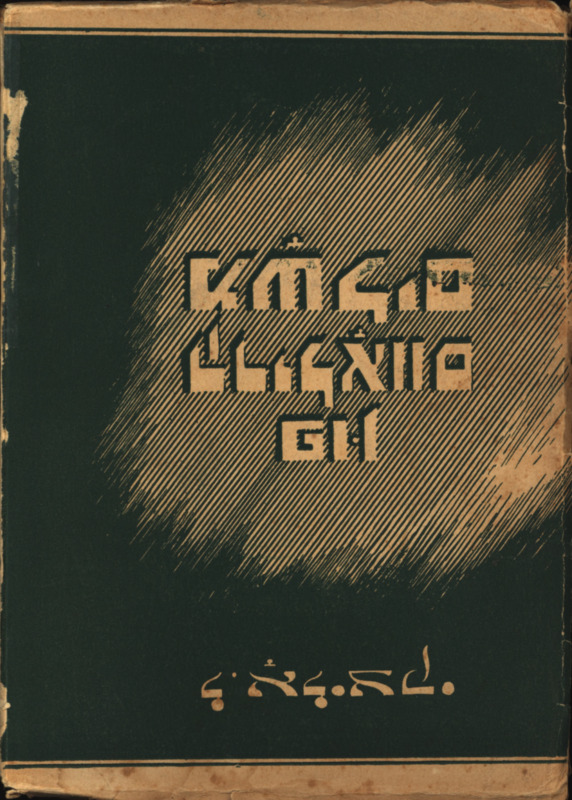
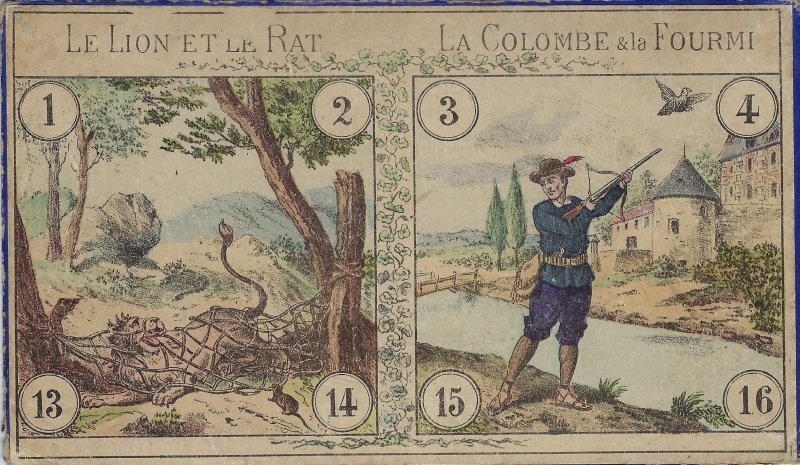
1880? Complete set of 12 cards with blue backing similar in format to the above two sets, but with two last cards with unusual and repetitive numbering. By MD Mauclair Ironside, according to the seller. €60 from Fabrice Carmier, Genay, through Ebay, May, '22.
Four of these cards duplicate those we have by Mauclair and Dacier, namely those beginning with 9, 33, 57, and 73. Six others fill in around them to form a perfectly numbered set up until the cards beginning 77 and 81. Those two cards, pictured here, have predictable numbers across the top but unpredictable numbers in either one box (77) or both boxes (81). Put together the first ten here and the last two from Mauclair and Dacier and we have a full and predictable set! These boards are somewhat bowed but still lovely.
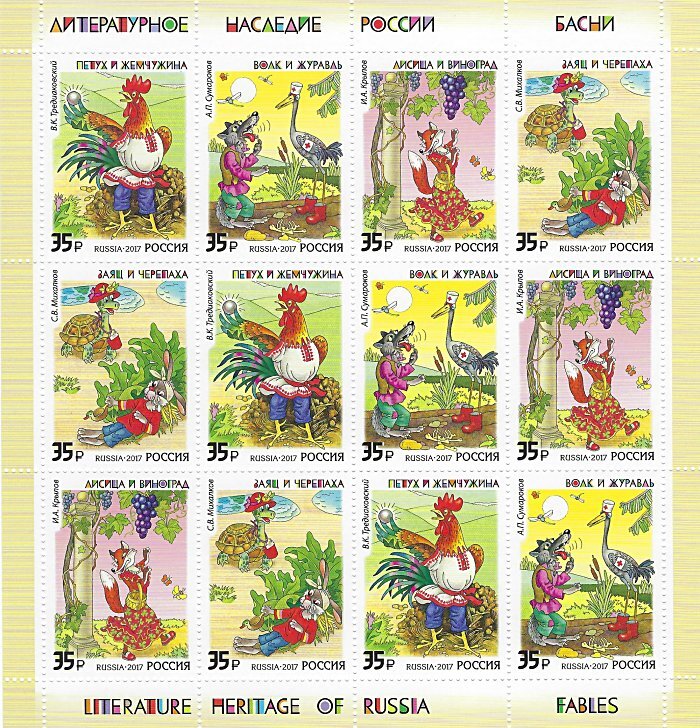
2017 Full 4x3 sheet of four "Literature Heritage of Russia Fables" stamps. 35p apiece. FG, TH, CJ, and WC. $14.30 from Alexander Tanakin, Moscow, through eBay, July, '18.
I think I know the particular value for philatelists of having a full sheet of a given stamp or series of stamps. I am not sure what it adds to produce the same stamps in staggered rows. This format gives Russians a chance to see the title in their own language and in English.
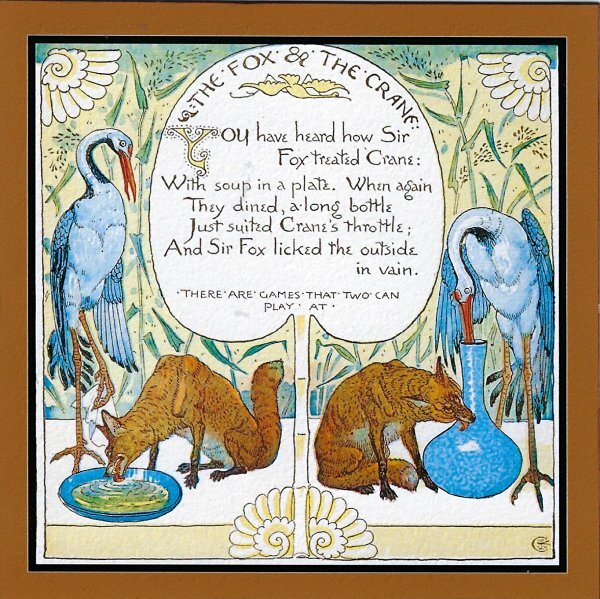
2018 FS Refrigerator magnet. 4½" square. With Walter Crane's illustration of the fable.
The detail in this reproduction is spectacular. Crane's two-panel approach appeals to me as the way to present this fable. As often, W.J. Linton's text is more comment than narrative.
2000? FS pressed glass dish. 5” in diameter. Source unknown.
This is a lovely little piece showing the stork’s revenge. I wondered what category it might belong to – small plate, ringdish, children’s set? I get two strong opinions on the web. Marcike Michl, SG, in a September 2010 listing describes it as a “Kleiner Teller” and guesses a date of about 1900. The best guess of the unknown producer is someone in France or Germany. Google describes it as a “vintage Westmoreland Glass Cup Plate. These small, pressed glass plates were produced by the Westmoreland Glass Company of Grapeville, Pennsylvania, which operated from 1890 to 1984.
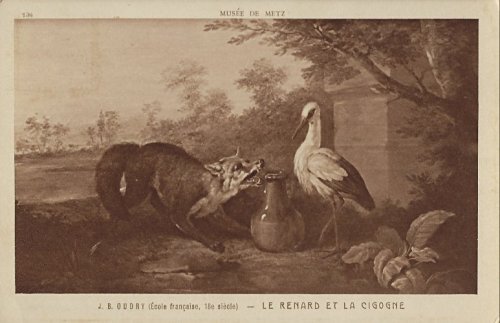
1912? J.B. Oudry, "Le Renard et la Cigogne.: Sepia-and-white photograph of FS painting. Musée de Metz. Metz: E. Prillot, Éditeur. $8 from Bertrand Cocq, Calonne Ricouart, France, Sept., '18.
Oudry is famous for his magnificent tapestry-like illustrations for the significant four-volume edition of the fables of 1755-59. Here he shows off his painter's gifts. The stance and expression of the fox, I would say, suggests the fox's appropriate dissatisfaction with his payback. The scenic background seems to me typical of the Oudry we know from those magnificent illustrations.
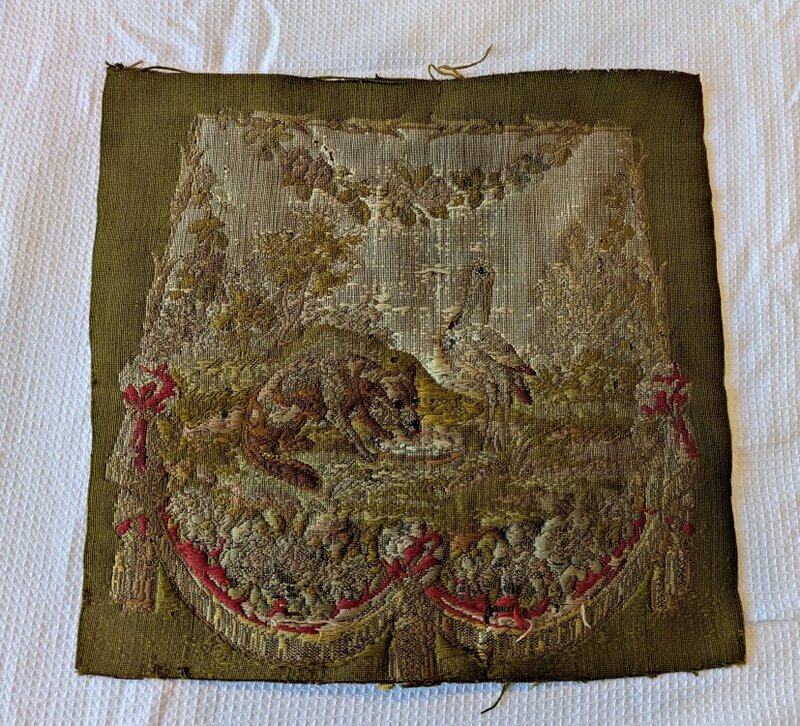
1850? FS Canvas Tapestry. Presumably made in Aubusson, France. 17” x 16.5”. Source unknown.
This well-worn piece still has a recognizable scene, with the fox lapping up his thin soup while the frustrated stork looks on, perhaps already planning some payback. Would a piece like this have covered a chair or pillow? Is it, as I believe, deeply worn?
2005 Four reprints of 1936 prints titled "Fruity Fables," from the magazine The Sketch. reprinted by An Englishman in LA, "the most unusual company this side of the 15th century." Each of the four is about 11" x 14". Artist G.E. Studdy. Between $6.99 and $14 each from the reprinters on eBay, July, '05.
As the company's commentary on the prints points out, the "vibrance of the printing and the beauty if its style" make these prints outstanding. There is a sauciness to the approach taken to the fruits.
1930? Three colored "hidden picture" trade cards featuring fable titles and pictures with hidden elements. Fructines-Vichy Delicieux Bonbons. One extra of "The Spider and the Lark." $15 from Bertrand Cocq, Calonne Ricouart, France, Sept., '18. Five more cards and three duplicates, all from Pharmacie Bouchez in Amiens, for €6 from chromosetcollections through Ebay, August, '22.
My attempts to solve these three pleasant cards ended with two of three easy successes and one tougher experience. Each card front defines what is hidden in its picture. Thus for WL, we read that the lamb's mother is not far away. Click on the image to see a larger version and on "solution" to see where I believe the solution lies in each case.
1890? One FK button. 1.2" in diameter. Unknown source.
This is our only FK button. The steels surrounding the "King" are the tops of reeds. One of them is missing. The button is crimped slightly. This metal button is stamped through the back. There is no other backing.
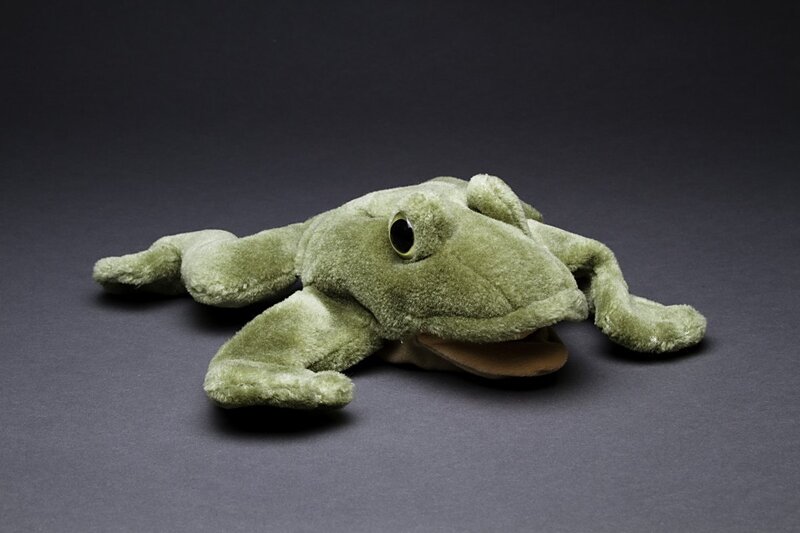
1985? Frog puppet with attached Aesop's fable "Is There A Doctor In the Pond?" Puppets With a Tale: Folktails" series by Folkmanis, Inc., Emeryville, CA. Made in Korea. Gift of Margaret Carlson Lytton, Christmas, '90. Extra exemplar with a detached card from a flea market, August, ’10.
The card attached to this frog in the “Puppets With a Tale” series tells the story of the frog who suddenly announced to the animals that he was a physician. A clever fox retorted “Well, I’m certainly no doctor, but it looks to me like YOU certainly could use one.” He elaborates on the frog’s nervous, jumpy behavior, his sick sounding croaking, crooked legs, and blotched and wrinkled skin. The four paws have patches of Velcro to put legs together. A clever manipulator can get fingers into the upper and lower jaws as well as both front legs.
1980? French wooden puzzle and stacking toy based on Aesop's fables. One fable image on each of the four sides: MM; "The Heron"; FC; and TH. 8" high and 3½" square. $36.89 from FrenchVintageBibelot through Etsy, Dec., '20.
Ingenious and delightful! I wonder if this is a "one-off" created just once. Or was it a manufactured toy made many times over? Ten "storeys" make up four different images. Watch out! Solving one side does not solve the others! Of course, getting the solution "wrong" makes for some surprising characters!