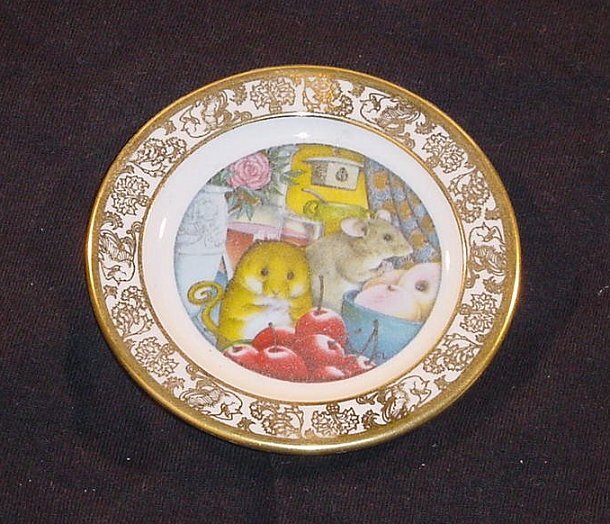
1982 Franklin Porcelain miniature plate. The Best Loved Fairy Tales: The Town Mouse and the Country Mouse. Carol Lawson Signature Edition. A Limited Edition of Fine Bone China. #41 of 50 designs. $7.95 from Simply Wonderful Gifts, Bend, OR, through Ebay, July, '00.
The rim around the circumference of this 3¼" miniature plate is done in a dove pattern trimmed in 24K gold. The inside 2" circle shows the two mice enjoying fruits. To see a larger view of the plate, click on the image.
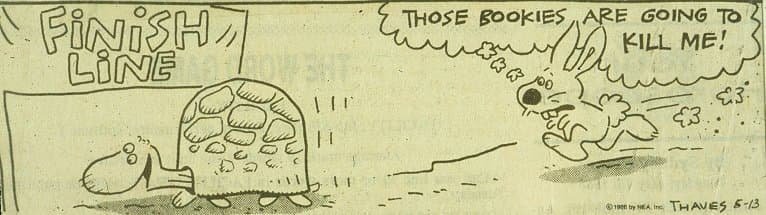
1986 Frank and Ernest. TH cartoon. "Those bookies are going to kill me!" exclaims the frantic hare approaching the finish line with the tortoise leading him. Dated 5-13. Copyright 1986 NEA, Inc. Signed "Thaves." Unknown publication and source.
This is one of the funniest fable cartoons I have encountered. People respond to it immediately in lectures in which I have shown it.
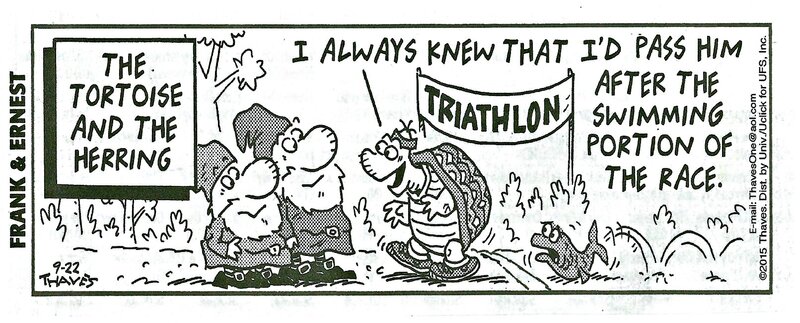
2015 Frank & Ernest comic. “The Tortoise and the Herring.” Triathlon. “I always knew that I’d pass him after the swimming portion of the race.” Photocopy. Thaves. Distributed by Univ./Uclick for UFS. Unknown source.
The tortoise announces proudly at the end of the triathlon as the herring comes bouncing along behind.
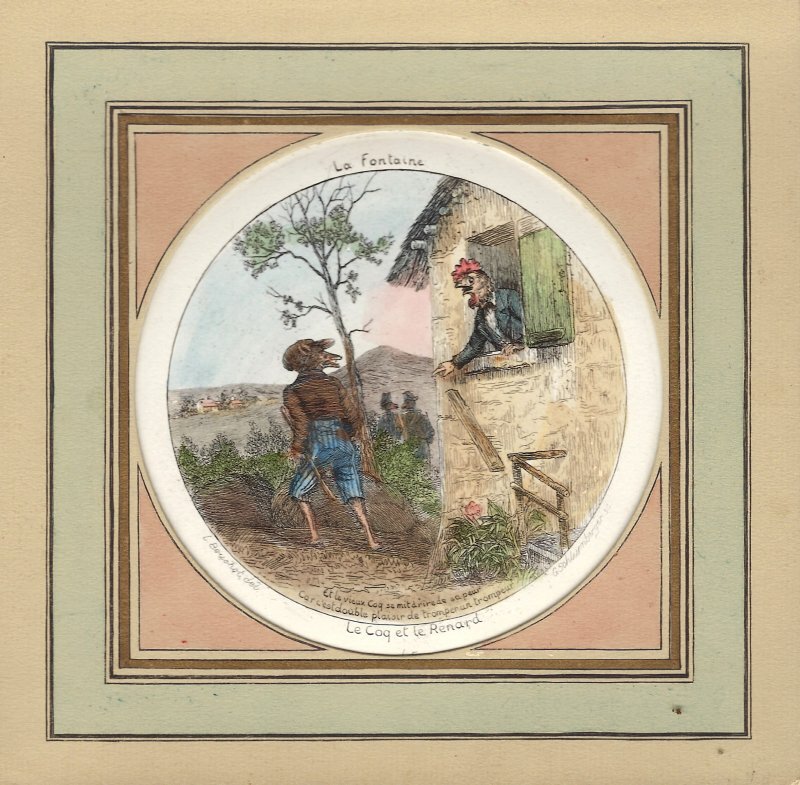
1850? Three matted circular colored engravings of fables of Jean de La Fontaine. €150 from lefennec205 through Ebay, Sept., '22.
Our collection has abundant editions using black-and-white illustrations from François Bouchot, but here are three lovely engravings in color. I fear that it is hard on the web to render the detail I find in this well-executed illustrations!
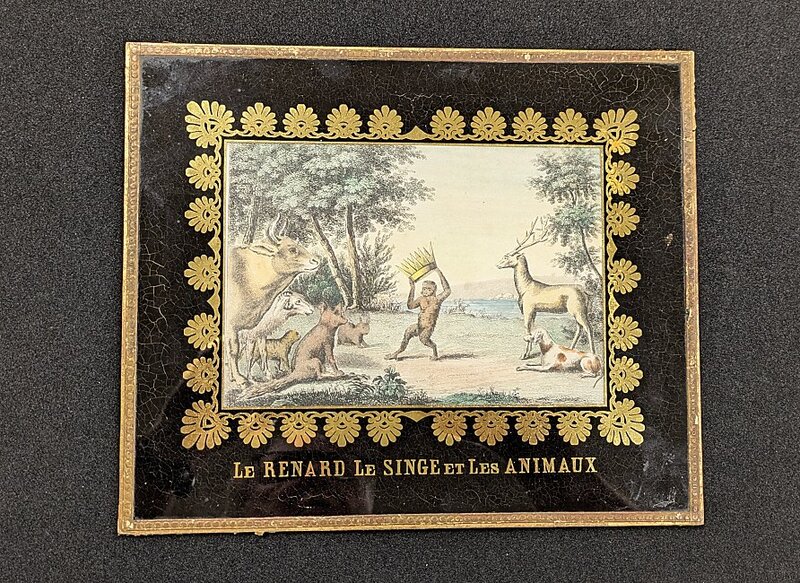
1834? Matted, framed in glass illustration of La Fontaine's "The Fox and the Monkey," apparently by Emile Joseph Alexandre Gouget. 10.5" x 8.75". Unknown source.
Here is a fifth form in which I find Gouget's work. In this case, someone has apparently separated Gouget's illustration and hand colored it effectively. The text that would have occupied the lower half of Gouget's page here becomes the verso, enhanced by the swirls that mark his fable work. The illustration finds the monkey at the "before" in this fable, where he seizes the crown. Soon he will be caught in shame in a simple trap and lose his claim to be king. Foxes do that sort of thing! The framing work was done by Romain Barillier in Paris.
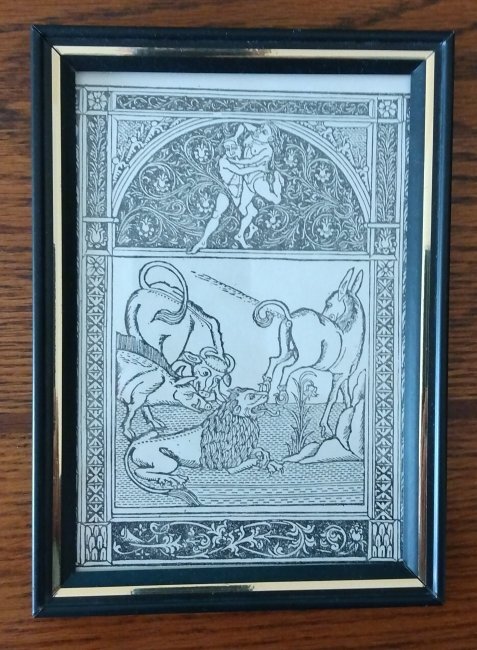
1988 Framed Xerox copy of Francisco del Tuppo's illustration for "Animals Paying Last Respects to King Lion." Gift of Rev. Michael Zeps, S.J., July, '88.
This is an object where fable-collecting connects with other big things in my life. One of those things that I have done less well than others is to serve as a superior in several Jesuit communities. The object here is a framed Xerox copy of Francesco del Tuppo's 1485 image of the animals attacking the sick old lion. They are, one after another, paying him back for his heavy-handed rule over them. They can do so now that he is weak and in his last days. The lion understands it from others but is particularly insulted by being humiliated by the donkey. My good friend Fr. Mike Zeps, S.J., was charged with giving a farewell speech as I finished a difficult stint as a Jesuit superior -- difficult for me, and probably even more difficult for many of the Jesuits there. To offer a gift fit for its recipient, Mike actually went to the public library and found Taplinger's "The Life and Fables of Aesop" with del Tuppo's illustrations and chose this image of "saying good-bye." Mike knew my taste well enough that I would enjoy the wit of the selection. Notice that the donkey is not only kicking the lion in the mouth. He is also expressing himself with another bodily reaction. Fable can bring wit and even a kind of consolation to a tough moment!
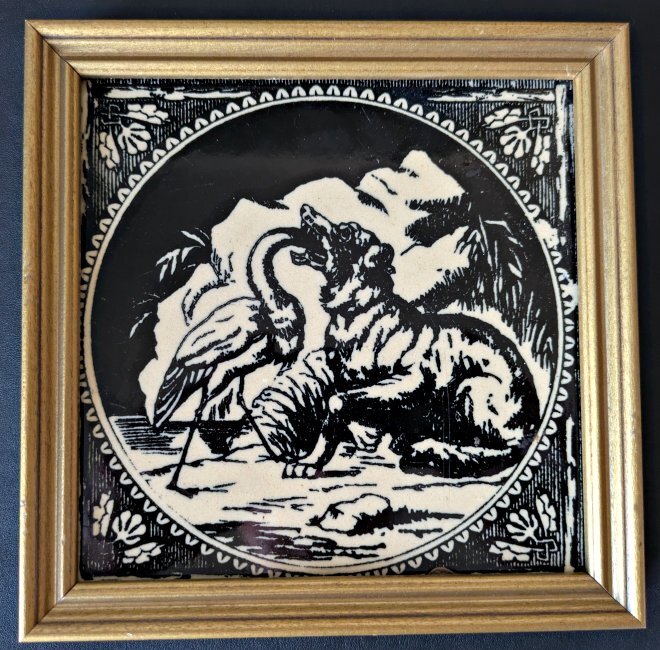
1860? Framed Tile of WC. Stoke on Trent: Minton Hollins & C Patent Tile Works. Unknown source.
This rendition of Samuel Howitt's WC from 1811 is very dark. The tile is loose in the frame. It was fascinating to piece together the printing on the "waffle" back of the tile. I am surprised that we have not yet found other such Minton tiles.
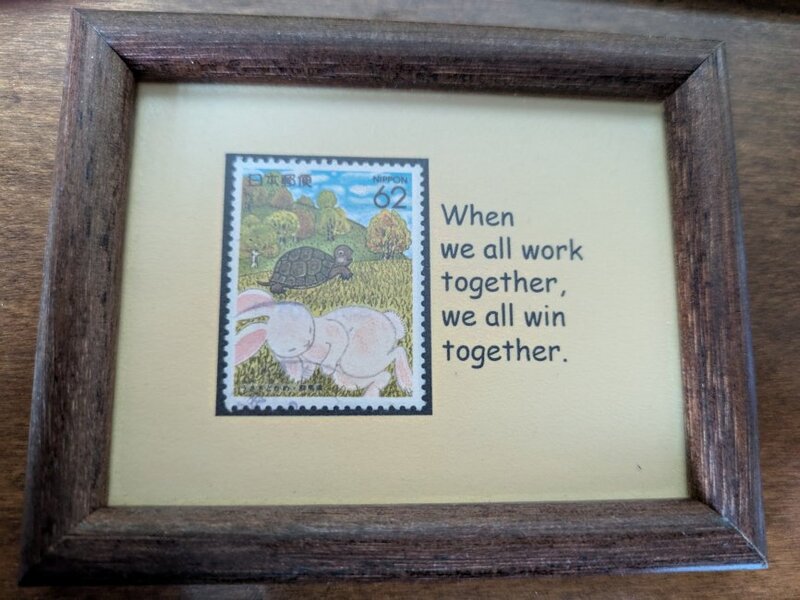
1991 Framed Japanese Postage Stamp with Moral. "When we all work together, we all win together." 4" x 3.25". Unknown source.
Now here is a curious find, given or found perhaps years ago. It is a genuine Japanese stamp of which I had not know previously. I promptly bought a copy! It is framed with a moral, perhaps a creative moral for this fable. Its back has this legend: "Magnet Postage Stamp Art," "Handcrafted," "Genuine postage stamp." There is also a company name with an online address. Both seem to have disappeared. The magnetic strip on the verso may not be (any longer) strong, but I presume that that is the "magnetic" feature. The stamp is listed as "JAPAN Sc#Z113 1991 Kunma." I continue to be amazed not only at what we find but what we have found!
2000? Framed FG original painting. Kai. 296/500. 4" square. Gift of Margaret Carlson Lytton from the Libreary of Congress Gift Shop.
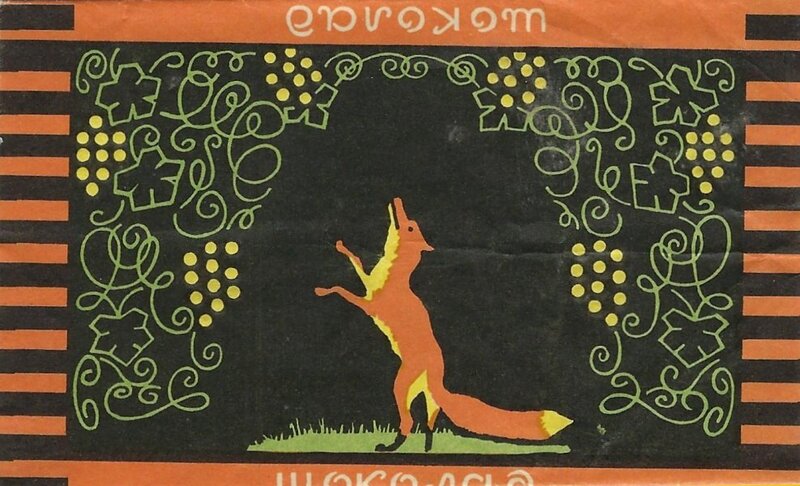
Beautiful, delicate work! The image is about 1.5" square. This fox seems quite self-possessed. And those grapes seem so close! Is this the same Kai that is on Etsy and Markowicz these days? I am disappointed that, although there were 500 copies of this work, none of the others show up on the web.
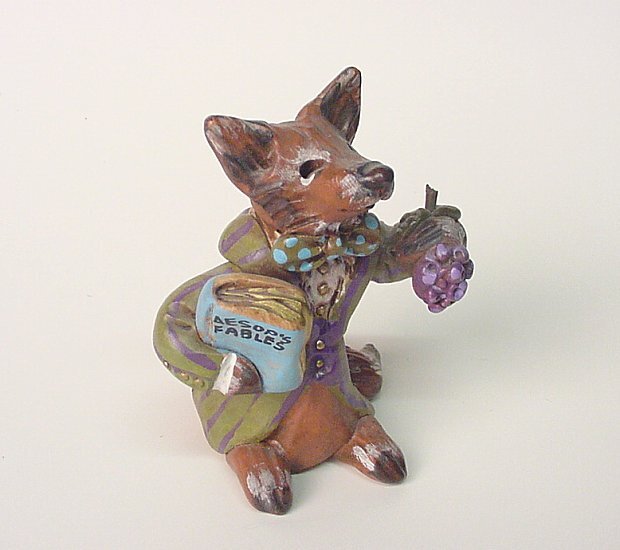
1986 Fox holding grapes. 3¼" high. Pat Lane Diaz, Wausau, WI. West Allis Craft Fair.
Here is a little mastepiece! This is perhaps the only time that I have seen the fox holding the grapes. Did he perhaps go out and buy them?
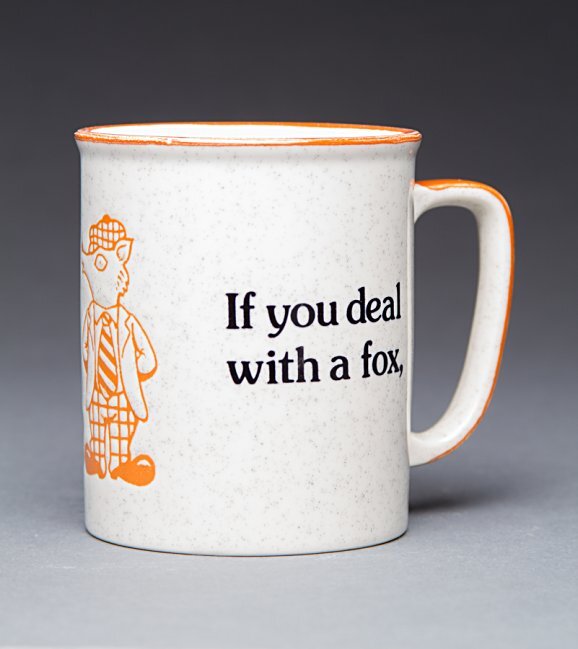
1995? Gray and brown cup with black lettering and brown figure. "If you deal with a fox, think of his tricks. Jean de La Fontaine." Made in Japan. Annamieke Laport, Salem, OR, through eBay, August, '
A good question would be: "Which fable of La Fontaine does this come from?" Often the fox in La Fontaine seems wise but comes up losing, as when the cat does better with its one trick of climbing the tree than the fox does with his hundred dodges. The crow in FC can certainly learn frm the fox's tricks. The fox on this cup has a suitcase -- or at least a valise -- ready to go.
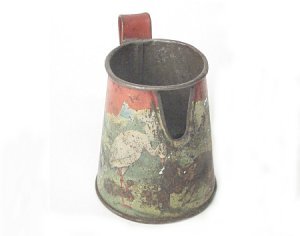
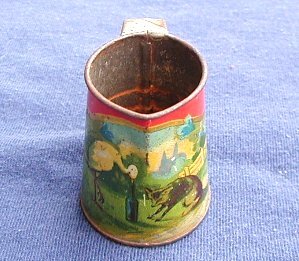
This teapot, just over 2" high and with a handle going even higher, is missing its spout. It has the same FS scene as above, though some heavy rust obscures it. $5 from Marlene Schmidt, Readlyn, Iowa, Nov., '00.
This handled pitcher stands almost 2" high and displays FS against a bright red litho and blue flower background trimmed in gold. In all of the FS scenes here, the stork has his beak well down into what looks like a bottle, which the fox watches intently. $40.99 from Jo-Ann Deacon, Hamilton, Ontario, through Ebay, Feb., '00.
1890? Circular pin with an unusual view of FS. 1” in diameter. Safety clasp on the verso. Verso reads “Nur Schein Invite. 67.” Unknown source.
This pin reproduces an image found on one of two German verse coins in the collection. Together they offer a “before” and “after” in the FS story. The verse there urges not to make fun of a competitor. Here the German seems to say perhaps “Appearance only invites” or, more literally, “Only appearance invites.” One web reference suggests that there is a second pin with an image like that on the second coin.
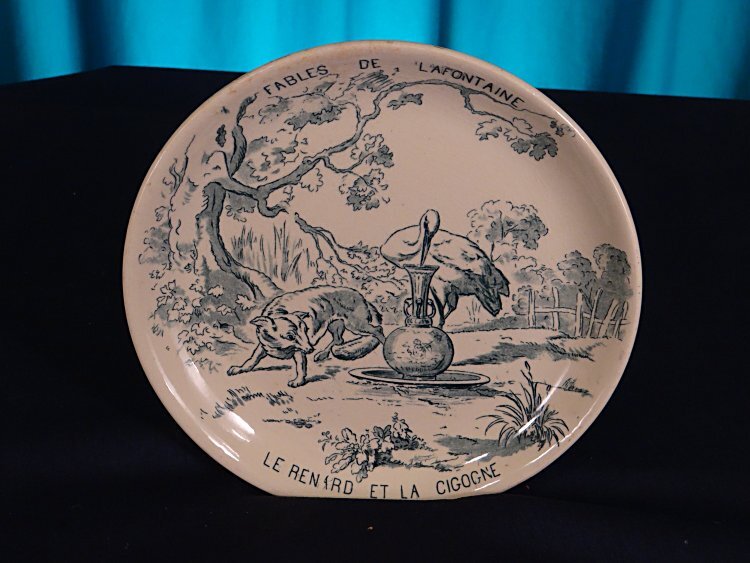
1920? 8" cream-colored plate with a blue-green colored design depicting FS. The plate reads "Fables de LaFontaine" and "Le Renard et la Cigogne." The back stamp reads "Porcelaine opaque de Gien." There is a registry mark on the plate's back. $35 from Linda Leffingwell, Doyestown, PA, June, '11.
The block lettering is typical of Gien work. Though the scene is the fable's second phase, in which the stork is turning the tables on the fox, the artist manages to position the stork's tall vase inside of the fox's shallow soup-bowl. The fox looks on, perhaps noticing the enticing and edible creature suggested inside the vase. The scene covers the entirety of the front of the plate.
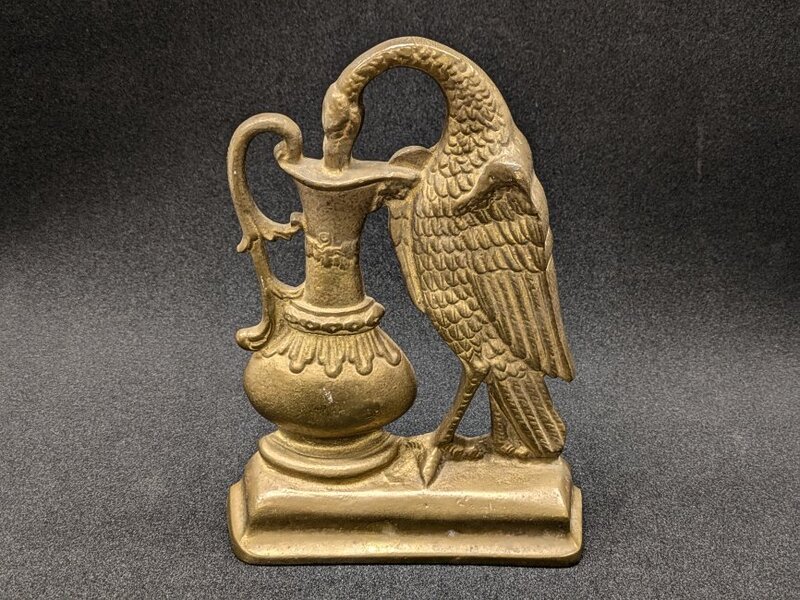
1900? Heavy brass doorstop presenting FS scene of stork eating from a vase. 10" high. Unknown source, date, or price.
Now here is a surprise. This object is one of those acquisitions about whose information I was not careful at a busy time. I needed to find out what I could. I am thankful that I tried Google Images. The page lit up with many exemplars of exactly this doorstop. The variety among the offers was remarkable especially on two counts. The fowl here is variously characterized as a ho ho bird, a crane, or a swan drinking from a ewer. The prices range from $99 to $500. It all makes me even more curious to find out how I acquired our exemplar!
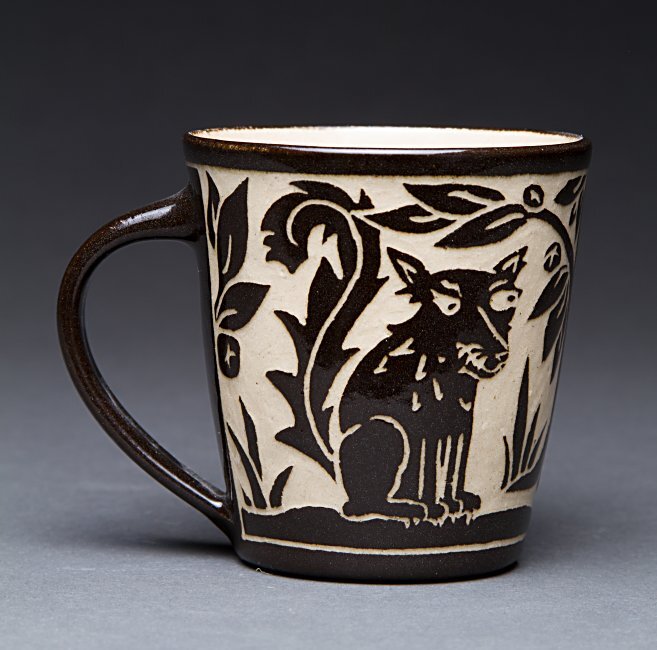
2000? Brown and cream cup featuring FS. Katherine Hackl, Spindletop Studios, Stockton, NJ.
A fox with an attitude looks directly at a peaceful stork standing over a vase. Plants fill in the open spaces on this almost geometric cup. The base of the cup is stamped with a fish.
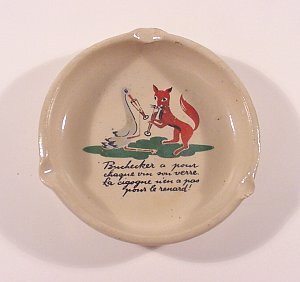
1960? Salt glaze ash tray presenting FS. Buchecker Co. Excelsiorwerk, Lucern, Switzerland. $6 from Jack De Foe, Peoria, AZ, through Ebay, April, '99.
The stork eats and drinks while the fox can only look into his long, tall glass. The legend underneath the scene reads "Buchecker a pour chaque vin son verre. La cigogne n'en a pas pour le renard!" "Buchecker has for every wine its own glass. The stork did not have the right one for the fox!" I take it that Buchecker is a glass-supplier for wine bars. Their description on the back says that the produce glass, porcelain, and crystal for restaurants, hotels, and bars. What a lovely little bit of Aesop to show up on a bar counter!
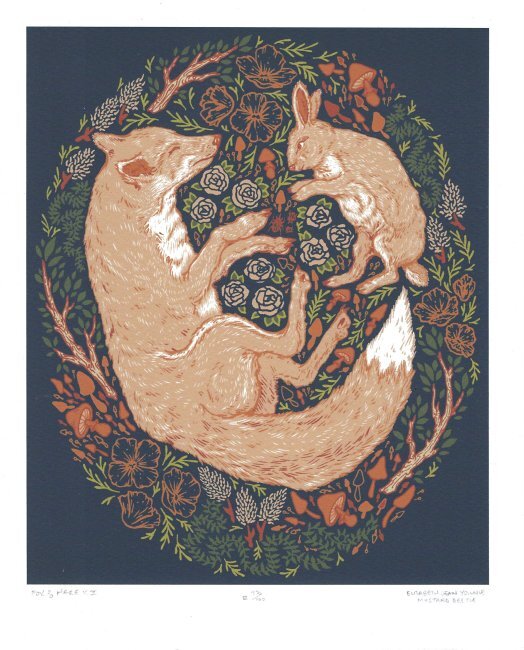
2024? Limited edition print "Fox and Hare V. II" by Elizabeth Jean Younce for Mustard Beetle, Los Angeles, CA. #72 of 100. 8" x 10". Gift of Sonja Carlson, Dec., '24.
What a delightful gift! The artist's structuring puts the two animals together in an oval. The woods surround and separate the two. There seem to be many stories of the fox and the hare. There is a story among traditional fables catalogued by B.E. Perry as Perry #333, Chambry #192, and Gibbs #596. In this fable, the fox says to the curious hare 'If you don't know my arts, I will have you to dinner so that you can get a taste of my art.' When the hare arrives, he finds that he is the dinner. I would also add a widely known story, as it is retold online by Randall Craig: "An old master was with his disciple walking in the woods, when they observed a hare being chased by a fox. The student observed that it would not be long before the hare would be caught, and eaten by the faster (and probably smarter) fox. The master replied that this particular rabbit would get away, and that they should stay and watch. Sure enough, after five-ten minutes of watching, the rabbit did get away, leaving a tired (and probably hungry) fox." The moral commonly drawn is that the hare was running for his life, while the fox was running for his lunch.
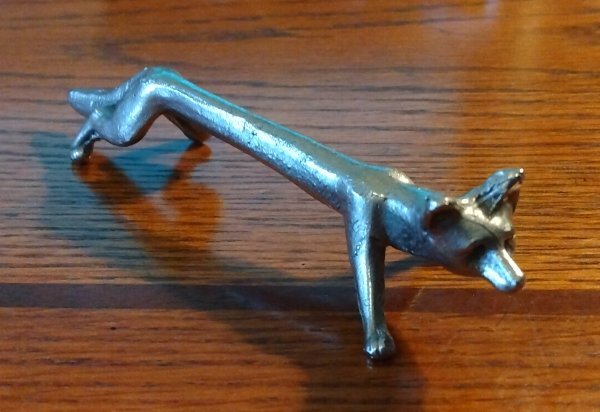
1990? Two knife-holders presenting a fox and a hare. 3½" x 1½" (hare) and 4" x 1". Unknown source.
The elongated bodies fit with their role as knife-rests. Is there a fable of a fox and a hare? Yes, says Northcote, who presents this story: " A little timorous Rabbit, who had a safe retreat in his burrow underground, had often perceived an artful Fox lurking near the spot, as if watching for the first opportunity to seize and devour him. However, he lay secure for the present, as the Fox could not enter the small burrow. One day, soon after, the devoted Rabbit saw the Fox in deep confabulation, and seemingly in great amity with the Weasel. This, he conjectured, boded no good to himself, as he found but too soon to be the case; for presently after the Weasel entered his burrow, and attacked him with such fury and fierceness, that he had no other chance of saving his life but by flight. But no sooner bad he darted from his burrow, than he immediately found himself seized on by the Fox; who, together with the Weasel, began to tear him in pieces, when thus the unfortunate victim of their arts, in his dying agonies, uttered his complaint: “I foresaw that my doom was determined on when you two counseled together.” I presume that I acquired these as fable knife-rests. I have not been able to identify a larger set to which they might belong.