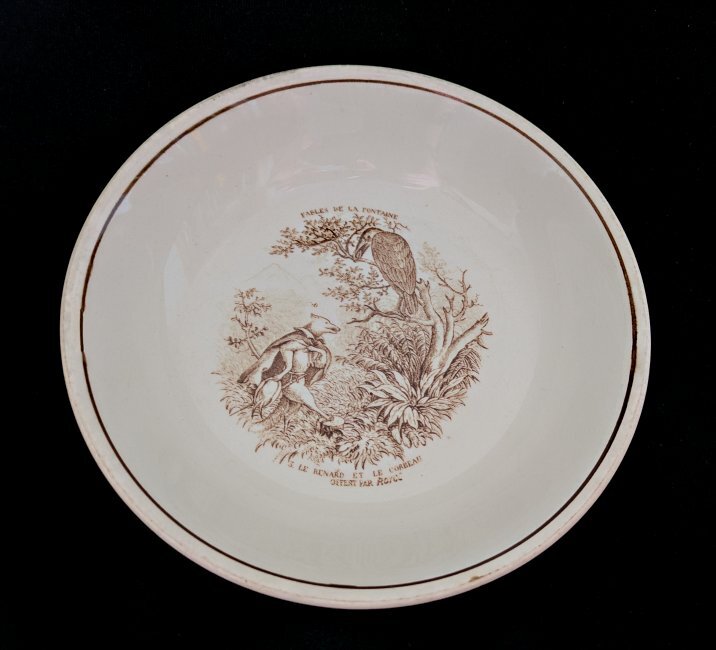
1930? 7¼" white bowl from Sarreguemines, France. 1.5" deep. Inside the bowl there is a brown presentation of FC. The front carries three inscriptions: "Fables de la Fontaine," "Le Renard et le Corbeau," and “Offert par Royce.” The back has the usual Digoin stamp. From an unknown source.
In this case the series moves away from Grandville to Royce. Renard admires below with his hat in hand. Was Royce an adapter of Grandville's work?
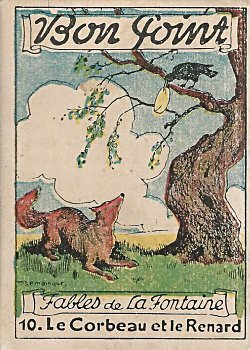
1930? 1 small (about 2" x 2¾") colored "Bon Point" card illustrating La Fontaine's FC. #10. Phosphatine Falières. L. Bellenand et Fils.
Here is an example of simple colored printing that is not exact. I presume that "Bon Point" indicates a prize card. The verso includes the moral "Tout flatteur vit aux dépens de celui qui l'écoute."
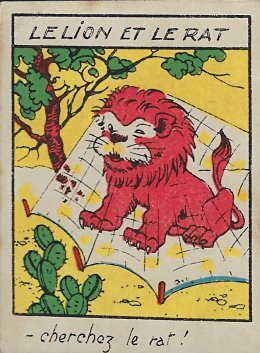
1900? 3 small (2⅝" x 3") cards with four-color images including a hidden picture. Each has a statement identifying the hidden character. $5 each from Bertrand Cocq, Calonne Ricouart, France, Sept., '20.
Part of the challenge with hidden-picture cards, as I am learning, is "Am I looking for an abstruse image or a terribly simple one?" The scale of expectation can vary even within a small set, as I believe it does here. The clue-statements here are "Look for the rat!" and "The wolf is looking for the lamb" and "The wolf is not far away!"
2022? Four wall hangings of images lithographed on tin. About 8” x 11½”. $15 each from Joshua Joshua Jacobovits, Shiloh, Israel. Jan., ’25.
This is a first in our collection. Three of these four use standard traditional images, including one from Rackham and one from Boutet-Monvel. The image from the latter, FS, seems unfortunately cropped short. The other image is a lively presentation of FC. I am unsure just how the creators thought these tin plates would be used.
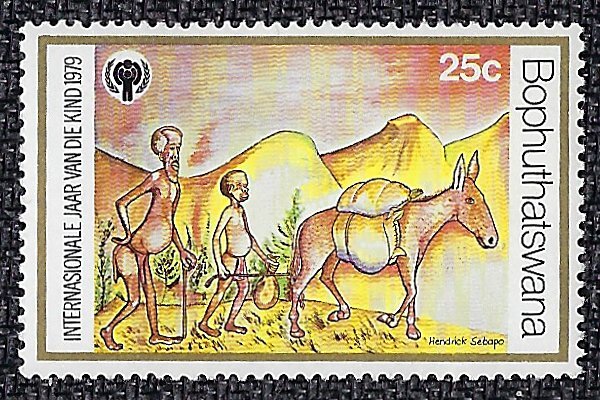
1979 Four stamps celebrating the international year of the child, 1979. Botswana appears as Bophuthatswana. Stamps have textual material in English or Dutch. Value of each stamp ranges: 4c, 15c, 20c, and 25c. The 25c stamp features two humans walking with a donkey or mule, which appears to have significant burdens. Unknown source.
Might the story behind this stamp be MSA? It would only be a sign that Aesopic stories get around!
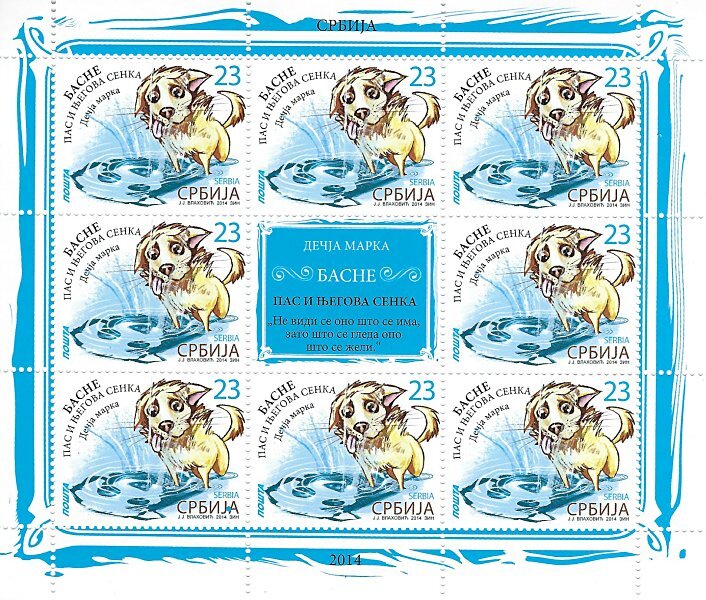
2014 Four Serbian stamps. Decia Marka. DS (23), FC (35), CJ (46), and "The Tortoise and the Eagle" (70). "Basne." Apparently the art work is done, two by J.J. Vlahovic and two by M. Pachovich. Scott 680-683. Multiple copies from several vendors, including 3x3 sets of all four from Prvoslav Jahkovic, Krusevac, Serbia for $35.96 in September, '14; individual stamps from Michael S. Kott, Schaumburg, IL, for $3.25, April, '16; and strips from 2430psmlj@gmail.com for $16.22, Sept., '15.
Four lovely images. Great color work, especially on FC and CJ! I had not known that a unit of stamps for collectors is the sort of 3 x 3 square that we find several times here. I remain amazed at how many countries have found their way to including fables in stamps. There is no indication here that these four basic stories came to Serbia through La Fontaine or through Krylov.
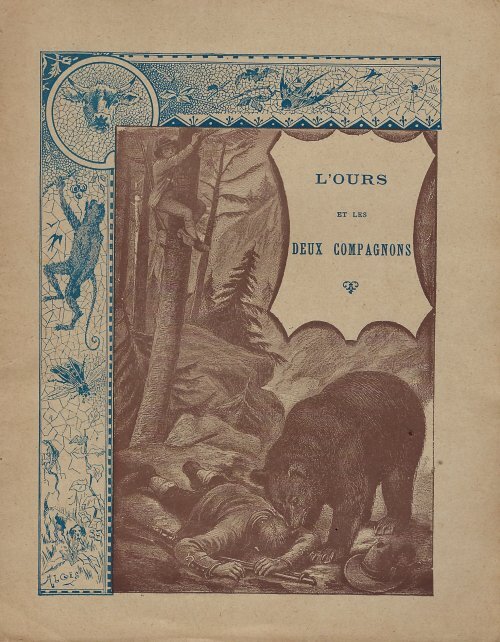
1895? Four schoolbook dust-jackets published by C(amille) Charier in Saumur, France, depicting fables: “Wolf Become Shepherd”; TB; TMCM; and WC. $10 each from Bertrand Cocq, Calonne-Ricouart, France, Sept., ’21.
Fragile and beautiful old book covers, different in style from many that come later. A monochrome fable illustration with an open space for a title is set inside a large monochrome border at the left and top. This border is uniform in these four exemplars, though its color varies. It is signed by “Algis,” as is the monochrome inset of WC. TMCM and “Wolf Become Shepherd” are signed by “G. Dascher.” “C. Charier” seems to be the publisher. One can find other cards or illustrations by Charier on the web. Many seem to be about WWI. Neither Algis nor Dascher shows up in our collection otherwise. Someone seems to have colored portions of the fleeing mouse in TMCM.
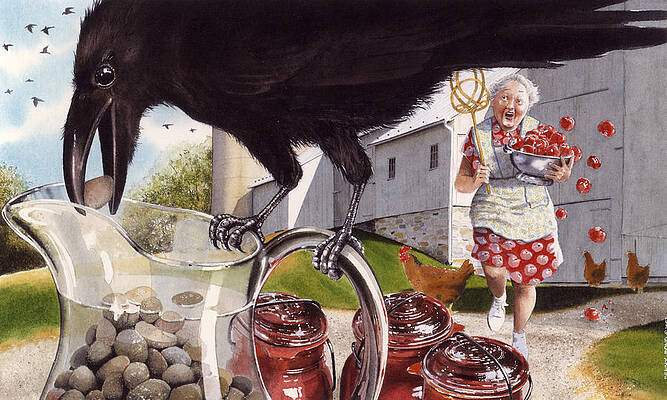
2022? Four prints 12" x 8" (image size 10" x 6") for $21.88 each from FineArtAmerica through Etsy. Archival Matte Paper, Nov., '24.
I was first attracted to Bond's "The Man and his Sweethearts" (see below) and then found the other three highly imaginative approaches to standard fables. I will offer a comment on each below.
CP: Is Auntie upset that some bird has requisitioned her pitcher of water?
"Frogs and the Well": Is not the "hero" of this fable the frog lurking at the top, wondering if this plunge is wise?
TH: Perhaps the most surrealist of Bond's fable prints, both in the turtle like a baseball catcher and the head of the horizontal sleeping human. Does the sleeper's position echo that of the column-person underneath his bench?
2W: This print tells the story dramatically. The competitors are nicely contrasted in a number of ways. In the enlarged version (click on the image), notice the hairs on the man's shirt, pants, and jacket.
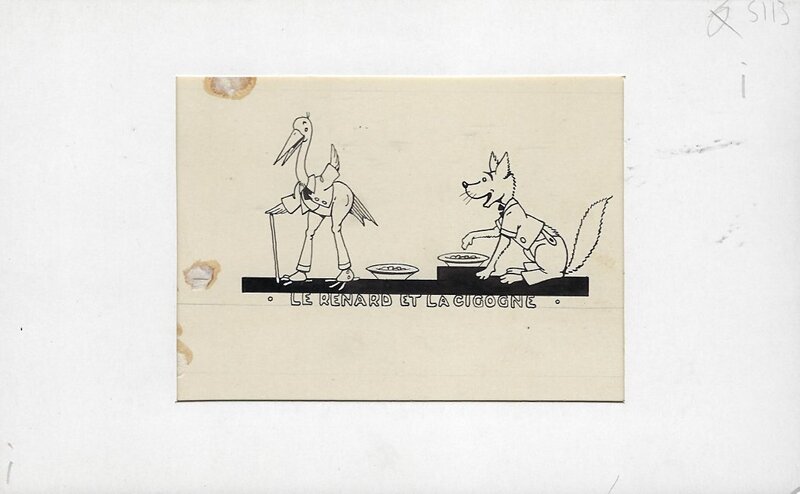
1960? Four original pen-and-ink drawings of Aesop's fables, about 4" x 2½'. FS, FC, TH, and WL. €60 at Daniel & Lilli, Saint-Ouen Flea Market, June, '19.
How surprising to find four original "India ink" drawings in a shop specializing in buttons on a hot weekend afternoon at the Marché des Puces! These drawings are quite clever. The stork is turning down the fox's soup without even trying it! The fox is holding out his top hat to catch the crow's cheese. The hare is catching butterflies while the tortoise crosses the finish line. The wolf at the river carries a big stick as he accosts the lamb with his jacket and neck-kerchief. The lettering is so perfect on these four drawings that I wonder if they were not printed. In any case, I delight in them!
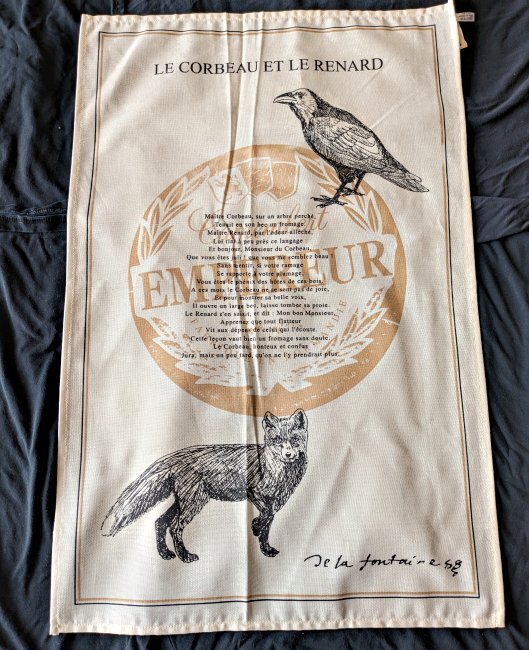
2000? Four matching cloths of La Fontaine’s Fables from le Musèe de la Fontaine. OF; “The Heron”; TH; and FC. Pure cotton. 18.5” x 28”. Le Musèe de la Fontaine. Distributed by Tradilinge. Unknown source.
These four cloths offer texts in black, central figures in black, and brown background in a very pleasing combination. What are these cloths meant to do, other than to represent La Fontaine’s fable beautifully? I learned from investigating these cloths that L'Empereur is a soft, washed rind cheese made with pasteurized cow's milk.
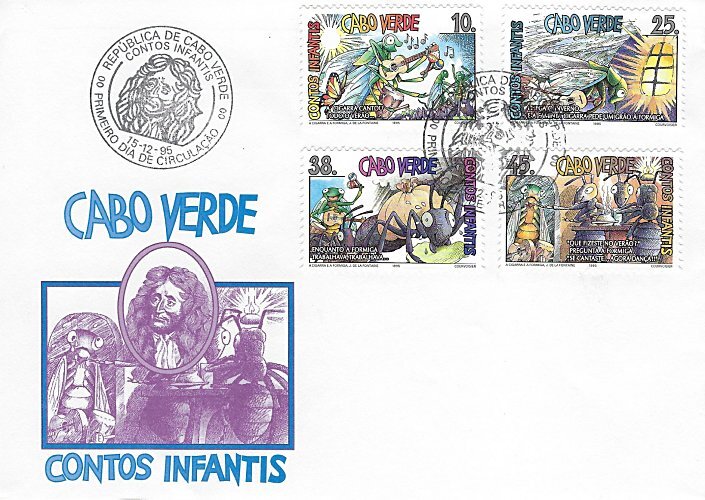
1995 Four GA stamps celebrating the 300th anniversary of the death of Jean de La Fontaine. FDC from December 15, '95. On an FDC envelope celebrating "Contos Infantis" with an image of the grasshopper and ant, including a cameo of Jean de La Fontaine. From an unknown source. The denominations of the stamps are 10, 25, 38, and 45. "Courvoisier."
The style of the images is that of graphic novels: lively, colorful. In the first image, the grasshopper is making music with the help of maracas. The second presents rain and the warm light of the ants' home. The third, perhaps out of order, shows the ant working hard. The fourth has the grasshopper standing at the door, crying, and being rejected. "Dance!" Each stamp has a bit of the narrative in block letters.
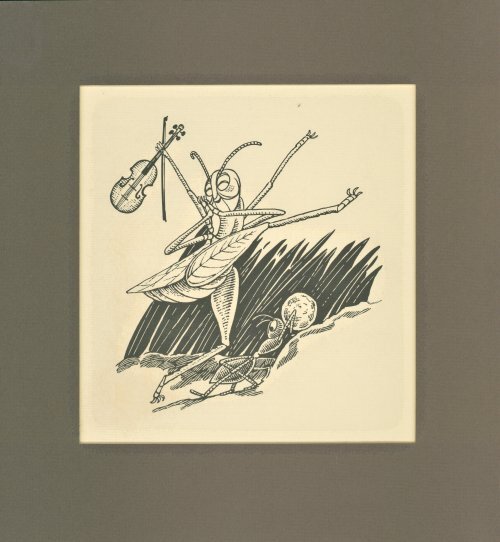
1980? Four large matted prints of GA. Various sizes. Unknown source.
I enjoy this creative approach to the story, particularly the scene in which the grasshopper is using his violin as firewood. So far I have not been able to uncover an artist. Of course I wonder if there are not more prints in the series, including perhaps a print of rejection by the ant. The prints range from 7.25” to 12” across, with matting bringing the total width to 11.25” to 12”.
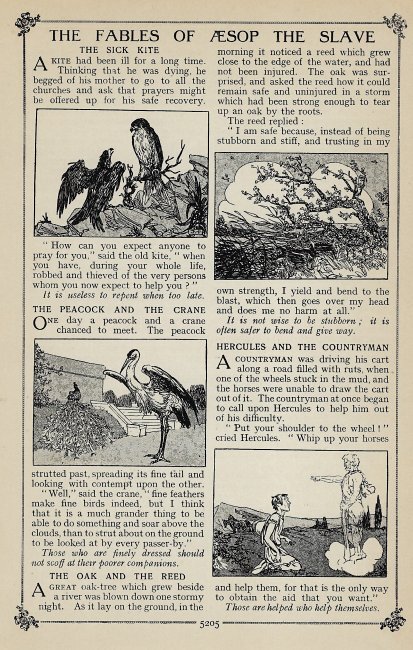
1920? Broadside presenting four fables with titles, images, and morals. Page 5205. $10 from Janet Vachon, Aurora, ME, April, '14.
I discovered this piece among purchased materials ten years alter. Might it be a printing on sturdier card stock of a page from one of those encyclopedias that offer all sorts of snippets? The verso, 5206, begins a piece titled "The World on a Table." We have several such encyclopedias among our books, but none of the page numbers seem to align with those here.
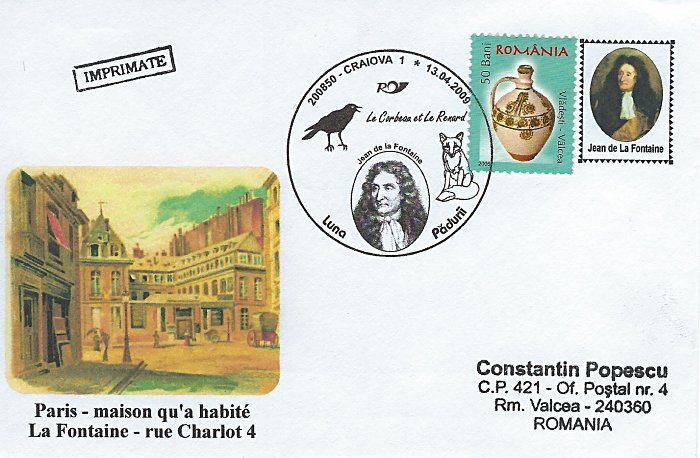
2009 Four envelopes featuring stamps of Jean de La Fontaine, his Paris home, a tortoise, and a hare. April 13, '09. Addressed to Constantin Popescu, Rm. Valcea, Romania. From Constantin Popescu, May, '09.
One notices the popularity of TH. There are three cancellation seals. They feature TH, FC, and GA, respectively. The seals, stamps, and envelopes are nicely correlated. I am surprised to see La Fontaine's Paris home featured rather than his home in Chateau-Thierry. "Luna Padurii" seems to mean "Forest Moon." Occurrences on the web seem to indicate that it lasts from March 15 to April 15. Offhand, it is hard for me to see the connection with La Fontaine.
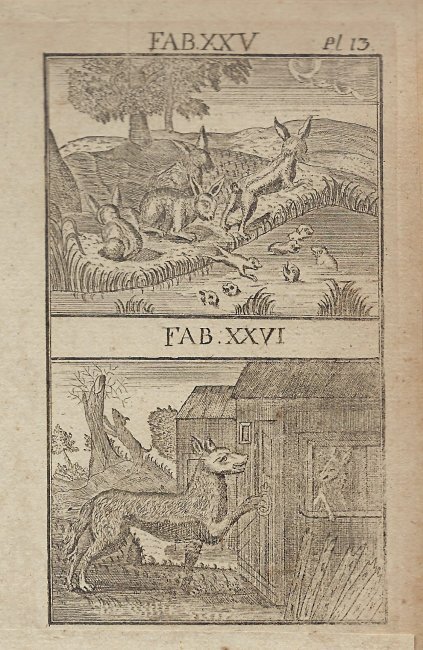
1750? Four broadsides of eight illustrations each by Georg Paul Busch from his 117 illustrations for the edition by Abbé Jean-Baptiste Morvan de Bellegarde (Amsterdam 1708). €60 from Antiquariat Kitzinger, Munich, July, '19.
I took time to scan and reproduce these lovely illustrations, which seem to have been presented two per page. Here sets of four are joined together. These four comprise Plates 13-24 and 33-36. Bellegarde is well represented in the collection, both in original editions and later re-editions and facsimiles.
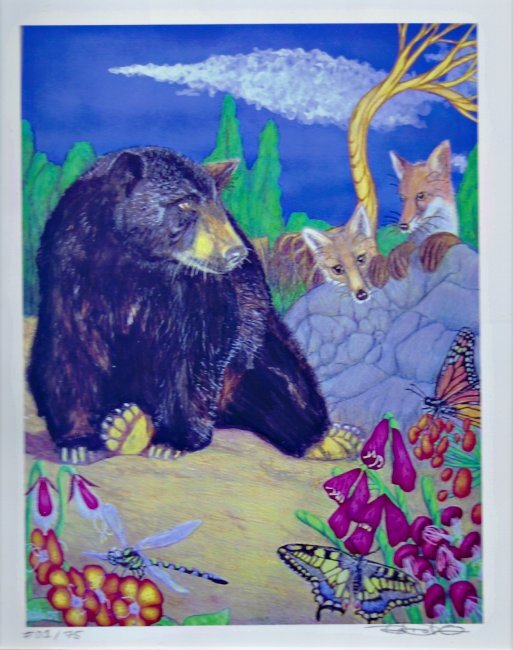
2004 Four signed, numbered acrylic presentations of Aesop’s Fables by Robert Thomas Robie, Walla Walla, WA. Matted. 6.8" x 9" image; 8.5" x 11" paper. From EBSQ book of fables? Unknown source.
The four have wonderfully vivid coloring. I have not been able to find – or even to find out more about – the EBSQ edition of fables.
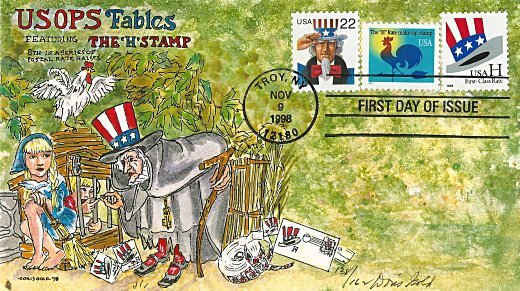
1998 Four "USOPS Fables" First Day of Issue envelopes featuring The "H" Stamp. Postmarked Troy, NY, Nov. 9, 1998. Signed by Doris Gold. $8 fFIP Covers, Melissa, TX through Ebay, April, '08. $5 from rka through Ebay, August, '04. $7 from Eric Wile, Greensboro, NC, Jan., '06. One further extra.
The picture is of Uncle Sam reaching down to check on whether Hansel has grown fatter, while Gretel sits nearby. Both copies include an insert "Hansel and Gretel Meet Usops." The insert answers my question in its second sentence by identifying USOPS as United State Office Postal Service. In this version, Gretel took along her stamp album, and that saved the two children. The children come upon a post office made of magnificent stamps. The story goes on from there. Notice that each of the four envelopes carries a different number out of 162: 40, 68, 95, and 138. I need to stop buying these envelopes!
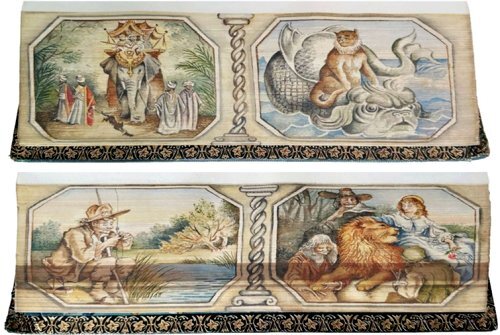
1870? Split-double fore-edge painting on a first edition English translation of La Fontaine's fables.
Here is one of the new stars in our collection! It is a beautiful, heavy (10.5 pounds) edition with slip sheets for the full-page illustrations, heavy paper, and robust binding. Weber Rare Books offered 1870 as their guess as to its date. I presume it is a first English edition. The outstanding feature of this copy lies in its four outstanding fore-edge paintings. I will quote Weber’s description: ‘With a split fore-edge painting, sometimes called a “split-double”, with the volume showing a total of four paintings made after Doré drawings found within the book, 2 being side-by-side on either the left or right-hand fanned edges. Facing one direction (left): “The Little Fish and the Fisherman” [page 238] and “The Lion in Love” [p. 157]; on the other side (facing right): “The Monkey and the Dolphin” [p. 173] and “The Rat and the Elephant” [p. 489].’ I was particularly happy to “land” this book for two reasons. A recent report to Reinert-Alumni Library seemed to suggest that the collection target higher end acquisitions unavailable elsewhere. We are also planning a new layout of collection treasures for visitors emphasizing modes of illustration. What an excellent example of a rare mode of illustration!
Weber notes that the paintings were commissioned by Harrington’s (London), ca. 1990s-2010. The handwriting on the volume, from the artist on staff for the bookshop, has penciled in 29 lines of penciling used to highlight and detail this painting added to the volume. The note begins: “Split Foredge Painting / In four panels.” Commissioned by Harrington’s toward the end of the 20th century.
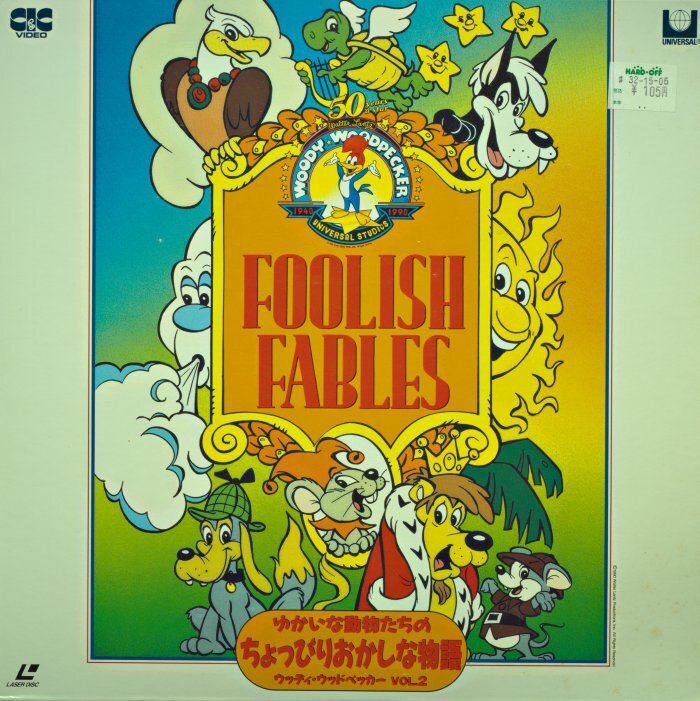
1990 Foolish Fables. Bilingual. 109 minutes. PILA 1038. CIC: Universal City Studios. Made in Japan. Unknown source.
The enclosed page lists the cartoons, and the dust-jacket celebrates Woody Woodpecker. Recognizable fable titles include LM and “Flying Turtle.” One apparent parody is “The Dog That Cried Wolf.”
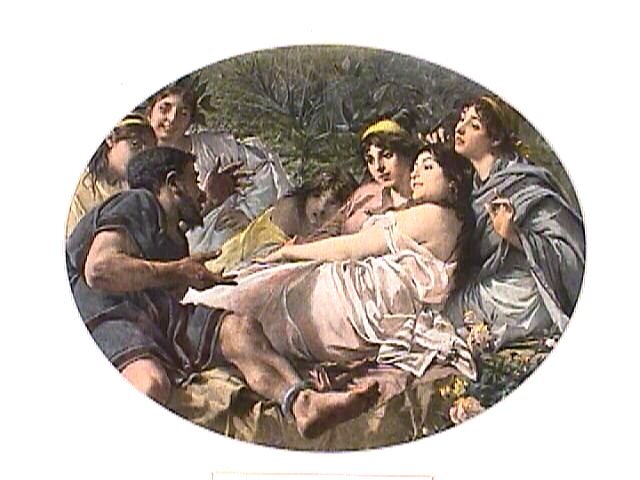
1878 "Aesop Narrating His Fables" by R. Fontana. Published as part of the "Exposition Universelle de 1878" by Gebbie and Barrie. Gravure by Goupil Companie. Hand tinted with watercolors and sold for $35 by David Eisler (Aylesbury, Bucks, England) at Baltimore Antiquarian Fair, August, '91. The scene shows a manacled, bearded Aesop entertaining a group of delighted young women. The same engraving appears as the frontispiece to the Ariel Booklet edition (1848/1890?) of Aesop's Fables with the James text and Tenniel illustrations put out by the Knickerbocker press. Click on the picture to see a fuller version.
1906 Print of R. Fontana's 1878 engraving "Aesop Narrating His Fables." The work was originally published as part of the "Exposition Universelle de 1878." $5 from Stephen P. Ryder, Alexandria, VA, through Ebay, Sept., '99.
This black-and-white reproduction of Fontana's work comes nowhere near the lovely hand-colored version I have listed under "Engravings." Who knows, however, when it will come in handy?!
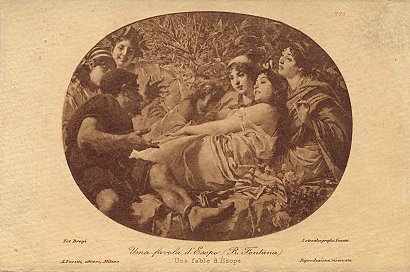
1930? "Una favola d'Esopo/Une fable d Ésope" (R. Fontana). Fot Brogi. Fotocalcografia Fusetti. A. Fusetti, editore, Milano. #773. 20,000 Lire at the Porta Portese flea market, August, '98.
The monchrome oval scene reproduces a larger 1878 engraving I have long enjoyed. Find it here under "Engraving." It shows a manacled, bearded Aesop entertaining a group of delighted young women. The same engraving appears as the frontispiece to the Ariel Booklet edition (1848/1890?) of Aesop's Fables with the James text and Tenniel illustrations put out by the Knickerbocker press.