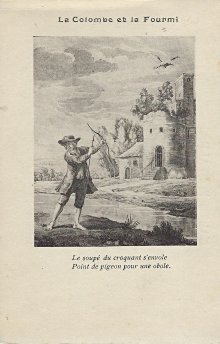
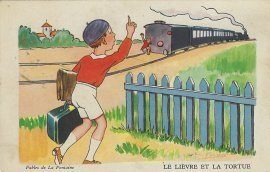
1900? Two portrait postcards with black-and-white illustrations and a moral. Illustrations after Oudry and Gheeraerts? €4 from ABC de la C.P.A., Lyon, at the Paris Post Card Exhibition, Jan., '05 and for €3 from St. Ouen, August, '13.
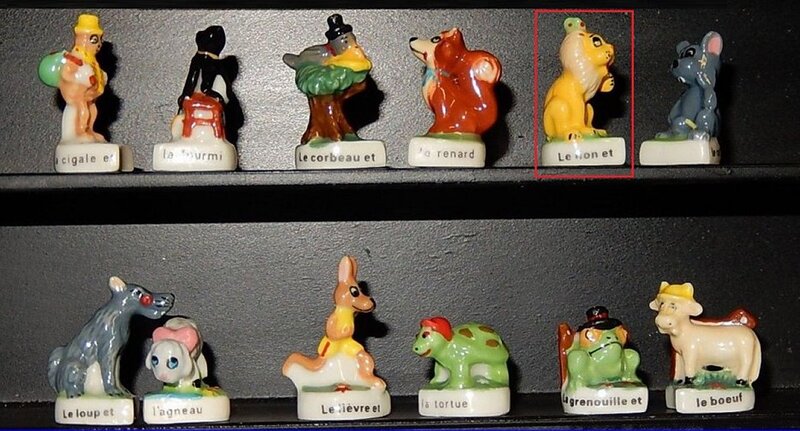
2008 Set of 12 fèves of the fables of La Fontaine by Vahine.
This group of fèves is unusual for being paired. Fables are of course often about pairs encountering each other. In this case, each little statue is shaped to fit alongside its partner. So I offer photos of the "couples."
1950? Fables of La Fontaine. Twenty-three (out of a series apparently of twenty-four) full-color postcards displaying favorite La Fontaine fables, with young people playing appropriate human roles. V. Spahn signs the cards. Card #17 is missing. €62 for the set from Serge Ferry at the Paris Post Card Exhibition, Jan., '05. Extra copy of #12 from Suzanne Botti, Le Bono, at the Paris Post Card Exhibition, Jan., '05. Extra copy of FK for $9.99 from Gold-Coast, Brentwood, TN, Nov., '13. Extra copies of #7 and #15 for €1 apiece from Akpool, Berlin, August, '18. TH for €4 from collecman through Ebay, June, '22.
The text of the fable takes up most of the message-space on the verso of the cards. Under the picture is "Fables de la Fontaine" in Italics at he lower left and a block-print title at the lower right. The modes of translating the fables into children's life are fascinating here. The emphasis is not on simple "cuteness." The children can play the fable straight, as in "L'Huitre et les Plaideurs" and GGE. FC is thus about one child stealing a ball while another sits up a tree and watches his ball stolen. Or a child can assume an unpleasantly animalistic role, as when TMCM shows an imperious girl chasing two boys away from a table full of food. The picture opens up whole new categories of interpretation when "The Wolf Become a Shepherd" shows a child picking up play sheep on the lawn. Again, there are whole new interpretations at work when FK shows a girl in a bathing suit with a frog clinging to her shoulder. Is she queen of the frogs? A few cards perhaps hardly make sense. What does the boy falling into the water have to do with OR? The set hits a low point, I believe, when it offers a black male child wearing feathers as "Le Geai Paré des Plumes du Paon." Perhaps the cards are meant simply as fun and not to be interpreted at all. Card #15 adds a false number to its fable title: "XIV." All the cards here seem to have been sent or addressed to the same party--but never to have been mailed with a stamp. Finally getting #17, TH, in June of 2022 completes the set.
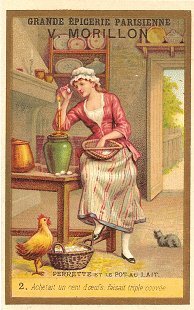
1891? Perrette et le Pot au Lait. Grande Épicerie Parisienne V. Morillon. Three numbered cards, each with a section of La Fontaine's text under the illustration. Publishers: Paris: Imp. Romanet et Cie.
These three cards, #2, #4, and #5 of a set of six, are almost identical with the cards in Liebig's 1889 series of the same name. These cards are thinner by about a quarter-inch. They thus measure about 2½" x 4⅛". The artist here carefully removes from each scene the object that advertises Liebig. Thus in the second scene, the candle by which the milkmaid examines an egg rests not on a giant can of Liebig but rather on a vase. In the fourth scene, the can of Liebig resting up on a shelf has disappeared. In the fifth scene, the directional sign that once pointed to "Cie Liebig" now is blank. The title of the series and a short section of La Fontaine's text are printed near the bottom of each illustration. The backs of the three cards are identical. They advertise "Chocolat Morillon," guaranteed to be pure. Apparently Morillon won the golden medal, the "Grand Diplôme d'Honneur" at the Grand Concours d'Alimentation in Paris in 1891 for, as the card says, the superiority of its products. Prices for chocolate and vanilla are given.