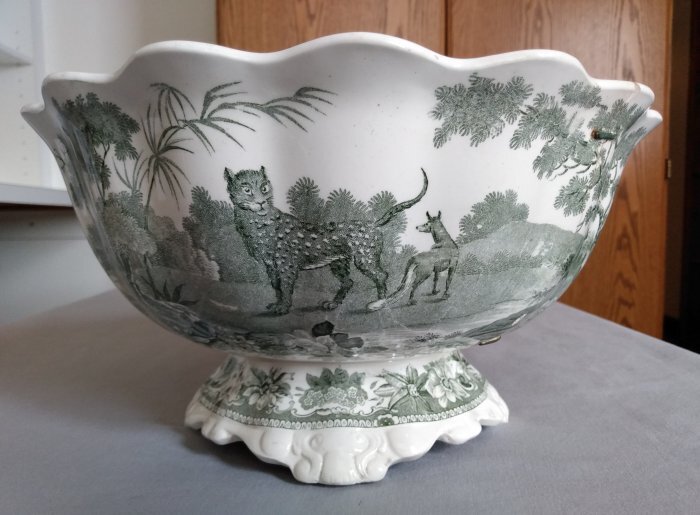
1835 Spode Aesop's Fables Large Fruit Bowl Comport. Center: Lion and Fox. Rim: Leopard and Fox. Staffordshire Green Transferware. Staffordshire, England: Copeland and Garrett: New Blanche Potteries. 11" wide. 5½" tall. $140 from Aesthetic Transferware, Montague, MA, April, '22.
I agree with the seller that this large bowl is crisply transfer printed in the best green color. It features oversized flowers with hidden fox heads. The center has the fox wary of the supposedly sick lion. The outside has a repeated scene of the leopard bragging about his beautiful skin and the fox answering in terms of the beauty of his mind. As the seller noted, a large piece had been reapplied with glue and staples, one of only a few that probably still survive. "We rarely add a damaged piece to our shop unless it’s worthy of merit." I agree with that too!
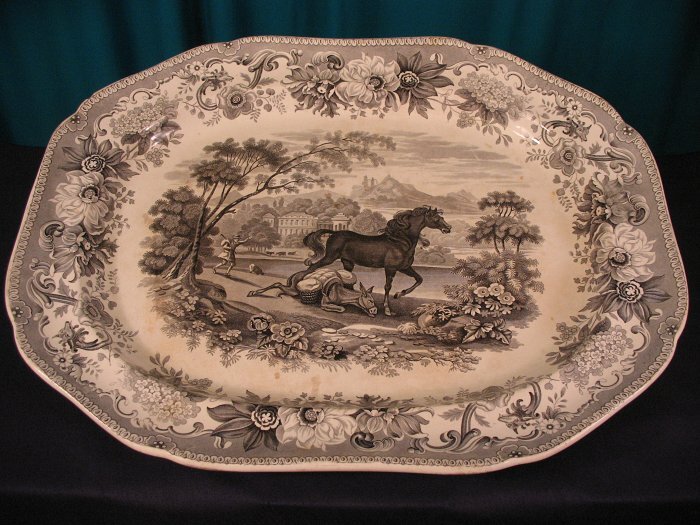
1831? A serving platter, 20¼" x 15½", showing "The Horse and the Loaded Ass." "Aesop's Fables." Spode. England. Gift of Barbara Markuson, Glenwood, IA. August, '10.
This platter is done in the relatively rare black style. Barbara gave it to me in honor of her deceased husband Stanley, who carried the large platter back in his lap as he returned by airplane from Barbados. Barbara had taken the platter to the Antiques Road Show, where the antiques expert mentioned the particularly fine rendition of the horse and the relatively rare black. She valued it at $250. I wonder if it belongs to Spode's original "Aesop's Fables" series, apparently issued in 1831. The fable is apparently Perry #181. I present here Babrius #7, which seems to be the first to do the fable exactly this way: A man had a horse which he used to lead along with him free of any burden. He put the burden upon an aged ass. So the latter, worn out by much toil, went up to the horse and spoke with him about it: “If you are willing to share a part of my load, I may, perhaps, come through alive, but otherwise I shall die.” “Go along," replied the horse, “don't bother me." The ass plodded on in silence, but presently, spent with toil, he fell down and lay dead, as he had foretold. Immediately the master drew up the horse beside him and, unfastening the entire load, put upon the horse not only the packsaddle of the poor drudge, with all its burden, but in addition also, after flaying him, the ass's skin.” Alas," said the horse, “how poor was my judgment; that very burden, of which I was unwilling to share even a small part, has now of necessity been put upon me in its entirety."
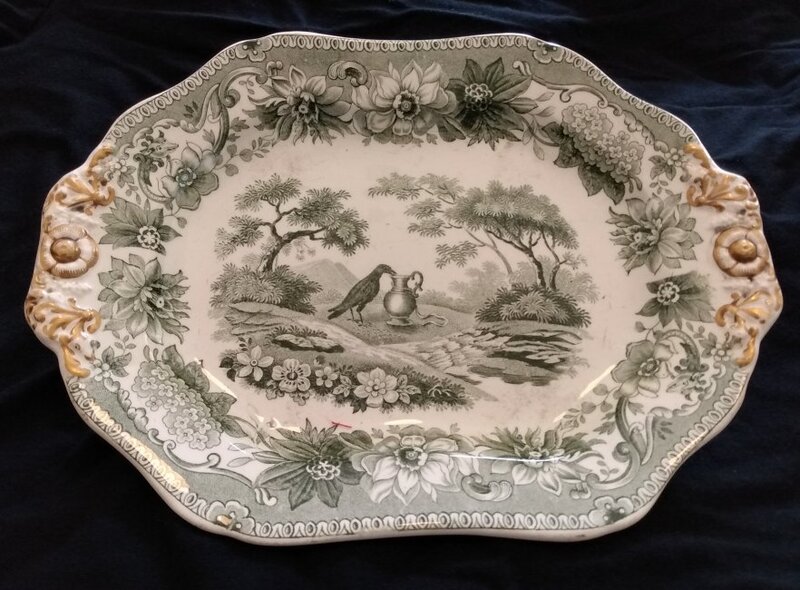
1830? Spode Pearlware Dish. Green Transfer with Golden handle portions. CP in an open landscape surrounded by blosson framework and edge dentils. GBP 59 from Enochwood through Ebay, August, '22.
Here is another fine Spode piece, fully intact. "The Crow and the Pitcher" is on the verso, along with "Spode Aesop's Fables."
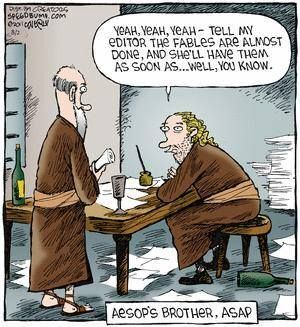
1990? Speed Bump cartoon by Dave Coverly. "Aesop's Brother, Asap." Taken off the web.
Good exploitation of a pun and the common knowledge that Aesop was in the ancient Western world. Well done!
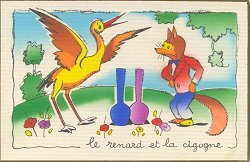
1955? Fables of La Fontaine. Three, out of an apparently larger series, full-color postcards displaying La Fontaine fables in cartoon-like fashion, with sparkling dust glued around the outlines of important parts of each illustration. Made in France. Paris: TDA: Marque Déposé. #721. €4 apiece at the Paris Post Card Exhibition, Jan., '05. FC for €1.20 from Jean Bobelet, Le Chautay, France, through Ebay, June, '20.
Most of the four animal figures on these cards are clothed. For some reason, the stork offering food to the fox in tall vases is not clothed. The fox has his hands on his hips in a fine gesture of disappointment and even dudgeon. In TH, the hare hurries so quickly toward the finishing line that he loses his hat. In FC, the fox holding an umbrella with one hand reaches the other hand out to catch the fallling cheese. It is hard for me to see what the gray sparkles add to these pictures.
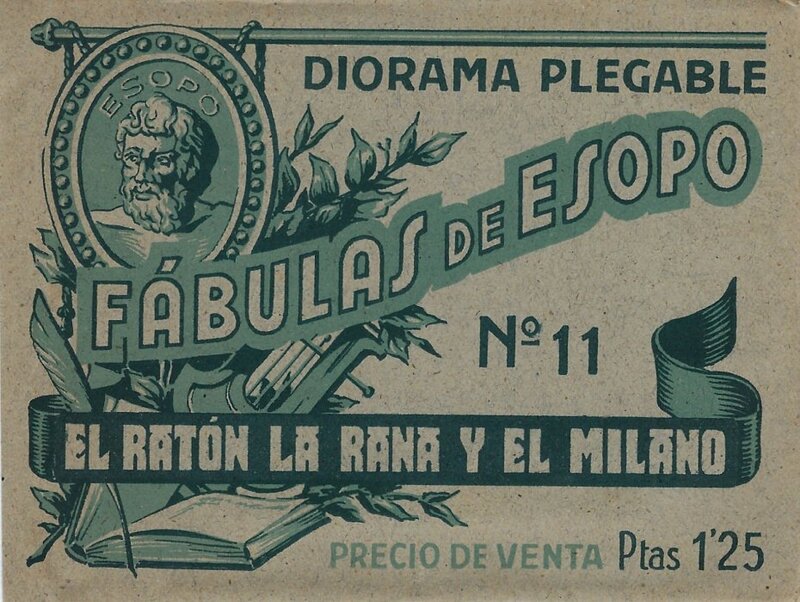
1940? Ten numbered Spanish foldable dioramas in individual envelopes. 3¾" x 4¾". From a set of 19 (and a planned set of 27?). The first seven for £95 from Unicorn Books, Hatch End, Middlesex, April, '98. Three further dioramas for $10.06 each from Libreria Raices, Alicante, Spain, through AbeBooks, May, '24.
These strange and delicate creations witness to the range of places in which Aesop shows up. In each "folding diorama," stiff paper is cleverly folded and pasted so that the result is a folded-over scene with two layers on its lower fold. One of these lower layers is a floor with openings, and the other below includes people and items that emerge through the openings. As an onlooker lifts up the top fold, the characters lying flat on the upper bottom fold rise up and thus give the scene a third dimension. The works are fragile, and few of the characters still stand up well. "The Fox and the Hunters" is in perhaps the best condition of the group. The fable's text and morals are given on the bottom of the lower fold, and on the top of the upper fold is a list of published and to-be-published dioramas. Notice that none of ours come from the promised group between "20 and 27." Did it ever appear? The ten we have are:
· The Hunter and the But (No. 3, but not yet numbered on its own envelope)
· The Fortune Teller (No. 6)
· The Lying Shepherd (No. 7)
· The Miser (No. 9)
· The Monkey and Her Children (No. 10)
· The Mouse, the Frog, and the Kite (No. 11)
· It's Donkey and the Dog (No. 12)
· The Thief and the Dog (No. 13)
· The Fox and the Wolf (No. 14)
· The Fox and the Hunters (No. 17)
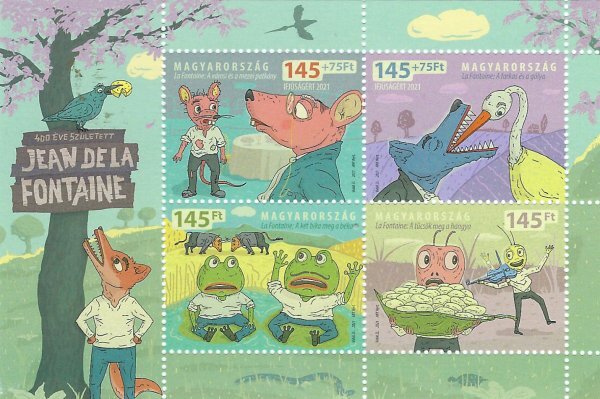
2021 Souvenir Sheet from Hungary of four stamps commemorating the 400th birth anniversary of Jean de La Fontaine. $4.99 from Siew Lee Wong through Ebay, May, '22.
The artist here offers five strong and even idiosyncratic interpretations of well known fables. Outside of the four stamps themselves there are the fox and crow with a sign commemorating the French fabulist. TMCM and WC seem quite traditional. The grasshopper is having a gay old time while the ant labors. Does the fourth stamp present OF or "The Frogs and the Bulls"? That is, does the right frog demonstrate fear with his arms up, or is he indicating the size of a bull?
1980? Souvenir Bowl of La Fontaine's Fable "Rabbit and Weasel Before the Judge Cat." Hand-painted? Signed by M. Praquin. "Décor: L'Or et l"argent – Cadeau." 5" in diameter. Crepy: Limoges. Unknown source.
Here is another unusual item in this collection. The fable is clear and well illustrated. A housing issue between rabbit and weasel was referred to Raminogrobis, the saintly hermit cat. He invited the two litigants closer, claiming impaired hearing. When they came closer, he grabbed both. That was the end of the rabbit and the weasel. What does one call this kind of small bowl? There is so much information on the bottom!