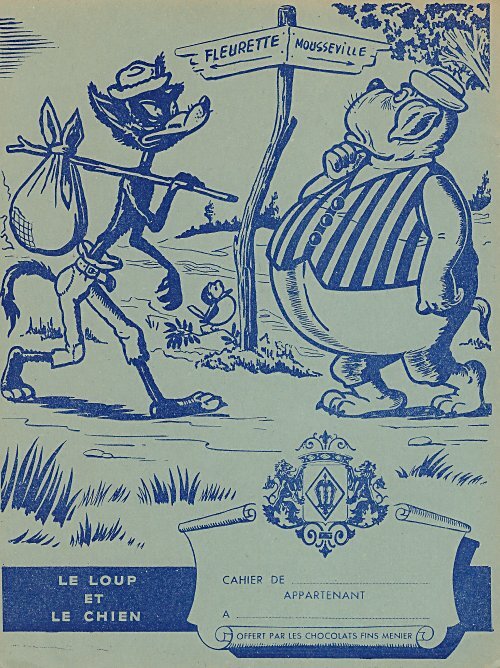
1950? School dust jacket "Le Loup et le Chien" offert par les Chocolats Fins Menier. Imp. Typo Noisiel. About 7" x 9½". €1 from French Vintage Shop, Paris, through eBay, Feb., '13.
This blotter nicely exaggerates the rotundity of the dog on the right and the famished skinniness of the wolf on the left. They meet at a crossroads, where roads lead to Fleurette and Mousseville, respectively. On the verso, the smiling dog advertises the "Fables de La Fontaine" cards one can get in Menier chocolate bars and other Menier products.
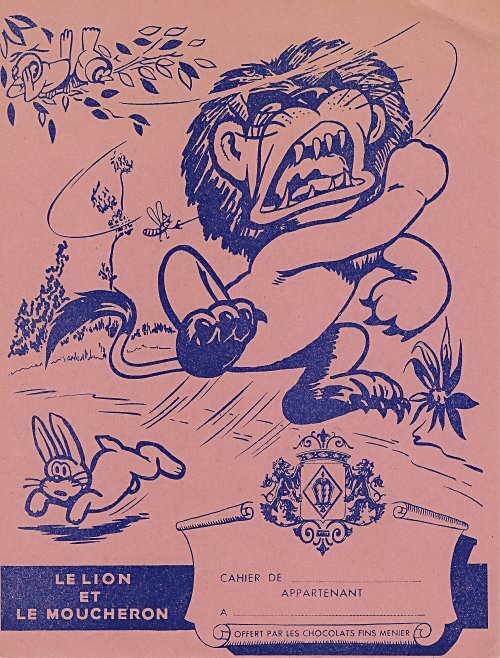
1950? School dust jacket "Le Lion et le Moucheron" offert par les Chocolats Fins Menier. Imp. Typo Noisiel. About 7" x 9½". €1 from French Vintage Shop, Paris, through eBay, Feb., '13.
The mosquito almost gets lost in this picture as he flies into the upper left corner of the cover of this "Cahier." The viewer might be more drawn to the rabbit who ruins by while the lion takes a missing swing at the mosquito. On the verso the lion is smiling, perhaps because he has just enjoyed some Menier chocolate. The mosquito seems to be enjoying a chocolate himself as he rests on a mushroom.
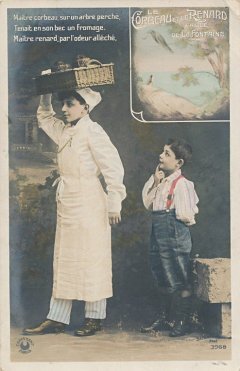
1910? Three colored photographic postcards from a set (of 6?) using children to portray La Fontaine's FC. Sozerac 3968. Paris: Croissant. Card #3 for $9.99 from Stefano Nels, Columbia, SC, through eBay, July, '05. Cards #1 and #2 for $20 from Bertrand Cocq, Calonne Ricouart, France, Sept., '18.
The human story is utterly consistent with the fable, as a child sees bakery in the tray on the baker's head and flatters him to get some of the bakery. As in the "Croissant" version of TH, there is a portion of each card's picture given to a colored rendition of the original fable, the first of them announcing the title. These three cards present the first nine lines of La Fontaine's fable, and thus I have labelled them Cards #1 through #3 of the set. Are these cards hand-tinted? The coloring of FC in the upper right of Card #3 is particularly nice.
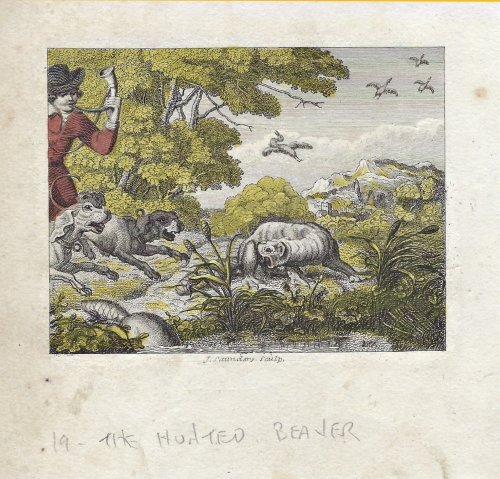
1800? Two lively 5” x 5” duochrome (hand-painted?) illustrations. Image 3.8” x 3.2”. “Saunders Sculp”. From LaArtier, Portslade, West Sussex, England.
It is hard to know whether these are separated book pages or separate prints.
“Beaver” is a less told tale, partly because of its subject matter. The action of the beaver is here quite unmistakable. Well colored!
The range of browns in this rendition of UP is particularly strong. The artist includes the dogs, which I believe are a fiction of the clever rooster’s mind.
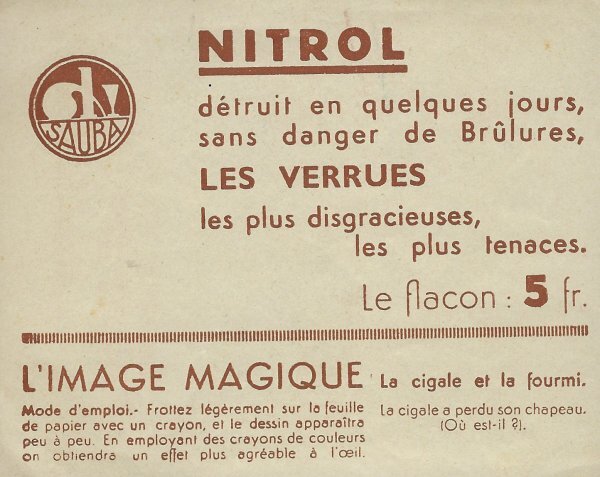
1935? Two frictographic “Image Magique” hidden page slips advertising Sauba syrups to counteract worms and warts. A child should rub a crayon on the “blank” verso and an image will appear – an image with a hidden item to find. 4⅞” x 3⅞”.
These two slips combine elements this collection has encountered before: hidden images and frictography. Surprises keep coming! I am so tempted to “violate” these ephemeral treasures by trying to bring out their pictures!
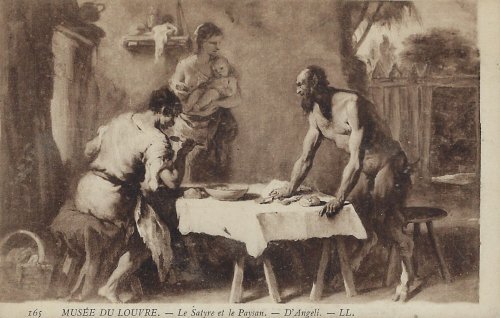
1900? Black-and-white postcard with a photograph of D’Angeli’s “The Satyr and the Peasant.” “165 Musée du Louvre. LL.” $5 from Bertrand Cocq, Calonne-Ricouart, France, Sept., ’20.
Do I understand correctly that this presentation of the fable departs from other presentations of the time chiefly in the expressive stance of the Satyr? Is he at the point of getting up to leave this place of double-speak? “LL” correlates with one of our presentations by Jordeans of the same fable.