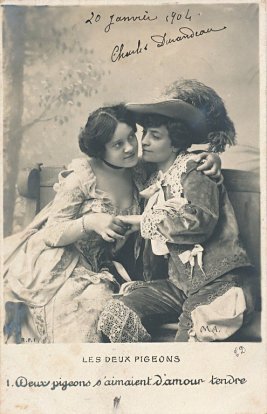
1903? Complete set of ten numbered photographic postcards presenting "Les Deux Pigeons." RPI. $120 from Bertrand Cocq, Callone Ricouart, France, Sept., '18.
Many levels of interpretation are at play in the presentation of this fable. La Fontaine writes this story about two male doves, one of whom has wanderlust and, against the urgings of his dear friend, goes off to experience the world so that, as he sees it, he can return and relate to his dear friend his adventures abroad. The trip turns out to be uncomfortable and dangerous, and the traveler returns wounded. The two are happy to be reunited. La Fontaine himself reflects then, at the age of 68, wondering whether he will ever experience the flames of passion that he did earlier. His last line is "Have I passed the time for loving?" That is, he himself, seems to see a deeply romantic and even erotic theme in the story. Interpreters of La Fontaine have been quick, in my experience, to portray the story as about two lovers. Here we are presented with a male friend who needs to travel, to the pain of his stay-at-home female friend. (Is the male traveler being portrayed here actually by a female?) The set of ten cards tracks the interaction with sensitivity. Notice the eighth card, where the solitary friend waits and hopes for the return of her dear friend. The cards were all posted to the same party during January and February, 1904. All but two are signed by Charles Durandeau. The cursive writing of La Fontaine's phrases on each card is curious.
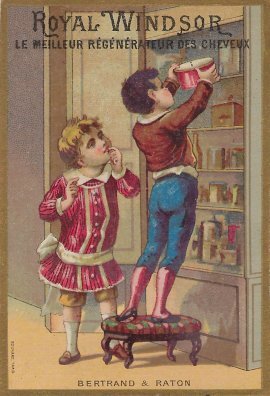
1900? Six trade cards advertising Royal Windsor hair restorer, as found at Maison Louis Urseau in Angers. Paris: Bognard.
These cards are in unusually good condition, and they are carefully done. The scene of WL is repeated with less shown on every side of the image in a single card advertising Houet in Brou.
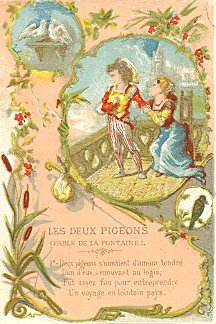
1890? 3 colored cards of La Fontaine's fable "Les Deux Pigeons." All three give the full verso to Rousset's instant soups Manioc-Rousset and Consommé Rousset. One extra of card #4, better printed by Abbadie in Paris and advertising instead Réaux in the Grande-Rue in Lisieux.
Each card quotes four to six lines of La Fontaine's fable at the bottom of the picture side and offers about four images above and alongside separated by swirling floral borders. There is a number before the verse, giving the card's place in a sequential set that must have numbered six to eight cards. Those here are numbered 1, 3, and 4. The first of these pictures the fable's beginning, when one pigeon decides to leave the other for a trip: a pair of pigeons is juxtaposed to a young man and woman. Card #3 pictures the moment at which an eagle attacks a vulture which is about to attack the pigeon; in the human translation, a horse-rider attacks a man about to attack the young traveler. Card #4 shows the very next phase, a cruel shot of a stone by a boy; here the young man holds his head, stunned by a blow from a sling-shooting youth. Rousset, in the Rue de la République in Lyon, also makes Café Moka for instant Café au Lait. Réaux seems to offer so many products that it is hard to specify what kind of store it is!
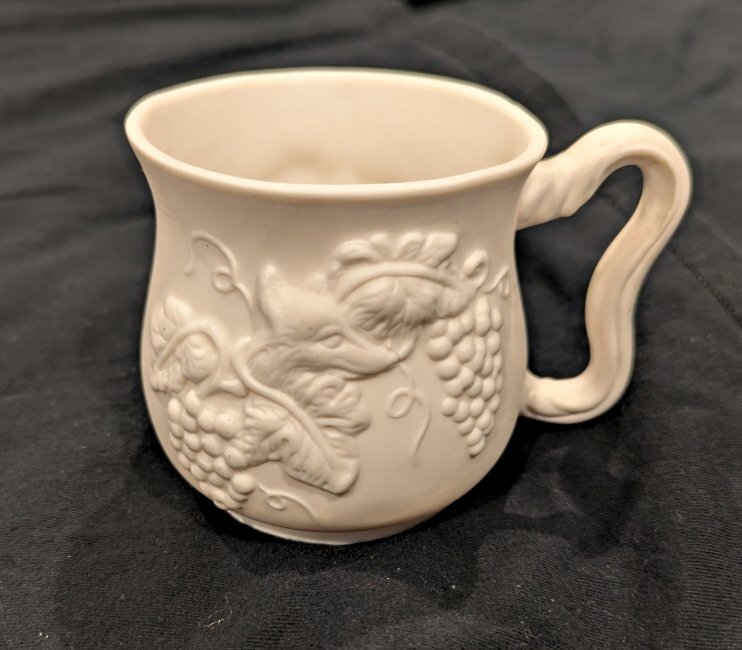
1920 Rouse Parian Mug with FG. 2.5" x 2.5". Trenton, NJ: Rouse Pottery. Unknown source.
I was surprised to find an identical mug in the Henry R. Luce Center for the Study of American Art at the Metropolitan Museum of Art. "Rouse Parian" is stamped on the bottom. As often with the motif of "Fox and Grapes," the fable's emphasis that the fox cannot get the grapes is missed as the two are brought together in image.
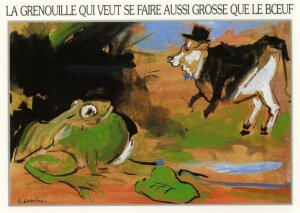
2008? Six cards featuring paintings of La Fontaine's fables by Rotislas Loukine. Editions Combier-Macon. €3 each at St. Ouen, August, '13.
These are dramatic oil-paintings! Can we call the style "impressionistic"? One needs to know the fable, but then the picture comments wonderfully on the fable's message!
Four labels come from smaller pieces – 18 grams --of chocolate. The color scheme is different on each, though the format remains the same. By contrast with the larger chocolate bars above, these wrappers seem to be shut, as though the top and bottom have become pasted together. I have not had the heart to re-open them! One verso below gives a sense of the similar siblings.
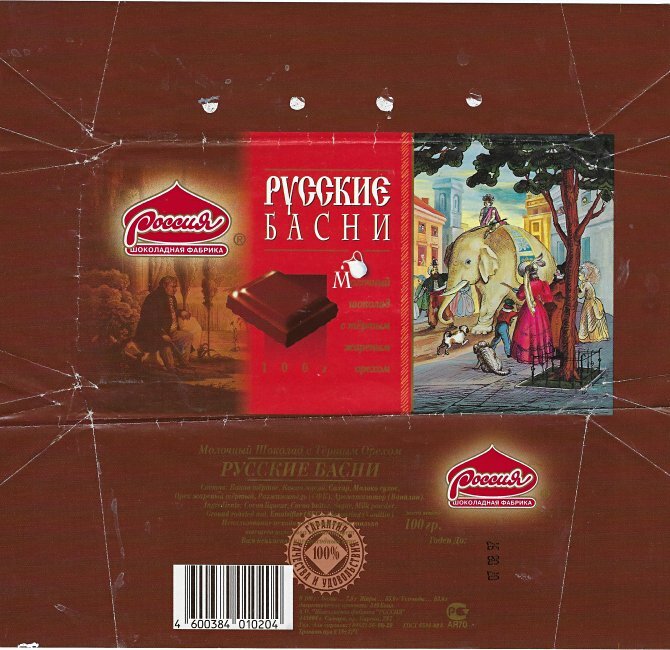
These four large (8½" x 8") wrappers include a lovely fable picture, which I offer here in each case as a detail. Do not miss what I believe is a double fable representation in the last wrapper. I believe that the artist is representing two fables at once. Might the human figure there suggest even a third fable?
Besides the large maroon wrappers, Rossia also offered gold wrappers in two different sizes: 8½" x 8" (100 gram) and 6¼" x 6" (50 gram). We have two of the former and one of the latter.