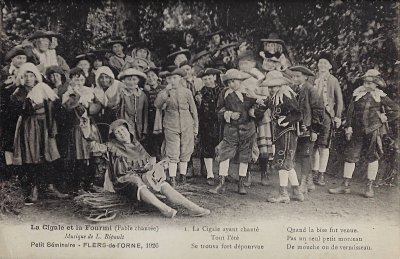
1926 Series of six photographic postcards representing a musical performance of GA by Petit Séminaire Flers-de-l'Orne. Music by L, Ripault. €60 from histoirepostale83 through Ebay, Dec. '19.
The six numbered photographic postcards show the cast at six moments in the presentation, marked by a portion of text from La Fontaine's fable. The scenes show summertime singing, wintertime hunger, pleading for food, declaration by the grasshopper of singing for the pleasure of any listener, rejection by the ant, and "Choeur Final." Blank versoes.
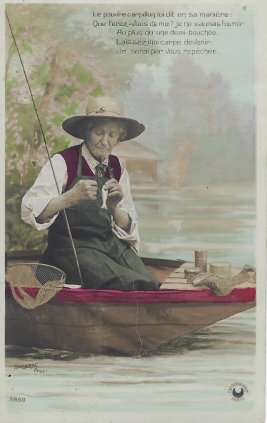
1910 “Le Petit Poisson et le Pécheur: Fable de La Fontaine.” Complete two-card set of colored photographic postcards. “Croissant Paris.” “3850.” Complete colored series of 2 portrait postcards photographed by Sazerac (“Sazerac phot.”) and published by Croissant in Paris. $5 each from Bertrand Cocq, Calonne Ricouart, France, Sept., '20.
This pair of cards is quite similar to the MM set by Sazerac and Croissant, especially the coloration of the photographs against a colored background screen. As Bertrand notes, a two-card set seems quite unusual!
Art print “Slow & Steady Wins the Race – The Tortoise and the Hare.” 8½” x 11”. $18.48 from Peter Pan Prints through Etsy, August, ’18.
The artist here places the hare’s white against the tortoise’s larger green space. I am delighted to see Etsy’s artists taking up Aesop!
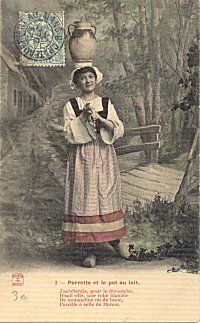
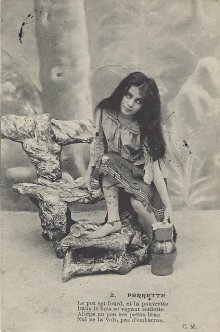
1905? Perrette et le Pot au Lait. Three postcards of J. de Montrut's version of "Perrette et le Pot au Lait" presented with black-and-white photographs. Several colors have been added. Beneath each picture is a number ("2," "4," and "5" respectively) and a few lines of text, apparently from a version by J. de Montrut. €3 each from Eclair Collections, Angers, at the Paris Post Card Exhibition, Jan., '05.
The photographs are the ultimate in posed photographs taken before large sheet-like backgrounds. Here one can see the ripples in the cloth background. The three scenes show, progressively, the joy of the dreaming milkmaid as she dreams of buying a new dress, her dismay at seeing the broken pot and spilled milk, and her regret. The pot seems more broken in the third picture than it was in the second! Portions of the maid's clothes are colored red. Is some of the background a light green? My guess is that there are only five cards in this series, since card #5 seems to end the text, with an attribution to J. du Montrut. Will I ever have a chance at the missing two cards?
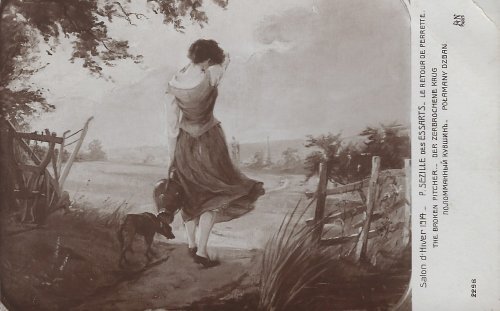
1914 One photographic postcard presenting “The Return of Perrette.” P(ierre) Sezille des Essarts. Salon d’Hiver 1914. 2298. Paris: Albert Noyer. $8 from Bertrand Cocq, Calonne-Ricouart, France, Sept., ‘’20.
This is a different view of MM, namely the return back home with the broken or dropped pitcher. Depicting Perrette from the back is appropriate here, as is the accompanying gesture. She has raised an arm to her head or face in a gesture of frustration and regret. Auguste Frédéric Pierre Sezille des Essarts was born in 1867. He has a variety of works represented on the internet, including an old favorite of mine showing a young couple escaping a rainstorm.
1905? Set of ten photographic postcards of "Perrette." All addressed to Mademoiselle Hebert in Rouen and Veules-les-Roses. $40 from Bertrand Cocq, Calonne-Ricouart, France, Sept., '20.
The cards are postmarked in 1906. The approach to the story known perhaps best through LaFontaine's fable is slightly different, especially as it involves a dog. 1. This Perrette is thinking as she goes about her dear old father. 2. She stops in the woods to put down the heavy pot. 3. It even seems a good idea to take a nap in the heat; she can catch up afterward. 4. Perrette dreams of the profits and their purchases, including clothes and jewels. 5. She wakes to find she has been joined by a dog. 6. She shares her lunch with her new friend. 7. Ah, but when you eat you must drink. The dog seems to point to the pot as the answer to her need. 8. Oh, my, that will lessen the value of this pot of milk. 9. In the meantime, the pot breaks. What bad luck! 10. Perrette and the dog pray together for God to restore the pot. One surprise is that there are some stamps for five centimes and some for ten. The text is attributed to C.M. I cannot find "C.M." online. Here is another example of using a simple photographic background and photographic postcards of children to offer a variant on a well-known La Fontaine fable.