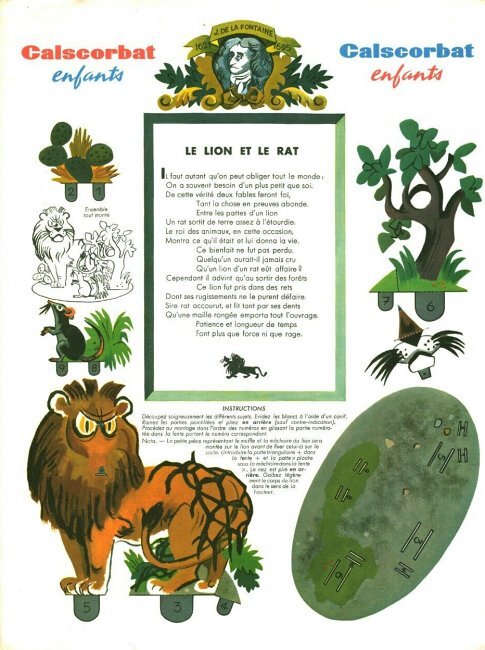
1948 Three paper scenes to cut out and mount. Sponsored by "Calscorbat enfants a la framboise." 9½" x 12½". WL and FS for $8 each from Bertrand Cocq, Sept., '20. LM for €6 from Mathys2004 through Ebay, Sept., '21.
Apparently three of seven sheets that came in a booklet "J'apprends les Fables de La Fontaine en m'amusant" published by Editions Brunier in 1948. About five elements have tabs that one places through slots in the elliptical base to make the fable scene. A text of the fable and instructions for the scene are on the front of each broadside. Lovely coloring! I am not sure that the cardstock is quite firm enough to handle young fingers manipulating the tabs. The nearby farmer in FS and the extra layer for the lion's muzzle are lovely touches! The pages are identical with those in a book "J'apprends les Fables de La Fontaine en m'amusant."
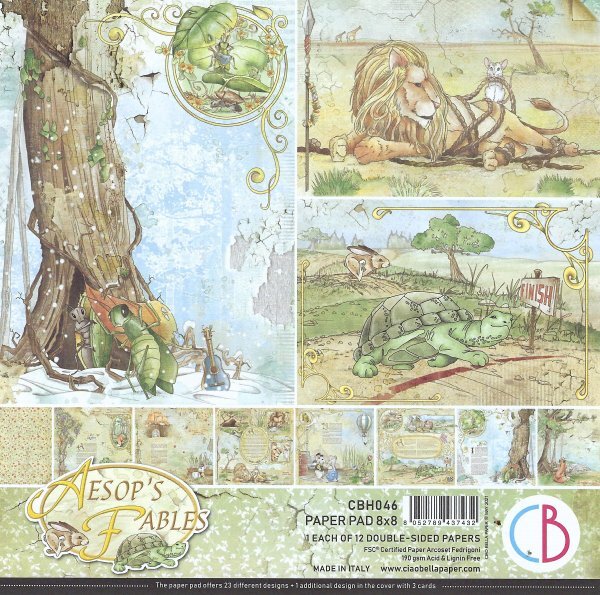
2022? Paper pad 8" x 8". Twelve double-sided papers, many featuring Aesop's fables. Italy: Ciao Bella Paper. Card stock. $10.95 from ASC Supplies through Etsy, July, '22. One extra set.
Here is again something new to me: I am not sue what one is to do with these sheets, bout they are beautifully produced! Cards present the six scenes pictured below, as well as FC. There is also FC and a page of fable characters. Versos and one card feature old, slightly deteriorated wallpaper.
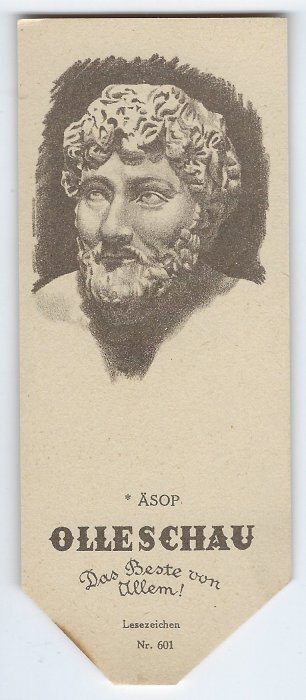
1937? Paper bookmark "Äsop" from Olleschau, "Das Beste von Allem!" Lesezeichen Nr. 601. With verso offering information on his life and work. 5½" x 2¼".
My, a collection of over 600 bookmarks! Olleschau seems to have been a producer of cigarette papers. This series was published apparently between 1936 and 1938. I have guessed therefore at a date of 1937. What a strange thing to find! Aesop gets around!
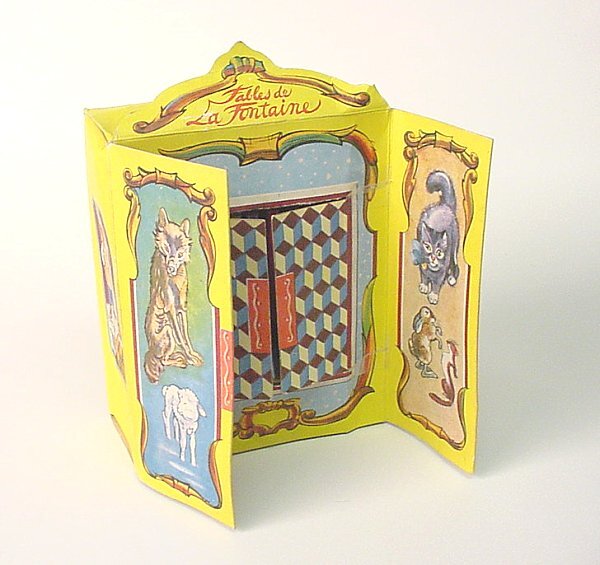
1956 Paper book cabinet for the 12 books "Fables de La Fontaine." 5" x 2¼" x 8" high. Paris: Presses de la Cité. $50 for the set from Dany Wolfs, Roesalare,Belgium, April, '01.
The cabinet has suffered from its travels. It has two sets of doors. Around the outside we see WL, FC MM, and "The Cobbler and the Banker" together with a circular melange on the back of the cabinet. Inside the doors are LM and "The Hare, the Weasel, and the Cat." The back illustration is signed " Andrépec." Click on the picture to see a larger version.
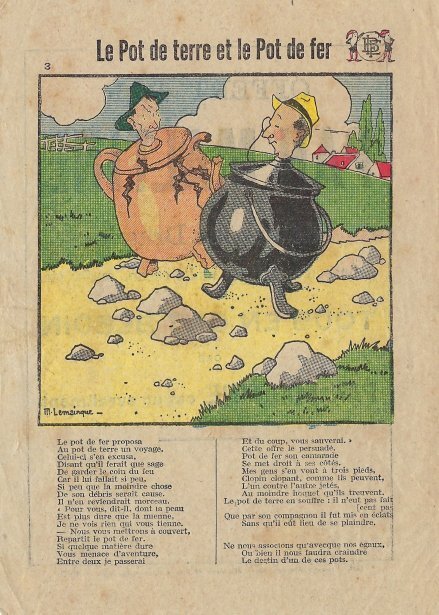
1933 Two handbills of La Fontaine fables illustrated by M. Lemainque: 2P and "Le Gland et la Citrouille." 5⅜" x 7⅜". Printed by Louis Bellenand et Fils, Fontenay-aux-Rises, Advertisement on verso. €2.59 each from la fee chinette through Ebay, Sept., '22.
Dragees are candy-like. Would we call them "dietary supplements" now, 90 years later? Both of Lemainque's illustrations are pointed and engaging. The human pots are fun! There is a clever printer's seal at the top right of the image side of the handbill.
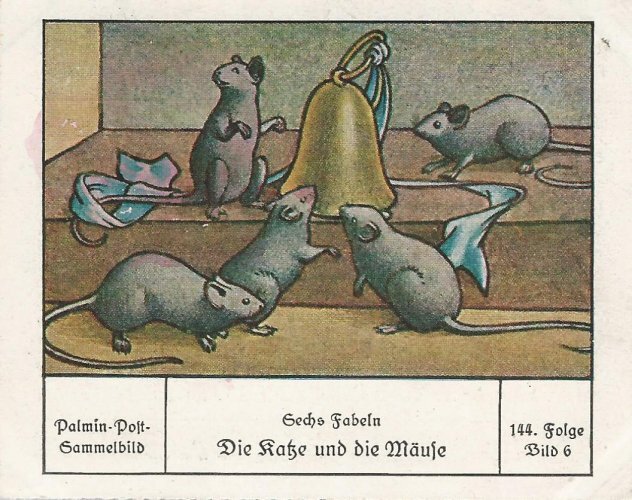
1920? Sechs Fabeln. Palmin-Post-Sammelbild. 144. Folge, Bild 1, 2, 5, 6. Four cards (of 6?) advertising "Palmin, das reine Cocos-Speisefett, nur echt mit dem Nameszug Dr. Schlink."
These four cards are in quite a different style from Palmin's other set. DS, LM, CP, BC. I am guessing that the cards show an art deco style. The German text is all in Gothic letters favored in the twentieth century up to 1945. The edges are rough cut and may have been part of a larger page. The verso has a prose fable text with no indication of a fabulist or visual artist or card printer.
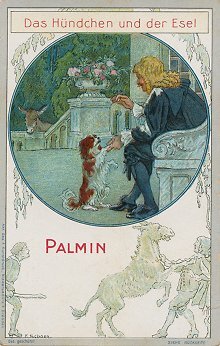
1890? Fabeln von LaFontaine. Five cards (of 6?) advertising "Palmin, Feinstes Cocosfett zum Kochen, Braten und Backen." 2¾" x 4 3/8". I have cards #1, 3, 4, 5, and 6. F. Schoen. Hamburg: H. Schlinck and Companie, sole producers of Palmin. F. Kunstdruck, Niedersedlitz bei Dresden. Gift of Heinrich von Fuchs, July, '00. FS (card #2 completing the series) for 9.19 from Heidi 31.7.70 through Ebay, Feb., '19. Extra of "Bild 4: Das Hündchen und der Esel" for $9.48 from heidi31.7.70 on Ebay, August, 20.
A colored circle stands under a red title and over a shadowy white-and-gray scene from the same fable. The interplay between the two scenes makes these some of the loveliest fable trade cards I have seen. Perhaps the best of them shows the horse and the exhausted ass in the colored circle and then, in the larger picture, the horse carrying the hide and burdens of the ass. It is no surprise that the driver raises his whip now to the beleaguered horse! Where, I ask, is that second card in the set? The fables included here are:
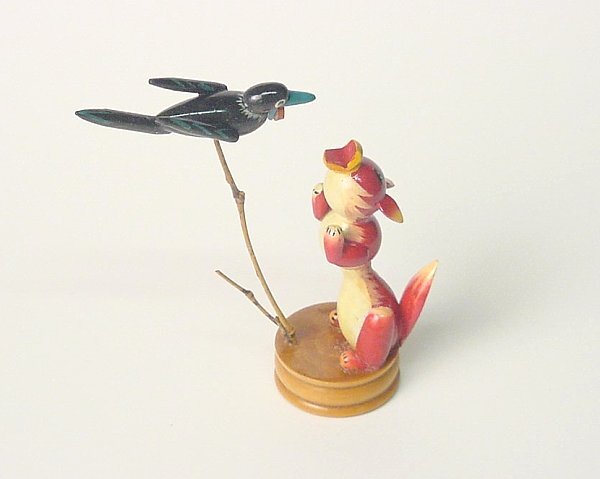
1950? Painted wood nodder. 1½" in diameter around the base and 5" high.
The crow is balanced on a slender twig. He thus moves with any movement of the base, and so he appears ready to drop the cheese as he displays his prowess in singing. Might this little piece be either German or oriental?
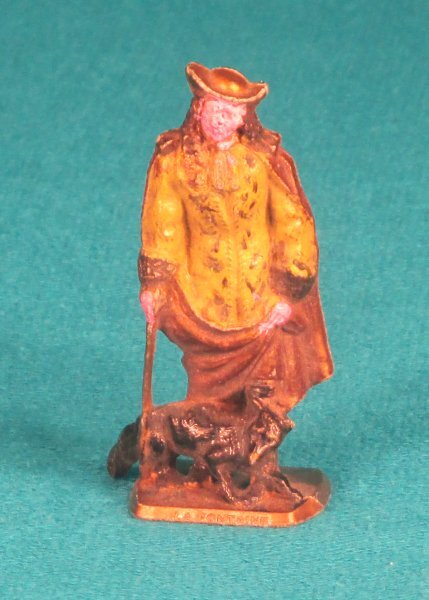
1960? Painted plastic statuette of Jean de La Fontaine. 2½" high. Mokarex deposé. Unknown source.
This statuette adds color to the other exemplar in the collection. I would guess from what I see online that the painting has been done not by Mokarex but by an amateur hand, which may have had trouble both with the the poet's face and with Renard. Are there black foxes?
1885? A Booklet of 7 black and white fable illustrations advertising Painkiller produced by Davis & Lawrence Company, NY.
Though the cover is colored, the internal pictures on each right-hand page are black-and-white reproductions of cards used for J. & P. Coats Spool Cotton, McPhail Pianos, Emerson Pianos. The surprise is all the greater because I have found a booklet in the same format that does use colored versions of the pictures: Wright's Pills.
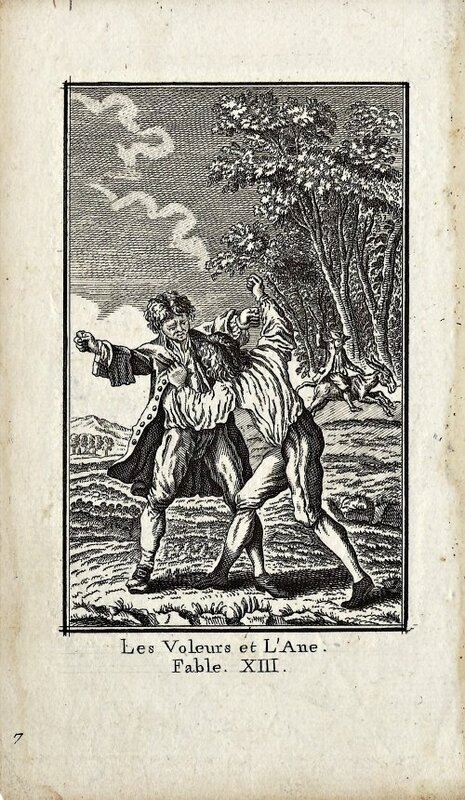
1850? 13 separated pages from a set of (La Fontaine’s?) numbered fables. 4.25” x 7.2”. €50. Unknown source.
I wonder if I will be able to find this edition in our collection. And I wonder if these really are separated pages. There are (page?) numbers besides the individual fable numbers. Is that Fable CXXIII not “La Discorde”? The illustrator has the traditional problem in presenting the face of a lion, presumably because he had never seen one.