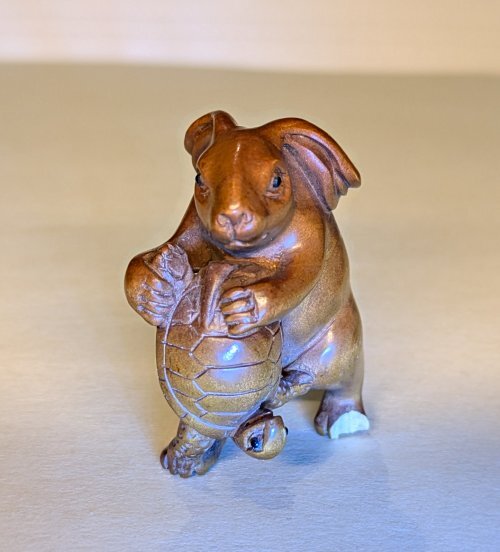
1980? Netsuke of a Hare Carrying a Tortoise.
This is a surprising posture, even more surprising because the turtle has his head turned around 180 degrees! The hare has lost a chunk of his left back paw. What beautiful artistry!
The writers on the verso are at some pains with this story's application. Two children are enjoying big containers of four of Nestlé's great candy: Mintips, Anitips, Réglistips, and Eucalyptips. A rascal comes and takes them away. He can because he is stronger than they are. So, children, you need to be stronger and more energetic – not to take away like this rascal but to defend. Remember Maréchal Lyautey's remark in Morocco: "When people know your strength, you will not have to use it." Réglisse, I have just learned, is licorice. What a bad boy that fellow in the cap is!
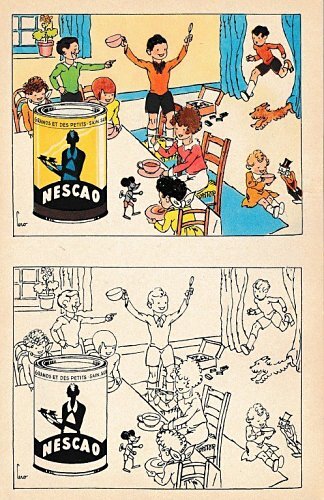
Young René has developed a pattern. He works poorly all year long, but then races through his work at the end. One day he pays for this fault. His classmates have all been invited to a cup of Nescao with buttered bread. René, sure that he can get there quickly, arrives late. Every drop of that delicious Nescao has been consumed! In the picture we see René just entering through the drapes at the upper right. The other children are not only enjoying the Nescao; they have also found the "vignettes," stickers to put into their Nestle albums, so that they can get 50 Francs for completing an album – and have a chance besides at a ticket in the National Lottery!
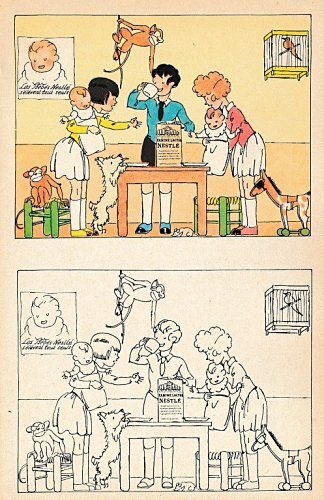
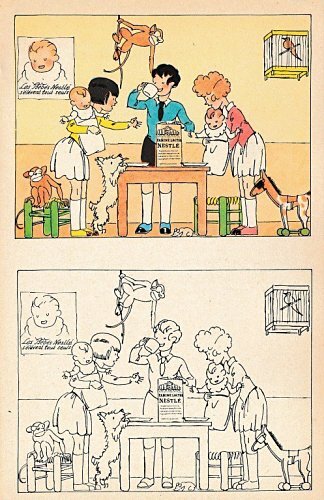
In this episode, two young mothers, always wanting the best for their babies, come across a container of Farine Lactée Nestlé. I imagine that this is something like "cream of wheat" with milk. The two argue over whose it is: one saw it first and one found it first. This is the very argument that came up between two men on the beach in La Fontaine's fable. One had seen an oyster first, and one possessed first. Their decision was to ask a passerby, who took the oyster, ate it, and divided the shell between the two. In our story, the two women ask Boby, a wise young man, what they should do. He urges them to cook up a cupful. He promptly consumes the cupful and gives the cup to one woman and the saucer to the other. Boby remembers from his youth the sweet flavor of Farine Lactée Nestlé.
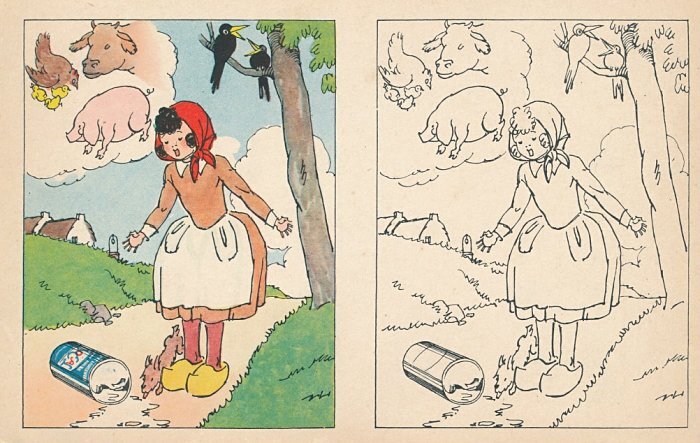
Nestlé's MM illustration is standard enough, except that what this milkmaid drops is a can of "Lait Idéal de Nestlé." What has this little Marion been dreaming about along her way? Of course! Of cooking with Nestlé's creamy product! The verso gives us two cartoons, one of the traditional Perrette and one of the modern Marion. Click on either image to see it enlarged.
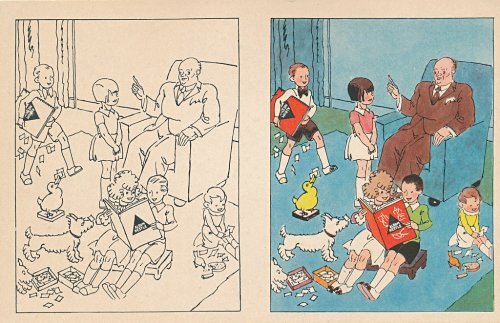
Here the family father is advising his children to fill in their Nestlé albums: that is productive work! The verso then reminds us of the story of the laborer who entices his children – albeit after his death – to dig into the family farm. Work, not luck, brings success. As far as I am aware, Europeans more than Americans provided children with advertising albums into which to paste small stamps. This collection has several such promoted by Menier chocolate candy. The verso moralizes that there is no luck involved in assembling a Nestlé album, and work will bring a reward of 50 Francs for a completed album!
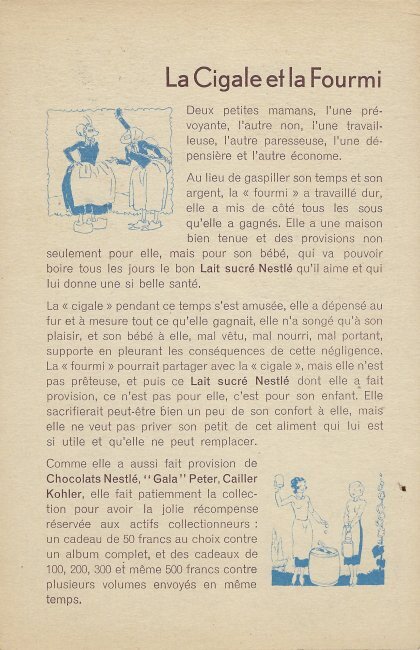
There are two mothers. One is hard working, always prepared, and makes sure that her child drinks lots of Nestlé sugared milk. The other is opposite and has to beg for Nestlé sugared milk from the first mother. Apparently she does not get it. The first mother is so careful that she can save money by putting together cards like this into a Nestlé album!
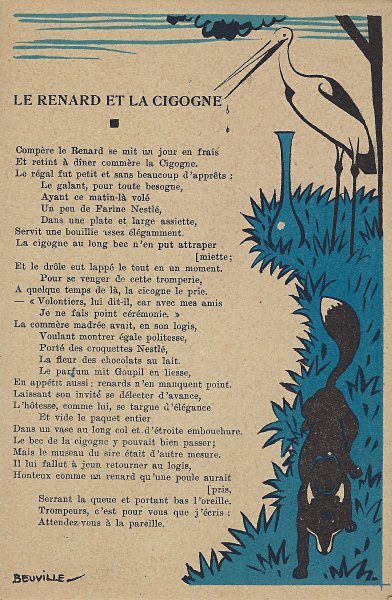
1925? Twelve Nestlé trade cards, all advertising a contest worth a million francs in prizes. Most involve some connection with La Fontaine’s fables. Seven are signed “Beauville.” The others have no signature. 4¾” x 7”. Ten are blue duochrome. £12 from 123colis123colis through Ebay, August, ’21.
Here is a third set of Nestlé trade cards. I present first a verso. There are eight different versions, three of them duplicated. Those duplicates are, roughly, “Did you work hard this week?” and “He’s really hungry!” and “Do you know what a white night is?” (A white night is a sleepless night, caused of course by a child hungry or struggling with digestion. Solution? Something by Nestlé!) Each includes a stipulation of the prizes in Nestlé’s contest. Apparently many Nestlé products suitable for children contained “stamp-vignettes” which children collected in an album “Wonders of the World.” Prizes for filling an album included 200 “Harwood” gold watches and 350 “Griffon” bicycles.
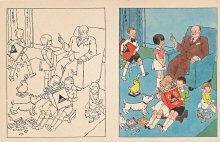
1940? Six large cards (8¼" x 5¼") presenting a colored scene and its black-lined outline to color in. Nestlé. The verso applies the fable presented in the human application in the illustration. $60 from Bertrand Cocq, Calonne Ricouart, France, Sept., '18. GA for €9.99 from Lisi47 through Ebay, Sept., '21.
Some significant effort went into developing this set of cards. Each front illustration advertises a different Nestlé product, and the verso works cleverly to view the human situation on the front of the card in terms of a fable named at the top of the verso. Thus one card's verso recalls the story of the laborer who entices his children – albeit after his death – to dig into the family farm. Work, not luck, brings success. The front of the card showed a family grouping where children are learning to paste small Nestlé stamps into a large Nestlé album. The verso moralizes that there is no luck involved in assembling a Nestlé album, and work will bring a reward of 50 Francs for a completed album! Click on any image to see it and its verso on their own page.
1930? Seven Nestlé advertising cards. Text and illustration on the front side of each card in duochrome black and blue. The verso of each, in black and one other color, has questions, suggestions, and a mention of Nestlé.
Because in many ways the backs of these cards are more interesting than the fronts, I will include each here. They seem to be tips for pupils, always including an advertisement for Nestlé chocolate in one form or another. Some backs recommend reaching to Nestlé during the times when one gets hungry between meals, for example. The "applied" fables seem to me to be forced, as when a monkey's opening a can of Nestlé saves the day for a bear family. The true story of FG turns out to include a young student who had his Nestlé and knew that the grapes were good. He got one of them! The versos offer fascinating inquiries. "Did you do your work this week?" "Let's make a collection!" "When your grandparents were babies." "Do you like dishes with cream?" My, what questions! 4¾' x 7".
2022 Five sets of needlepoint pattern pages for finished work displaying fables of La Fontaine.
I thought I would be receiving paper through the mail. What I received was rather a large set of pdf patterns through email. The sets, from 12 pages to 36 per project, fit together to complete the whole picture. I present here the finished designs, with the number of pages needed to create the design.
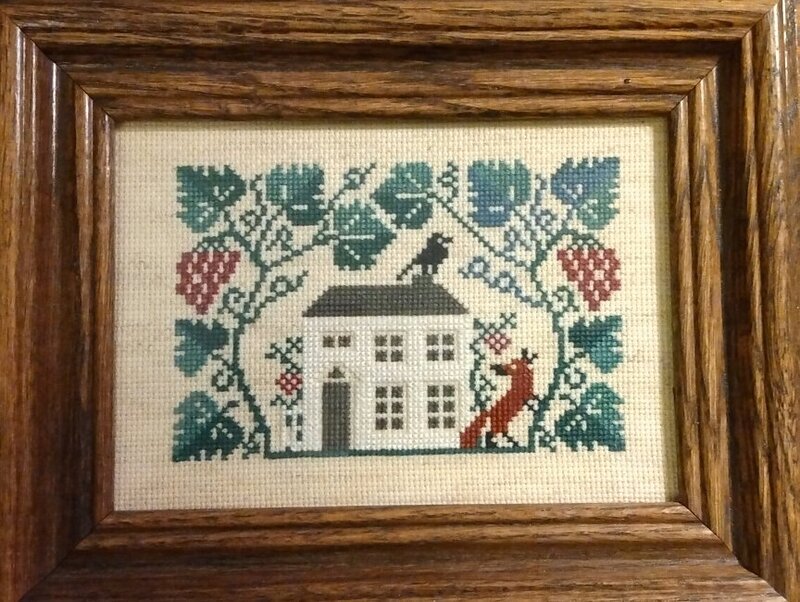
2004 Needlepoint of FC "Wrought by the Hand." Dorothy Unangst. 9½" x 7½". Unknown source and time of acquisition.
Very nice work! In this case, the crow is perched on top of a roof rather than in a tree. The composition is lovely. Trees on either side frame the house together with the two characters. Beautifully framed.
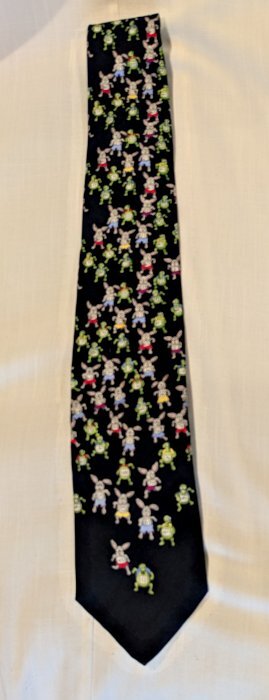
2010? Necktie "Aesop's Marathon." (The Hare and the Tortoise). Stamford, CT: Alynn Neckwear. Two copies. Unknown source.
There are lots of tortoises and lots of hares in this marathon! Aesop's story keeps stimulating new ways of thinking and visualizing! Alynn Neckwear is still going, but this ties seems to have gone "out of print." The creator has fun with groups and numbers. I see repeated runner's numbers, but they do not seem to be in the same group as the other appearances.
Architect: Kimball, Steele & Sandham and George B. Prinz The U.S. District Court for the District of Nebraska met here until the late 1950s or early 1960s.
Still in use by the federal government.