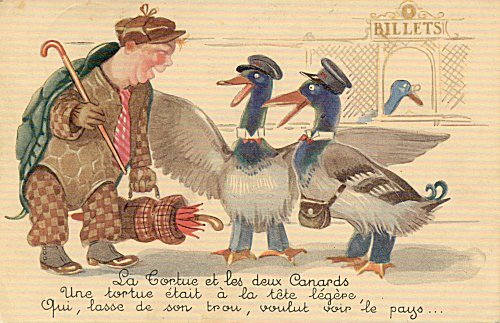
1920? X. Mauzan, "La Tortue et les deux Canards." "Une tortue était à la tête légère,/Qui, lasse de son trou, voulut voir le pays..." €6 from Dominique Chapelon, Yronde et Buron, at the Paris Post Card Exhibition, Jan., '05.
This tortoise is a real pip! He may be the best human tortoise I have seen. One might have to look twice to notice that he is a tortoise. His dress may give him away as out of control, as plaids, checkerboards, and patterns clash terribly. He is also apparently quite a load!
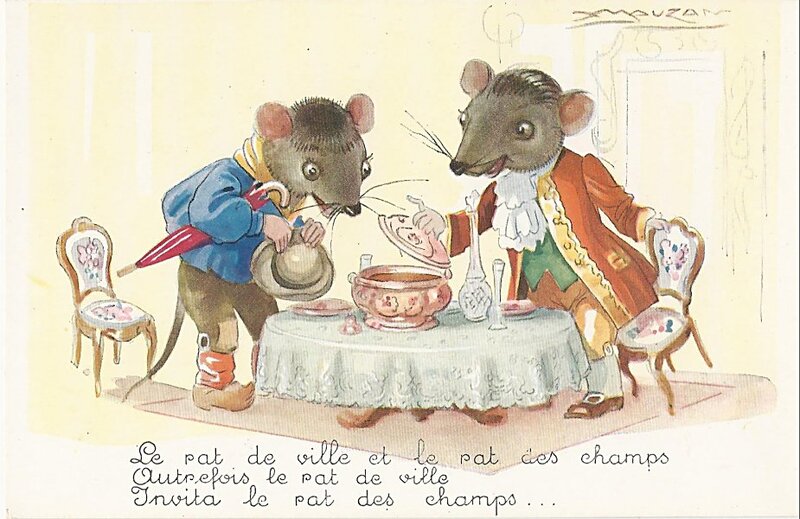
1920? X. Mauzan, TMCM. Gift of Bertrand Cocq, Calonne-Ricouart, France, August, '15
The clothes of the two mice are nicely contrasted. The script and characterization are typical of Mauzan.
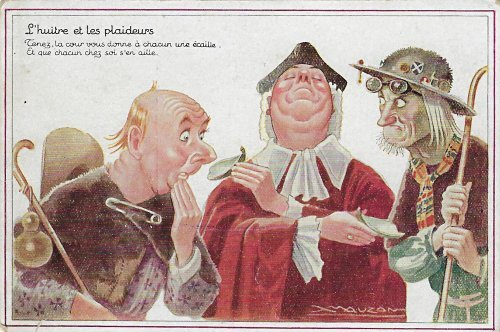
1920? X. Mauzan, "The Oyster and Litigants." €5 from Akpool, Berlin, Sept., '19
The expressions on all three characters' faces are excellent. The exaggerated mode of dress for each emphasizes the roles well. It is easy to enjoy Mauzan's presentation of each fable!
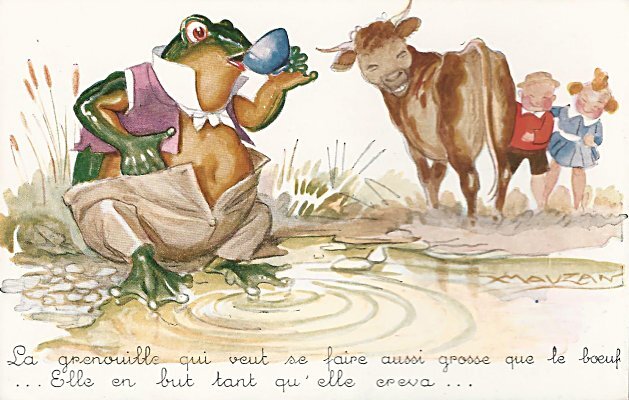
1920? X. Mauzan, OF. From Bertrand Cocq, Calonne-Ricouart, France, August, '15.
The frog in this rendition is drinking himself out of pants. The bull looks suspiciously like the "Vache qui rie." Two children enjoy the craziness.
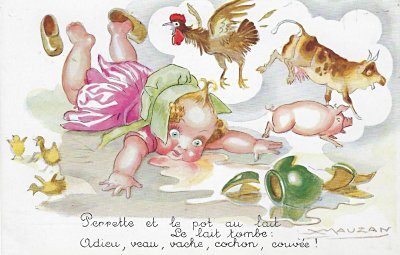
1920? "Perrette et le Pot au Lait." X. Mauzan. $7 from Bertrand Cocq, Calonne Ricouart, France, Sept., '18. Extra for €6.60 from Akpool, March, '19.
This further card in the series of Mauzan's work has the same dynamism and emotionality one sees in his other cards. Her wooden shoes are still flying off, her jug is broken, and she lands on her face. All three of her dreamed of animals are fleeing. Well done! Bertrand tells me that this card completes this series. A German postcard trader knows that I have collected Mauzan and sends me regularly other work of Mauzan, some of it tending toward the pornographic…..
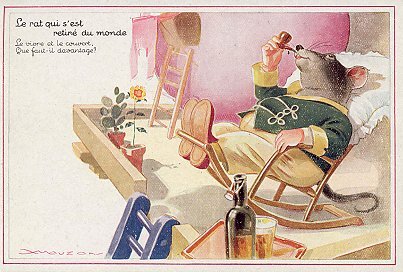
1920? X. Mauzan, "Le rat qui s'est retiré du monde." French handwritten message on the back. Imprimé en France. 20 Francs from Normand Antiquités at the Marché Dauphine, Saint-Ouen Clignancourt, May, '97.
The rat sits in a pillowed rocker outside his Dutch cheese. He smokes a pipe, and there is a glass of beer nearby. The couplet under the title in the upper left corner of this picture side of the card asks: "Le vivre et le couvert,/Que faut-il davantage?"
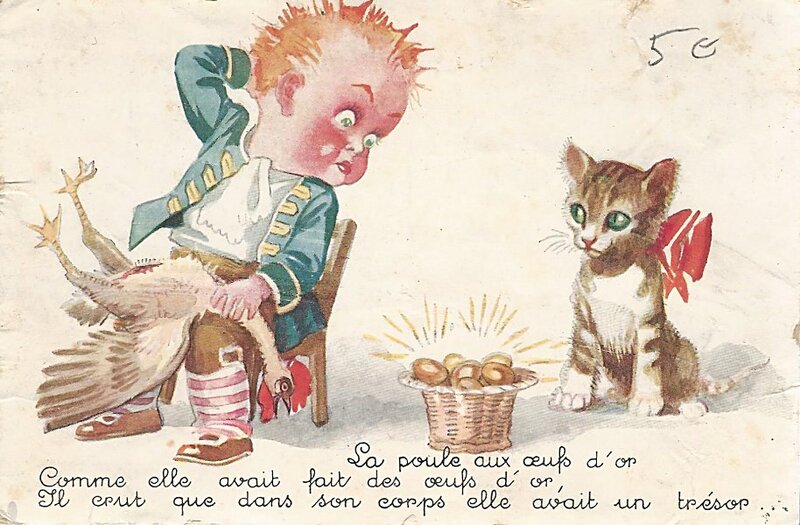
1920? X. Mauzan, GGE. From Librairie Prologue, St. Ouen, for €5, August, '15.
Another strong effort by Mauzan. When Mauzan turns to humans, he uses children. Here the red-faced killer of the hen seems more amazed at the collection of the golden eggs than at the empty dead chicken in his lap.
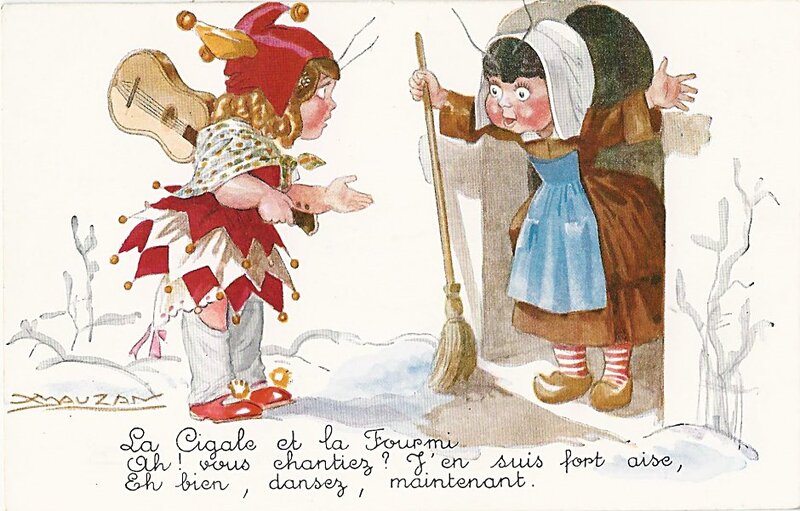
1920? X. Mauzan, GA. Gift of Bertrand Cocq, Calonne-Ricouart, France, August, '15.
Very nice contrast in clothing and gesture. The white winter world of the GA dominates the picture, with color suggested in the warm inside of the ant's home.
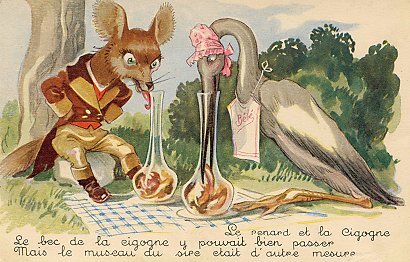
1920? X. Mauzan, "Le Renard et la Cigogne." $15 at Foster City, Feb., '97.
The dealer has identified this art as by Mauzan. There are two lines of La Fontaine's fable at the bottom of the lovely colored picture under the title. Curiously, the stork has a napkin around her neck with "Bébé" on it. What difference does the stork's age make? The stork and fox are pictured with vases before them; the stork eats while the fox licks.
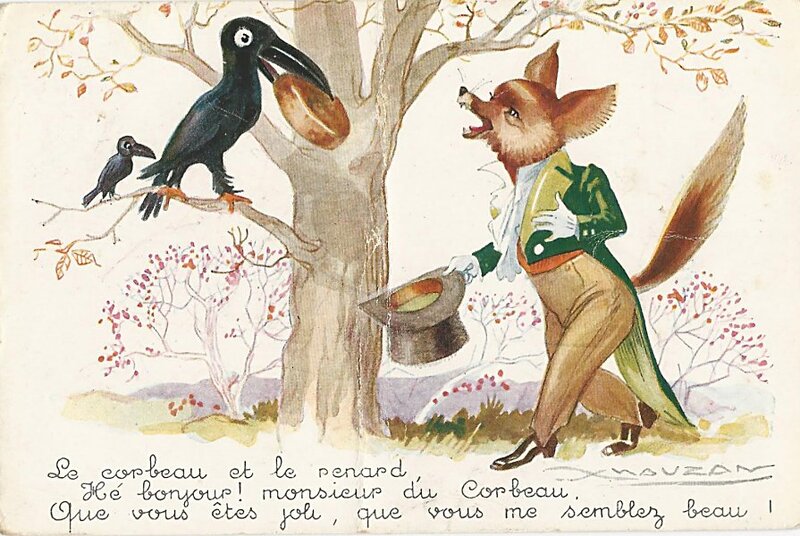
1920? X. Mauzan, FC. Gift of Bernard Cocq, Calonne-Ricouart, France, August, '15. One extra for €4 from Recto-Verso, Strasbourg, July, '19.
The fox gains in power by being dressed, and nattily at that. The crow is just his natural self. The script and characterization seem typical for Mauzan.
1983 Postcard memorializing the centenary of the birth of Achille Lucien Mauzan. Éditions Carnevale-Mauzan. $10 from S. Millus, Waterville, OH, July, '12.
Several things make this card unusual for me. First, it falls outside the series of Mauzan cards I had already gathered. Secondly, it dates this card – and so helps with the others – in 1944. Thirdly, trying to find out more led me to learn his first names and so to correct what seemed to be an "X" in his signature on cards. Finally, I am cataloguing this card in December of 2020 and presumed that I had received it recently. I was astounded to look at the envelope and see a postmark of 2012! The card is full of Mauzan's typical humor and gift for satiric exaggeration.
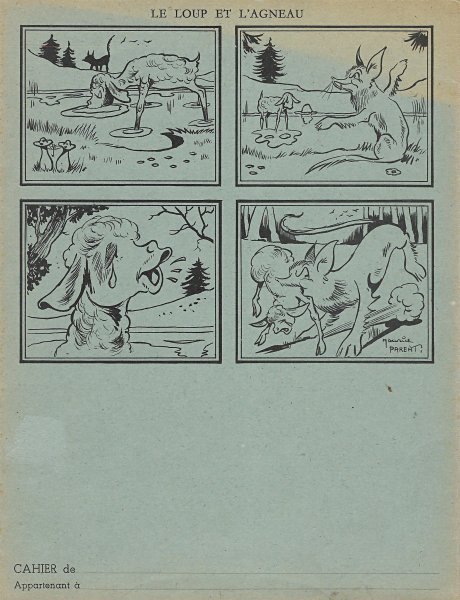
1950? Three French dust-jackets, 9½" x 7", apparently for a school book, with art signed by Maurice Parent. One advertises "Costes, 36 et 38, Boulevard Richard-Wallace, Puteaux." 25 Francs from Annick Tilly at the Clignancourt flea market, August, '99. The other two lack advertising and present WL, one on green and one on red paper stock. Each for $5 from Mme Denise Debuigne, Rennes, France, Feb., '05.
These dust-jackets are unusual in providing oversized flaps on both sides of the inside, one offering the text of the fable and the other a bust-portrait of and a few lines about Jean de La Fontaine. On the cover of the FS exemplar there is an invitation: "Dear Children" should tell their parents for Christmas to address themselves to Costes. The back covers show a multiplication table nailed to a tree. Around it a crow flies with cheese in its mouth, while a fox runs up underneath. In the foreground are a tortoise and a hare.It is possible that the artist is Maurice Parenti, with the letter " i" on the end of his name.
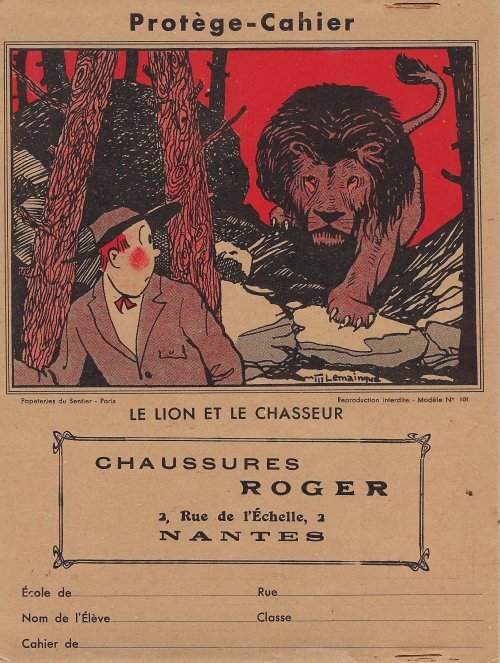
1935? Five dust-jackets, each with a duochrome illustration of a La Fontaine fable by Maurice LeMainque (1893-1942). 7" x 9½" overall, with illustrations 6⅜" x 4⅝". Papeteries du Sentier. €5 each from kam-oulox through Ebay, Nov., '22.
LeMainque may be at his best here when he shows humans, as in 2P and MSA. As it happens, those two are different from the other three in having large interior flaps, which are used to present the fable text. The book-cover presenting "The Lion and the Hunter" seems to come from a different series. It contains an advertisement and frames its illustration. Each illustration has a specific model number:
"Lion and Hunter": 101
2P: 103
OF: 104
MSA: 111
"Gardener and Bear": 112.
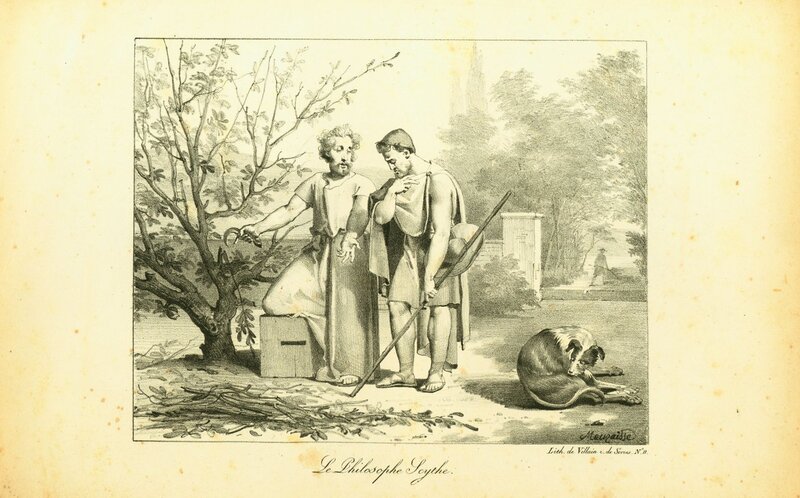
1818? 35 Lithographs by LeComte, Vernet, Engelmann and Mauraisse from about 1817 through 1820. Mostare 14½" x 10½". $80 from jordanb2011 through Ebay, Jan., '21.
Engelmann seems to be the engraver for many of these. I have assigned him authorship for those not signed by LeComte or Vernet. These seem to be pages from a book in our collection, "Fables choisies De La Fontaine ornees de figures lithographiques" from 1818, published by Engelmann.
1820? Matted presentation of four fables of Le Bailly with engravings. $20 from Barense at Foster City, Feb., '97.
Madame Barense had this ready for me as soon as I asked for fables on my first stop at this show. The four fables presented are "L'Enfant et la Noix," "Le Loup et le Herisson," "Le Pecheur et les Brochets," and "Le Cheval et le Taureau." The texts are slightly stained at their sides. The illustrations are small (1½" x 2") but strong.
1870? Matted hand-colored illustration of DW, a page from an edition of Charles Bennett's fables, engraved by Swain. $20 from John and D'Ann Stone, The Bay Window Print Locker, Florence, OR, through Ebay, July, '99.
The colors are excellent, down to golden buckles on the natty dog's shoes. The red-polka-dotted golden scarf of the Wolf is also well rendered here. Painting a Bennett scene brings up some good questions. I have, for example, noticed the hands of both animals for the first time. Might I be noticing them because they are the only flesh-colored items in the picture?
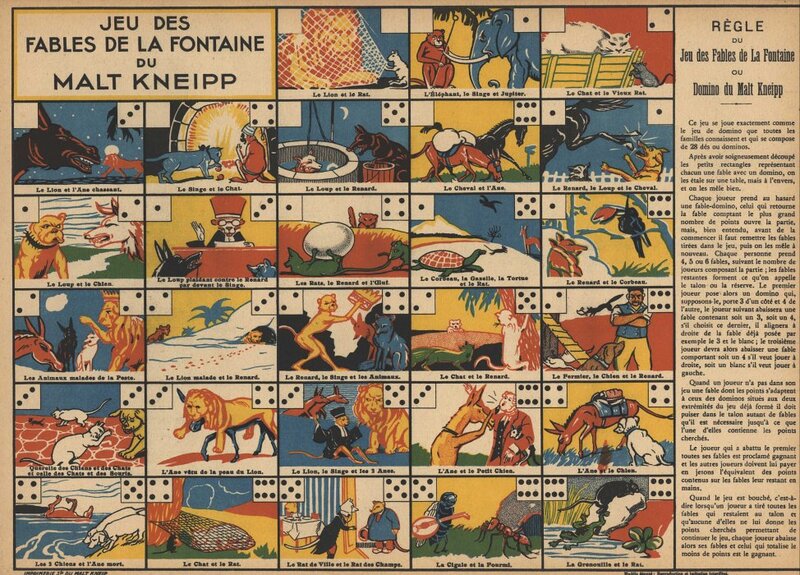
1930? Malt Kneipp cutout domino game. 13½" x 9¾". €15.50 from olivier9862 through Ebay, Oct., '22.
This light cardboard piece could have appeared here under "Advertisements," "Printed Material," or "Games." I chose the last of the three. The sheet includes instructions to cut out the 28 dominos, each of which pictures a well-known La Fontaine fable. The seller guessed a printing date between 1928 and 1940. It is curious that "Kneipp" is spelled with two p's at the end at the top of both parts of this sheet. The printer, however, is "Malt Kneip."
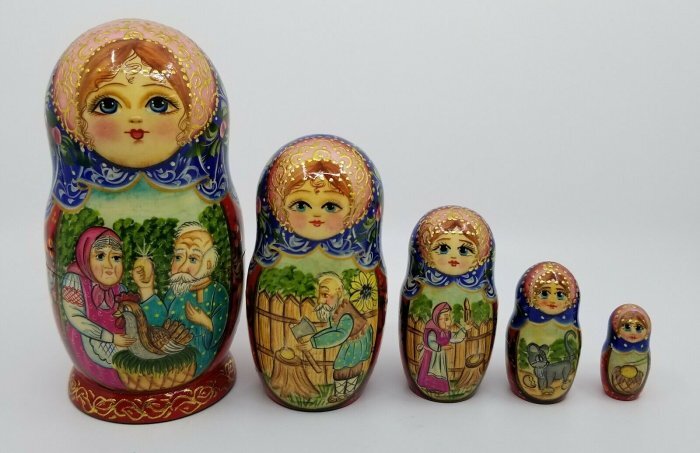
2000? Russian matryoshka set of 5 dolls representing GGE. $45 from shisa-630 through eBay, May, '22.
This is a beautiful matryoshka. The three largest dolls are particularly well executed. I may be missing something, but I do not believe that the sequence of dolls is meant to tell this fable. They seem rather to isolate the characters involved and present them individually. The tragic note of the fable comes in in the axe in the farmer's hands in the second doll. Might the last doll suggest something like the result of the fable: we have a golden egg, and that is all that we have?
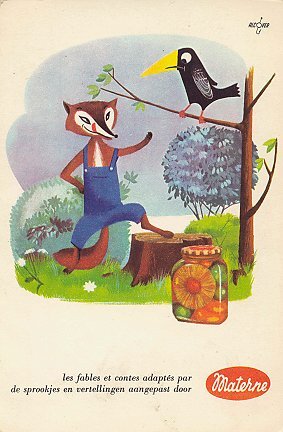
1950? Fables et Contes Adaptés par Materne. 2 cards with La Fontaine's French and a Dutch translation on the back. "Fabels en Vertellingen Aangepast door Materne." Alcover. On the front of each is an illustration involving Materne food products. $8 apiece at Foster City, Feb., '97. TH for $5 from Bertrand Cocq, Calonne Ricouart, France, Sept. '20.
On the first is a fox who seems to have got a jar of candied fruits from the crow in the tree. On the second, a stork cannot get the jar of jam out of the vase; a fox looks on. In TH, the hare is busy eating something (jelly? fruit?) from a jar of Materne while the tortoise passes in the background. Curiously enough, the picture side of each card speaks of "De Sprookjes en Vertellingen" (my emphasis) rather than, as on the back, "Fabels en Vertellingen."